
May 1, 1923: The Los Angeles Memorial Coliseum opens, adjacent to the campus of the University of Southern California. It completed a stretch of two weeks in which three of the greatest stadiums ever built on planet Earth opened: The original Yankee Stadium in New York on April 18, and the original Wembley Stadium in London on April 28. Of the three, the Coliseum is the only one that still stands, 99 years later.
Unless you count the nearby HOLLYWOOD sign and the Golden Gate Bridge in San Francisco as "buildings," the Coliseum is the most famous building in the State of California.
At its opening, seating capacity was 75,144. It was expanded to 101,574 for the 1932 Olympic Games. A renovation, necessary after the 1994 Northridge Earthquake, dropped capacity to 93,103. Another recent renovation, including wider seats, and bigger media facilities (including a new press box, named for the late Los Angeles Times executive Otis Booth), requiring the removal of some seats, has made the current capacity 77,500, making it the 2nd-biggest stadium in California, behind the Rose Bowl in nearby Pasadena.
It hosted a football game for the 1st time on October 6, 1923. The University of Southern California hosted Pomona College, and won, 23-7. The USC Trojans have used the Coliseum as their home field ever since.
Their nearby rivals, the University of California at Los Angeles, played home games there from 1933 to 1981. The UCLA Bruins now play home games at the Rose Bowl, which, due to the Trojans' success, has often seemed like a secondary home field to them, not just every other year when they play UCLA in their home-and-home series, but also on January 1, when the Rose Bowl game is usually played.
The Coliseum has also been the leading professional football venue in Southern California. In the NFL, the Los Angeles Rams played there from 1946 to 1979, and again from 2016 to 2019; the Los Angeles Raiders from 1982 to 1994; Super Bowl I in 1967 and Super Bowl VII in 1973; and the postseason Pro Bowl from 1951 to 1972, and again in 1979.
Other pro football teams using the Coliseum: The Los Angeles Dons of the All-America Football Conference from 1946 to 1949, the Los Angeles Chargers of the American Football League in 1960, the Los Angeles Express of the United States Football League from 1983 to 1985, and the Los Angeles Xtreme of the XFL in 2001.
It has hosted the U.S. national soccer team 20 times, starting in 1965; and Mexico's team 61 times. In 1967, the only season of play for the United Soccer Association, it hosted the Los Angeles Wolves, who won that league's title. It also hosted the city's entry in another league starting that season, the Los Angeles Toros of the National Professional Soccer League. After that year, the two leagues merged to form the North American Soccer League, whose Los Angeles Aztecs used the Coliseum as their home field in the 1977 and 1981 seasons.
The Los Angeles Dodgers used the Coliseum as their 1st home field after leaving Brooklyn, while waiting for Dodger Stadium to be built, from 1958 to 1961. Their home games in the 1959 World Series against the Chicago White Sox attracted over 92,000 fans, the highest-attended competitive games in Major League Baseball history. An all-time record crowd for baseball, 115,300, attended a preseason game between the Dodgers and the Boston Red Sox on March 29, 1958, honoring the Dodgers' 50h Anniversary in Los Angeles.

Baseball setup
And, of course, the Coliseum was the main venue for the 1932 and 1984 Summer Olympic Games. While SoFi Stadium will host the Opening Ceremony of the 2028 Summer Olympics, the Coliseum will host the track & field events for the 3rd time.
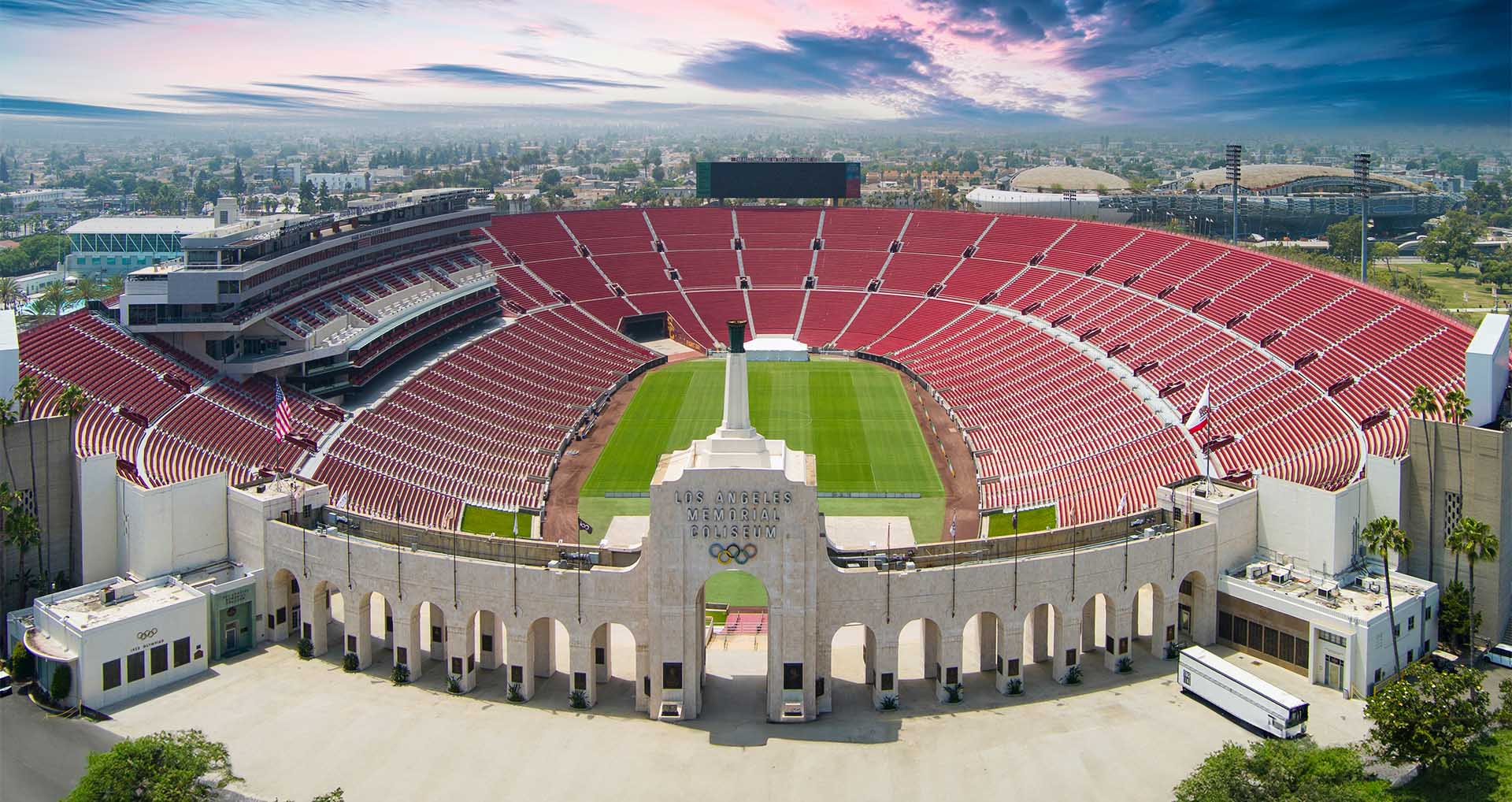
Post-renovation, with all red seats
and the Otis Booth Press Box
In 2018, naming rights to the playing surface were sold. It is now United Airlines Field. The Coliseum name remains for the stadium as a whole.
*
May 1, 1923 was a Tuesday. Joseph Heller, known for his World War II novel Catch-22, was born on this day. So was television director Ralph Senensky, who directed 6 episodes of the original Star Trek series.
It was the off-season for the NFL and the NHL, and there was no NBA yet. But a full slate of Major League Baseball games was played:
* The New York Yankees, flush off the successful opening of their new Stadium, beat the Washington Senators, 8-7 at Griffith Stadium in Washington.
* The New York Giants, no longer having to share the Polo Grounds with the Yankees, and expanding it to compete with Yankee Stadium (unsuccessfully, as it turned out), hosted their arch-rivals, the Brooklyn Robins, and beat them, 4-3. The Robins were named for their manager, Wilbert Robinson. After he was fired following the 1931 season, they reverted to their previous name, the Brooklyn Dodgers.
* The Boston Red Sox beat the Philadelphia Athletics, 5-4 at Fenway Park in Boston.
* The Boston Braves beat the Philadelphia Phillies, 12-10 at Baker Bowl in Philadelphia.
* The Chicago Cubs beat the Cincinnati Reds, 3-1 at Redland Field in Cincinnati. It was renamed Crosley Field in 1934.
* The Detroit Tigers beat the Cleveland Indians, 6-5 at Navin Field in Detroit. It was renamed Briggs Stadium in 1938, and Tiger Stadium in 1961.
* The Chicago White Sox beat the St. Louis Browns, 5-3 at Comiskey Park in Chicago.
* And the Pittsburgh Pirates beat the St. Louis Cardinals, 6-2 at Sportsman's Park in St. Louis.


No comments:
Post a Comment