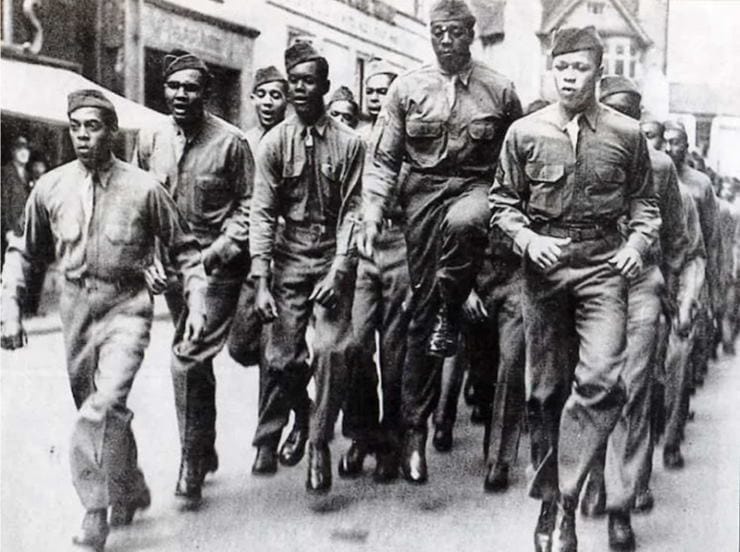
June 25, 1943: The British people give the U.S. Army a lesson in racial prejudice. It becomes known as the Battle of Bamber Bridge.
For 2 years, from early 1942 to mid-1944, U.S. troops were in Britain, preparing for the invasion of Western Europe. British civilians grew tired of these Americans, saying they were "overpaid, over-sexed and over here." (They were hardly overpaid: A popular song of the war said that soldiers made "Twenty-one dollars a day, once a month." That $21 per month works out to about $355 in 2022 money.)
Bamber Bridge, in Lancashire, 35 miles northeast of Liverpool, 35 miles northwest of Manchester, and 4 miles southeast of Preston, hosted American servicemen from the 1511th Quartermaster Truck Regiment, part of the U.S. Army's Eighth Air Force. (The Air Force was a part of the Army until 1947.) It was logistics unit, delivering materiel to other bases in Lancashire. The 234th U.S. Military Police Company were on the town's north side.
The U.S. armed forces were still racially segregated: The enlisted men of the 1511th were almost entirely black, while all but one of their officers, and all of the MPs, were white. They had heard about the race riot in Detroit on June 20, and tensions were high. When U.S. officers demanded a separate bar in town for black troops, all 3 pubs posted signs saying "Black Troops Only," serving white locals, but not white American soldiers.
One was Ye Olde Hob Inn. On the night of June 24, 1943, 2 MPs, Corporal Roy A. Windsor and Private First Class Ralph F. Ridgeway, responded to a report of trouble. The MPs had standing orders to arrest soldiers who were out of camp without a pass, were disorderly, or were not in proper uniform. On entering the pub, they encountered one soldier, Private Eugene Nunn, who was dressed in a field jacket rather than the required Class A uniform, and asked him to step outside.
An argument ensued, with local people and British servicewomen of the Auxiliary Territorial Service siding with Nunn. One British soldier challenged the MPs by saying, "Why do you want to arrest them? They're not doing anything or bothering anybody."
Staff Sergeant William Byrd, who was black, defused the situation. But, as the MPs left, a beer was thrown at their jeep. After the MPs picked up 2 reinforcements, they spoke to Captain Julius F. Hirst and Lieutenant Gerald C. Windsor, who told the MPs to do their duty and to arrest the black soldiers. A group of MPs intercepted the soldiers on Station Road as they returned to their base at Mounsey Road. As a fight broke out, the MPs opened fire, and one bullet struck Private William Crossland of the 1511th in the back and killed him.
Some of the injured black soldiers returned to their base, but the killing caused panic as rumors began to spread that the MPs were out to shoot black soldiers. Although the Colonel was absent, the acting commanding officer, Major George C. Heris, attempted to calm the situation. Lieutenant Edwin D. Jones, the unit's only black officer, managed to persuade the soldiers that Heris would be able to round up the MPs and see that justice was done.
However, at midnight, several jeeps full of MPs arrived at the camp, including one improvised armored car, armed with a large machine gun. That prompted black soldiers to arm themselves with weapons. Around 2/3rds of the rifles were taken, and a large group left the base in pursuit of the MPs. British police officers reported that the MPs set up a roadblock, and ambushed the soldiers.
The black soldiers warned the townsfolk to stay inside when a firefight broke out between them and the MPs, which resulted in 7 wounded. The fighting stopped around 4:00 the next morning, with an officer, 3 black soldiers, and 1 MP having been shot, and 2 other MPs beaten. Eventually, the soldiers returned to the base, and by the afternoon, all but 4 rifles had been recovered.
Although a court martial convicted 32 black soldiers of mutiny and related crimes, poor leadership and racist attitudes among the MPs were blamed as the cause. None of the white MPs were charged, including the one who killed the black soldier, by shooting him in the back. Sentences for those convicted ranged from three months to 15 years, with seven sentences of 12 years or more.
Reviews resulted in the release of one man and reductions in all other sentences. Fifteen of the men returned to duty in June 1944 and six other sentences were further reduced. The defendant with the longest sentence returned to duty after serving 13 months.
General Ira Eaker, commander of the Eighth Air Force, placed most of the blame for the violence on the white officers and MPs because of their poor leadership and use of racial slurs. To prevent similar incidents happening again, he combined the trucking units into a single special command. The ranks of that command were purged of inexperienced or racist officers, and the MP patrols were racially integrated.
Morale among black troops stationed in England improved, and the rates of courts-martial fell. Although there were several more racial incidents between black and white American troops in Britain during the war, none was on the scale of that of Bamber Bridge.
President Harry S Truman desegregated the armed forces in 1948. Popular interest in the event increased in the late 1980s after a maintenance worker discovered bullet holes from the battle in the walls of a Bamber Bridge bank.
*
June 25, 1943 was a Friday. Singer Carly Simon was born. And these baseball games were played:
* The New York Yankees and the Boston Red Sox were tied, 2-2 after 11 innings at Fenway Park in Boston , when the game was called due to darkness. Fenway did not get lights until the 1947 season. Charles Wensloff pitched all 11 innings for the Yankees, and Joe Gordon hit a home run. The Boston starter's real birth name was Lancelot Terry, but he was, ironically, nicknamed "Yank."
Most of each team's stars were in the service at this point: Yankees Joe DiMaggio, Tommy Henrich, Charlie Keller and Phil Rizzuto; and Red Sox Ted Williams, Dom DiMaggio (Joe's brother) and Johnny Pesky. The Yanks' Bill Dickey and the Sox' Bobby Doerr were not yet in: Doerr played in this game, but Dickey did not.
* The New York Giants lost to the Boston Braves, 5-3 at the Polo Grounds. Mel Ott (now also the Giants' manager) and Dick Bartell hit home runs.
* The Brooklyn Dodgers lost to the Philadelphia Phillies, 8-2 at Shibe Park in Philadelphia.
* The Philadelphia Athletics beat the Washington Senators, 5-2 at Griffith Stadium in Washington.
* The Cleveland Indians beat the Chicago White Sox, 6-2 at Cleveland Municipal Stadium.
* The Chicago Cubs beat their arch-rivals, 6-0 at Wrigley Field in Chicago. Hiram Bithorn, for whom the ballpark in San Juan, Puerto Rico would eventually be named, pitched a 2-hit shutout, allowing only a double to Danny Litwhiler and a single to Johnny Hopp. Stan Musial went 0-for-4.
* The St. Louis Browns beat the Detroit Tigers, 6-3 at Sportsman's Park in St. Louis.
* And the Cincinnati Reds and the Pittsburgh Pirates were rained out at Crosley Field in Cincinnati. The game was made up as part of a doubleheader on September 10. The Pirates won the opener, 9-6. The Reds won the nightcap, 1-0. Bucky Walters pitched a 5-hit shutout.


No comments:
Post a Comment