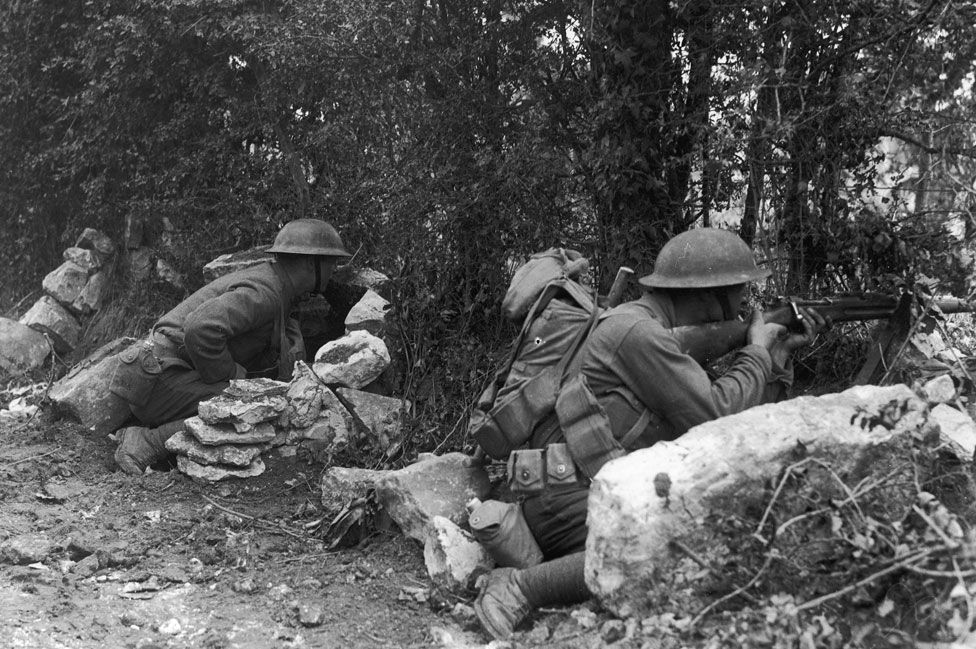
June 1, 1918: The Battle of Belleau Wood begins. It is the 1st land battle of World War I to feature American soldiers, and the 1st battle fought by American troops on the European continent.
The war had been going for nearly 4 years. Although Imperial Germany had provoked America into declaring war on April 6, 1917, it had taken until now for American troops to be properly trained and transported over to Europe, and ready to enter battle.
The timing was just right. Russia's exit from the war following the Bolshevik Revolution ended the Eastern Front on March 3, 1918. The troops of Kaiser Wilhelm II would now focus on the Western Front. Until then, they had been on the verge of collapse, and so had their country, as the U.S. Navy and Britain's Royal Navy had effectively blockaded them, starving them out. But, no longer having to fight Russia, Germany now had the numbers to militarily overwhelm the depleted, tired troops of France and Britain. And so, it looked like they might win the war, after being on the verge of having to surrender.
But, as George M. Cohan sang in his song, "Over There," the Yanks were coming. When they arrived on French soil, their training still wasn't complete. On July 4, 1917, the commander of the American Expeditionary Forces, General John J. Pershing, visited the Paris tomb of the Marquis de Lafayette, a hero of the American and French Revolutions. He reported that his chief disbursing officer, Lieutenant Colonel Charles E. Stanton, had said to the tomb, "Lafayette, we are here," as if America had come to pay the debt it owed to the Marquis for his assistance in the War of the American Revolution -- even if, this time, the British were on the same side as the Americans and the French.

General John J. Pershing
(The quote has been misattributed, in both source and timing: It entered the public memory as the words of Pershing himself, as he disembarked from his ship and first set foot on French soil.)
On June 1, German troops, under the personal command of Kronprinz Wilhelm -- the man who would have been Kaiser Wilhelm III had the throne still existed for him to take -- began an advance into Belleau Wood, near the River Marne, about 50 miles northeast of Paris. But they were every bit as tired and ill-supplied as the British and French men they were fighting.

Kronprinz Wilhelm
In contrast, the Americans were fresh, well-supplied, not yet disillusioned by the horrors of war, gung-ho as hell, and ready for a fight. The Army's 2nd and 3rd Infantry Divisions, and the 6th Marine Regiment, went into the Wood, and repelled "the Hun." By the time the battle ended on June 26, the Germans had lost 5,450 men, the Americans 1,811.
For the Germans, it was a fiasco: They pretty much remained in retreat thereafter, until signing the Armistice on November 11. For the Americans, it was a bloody nose, but a triumphant one, especially for the U.S. Marine Corps: Belleau Wood became a byword for them, part of their mythos, their defining battle of World War I, much as Iwo Jima was for World War II.
Pershing, known as "Black Jack," never wore more than 4 stars, as a man with the rank of full General is entitled to do. However, in 1919, Congress created the rank of General of the Armies for him -- effectively, a 6-star General. He is the only living soldier ever to receive this rank: George Washington and Ulysses S. Grant have received it posthumously. He was the only General of World War I to receive the equivalent of a 5th star, or "General of the Army," as was given to, among others in World War II, Dwight D. Eisenhower and Douglas MacArthur. Pershing saw the rise of the Nazis coming, and advocated for American opposition to them. He was too old to command troops in World War II, and died in 1948.
Kronprinz Wilhelm, like his father, left Germany in exile in the final days of World War I. He returned to Germany in 1923, supported the Nazis, became the pretender to the throne when his father died in 1941, fell out with Adolf Hitler, and died in 1951, no closer to becoming the Emperor of Germany than he was 10, or 33, years earlier.
*
June 1, 1918 was a Saturday. These baseball games were played that day:
* The New York Yankees beat the Chicago White Sox, 6-3 at Comiskey Park in Chicago. Herb Thormahlen was the winning pitcher. Former Athletics star Frank "Home Run" Baker went 3-for-5 with an RBI, although none of his hits were home runs. Another former A's star, Eddie Collins, 2-for-3 with a walk for the White Sox. Shoeless Joe Jackson had already played his last game of the season on May 11, having gone to work in a shipyard for the war effort.
* The New York Giants beat the Pittsburgh Pirates, 2-0 at the Polo Grounds. William "Pol" Perritt pitched a 3-hit shutout.
* The Brooklyn Robins (as the Dodgers were known from 1914 to 1931, under the managing of Wilbert Robinson) lost to the St. Louis Cardinals, 9-2 at Ebbets Field. Ivan "Ivy" Olson went 3-for-4 for Brooklyn. Rogers Hornsby went 0-for-4 with a walk for St. Louis.
* The Chicago Cubs beat the Boston Braves, 4-3 at Braves Field in Boston.
* The Philadelphia Phillies beat the Cincinnati Reds, 5-2 at Baker Bowl in Philadelphia.
* The Washington Senators beat the Cleveland Indians, 11-6 at League Park in Cleveland. Tris Speaker went 1-for-5.
* The Detroit Tigers beat the Boston Red Sox, 4-3 at Navin Field in Detroit. (The ballpark would later be renamed Briggs Stadium and Tiger Stadium.) The game went 13 innings, although I don't have a record of how the winning run was scored. Ty Cobb only appeared as a pinch-hitter, and drew a walk. Babe Ruth only appeared as a pinch-hitter, and struck out.
* And the St. Louis Browns beat the Philadelphia Athletics, 8-5 at Sportsman's Park in St. Louis. George Sisler went 4-for-4.


No comments:
Post a Comment