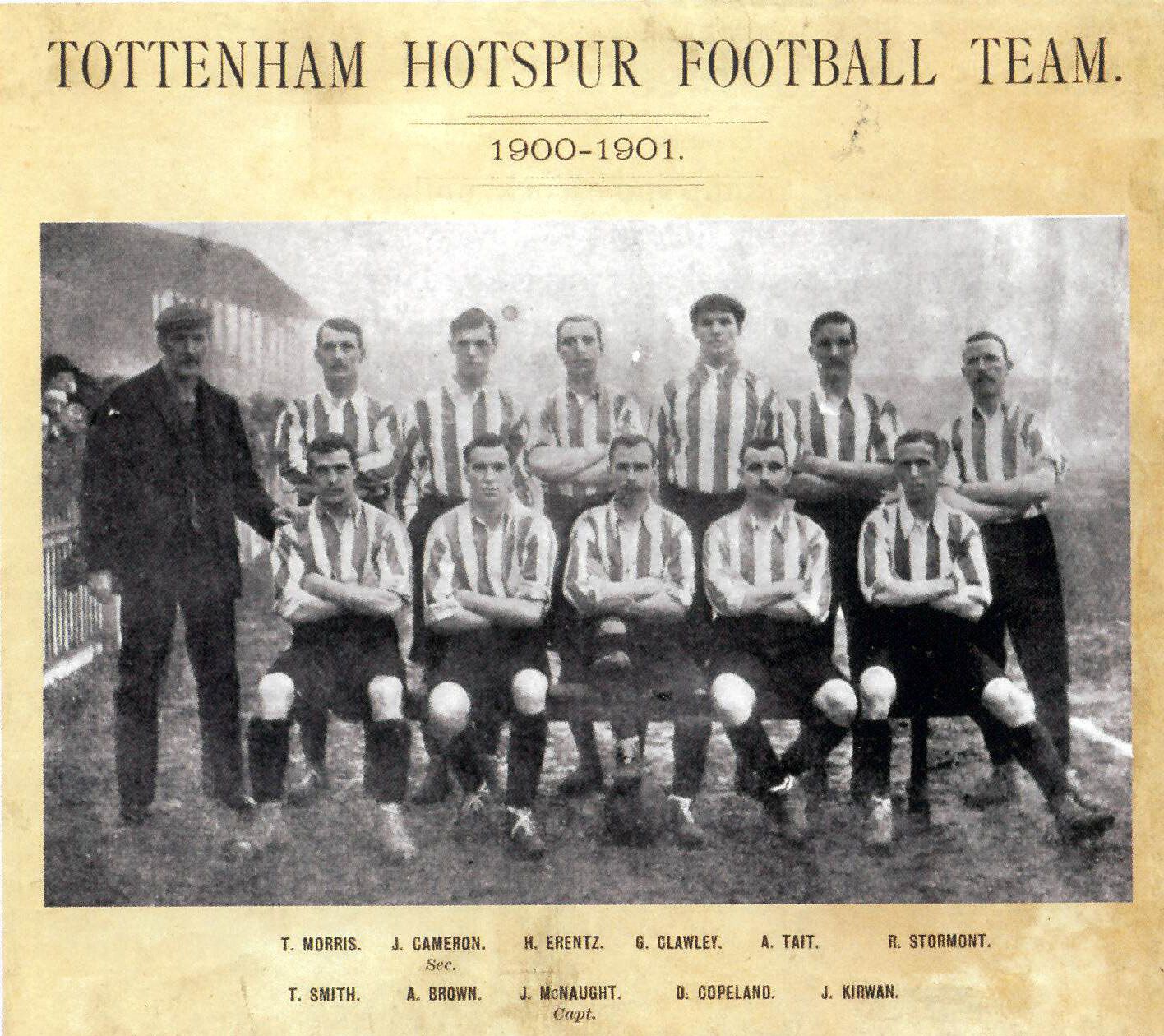
April 27, 1901: A replay is held for the FA Cup Final, at Burnden Park in Bolton, now part of "Greater Manchester."
The previous Saturday, the original Final was held at the Crystal Palace stadium in South London, since demolished and replaced with a much smaller stadium, and with no connection to the current nearby club named Crystal Palace. Sheffield United, of Yorkshire, who had won the Cup in 1899 and the Football League the season before that, took on Tottenham Hotspur, located in the County of Middlesex.
A law passed in 1963 would redraw the boundaries of London and its "Home Counties," eliminating Middlesex entirely, and bringing parts of Kent, Essex, Surrey and Hertfordshire into a new "Greater London" effective April 1, 1965. Only then did Tottenham, or "Spurs," become part of London. So any claims they have to being "the first London club to" do anything are, if achieved prior to 1965, untrue.
The Final was held before the biggest crowd in the event's history to that point, 110,820, probably because London-area teams had been few and far between: Most of England's truly successful football clubs had been in the North. But the match ended in a 2-2 draw, so a replay was required.
It was held a week later, in Bolton, before a much smaller crowd of 20,470. Fred Priest scored for Sheffield United in the 40th minute. John Cameron, a Scottish inside right, equalized for Spurs in the 52nd. Tom Smith, a right wing from Cumberland, gave Spurs the lead in the 76th; and Sandy Brown, a Scottish center forward, finished it off in the 87th. Spurs won, 3-1.
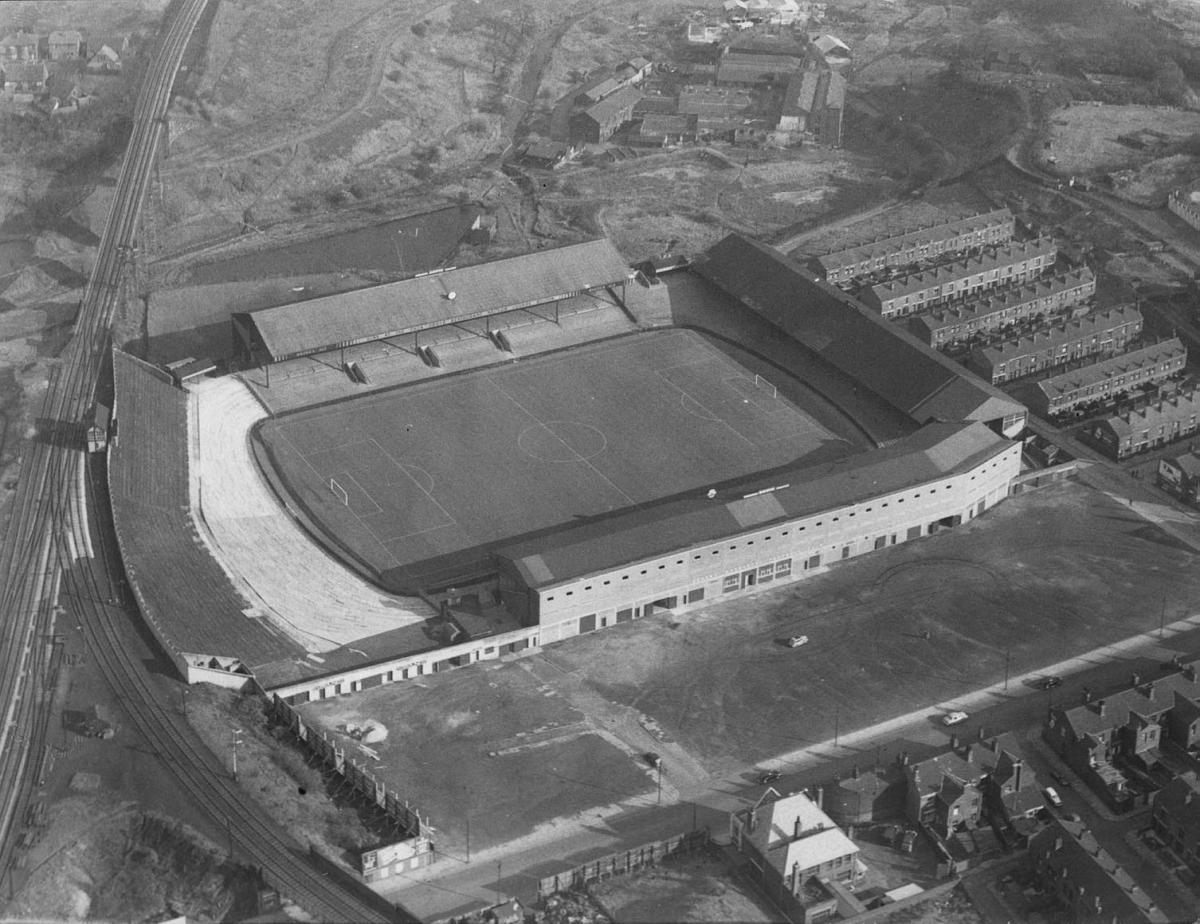
Burnden Park, Bolton, circa 1946
Jack Jones, a Welsh left half, was Spurs' Captain. But Cameron was their player-manager. Jones lived until 1931, Cameron until 1935, Smith until 1937, and Brown until 1944. Jack Kirwan, an Irish outside left, was the last survivor of this team, living until 1959.
Spurs had been founded in 1882, as an offshoot of a church's cricket club, and since 1899 had been playing at a stadium named White Hart Lane, named for one of its border roads, itself named after a pub called The White Hart. (A hart is a male deer.) This stadium was in Tottenham. Which, at the time, was still in Middlesex -- not in London.
Tottenham Hotspur were in the Southern League, not the Football League. To this day, Spurs fans call their team "the only team outside the Football League to win the FA Cup." Officially, this is true. But, from today's perspective, it makes it sound as if they were in the 5th level of England's "football pyramid," or lower. Why would you want to point out that your club, a 1st division mainstay, was once outside the League?
At any rate, at the time, the Southern League was more analogous to the 3rd division. And they remain the lowest-ranking team ever to win the Cup. No team from the 3rd division or lower has ever won it. There have been 7 teams from the 2nd division winning it: Notts County of Nottingham in 1894, Wolverhampton Wanderers of the Birmingham area in 1908, Barnsley of Yorkshire in 1912, West Bromwich Albion of the Birmingham area in 1931, Sunderland of the North-East in 1973, Southampton of Hampshire in 1976, and West Ham United of East London in 1980.
And bragging about something that happened in 1901? You don't see Chicago White Sox fans running around claiming they are the 1st team to win the American League Pennant, which was also won in 1901. Because, at this point, even they don't care about that particular achievement anymore.
Still, it was a major trophy, something Arsenal, who left South London for North London in 1913, and thus were in North London for 52 years before Spurs were even though Spurs hadn't moved since 1899, had not won yet, and would not win for another 29 years.
*
April 27, 1901 was a Saturday. Woolwich Arsenal, the team that Tottenham would eventually decide, for a dumb reason, was their greatest rival, went to Merseyside, and lost to New Brighton Tower, 1-0 at the Tower Athletic Ground. New Brighton Tower folded after the season.
These baseball games were played:
* The New York Giants lost to the Philadelphia Phillies, 5-1 at National League Park (later renamed Baker Bowl) in Philadelphia. Guy "Doc" White, a dentist, outpitched Luther "Dummy" Taylor, who was deaf.
* The Brooklyn Superbas beat the Washington Nationals, 6-3 at Washington Park in Brooklyn. Jay Hughes outpitched future Hall-of-Famer Kid Nichols. The Superbas became the Dodgers in 1911, changed their name to the Robins in honor of new manager Wilbert Robinson in 1914, and became the Dodgers again in 1932 after he was fired. They moved to Los Angeles in 1958. At the same time, the Giants moved to San Francisco.
The Beaneaters became the Braves in 1912, and, as I said, moved to Milwaukee in 1953, and to Atlanta in 1966.
* The Washington Senators beat the Philadelphia Athletics, 11-5 at Columbia Park in Philadelphia. Star 2nd baseman Napoleon "Nap" Lajoie went 3-for-3 with a walk in defeat for the A's. They moved to Kansas City in 1955, and to Oakland in 1968. (UPDATE: They moved to Sacramento in 2025, and hope to move to Las Vegas in 2028.)
The Senators became the Minnesota Twins in 1961. They were replaced by an expansion team with the Senators name that year, but that team also moved, becoming the Texas Rangers in 1972.
* The Baltimore Orioles beat the Boston Americans, 12-6 at Oriole Park in Baltimore. Harry Howell outpitched Cy Young. The Americans would change their name to the Boston Red Sox in 1908.
The Orioles would break up in 1902, and a new franchise was created in its place for the 1903 season: The New York Highlanders, who, in 1913, officially changed their name to what people had been calling them for a few years already: The New York Yankees. (Research by Yankee historian Marty Appel has proven that the New York franchise of 1903 onward is not the Baltimore franchise of 1901 and '02.) A new minor-league team would take up the Orioles name.
* The St. Louis Cardinals beat the Pittsburgh Pirates, 7-2 at Exposition Park in Pittsburgh. Pirate shortstop Honus Wagner was generally considered to be the best player in baseball at the moment, but, in this game, he went 0-for-5.
* The Detroit Tigers beat the Milwaukee Brewers, 13-9 at Bennett Park in Detroit. In 1912, a new ballpark would open on the site of Bennett Park, named Navin Field. It would be expanded and renamed Briggs Stadium in 1938, and renamed Tiger Stadium in 1961.
The Brewers would move after just 1 season, becoming the St. Louis Browns in 1902, and later the new major league version of the Baltimore Orioles in 1954. A new minor-league team would take up the Brewers name, before making way for the Boston Braves to become the Milwaukee Braves in 1953. They moved to Atlanta in 1966, making possible a new AL Milwaukee Brewers in 1970.
* And the Cleveland Blues beat the Chicago White Sox, 10-4 at South Side Park in Chicago. In 1902, the Blues acquired Lajoie from the Athletics, and named him their manager. For the 1903 season, they changed their name to honor him: The Cleveland Naps.
He left after the 1914 season, when the World Series was won by the Boston Braves. They'd used the Native American nickname for only 3 seasons. So the Naps then changed their name to the Cleveland Indians, and used that name until 2021, then becoming the Cleveland Guardians. The stories that they'd been named the Indians after tribesmen living on the shore of Lake Erie, and that they'd been named after the 1st Native American player in the majors, former Cleveland Spiders star Louis Sockalexis, have been proven incorrect.
* The Cincinnati Reds beat the Chicago Orphans, 9-2 at West Side Park in Chicago. The former Chicago White Stockings had long been led by Adrian Constantine Anson, known as "Cap" for "captain," and "Pop" as he got older, and after his 1897 retirement, were known as "the Orphans, because they missed their Pop." They became the Cubs in 1903.


No comments:
Post a Comment