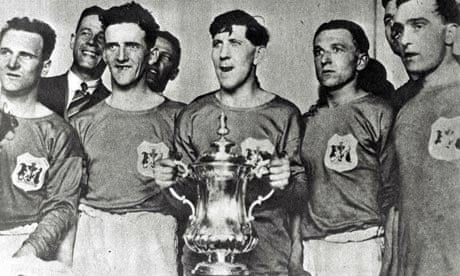
April 23, 1927: For the 1st time, and the only time, a soccer team from outside of England wins England's Football Association (FA) Cup.
In 1884 and 1885, Queen's Park Football Club of Glasgow, Scotland reached the FA Cup Final, losing to Lancashire team Blackburn Rovers on both occasions. Shortly thereafter, the Scottish Football Association (SFA) barred all member clubs from playing in the England's FA Cup.
Despite being the governing body for English "football," the FA allows teams from Wales to compete in its Football League, including the Premier League if it so qualifies, and its FA Cup tournament. But competing is one thing; challenging for honors (or "honours," as it would be "spelt" there) is another. It has rarely happened.
In 1925, Cardiff City Football Club reached the Final, where they lost to Yorkshire team Sheffield United. So it wasn't a big surprise when they got back to the Final in 1927. Along the way, manager Fred Stewart's "Bluebirds" beat Birmingham team Aston Villa, County Durham team Darlington, Manchester area team Bolton Wanderers, West London team Chelsea, and Berkshire team Reading.
They would oppose Arsenal Football Club. It was the 1st Final for the North London team, and they would go on to appear in many more. Herbert Chapman's "Gunners" had gotten there by beating Sheffield United, Staffordshire team Port Vale, Liverpool, Birmingham area team Wolverhampton Wanderers (a.k.a. "Wolves") and Hampshire team Southampton.
In an unusual turn of events, aided by the fact that, for most of the Cup's history, the Semifinals were held at neutral sites, each team played its Semifinal at the home ground of the team that the other beat in the Quarterfinal: Cardiff beat Chelsea at Wolves' Molineux Stadium, and Arsenal beat Wolves at Chelsea's Stamford Bridge.
The Final, of course, would be played at Wembley Stadium in West London, the national stadium that had opened in 1923. Given the distance, Arsenal would seem to have had the advantage. But they ran into a great deal of automotive traffic on the way in. In addition, they had injuries to their usual left back, Horace Cope; their usual right half, Alf Baker; and their usual outside left, Syd Hoar. Chapman decided that Baker and Hoar would be fit enough to play, but Cope would not.
Special trains had been run from Wales, and had been arriving at Paddington Station in West London since 4:00 in the morning. Among the Welsh fans in attendance was David Lloyd George, the 1st Earl Lloyd-George of Dwyfor, who had been Prime Minister during World War I, and his daughter, Lady Megan. Two years later, she became the 1st woman elected to Parliament from a district in Wales.
Winston Churchill, having been a Cabinet official under Lloyd George's predecessor, Herbert Asquith, was also in attendance. No one in the crowd of 91,206, including Churchill himself, had any idea that he would one day become Prime Minister, let alone in another World War.
This was the 1st Final to be broadcast on radio, by the BBC. As a result, a community concert was held inside the stadium, beginning at 1:50 PM, led by the bands of the Grenadier and Irish Guards. This would become a Final tradition, as would the playing of a song that made its Final debut on this occasion, Henry Francis Lyte's hymn "Abide with Me."
At 2:30 PM, King George V arrived. He met with referee William F. Bunnell and linesmen G.E. Watson and M. Brewitt. He met with Arsenal captain Charlie Buchan, who had led North-East team Sunderland to the Football League title in 1913, and he introduced the King to the rest of Arsenal's starting XI. The King was then introduced to Cardiff's captain, Fred Keenor, who introduced him to his teammates.
About said teammates: Although the team was based in Wales, only 3 of the 11 were, themselves, Welsh: Right half Keenor, outside right Ernie Curtis, and inside left Len Davies. (Like all British men who spell their surname "Davies," it was pronounced like "Davis.") Goalkeeper Tom Farquharson was from the Republic of Ireland. Left back Tom Watson, centre half Tom Sloan and inside right Sam Irving were from Northern Ireland. Right back Jimmy Nelson, centre forward Hughie Ferguson and outside left George McLachlan were from Scotland. Only left half Billy Hardy was from England.
Cardiff wore blue shirts and socks, Arsenal wore red shirts and socks, and both teams wore white shorts. Thus, each team was wearing its usual home kit for that era. Arsenal did not begin to wear their famed red shirts with white sleeves until Chapman ordered them in 1933.
Arsenal dominated the 1st half, but Cardiff's defense held. Already having 2 men playing hurt and a 3rd substituting for an injured player, Arsenal suffered another setback when centre half Jack Butler was hit in the face by the ball. Play was halted for a few minutes, and it's not clear whether his play was affected enough to allow what soon came.
In the 74th minute, with the game still scoreless, Curtis passed to Ferguson, who delivered what looked like a light shot. Arsenal goalkeeper Dan Lewis appeared to have saved it. But it slipped between his left elbow and his chest, and went into the goal. It remains the most famous goalkeeping "howler" in British soccer history.
The goal was blamed on Lewis' jersey being brand-new, not yet washed, and thus slippery. Ever since, no Arsenal player has ever taken the pitch without his jersey being washed first.
Cardiff hung on to win, 1-0. The King presented the Cup to Captain Keenor. For the 1st time, the FA Cup would leave England.
Lewis was treated with sympathy by Arsenal fans, who were not used to getting this close. But injuries would deny him a chance at redemption. When Arsenal won their 1st FA Cup in 1930, just 3 years later, it would be with Charlie Preedy in goal, among other changes that Chapman had made.
In fact, only 4 players would play for Arsenal in both the 1927 and the 1930 FA Cup Finals: Right back Tom Parker, right half Alf Baker, left half Bob John, and outside right Joe Hulme. New stars were added: Left back Eddie Hapgood, inside right David Jack, centre forward Jack Lambert, inside left Alex James, and outside left Cliff Bastin. This team would form the core of the Gunners that won the League in 1931, 1933, 1934, 1935 and 1938, and the Cup in 1930 and 1936, finishing 2nd in both in 1932.
Only once since have Cardiff gotten close to a major English honor, reaching the FA Cup Final again in 2008, despite then being in English football's 2nd division. But only one "team of destiny" could win it, and they were up against another, Hampshire team Portsmouth F.C., who won.
Despite being eligible for the FA Cup, Cardiff City F.C. are eligible for the Welsh Cup, sponsored by the Football Association of Wales (FAW). They've won that a record 22 times, including in 1927, when they held both England's and Wales' Cups. But they haven't won the Welsh Cup since 1993.
They played their home games at Ninian Park from 1910 to 2009. They subsequently moved into the modern Cardiff City Stadium. A statue of Captain Fred Keenor now stands outside, and shows him holding the FA Cup.
The original Wembley Stadium closed in 2000. The new one was built on the site in 2007. The FA Cup Finals of 2001 through 2006 were played at the next-biggest stadium in Britain, the Millennium Stadium, now known as the Principality Stadium -- in Cardiff.
Cardiff City manager Fred Stewart died in 1954, Arsenal goalkeeper Dan Lewis in 1965, Keenor in 1972. Ernie Curtis was the last surviving Cardiff player from this game, living until 1992.
*
April 23, 1927, like most FA Cup Final days, was a Saturday. These baseball games were played that day:
* The New York Yankees lost to the Philadelphia Athletics, 4-3 at Shibe Park in Philadelphia. Mark Koenig made a bad throw on a Mickey Cochrane grounder, allowing the winning run to score in the bottom of the 9th inning. Ty Cobb, running out the string with the A's, went 2-for-4. Former Dodger star Zack Wheat, also running out the string with the A's, appeared as a pinch-hitter, and did not reach base.
Babe Ruth and Lou Gehrig each hit home runs. Ruth would finish the season with a record 60, Gehrig with 47, at the time the most of anybody, ever, other than Ruth. Despite this result, the Yankees would beat the A's out for the Pennant by 19 games.
* The New York Giants beat the Philadelphia Phillies, 5-1 at the Polo Grounds. Rogers Hornsby went 2-for-3 with a walk. Mel Ott went 1-for-4 with an RBI. Bill Terry went 0-for-3, but had an RBI on a bases-loaded walk.
* The Brooklyn Robins (as the Dodgers were known while Wilbert Robinson was manager from 1914 to 1931) lost to the Boston Braves, 4-2 at Ebbets Field.
* The Boston Red Sox beat the Washington Senators, 5-4 at Fenway Park in Boston.
* The Cincinnati Reds beat the Pittsburgh Pirates, 6-4 at Forbes Field in Pittsburgh.
* The St. Louis Browns beat the Detroit Tigers, 15-10 at Navin Field in Detroit. Yes, that's a baseball score, not a football score. (The ballpark would be renamed Briggs Stadium in 1938 and Tiger Stadium in 1961.) George Sisler, the Browns' greatest player ever, went 4-for-6 with 4 RBIs.
* The Chicago White Sox beat the Cleveland Indians, 8-2 at Comiskey Park in Chicago.
* And the St. Louis Cardinals beat their arch-rivals, the Chicago Cubs, 7-0 at Sportsman's Park in St. Louis. Flint Rhem pitched a 2-hit shutout. ("Flint" was not a nickname, it was his middle name: Charles Flint Rhem.)


No comments:
Post a Comment