
The USS Pueblo, on display in Pyongyang
January 23, 1968: North Korean ships capture the USS Pueblo, including all 83 men on board.
The Pueblo (AGER-2) was a Banner-class environmental research ship, launched in 1944. On January 11, 1968, it left the U.S. naval base at Sasebo, Japan, with 5 officers, 38 enlisted men, 1 officer and 37 enlisted men of the Naval Security Group, and 2 civilian oceanographers, to provide a cover story. Its mission was to conduct surveillance of Soviet Navy activity, and to intercept electronic signals from North Korea. It had been less than 15 years after the signing of the Truce of Panmunjom, but, officially, North Korea still believed itself to be at war with America and South Korea -- and still does.
For this reason, the Pueblo was trying to stay at least 13 nautical miles off the North Korean coast, as anything within 12 miles is considered that country's waters and therefore its legal territory. As the ship's commanding officer, Captain Lloyd Bucher, later revealed, only 2 sailors on board had what he called "good navigational experience." What's more, North Korean policy is that their waters extend to 50 miles -- which the United Nations does not recognize.
A North Korean submarine, a converted Soviet sub, began tracking them on the afternoon of January 20. On the afternoon of January 22, 2 North Korean fishing trawlers got within 30 yards of the Pueblo. On January 23, the sub approached the Pueblo, and ordered her crew to stand down. They didn't. Warning shots were fired. Torpedo boats and MiG-21 fighter jets joined the chase. And since the Pueblo crew were trying not to attract attention, its guns were covered and not prepared for use. Only 1 former crew member had any experience with firing guns like those onboard.
Evasive maneuvers were made for 2 hours, before the North Koreans finally had enough, and started shooting, hitting Bucher and a Signalman with what turned out to be minor wounds. The crew began destroying "sensitive material," but there was too much to get rid of in time. Nor was there enough time for U.S. ships or planes to respond to the distress signal. At 2:55 PM local time, the Pueblo was boarded.
It took 5 days, until January 28, for the U.S. media to report this. Over those 5 days, President Lyndon B. Johnson and his advisers debated what to do, not wanting an Asian version of the Cuban Missile Crisis, especially since, unlike in 1962, China was also nuclear-capable. While there was already a Sino-Soviet split, both the Soviet Union and the People's Republic of China would have been on North Korea's side in any attack from the U.S. And the Tet Offensive began in Vietnam on January 30, making things even more tense.

Apparently, this familiar picture was taken
while he was preparing his March 31 speech.
But it would be understandable if it had been taken in late January.
So the safest thing to do was to negotiate, even though the North Koreans had previously dragged their heels for 2 years in peace talks in the Korean War.
At one point, a photograph of some of the ship's officers was released, along with a statement that they were being treated well by their captors. Except that some of the officers in the photo were raising their middle fingers, a signal that they were, forcibly, lying. They had told their captors it was a "Hawaiian good luck sign," and the captors bought it, at first. The truth was, the officers were being tortured and starved.
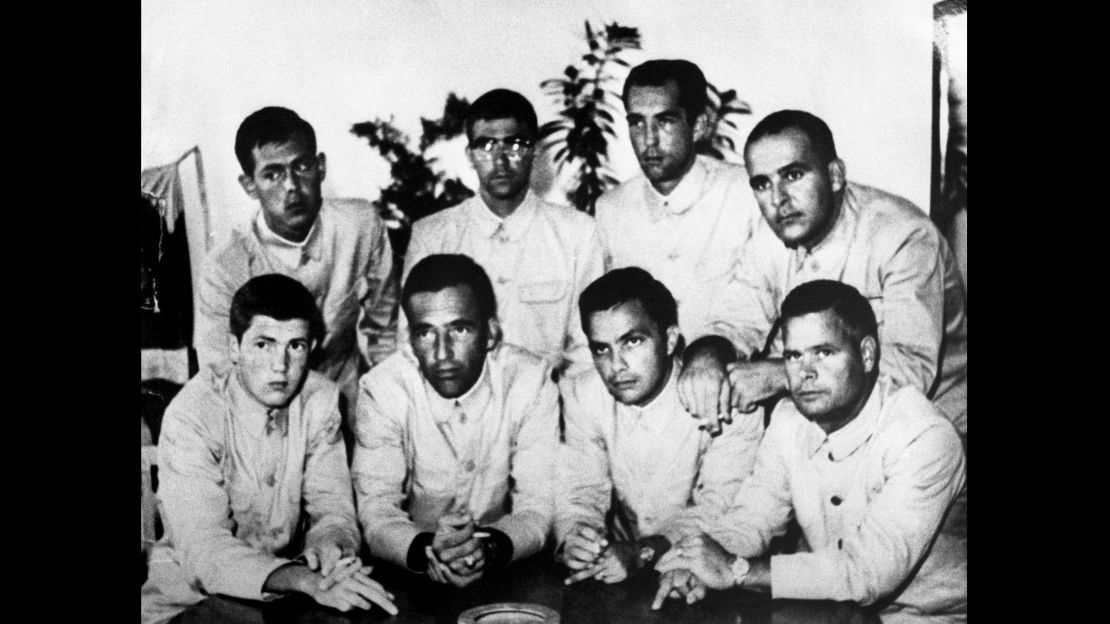
The negotiations put an end to the forced starvation, but it ended up taking until December 23 for 82 men, and one dead body, that of Fireman Duane D. Hodges, to be released, at the Bridge of No Return in the De-Militarized Zone (DMZ).
Secretary of the Navy John Chafee, former Governor of Rhode Island and later a Senator from that State (as would be his son, Lincoln Chafee), refused to hold courts-martial for Bucher or anyone else on board, saying, "They have suffered enough."
In 1970, the Captain published his account, Bucher: My Story. He died in 2004, at age 76. In 1973, ABC aired the TV-movie Pueblo, starring Hal Holbrook as Bucher. In 2001, the NBC drama The West Wing aired an episode titled "Gone Quiet," about a fictional U.S. ship that was missing near North Korea. Holbrook played Albie Duncan, an elderly former Undersecretary of State, telling President Jed Bartlet (Martin Sheen) that the incident was reminiscent of that of the Pueblo, saying, "I was there." It was clearly a reference to Holbrook's earlier role, although it was a suggestion that the fictional Duncan was part of the negotiations to get the real crew freed, 33 years earlier.
The Pueblo is now North Korea's biggest tourist attraction, berthed at the Fatherland War of Liberation Museum in the national capital of Pyongyang. And yet, it remains on the U.S. Navy's active roll, the only such ship currently held by another country.
*
January 23, 1968 was a Tuesday. Baseball was out of season. The football season had ended 9 days earlier, with the Green Bay Packers beating the Oakland Raiders in Super Bowl II.
There were no NBA games played that day, and no NHL games, but there were 3 played in the American Basketball Association:
* The Minnesota Muskies beat the Kentucky Colonels, 120-97 at the Metropolitan Sports Center in the Minneapolis suburb of Bloomington, Minnesota.
* The New Orleans Buccaneers beat the Dallas Chaparrals, 112-104 at the New Orleans Municipal Auditorium.
* And the Oakland Oaks beat the Houston Mavericks, 120-110 at the Oakland Coliseum Arena.


No comments:
Post a Comment