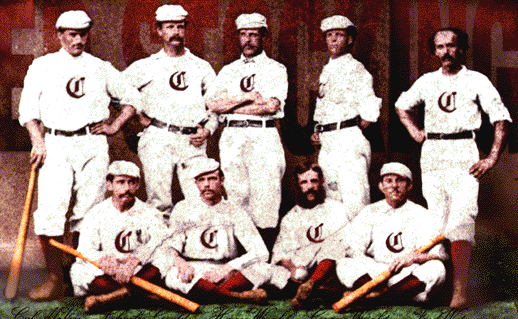
Hail the Champions:
* Pitcher, Asa Brainard, a native of Albany, New York, 1841-1888.
* Center fielder and manager, Harry Wright, born in Sheffield, England, and grew up in New York, 1835-1895.
* 3rd baseman, Fred Waterman, Manhattan, 1845-1899.
* Left fielder, Andy Leonard, born in Cavan, Ireland and grew up in Newark, 1846-1903
* 2nd baseman, Charlie Sweasy, Newark, 1847-1908
* Catcher, Doug Allison, Philadelphia, 1846-1916.
* Substitute, but mainly an outfielder, Dick Hurley, Honesdale, Pennsylvania, born in 1847, and history has lost track of him, the last record of him being in 1916.
* 1st baseman, Charlie Gould, the only one actually from Cincinnati, 1847-1917.
* Right fielder, Cal McVey, born in Montrose, Iowa and grew up in Indianapolis, 1849-1926,
* Shortstop, George Wright, Yonkers, brother of Harry, the last survivor, 1847-1937.
So it was a pair of Wright Brothers in southern Ohio who, essentially, invented professional baseball, just as another such pair invented the airplane. Harry and George are in the Baseball Hall of Fame, 1 of only 2 pairs of brothers both in. The other is Paul and Lloyd Waner of the 1920s and '30s Pittsburgh Pirates.
It was a different world. Pitching was done underhanded, so it really was "pitching," not "throwing." And it was done from a flat "box," not a raised mound. A batter could still call for a high or a low pitch. Brainard was the best pitcher of the time, and other teams would call their best "our Asa." From this name, the term "ace" for a great pitcher was born.
There really wasn't professional sports at this point. Taking money to play a game was frowned upon by "gentlemen." The 1st college football game was played 2 days earlier, in New Jersey, and it was basically a 25-a-side soccer game. Between these 2 events, 1869 became as good a year as any with which to start this project.
Soccer had barely been standardized, with England's Football Association establishing rules in 1863. Hockey was in its infancy. Basketball was 22 years away from being invented; volleyball, 4 years after that. Boxing was an "underground" sport. Horse racing was big, as sports went. The Olympic Games weren't even an idea. If you consider golf a sport (I don't), what came to be called the British Open began in 1860, but the U.S. Open was a long way off. And tennis had yet to see its equivalents, Wimbledon and the U.S. Open, founded.
Connie Mack, later known as "The Grand Old Man of Baseball," was 6 years old. Jacob Ruppert, who would build the 1st Yankee Stadium and the 1st Yankee dynasty, was 2. So was Cy Young. John McGraw wouldn't be born for another 4 years; Honus Wagner, for 5; Christy Mathewson, for 11; Ty Cobb, for 17; Walter Johnson, for 18; Babe Ruth, for 24.
There were 37 States in the Union, and 14 Amendments to the Constitution of the United States. Legally, women could not vote anywhere in America. A month later, on December 10, 1869, the 1st place in the country to grant that right did so: The Wyoming Territory. Hence, when it gained Statehood in 1890, Wyoming became known as "The Equality State." There was no Food & Drug Administration, no banking insurance, and as far as legal protections for labor went, dream on.
The President of the United States was Ulysses S. Grant. Andrew Johnson was the only living former President. Rutherford B. Hayes was Governor of Ohio. James Garfield was in Congress from Ohio. Chester Arthur was the Chairman of the New York State Republican Committee. Grover Cleveland was a young lawyer in Buffalo. Benjamin Harrison was a young lawyer in Indianapolis. William McKinley was the prosecuting attorney of Stark County, Ohio. Theodore Roosevelt was 10 years old, William Howard Taft 11, Woodrow Wilson 12, Warren Harding 4. Calvin Coolidge and every President since him had not yet been born.
There were still living veterans of the French Revolution, the Irish Rebellion of 1798, and the Napoleonic Wars. The last verified surviving veteran of the War of the American Revolution had died the year before. There was still a surviving member of the Lewis & Clark expedition.
Canada had only been semi-independent for a little over 2 years. Its 1st Prime Minister, John A. Macdonald, was still in office. The Prime Minister of Great Britain was William Ewart Gladstone, in his 1st tenure in that office, of what would prove to be 4. The monarch was Queen Victoria, great-great--great-grandmother of King Charles III. The Pope was Pius IX. The holder of the Nobel Peace Prize? There were no Nobel Prizes yet: Alfred Nobel was still alive.
Major novels of 1869 included War and Peace by Leo Tolstoy, The Idiot by Fyodor Dostoevsky, Lorna Doone by R.D. Blackmore, and The Man Who Laughs by Victor Hugo, later turned into a movie that would inspire the comic book character of the Joker. Mark Twain published The Innocents Abroad, an account of a trip he'd taken 2 years earlier, and it would remain his best-selling book for the rest of his life.
The songs "The Little Brown Jug" by J. Eastburn Winner and "Shoo Fly, Don't Bother Me" by T. Brigham Bishop were published. Richard Wagner premiered his opera Das Rheingold.
No one had yet heard of Sherlock Holmes, or Tarzan, or Phileas Fogg, or Allan Quatermain, or anybody that could later be called a "superhero."
Inflation was such that what $1.00 bought then, $21.52 would buy now. A U.S. postage stamp cost 6 cents. A new 2-room house would cost about $300. The price of a ride on the New York Subway, or of a gallon of gas, or of a McDonald's meal, or of a new car? I can't tell you, because those things didn't exist yet. Nor did the Dow Jones Industrial Average.
I can tell you that coffee was about 12 cents a pound. The average price of a work horse (equivalent to a tractor) was $150, and that of a "saddle horse" (equivalent to a car) was $200. The saddle itself would set you back another $30. A buggy, probably closer to a "car," would have been $75, but, again, you would have needed a horse to pull it; so, adding the work horse, and that's $225.
The tallest building in the world was the Great Pyramid in Giza, Egypt, 481 feet high. America's 1st transcontinental railroad had been running for less than 6 months. The telephone was still 7 years away; the phonograph, 8; the practical electric light bulb, 10; automobiles, 16; motion pictures, 25; the airplane, 34; radio broadcasting, 51; and network television, 78.
Antibiotics? Forget it: Alexander Fleming, discoverer of penicillin, wouldn't be born for another 12 years. Air conditioning? Sweat it out: Willis Carrier, its inventor, wouldn't be born for another 5. An understanding of how the universe worked? No chance: Albert Einstein wouldn't be born for another 10. Birth control, of any kind, other than "the rhythm method"? Tough luck, sister: Margaret Sanger wouldn't be born for another 10.
Artificial organs or transplants? Who's kidding who: They were decades away. A decent study of mental health? Dream on: Sigmund Freud was 13 years old. Space travel? Even Jules Verne was just beginning to explore the idea in writing.
What else was going on in the world in the Autumn of 1869? The Red River Rebellion broke out in Western Canada. The scientific journal Nature was first published. The Suez Canal opened on November 17. The First Vatican Council opened in Rome.
In America, work began on the Brooklyn Bridge. Financiers Jim Fisk and Jay Gould combined to try to corner the gold market in September, and blew it, resulting in a financial panic known as Black Friday. Jesse James committed his 1st bank robbery. And Goldman Sachs, Campbell's Soup, and the H.J. Heinz Company were all founded.
Franklin Pierce, and Edwin Stanton, and Edward Smith-Stanley (the 14th Earl of Derby, former British Prime Minister, and grandfather of the donor of the Stanley Cup) died. Mohandas Gandhi, and Henri Matisse, and John Heisman were born.
The President of the United States was Ulysses S. Grant. Andrew Johnson was the only living former President. Rutherford B. Hayes was Governor of Ohio. James Garfield was in Congress from Ohio. Chester Arthur was the Chairman of the New York State Republican Committee. Grover Cleveland was a young lawyer in Buffalo. Benjamin Harrison was a young lawyer in Indianapolis. William McKinley was the prosecuting attorney of Stark County, Ohio. Theodore Roosevelt was 10 years old, William Howard Taft 11, Woodrow Wilson 12, Warren Harding 4. Calvin Coolidge and every President since him had not yet been born.
There were still living veterans of the French Revolution, the Irish Rebellion of 1798, and the Napoleonic Wars. The last verified surviving veteran of the War of the American Revolution had died the year before. There was still a surviving member of the Lewis & Clark expedition.
Canada had only been semi-independent for a little over 2 years. Its 1st Prime Minister, John A. Macdonald, was still in office. The Prime Minister of Great Britain was William Ewart Gladstone, in his 1st tenure in that office, of what would prove to be 4. The monarch was Queen Victoria, great-great--great-grandmother of King Charles III. The Pope was Pius IX. The holder of the Nobel Peace Prize? There were no Nobel Prizes yet: Alfred Nobel was still alive.
Major novels of 1869 included War and Peace by Leo Tolstoy, The Idiot by Fyodor Dostoevsky, Lorna Doone by R.D. Blackmore, and The Man Who Laughs by Victor Hugo, later turned into a movie that would inspire the comic book character of the Joker. Mark Twain published The Innocents Abroad, an account of a trip he'd taken 2 years earlier, and it would remain his best-selling book for the rest of his life.
The songs "The Little Brown Jug" by J. Eastburn Winner and "Shoo Fly, Don't Bother Me" by T. Brigham Bishop were published. Richard Wagner premiered his opera Das Rheingold.
No one had yet heard of Sherlock Holmes, or Tarzan, or Phileas Fogg, or Allan Quatermain, or anybody that could later be called a "superhero."
Inflation was such that what $1.00 bought then, $21.52 would buy now. A U.S. postage stamp cost 6 cents. A new 2-room house would cost about $300. The price of a ride on the New York Subway, or of a gallon of gas, or of a McDonald's meal, or of a new car? I can't tell you, because those things didn't exist yet. Nor did the Dow Jones Industrial Average.
I can tell you that coffee was about 12 cents a pound. The average price of a work horse (equivalent to a tractor) was $150, and that of a "saddle horse" (equivalent to a car) was $200. The saddle itself would set you back another $30. A buggy, probably closer to a "car," would have been $75, but, again, you would have needed a horse to pull it; so, adding the work horse, and that's $225.
The tallest building in the world was the Great Pyramid in Giza, Egypt, 481 feet high. America's 1st transcontinental railroad had been running for less than 6 months. The telephone was still 7 years away; the phonograph, 8; the practical electric light bulb, 10; automobiles, 16; motion pictures, 25; the airplane, 34; radio broadcasting, 51; and network television, 78.
Antibiotics? Forget it: Alexander Fleming, discoverer of penicillin, wouldn't be born for another 12 years. Air conditioning? Sweat it out: Willis Carrier, its inventor, wouldn't be born for another 5. An understanding of how the universe worked? No chance: Albert Einstein wouldn't be born for another 10. Birth control, of any kind, other than "the rhythm method"? Tough luck, sister: Margaret Sanger wouldn't be born for another 10.
Artificial organs or transplants? Who's kidding who: They were decades away. A decent study of mental health? Dream on: Sigmund Freud was 13 years old. Space travel? Even Jules Verne was just beginning to explore the idea in writing.
What else was going on in the world in the Autumn of 1869? The Red River Rebellion broke out in Western Canada. The scientific journal Nature was first published. The Suez Canal opened on November 17. The First Vatican Council opened in Rome.
In America, work began on the Brooklyn Bridge. Financiers Jim Fisk and Jay Gould combined to try to corner the gold market in September, and blew it, resulting in a financial panic known as Black Friday. Jesse James committed his 1st bank robbery. And Goldman Sachs, Campbell's Soup, and the H.J. Heinz Company were all founded.
Franklin Pierce, and Edwin Stanton, and Edward Smith-Stanley (the 14th Earl of Derby, former British Prime Minister, and grandfather of the donor of the Stanley Cup) died. Mohandas Gandhi, and Henri Matisse, and John Heisman were born.
That's what was going on in the world on November 6 and 8, 1869, when Rutgers and the school now known as Princeton played the 1st American football game, and the Cincinnati Red Stockings completed baseball's 1st professional season undefeated.


No comments:
Post a Comment