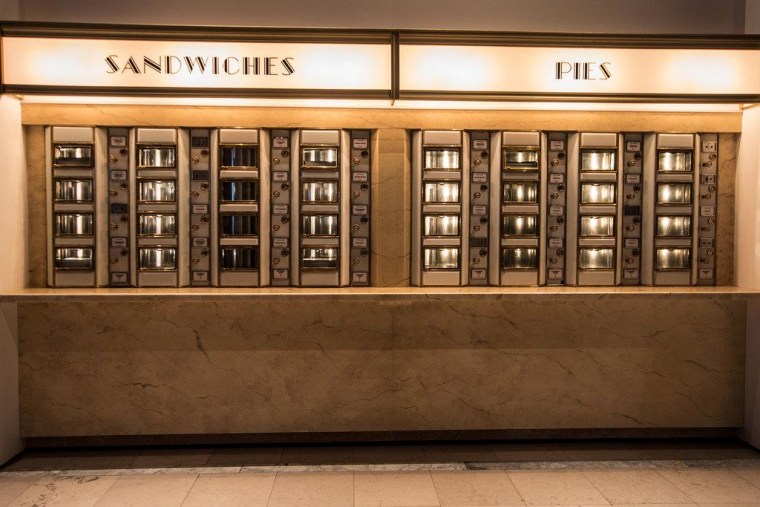
June 12, 1902: The 1st automat in America opens, under the name Horn & Hardart, at 818 Chestnut Street in Philadelphia.
Quisisana was a German company that introduced the world's first automat restaurant, in June 1895, on the grounds of the Berlin Zoo. The establishment was considered a success, selling 5,400 sandwiches, 9,000 glasses of wine and cordials, and 22,000 cups of coffee on the first Sunday of business. Quisisana also manufactured automat machines and equipment, including a milk vending machine which was adapted for use in German schools.
The name Quisisana comes from the Italian phrase qui si sana, which roughly translates to "here one is healed" or "here you become healthy." Automat is a loanword from German for "automaton," which was adopted from Latin automatus, originally borrowed from the Greek, meaning "acting of itself."
The concept was demonstrated at the World's Fair in Brussels, Belgium in 1897, and spread to other European cities. Frank Hardart, himself of Bavarian heritage, was inspired by the Quisisana automat restaurant. He then supposedly convinced Joseph Horn to place an order for automat equipment from the Quisisana company itself, in order to expand their existing restaurant services.
It took 2 years for Quisisana's equipment to arrive in Philadelphia for Horn and Hardart's first automat restaurant; partly because the steamship transporting the first machine sank. Their insurance company covered the bill, and they received their automat equipment in 1902. They opened their automat under the name Horn & Hardart. They expanded operations to New York in 1912, and the concept became part of popular culture in Northern industrial cities.
Originally, the machines in US automats only accepted nickels. A cashier sat in a change booth in the center of the restaurant, behind a wide marble counter with 5 to 8 rounded depressions. The diner would insert the required number of coins in a machine, and then lift a window, hinged at the top, and remove the meal, which was usually wrapped in waxed paper. The kitchen was located behind the machines to replenish food from the rear.
Automats were popular with a wide variety of celebrity patrons, including journalist Walter Winchell and songwriter Irving Berlin. The New York automats were also popular with unemployed songwriters and actors. Playwright Neil Simon called automats "the Maxim's of the disenfranchised" in 1987 -- by which point the reference was lost on most Americans, as the post-World War II growth of fast food had made automats obsolete.
By the 1970s, the automats' remaining appeal in their core urban markets was chiefly nostalgic. Another contributing factor to their demise was inflation, which increased food prices, and made the use of coins inconvenient at a time before bill acceptors were common on vending equipment.
The last Horn & Hardart automat in New York, at 200 East 42nd Street at 3rd Avenue, closed on April 8, 1991. I had been fortunate enough to visit it the year before, and paid $3 for a BLT and a soda. The company converted most of its New York City locations into Burger King restaurants.
Today, 818 Chestnut in Philadelphia is occupied by an empty lot. But 200 East 42nd is occupied by a similar restaurant, named Sandwicherie.
*
June 12, 1902 was a Thursday. These baseball games were played:
* The Baltimore Orioles were leading the Detroit Tigers, 9-3 after 7 innings at Bennett Park in Detroit. But it had been windy all game, and there were reports of a tornado nearby. The umpires agreed to stop the game. It was the 1st time a game in what would eventually be called Major League Baseball was stopped due to a tornado warning. Through June 12, 2022, it remains the only one. I have a separate entry for this event.
* The New York Giants beat the St. Louis Cardinals, 6-1 at the Polo Grounds.
* The Brooklyn Superbas lost to the Pittsburgh Pirates, 5-0 at Washington Park in Brooklyn. The Superbas became the Brooklyn Dodgers in 1911.
* The Boston Beaneaters beat the Chicago Orphans, 3-1 at the South End Grounds in Boston. The Beaneaters went through some name changes before becoming the Braves in 1912. The Chicago team, formerly known as the White Stockings and, for their youth, as the Colts, had long been led by 1st baseman and manager Adrian Constantine Anson. He was known as "Cap," for "Captain," until he got older, and became known as "Pop." He retired after the 1897 season, and the team became known as the "Orphans," because "they missed their Pop." They were renamed the Chicago Cubs in 1903.
* The Cincinnati Reds beat the Philadelphia Phillies, 12-3 at National League Park (later Baker Bowl) in Philadelphia.
* The Cleveland Bronchos beat the Philadelphia Athletics, 5-4 at League Park in Cleveland. The next season, the Bronchos renamed themselves for their best hitter and 2nd baseman, and even named him their manager: Napoleon "Nap" Lajoie. He went 0-for-2 with a walk in this game. They became the Cleveland Naps in 1903, the Cleveland Indians in 1915, and the Cleveland Guardians in 2022.
* The Chicago White Stockings beat the Boston Americans, 5-2 at South Side Park in Chicago. The White Stockings became the White Sox in 1904. The Americans became the Red Sox in 1908.
* And the Washington Senators beat the St. Louis Browns, 9-8 at Sportsman's Park in St. Louis.
The next day, a Friday the 13th, in Baltimore, a 7-year-old boy was taken from his parents a mile away to St. Mary's Industrial School, a Catholic-run part vocational school, part reform school. His name was George Herman Ruth Jr. He would eventually become known as Babe Ruth. A tornado is a force of nature, much stronger than Ruth turned out to be. But not by much.


No comments:
Post a Comment