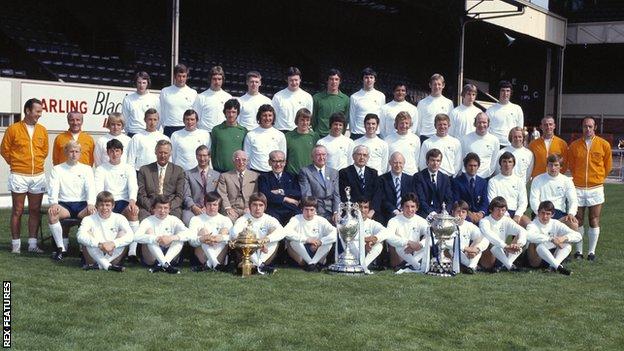
May 8, 1972: England's Football League comes to what remains the wildest finish in its history.
Going into the last 2 weekends of play, it was still possible for 4 different teams to win the Division One title. Arsenal, of North London, were not one of them: They had won both the League and the FA Cup, for "The Double," the season before; but, this time, they were in 5th place. Leeds United, of Yorkshire, were one of them. They had won the League in 1969, had blown the League title late in the 1970-71 season, and played Arsenal in the FA Cup Final on the final Saturday, beating them, 1-0.
There were also Liverpool, League Champions as recently as 1966, and the team Arsenal beat in the previous year's Cup Final; Manchester City, League Champions as recently as 1968; and Derby County, of Derbyshire in the East Midlands.
Derby -- and that's pronounced "DAHR-bee," not "DUR-bee," as it would be in America -- were the dark horses. In 1968, they had hired former Middlesbrough star striker Brian Clough as their manager, and in one season, he took them from the bottom of Division Two, in danger of being relegated to Division Three, to the title of Division Two and promotion to Division One. Three years later, he had them poised to pursue the Division One title.
He'd built a team with goalkeeper Colin Boulton; a back four of Ron Webster, Captain Roy McFarland, Colin Todd and John Robson; a midfield of John McGovern, Archie Gemmill, Alan Durban and Alan Hinton; and forwards John O'Hare and Kevin Hector.
On April 22, Derby beat Man City, 2-0 at Maine Road in Manchester. That was City's last League game of the season, and they finished with 57 points.
On May 1, Derby beat Liverpool, 1-0 at home -- at a stadium named The Baseball Ground. The Midlands were one of the few parts of England where baseball had caught on, but that was at the turn of the 20th Century, and interest fell away, returning to baseball's English cousin, cricket. But The Baseball Ground remained the name of Derby's stadium until they moved into a new stadium in 1997.
That May Day game eliminated Man City from the race, and it concluded Derby's League schedule -- or "fixture list," as would be said in England. Derby had finished with 58 points. (A win was worth 2 points, until the 1982-83 season, when, to discourage playing for a draw, with 1 point, a win was made 3 points.) Now, they had to wait for everyone else to finish.
Going into Monday, May 8, with games having been rescheduled for that day due to cup ties causing fixture congestion, Derby led the League with 58, Leeds had 57, and Liverpool had 56. Leeds had to beat West Midlands team Wolverhampton Wanderers, a.k.a. "Wolves," away to win the League outright. A draw would tie Derby on points. Liverpool had to beat Arsenal away to tie Derby on points.
If either team tied Derby for 1st, the tiebreaker would be goal average. Not goal difference, which it would later be changed to, but League goals scored divided by League goals allowed. Derby had finished with an average of 2.091. So if Leeds got a tie vs. Wolves, given that their average was already higher, at 2.483, then Leeds would win the title, and thus The Double. Liverpool's was 2.133, so if they beat Arsenal, they would finish ahead of Derby. In other words, to win the title, here's what they needed:
* Derby: Leeds to lose, and Liverpool to not win.
* Leeds: A win; or, a draw, and Liverpool to win by less than a massive blowout.
* Liverpool: A win, and Leeds to lose.
Clough was only 37 years old. He and his wife Barbara still had 3 young children, including Nigel Clough, who would later play for his father and also go into team management. Had it not been for a devastating knee injury while playing for Sunderland on Boxing Day 1962, he could still have been playing. Instead, along with his assistant manager and chief scout, Peter Taylor, he had taken a team that was in danger of relegation to Division Three, and, in 4 years, built them into a team that could end up as Champions of England.
Since there was nothing more he could do, Clough took his family on vacation -- or "on holiday," as would be said in England -- to the Isles of Scilly, off the coast of Cornwall. All he could do now was listen to the radio, as the Football League didn't allow live television broadcasts of their games.
At the Arsenal Stadium, nicknamed Highbury for the North London neighborhood it was in, Arsenal salvaged some pride by holding Liverpool to a 0-0 draw. And at Molineux Stadium in Wolverhampton, Wolves -- who were no slouches, as they finished 9th, and reached the Final of the UEFA Cup, losing to the other North London team, Tottenham Hotspur, who finished 6th -- got a goal from Frank Munro right before halftime, and another from their best player, Derek Dougan, in the 67th minute. Billy Bremner, Leeds' diminutive Scottish Captain, got the Whites to within 2-1, but they could not find the equalizer that would have won the title. It all ended Derby 58, Leeds 57, Liverpool 57.
The BBC sent a film crew from their Cornwall affiliate to film a phone call from their London studio to Clough's hotel room, for broadcast the next day. It was a bizarre end to a wild season, with an unlikely Champion.

It was around this time that Clough began bragging,
"I might not be the best manager in the country,
but I'm in the top one."
Clough would continue to gain upsets with Derby, taking them to the Semifinal of the 1973 European Cup. He left them over a dispute with team chairman Sam Longson, over transfer funds. After taking the manager's job at Sussex team Brighton & Hove Albion, Leeds hired him to replace Don Revie, who became manager of England. Both men spectacularly failed in their new jobs.
In 1975, Clough was hired by Derby's East Midlands' arch-rivals, Nottingham Forest, and led them to the League title in 1978, and to the European Cup in 1979 and 1980.
*
May 8, 1972 was a Monday. American Football was out of season. The NBA season ended the day before, when the Los Angeles Lakers beat the New York Knicks in Game 5 of the Finals. The ABA Finals were between Games 1 and 2, and the Indiana Pacers went on to beat the New York Nets in 6 games. The Stanley Cup Finals were between Games 4 and 5, and the Boston Bruins ended up beating the New York Rangers in 6 games.
There were 2 Major League Baseball games. The New York Yankees beat the Minnesota Twins, 5-3 at Metropolitan Stadium in the Minneapolis suburb of Bloomington, Minnesota. Mel Stottlemyre outpitched Bert Blyleven. Former Philadelphia Phillies star Johnny Callison hit a home run for the Yankees. Harmon Killebrew went 1-for-3 with a walk. Rod Carew went 2-for-5 with an RBI.
And the Los Angeles Dodgers beat the Montreal Expos, 5-2 at Jarry Park in Montreal.


No comments:
Post a Comment