
The Knicks (almost nobody calls them by their full name) were founded in 1946, as a charter franchise in the Basketball Association of America, which became the National Basketball Association in 1949. They and the Boston Celtics are the only 2 charter franchises still playing in their original cities. The only other charter franchise still playing is the Philadelphia Warriors, who moved to San Francisco in 1962, and have been known as the Golden State Warriors since 1971.
The Knicks reached the NBA Finals in 1951, but lost in 7 games to the Rochester Royals, who are now the Sacramento Kings. They reached the Finals again in 1952, losing to the Minneapolis Lakers in 7. They reached the Finals again in 1953, losing to the Lakers in 5. They had not reached the Finals since.
The Lakers, on the other hand, won the 1948 National Basketball League title, and were admitted into the NBA, where they then won 5 of the next 6 titles. In 1959, they lost the Finals to the Celtics. After the 1960 season, they were moved to Los Angeles, where they won the Western Division title in 1962, 1963, 1965, 1966, 1968 and 1969 -- and lost to the Celtics every single time, including in 7 games in '62, '66 and '69.
By this point, the Knicks had been rebuilt under head coach William "Red" Holzman (who had played for the '51 Royals), chief scout Dick McGuire (who had been a star on those early 1950s teams), and general manager Eddie Donovan. Playing at the new Madison Square Garden that had opened in 1968 were future Hall-of-Famers Willis Reed, Walt Frazier, Dave DeBusschere and Bill Bradley.

Red Holzman
In 1969, the Knicks got to the Eastern Division Finals, losing to the Celtics. The 1969-70 season was when it all seemed to be coming together. They had an 18-game winning streak, an NBA record (but for only 2 more years).
In the Playoffs, despite the presence of Earl "the Pearl" Monroe, one of the few players who could match "Clyde" Frazier for flashiness, the Knicks beat the Baltimore Bullets in 7 games. Then, despite the presence of Alcindor and already-all-time great Oscar Robertson, the Knicks beat the Milwaukee Bucks, to reach their 1st NBA Finals in 17 years.

Clyde. 'Nuff said.
Let's put this in perspective. At this point, the Yankees had won 20 World Series. The Giants had won 4 NFL Championships. The Rangers had won 3 Stanley Cups. And in the preceding 16 months, the Jets had won the Super Bowl, and then the Mets had won the World Series. The Jets had only been in existence since 1960, the Mets since 1962. The Knicks had been a founding franchise of the NBA, in 1946, and in 24 years, they had gone 0-3 in Finals, and had never won a Championship. They needed one.
In their way were the Lakers, who had 3 of the defining figures of the NBA's 1st quarter-century: Wilt Chamberlain, the best player the game has ever known; Elgin Baylor, the 1st man to really make the game stylish; and Jerry West, the best shooter the sport had yet seen and a really good defensive player, too. The Knicks would have home-court advantage, but they were huge underdogs. The Lakers seemed to have both talent and hunger on their side.

Elgin Baylor, Wilt Chamberlain and Jerry West
*
April 24, 1970. Game 1 at The Garden. It was surprisingly easy for the Knicks, as they won, 124-112.
April 27, 1970, Game 2 at The Garden. So much for easy: The Lakers struck back, and won 105-103.
April 29, 1970, Game 3 at The Forum, in the Los Angeles suburb of Inglewood, California. The Knicks thought they had the game won when DeBusschere made a basket with 3 seconds left. But then came the first true "buzzer-beater" in NBA history: West fired a shot from behind half-court, and it went in. No 3-point field goals in those days (although the American Basketball Association used it), so this sent the game to overtime.
Instead of being stunned by West's shot, the Knicks showed their professionalism, shook it off, and got the job done, winning anyway 112-108.
May 1, 1970, Game 4 at The Forum. The Lakers had already shown the Knicks that they weren't going to give up without a fight, and they tied the series up again, winning this game 121-115 in overtime.
May 4, 1970, Game 5 at The Garden. A surreal day. Earlier, on the campus of Kent State University in the Cleveland suburb of Kent, Ohio, a demonstration was held, protesting President Richard Nixon's decision to expand the Vietnam War to Cambodia. This would have disastrous consequences for Southeast Asia, both short-term and long-term. Ohio National Guardsmen shot 13 students, resulting in 4 deaths and 1 permanent paralysis.
Al Albert was a student at Kent State at the time. His brother, Marv Albert, was a broadcaster for the Knicks, the Jets, and the New York Rangers. Marv had heard of the massacre, and, not knowing the names of the dead and the wounded, had made some calls to find out if his brother was all right. He got no answer. He had to broadcast the 1st half of the game not knowing if his brother was alive and well, alive but in a hospital, or dead. Finally, during halftime, he was handed a note saying that Al had been reached, and was fine, that he was nowhere near the demonstration.
In the middle of Game 5, Knick Captain Reed went down with a torn thigh muscle. Up until then, he had been keeping Chamberlain in check. But without Reed, their biggest physical presence and their emotional leader, the Knicks were in trouble.

DeBusschere stepped up, and kept Chamberlain from running riot across the Garden floor, although he finished with 22 points and 19 rebounds. The Knicks won, 107-100.
May 6, 1970, Game 6 at The Forum. Without Reed available, this was the least close game of the series. Chamberlain ran riot across the Forum floor, and DeBusschere couldn't stop him: 45 points and 27 rebounds. West couldn't be stopped, either: 33 points and 13 assists. The Lakers won, 135-113. To put that in perspective, until this point, the highest point total in the series was the Knicks' 124 in Game 1; the Lakers' highest, 121 in Game 4.

Wilt Chamberlain and Walt Frazier
It meant that the Knicks needed Reed for Game 7. And the nature of his injury made it look like he wouldn't be available. At this point, pretty much everybody expected the Lakers to win the game easily, and thus win the title.
*
There were 19,500 paying customers at The Garden that Friday afternoon. Among them, Woody Allen was sitting courtside. Also from Brooklyn, but sitting up at the very top, in what were then known as the Blue Seats, was 13-year-old Shelton "Spike" Lee, who would also later become a renowned film director, and would also eventually be sitting courtside. And the one thing on the minds of Woody, Spike, and everybody in between was, "Will Willis play?"

On radio station WHN, 1050 AM (now WEPN, the flagship of ESPN Radio), Marv Albert himself asked, "The big question is, 'Will Willis Reed play tonight?'" Shortly, he got his answer, "And here comes Willis! The crowd is going wild!"
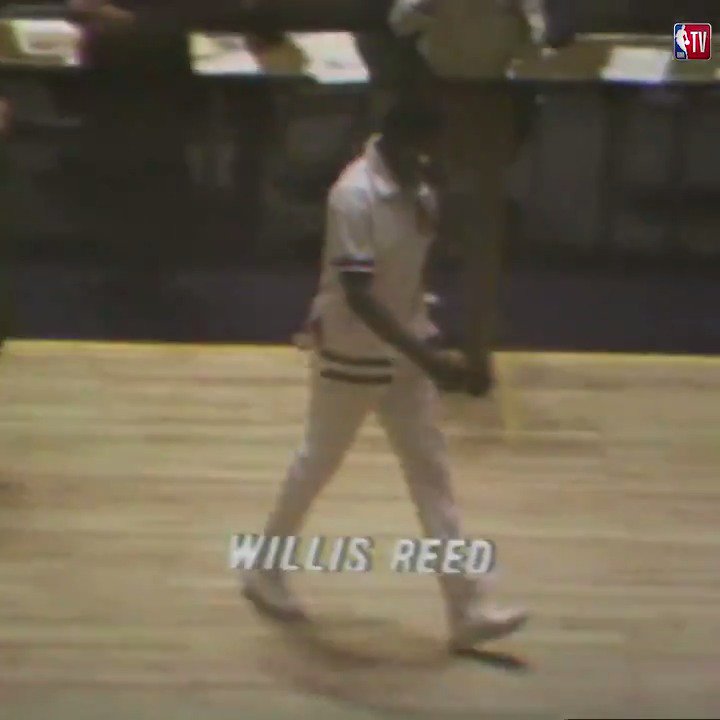
Reed limped out onto the court for warmups, and hit a few shots. The Lakers stopped and watched. It was over: He was in their heads. They were already beaten.
The game tipped off at 4:00 PM. Willis dragged his bad leg around the court, took the Knicks' 1st 2 shots, and made them both. It was effectively over. Willis played only 27 of the 48 minutes. That was more than enough.
Everyone remembers it as The Willis Reed Game. But Frazier had his best game: 36 points to lead all players, 19 assists to lead all players, 7 rebounds. Barnett had 21 points. DeBusschere had 18 points and 17 rebounds. Bradley had 17, Nate Bowman 6, Mike Riordan 5, Dave Stallworth 4, Cazzie Russell 2.
Despite 28 points from West, 21 points and 24 rebounds from Chamberlain, and 19 points from Baylor, the Knicks won, 113-99, and were World Champions for the 1st time. It became a particular point of pride for the Knicks that they held the Lakers to under 100 points in that Game 7.

Nationally, the game was broadcast on ABC. In the locker room afterward, Howard Cosell told Reed, "You exemplify the very best that the human spirit can offer."

Cosell (before his infamous toupee, but dripping with champagne),
Reed and Holzman
The Knicks finally had their title, and this game has only grown in New York sports legend. It's one of those games where a person who doesn't remember it must think that the venue must have held a million people, because that's how many people have said they were there that day.
In 1997, NBC had a promo for their sitcom Mad About You, with the following exchange:
Jamie Buchman (Helen Hunt): "What was the most amazing moment of your life?"
Paul Buchman (Paul Reiser): "Okay, you ready? 1970, NBA Finals, Game 7, Willis Reed limps onto the court, scores 4 points, Knicks win. I was there."
Jamie: "For me, it was our wedding."
That same year, as part of the league's 50th Anniversary celebrations, the NBA named Reed, Frazier and DeBusschere to its 50 Greatest Players. In 2021, as part of their 75th Anniversary celebrations, they were named to the 75 Greatest Players. Bradley was not named to either list.
In 2006, as part of their 60th Anniversary celebrations, the NBA took an online poll to determine "The NBA's 60 Greatest Playoff Moments." Willis Reed taking the court on May 8, 1970 came in 3rd, behind Michael Jordan's last shot to clinch the 1998 title for the Chicago Bulls, and Magic Johnson switching to center for an injured Kareem Abdul-Jabbar to win the 1980 title for the Lakers.
The moment is still there. Willis limping up the court is up there with the fans storming the field at Shea 7 months earlier, and Joe Namath waving that "We're Number 1" finger 14 months earlier. There have been huge moments since: The Yankees and Mets having many, the Giants having their Super Bowl wins, the Islanders winning 4 Stanley Cups, the Devils 3, and the Rangers the 1 that "will last a lifetime!"
But the Knicks have won just 1 title since, and that 1972-73 title just didn't have a signature moment that everybody remembers. Ask the average Knick fan how many games the Finals took, or if the title was clinched at home or on the road, or who the leading scorer was in the clincher, and they might not even know. (It was Game 5, at The Forum, and Earl "the Pearl" Monroe, obtained from Baltimore early in the 1971-72 season, scored 23. It was May 10, and the Knicks won 102-93.)
With the Mets having won the World Series the preceding October 16, this title by the Knicks made New York the 1st city ever to have an MLB-NBA "double." The San Francisco Bay Area (in 1975) and Los Angeles (3 times: in 1988-89, 1990-91, and 2002-03) are the only other cities to do this.
UPDATE: The Knicks finally won another NBA Championship in 2026.
*
May 8, 1970 was a Friday. This was also the day of "The Hard Hat Demonstration" or "The Hard Hat Riot" in New York. I have a separate entry for that event.
It was an off-day in the American Basketball Association Playoffs, which would be won 17 days later by the Indiana Pacers over the Los Angeles Stars. It was also an off-day in the Stanley Cup Finals, which would be won 2 days later by the Boston Bruins over the St. Louis Blues. And football was out of season.
These Major League Baseball games were played that night:
* The New York Yankees lost to the California Angels, 4-3 at Anaheim Stadium. (It was renamed Edison International Field in 1997, and Angel Stadium of Anaheim in 2004.) Clyde Wright outpitched Ron Klimkowski. Former Yankee Roger Repoz and future Yankee Jim Spencer hit home runs for the Halos, while Ron Woods hit one for the Bronx Bombers.
* The New York Mets lost to the San Francisco Giants, 7-1 at Shea Stadium. Ken Boswell hit a home run for the Mets, but Willie Mays hit 2 and Bobby Bonds 1 for the Giants.
Somehow, I don't think either Yankee fans or Met fans cared that much. They were overjoyed about the Knicks.
* A doubleheader was split at Jarry Park in Montreal. The San Diego Padres won the opener, 11-1. The Montreal Expos won the nightcap, 7-6. In the bottom of the 11th inning, Jimmy Qualls scored the winning run on a wild pitch by Gary Ross with Bobby Wine at bat.
* The Los Angeles Dodgers beat the Philadelphia Phillies, 8-4 at Connie Mack Stadium. The Phils' bullpen collapsed in the top of the 12th inning, including allowing a home run to Bill Sudakis.
* The Baltimore Orioles beat the Chicago White Sox, 6-1 at Memorial Stadium in Baltimore. Boog Powell hit a home run, Brooks Robinson went 2-for-4, and Frank Robinson went 1-for-4.
* The Atlanta Braves beat the St. Louis Cardinals, 8-7 at Atlanta Stadium. (It was renamed Atlanta-Fulton County Stadium in 1975.) For the Cards, Dick Allen went 2-for-5, but no RBIs. Lou Brock went 0-for-5, Joe Torre 0-for-3. For the Braves, Hank Aaron hit his 566th career home run, and Hal King his 2nd. Aaron would finish his career with 755, King with 24.
* The Houston Astros beat the Pittsburgh Pirates, 7-5 at the Astrodome in Houston. Roberto Clemente only entered the game as a pinch-hitter, and did not reach base.
* The Minnesota Twins beat the Cleveland Indians, 7-6 at Cleveland Municipal Stadium. Harmon Killebrew hit a home run, and Rod Carew went 2-for-4 with an RBI.
* The Kansas City Royals beat the Detroit Tigers, 9-3 at Tiger Stadium in Detroit. Dalton Jones and Bill Freehan hit homers for the Tigers, but it wasn't enough. Al Kaline did not play.
* The Chicago Cubs beat the Cincinnati Reds, 10-7 at Wrigley Field in Chicago. Ernie Banks went 0-for-5, but hit his 500th career home run 4 days later. Billy Williams hit 2 home runs. Pete Rose went 0-for-4, Johnny Bench went 1-for-4 with an RBI, and Hal McRae and Tony Perez each hit 2 home runs for the Big Red Machine, but it wasn't enough.
* And the Oakland Athletics beat the Boston Red Sox, 7-1 at the Oakland Coliseum. The only Boston run came on a home run by Carl Yastrzemski. Reggie Jackson did not play for Oakland.
* And the game between the Milwaukee Brewers and the Washington Senators at Milwaukee County Stadium was rained out. It was rescheduled as part of a doubleheader 2 days later. The Brewers won the opener, 6-5. In the bottom of the 9th, Ted Kubiak led off with a game-tying home run, followed by a walk by Ted Savage (not quite a leadoff walk, but every bit as deadly, as it turned out), a double by Danny Walton, an intentional walk by Jerry McNertney, and a single by Wayne Comer.
The Brewers also won the nightcap in walkoff fashion, 7-6, with McNertney singling home the winning run.


No comments:
Post a Comment