In the musical My Fair Lady, with book and lyrics written by Alan Jay Lerner and music by Frederick Loewe, linguistics professor Henry Higgins tries to get London street urchin Eliza Doolittle to drop her habit of dropping the letter H at the start of words by getting to say, noting historic Counties in England, "In Hertford, Heresford and Hampshire, hurricanes hardly ever happen." At first, it backfires, as she reverses it: "In 'artford, 'ereford an' 'ampshire, 'urricanes 'ardly hever 'appen!"
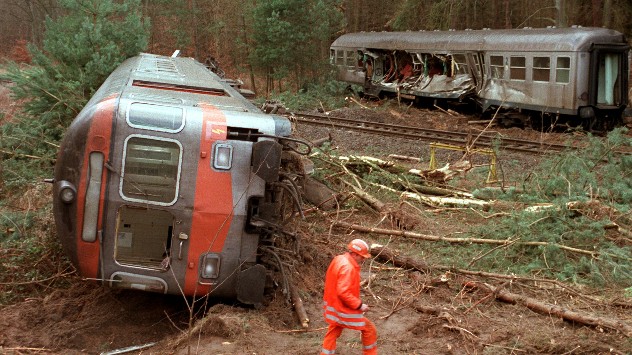
January 25, 1990: The Burns Day Storm becomes a rare European hurricane, sustained winds of over 70 miles per hour and gusts up to 104.
U.K. official records cite 97 deaths, 17 deaths were recorded in the Republic of Ireland, and 30 combined in the Netherlands and Belgium.
The storm was so named because it hit the British Isles on the anniversary of the birth of Scottish poet Robert Burns. Born in 1759, his most familiar poem (to Americans, anyway) became the New Year's Eve song "Auld Lang Syne."
His poem "To a Mouse" includes the line, "The best-laid schemes o' mice an' men gang aft agley," which usually gets translated into modern English as "The best-laid plans of mice and men often go astray." This line inspired John Steinbeck to title a novel Of Mice and Men. It also includes the words "bleak December," which may have inspired Edgar Allan Poe in the writing of "The Raven." And his song "Comin' Through the Rye" inspired J.D. Salinger to title a novel The Catcher in the Rye.
He was inspired by both the American Revolution and the French Revolution -- perhaps, being Scottish, he liked that both scared the English establishment -- and wrote "Birthday Ode for George Washington." This revolutionary spirit also attracted him to Russians, who have called him "the people's poet," despite their own literary tradition.
He had a longstanding heart condition, which killed him in 1796, only 37 years old. Since then, wherever they may be, Scots have celebrated January 25, the anniversary of his birth, with a Burns Day Supper, complete with the recitation of his poem "On a Haggis," as the eponymous dish is carved and served.
When asked in 2008 for the source of his greatest creative inspiration, Bob Dylan selected Burns's 1794 song "A Red, Red Rose" as the lyric that had the biggest effect on his life. He has statues in his hometown of Dumfries, in London, in Milwaukee, and in Montreal.
*
January 25, 1990 was a Thursday. Baseball was out of season. The NFL was approaching Super Bowl XXIV, in which the San Francisco 49ers would beat the Denver Broncos, 55-10.
There were 5 games in the NBA:
* The New York Knicks lost to the Utah Jazz, 115-89 at the Salt Palace in Salt Lake City, Utah.
* The New Jersey Nets lost to the Orlando Magic, 117-112 at the Brendan Byrne Arena at the Meadowlands. Reggie Theus scored 36 points for the Magic.
* The Washington Bullets beat the Boston Celtics, 99-98 at the Capital Centre in the Washington suburb of Landover, Maryland.
* The Phoenix Suns beat the Charlotte Hornets, 124-97 at the Charlotte Coliseum.
* And the Houston Rockets beat the Los Angeles Clippers, 102-101 at The Summit in Houston. It's now the
Central Campus of televangelist Joel Osteen's Lakewood Church.
And there were 6 games in the NHL:
* The New York Rangers beat the Calgary Flames, 8-5 at the Saddledome in Calgary.
* The New York Islanders lost to the Boston Bruins, 5-2 at the Boston Garden.
* The Philadelphia Flyers beat the Winnipeg Jets, 8-6 at The Spectrum in Philadelphia.
* The Pittsburgh Penguins beat the Detroit Red Wings, 5-3 at the Joe Louis Arena in Detroit.
* The St. Louis Blues beat the Hartford Whalers, 3-2 at the St. Louis Arena.
* And the Edmonton Oilers beat the Los Angeles Kings, 7-6 at the Northlands Coliseum. Dave Taylor scored a hat trick for the Kings, but they blew a 6-2 lead at the start of the 3rd period.


No comments:
Post a Comment