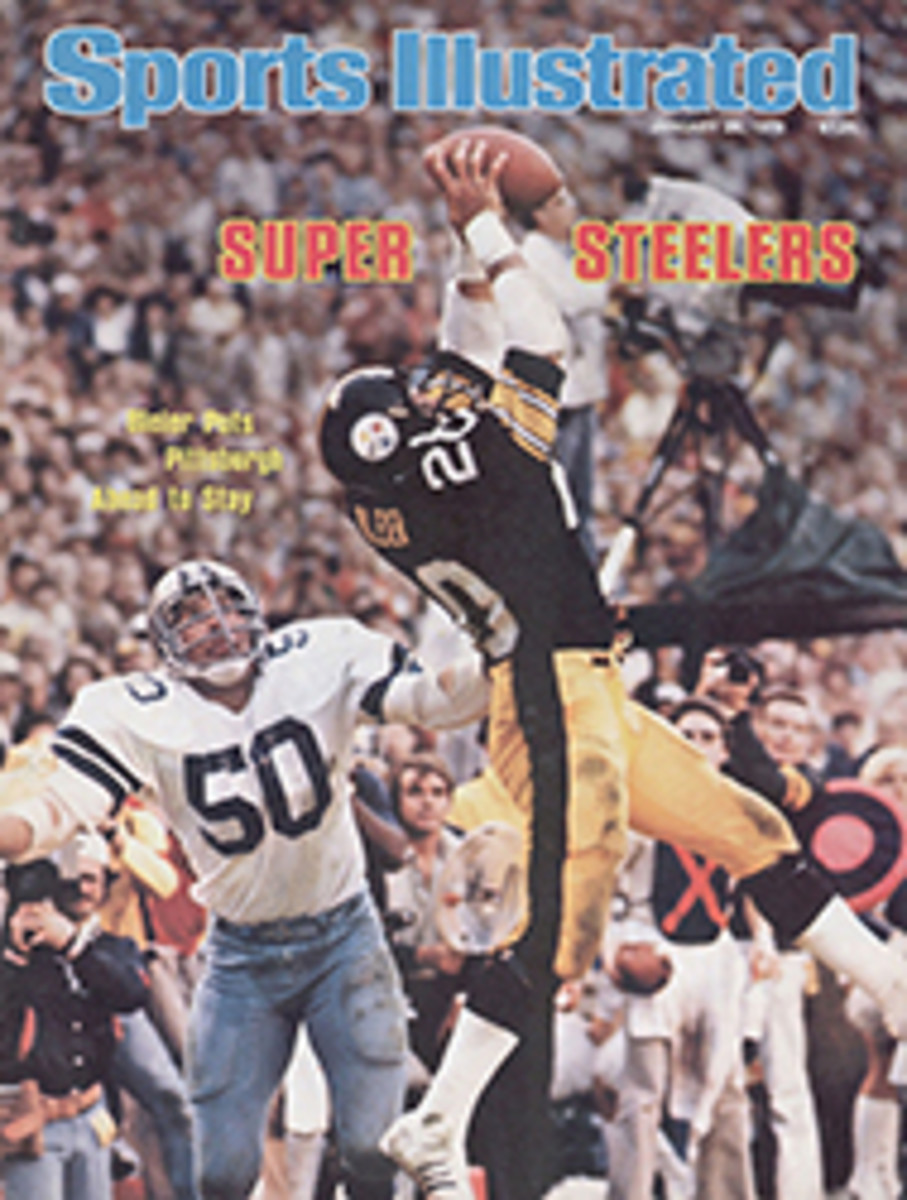
January 21, 1979: Super Bowl XIII is played at the Orange Bowl in Miami. The Dallas Cowboys, NFC Champions and winners of Super Bowls VI and XII, faced the Pittsburgh Steelers, AFC Champions and winners of Super Bowls IX and X -- and beat the Cowboys themselves in Super Bowl X.
In 2011, Chad Millman and Shawn Coyne published The Ones Who Hit the Hardest: The Steelers, the Cowboys, the '70s, and the Battle for America's Soul. It does a terrific job of telling the cultural histories of both Pittsburgh and Dallas, and the teams that played in those cities, including their meeting in Super Bowl X in 1976, up until their meeting in Super Bowl XIII in 1979. The problem is, the book ends with the postgame of that Super Bowl, and doesn't really explain who won "the battle for America's soul."
Indeed, while the Seventies Steelers are now regarded as one of the greatest football teams of all time, and the Seventies Cowboys are a level below them, looking at America from the Eighties onward, we, as a country, have become much more like Dallas and the Cowboys than we have like Pittsburgh and the Steelers:
Indeed, while the Seventies Steelers are now regarded as one of the greatest football teams of all time, and the Seventies Cowboys are a level below them, looking at America from the Eighties onward, we, as a country, have become much more like Dallas and the Cowboys than we have like Pittsburgh and the Steelers:
* Pittsburgh: Hard-working, patient, team-oriented, letting your performance do the talking, magnanimous in victory, appreciative of the people who got us there.
* Dallas: Materialistic, glitzy, self-indulgent, instant-gratification-seeking, trash-talking, drug-ridden, yet sanctimonious about religion.
It was a good book, but the lack of a true epilogue stops it from being a great book. But it is as good a look at the building of the Steeler dynasty, and as good a look at the 1st 20 years of the Cowboys, that we are likely to get anytime soon.
And while no Super Bowl has yet been called the "Game of Century," the way several college football games have been, it has been called "the ultimate game." Asked about playing in it before Super Bowl VI, Cowboys running back Duane Thomas said, "If it's the ultimate, how come they're playing it again the next year?"
The Cowboys did go into Super Bowl XIII as defending World Champions, and some of them were holdovers from their Super Bowl VI winners. (Thomas was retired by this point.) But the Steelers had also won 2 titles, and had won them more recently. They had gotten more experienced, and yet younger, as some of the veterans from Super Bowls IX and X had been replaced by younger, better players. They were 14-2 in 1978, their best season ever.
The Steelers' quarterback was Terry Bradshaw, who had really struggled before leading them to the title in the 1974 season. As a country boy from Louisiana, he had a reputation for not being very bright, even though he'd already quarterbacked a team to 2 titles.
And Cowboy All-Pro linebacker Thomas "Hollywood" Henderson told the media, "He couldn't spell 'Cat' if you spotted him the 'c' and the 'a.'" Henderson also predicted the Cowboys would win, 31-0.
The Steelers began the game as 3 1/2-point favorites. Their offense had Bradshaw, running back Franco Harris, receivers Lynn Swann and John Stallworth, and center Mike Webster. Their "Steel Curtain" defense had tackle Mean Joe Greene, linebackers Jack Lambert and Jack Ham, cornerback Mel Blount, and center Donnie Shell. That's 10 players who ended up in the Pro Football Hall of Fame. And that's not counting All-Pros like running back Rocky Bleier (on the SI cover above), offensive tackle Larry Brown, defensive ends L.C. Greenwood and Dwight "Mad Dog" White, and safety Mike Wagner.
Throw in team owner Art Rooney, administrator and owner-heir-apparent Dan Rooney, scout Bill Nunn and head coach Chuck Noll, and the fact that safety Tony Dungy was later elected as a coach, and that's 15 Hall-of-Famers.
Henderson has not been elected to the Hall of Fame. Nor has safety Charlie Waters. Who among the Cowboys has been? Quarterback Roger Staubach, running back Tony Dorsett, receiver Drew Pearson (though it took a long time to elect him), tight end Jackie Smith, defensive tackle Rayfield Wright, and linebacker Randy White. That's 6. Also, team administrators Tex Schramm and Gil Brandt, head coach Tom Landry, assistant coaches Mike Ditka (from the Pittsburgh area) and Ernie Stautner (elected for his playing for the Steelers in the 1950s). So, 11.
The Cowboys had the 1st drive, but fumbled the ball away. The Steelers took advantage, leading to a 28-yard touchdown pass from Bradshaw to Stallworth. 7-0 Pittsburgh. After a trade of turnovers, Staubach threw a 39-yard touchdown pass to Tony Hill. It was the time all season the Steelers had given up a touchdown in the 1st quarter of a game, and it tied the game at 7-7.
The script continued to go the Cowboys' way, as linebackers Henderson and Mike Hegman blitzed Bradshaw, causing him to do the kind of dumb thing Henderson suggested he was capable of: He collided with Harris, and fumbled. He picked the ball up, but was sacked by Henderson, and Hegman ripped the ball out of his hands, taking it 37 yards for a touchdown. It was 14-7 Dallas.
Bradshaw wasn't fazed. He threw a pass that Stallworth turned into a 75-yard game-tying touchdown. The Steelers forced the Cowboys to punt, but only got a missed field goal out of it. On the Cowboys' next drive, Blount intercepted Staubach. His return and a personal foul by Cowboy tight end Billy Joe DuPree gave the Steelers great field position. With 26 seconds left in the half, Bradshaw threw a 7-yard pass to Bleier, and it was 21-14 Pittsburgh.
That remained the score until, with 2:46 left in the 3rd quarter, the Cowboys had a 3rd and 3 on the Steeler 10, and Staubach faded back to pass. He saw Jackie Smith wide open in the end zone. Smith had played 15 seasons for the St. Louis Cardinals -- the football team that now plays in Arizona, not the baseball team of the same name -- and made 5 Pro Bowls. He had retired after the 1977 season, but accepted an offer from the Cowboys, who were dealing with injuries at his position. He didn't catch a pass all season long, but was praised for his blocking.
In a Playoff game against the Atlanta Falcons, he did catch a touchdown pass from Danny White, who was filling in for an injured Staubach. Although the Cardinals had gone 9-5 in 1963 (his rookie season), 9-3-2 in 1964, 9-4-1 in 1968, 10-4 to win the NFC Eastern Division in 1974, and 11-3 to win the NFC East, that game against the Falcons was the 1st winning postseason game in which he'd ever played.
Now, with less than 18 minutes in regulation to play in a game for the World Championship, and with his team down by 7 points, Jackie Smith was wide open in the end zone, and the target of a pass by one of the greatest quarterbacks who had ever played.
He dropped it. It looked like he slipped, his legs collapsing underneath him, and the pass popped out of his hands. Verne Lundquist, then the Cowboys' main radio announcer, said, "Aw, bless his heart, he's got to be the sickest man in America!"
Had he caught the pass, the Cowboys would have been a successful extra-point attempt from tying the game. Instead, the Cowboys had to settle for a 27-yard field goal by Rafael Septién. The Cowboys were trailing 21-17, the same score by which the Steelers beat them in Super Bowl X.
They could not build momentum on this. Franco Harris added to the Pittsburgh lead with a touchdown run halfway through the 4th quarter. On the ensuing kickoff, Roy Gerela slipped, causing him to squib the kick. This should have been a lucky break for the Cowboys.
Instead, Randy White tried to pick it up at the 24-yard line, but was wearing a cast to protect his broken left hand, and fumbled it. Dennis Winston recovered it, and the Steelers had the ball at the Dallas 18. On the very next play, Bradshaw threw to Swann, and he didn't drop it. That made it 35-17 Pittsburgh with less than 7 minutes to go.
The Cowboys didn't give up. Staubach threw a touchdown pass to DuPree with 2:27 left. They recovered an onside kick, and with 22 seconds on the clock, Staubach threw another touchdown pass, to Butch Johnson.
It was 35-31. Had they gotten the Smith touchdown instead of the Septién field goal, presuming Septién had made all the extra points, it would have been 35-35. But they couldn't recover the last onside kick, and the Steelers had won.
It was Jackie Smith's last game, and the last pass he was ever thrown. He caught 480 passes for 7,980 yards, the latter a record for tight ends that stood until 1990. He still holds the record of most yards per catch for any tight end, 16.1. But it took 11 tries after becoming eligible for the Pro Football Hall of Fame for him to be elected. It certainly looked as though the voters held it against him.
Henderson got the 31 points for the Cowboys right, as the Steel Curtain did not hold. But neither did the Cowboys' "Doomsday Defense." For most of the game, Bradshaw had it his own way. He was named the game's Most Valuable Player. He told the press, "Ask Hollywood how dumb I am now."
It would have been an even better question a year later, as the Steelers trailed the Los Angeles Rams early in the 4th quarter of Super Bowl XIV, and Bradshaw led them back to win, and he was named the MVP again. That made it 4 World Championships in 6 seasons.
It also linked up with the Pittsburgh Pirates' win in the 1979 World Series, in between the Steelers' back-to-back titles. Bradshaw and Pirates Captain Willie Stargell were named Sportsmen of the Year for 1979 by Sports Illustrated.
Henderson's drug problem drove him out of football, just as an elbow injury and clinical depression ended Bradshaw's career. Both men recovered, and can laugh about it all now.
Much like Liverpool Football Club in England, the Steelers had great success in the 1970s, in a city hit hard by industrial decline, where the "football" team meant everything. As with the 1965 Los Angeles Dodgers and the 1968 Detroit Tigers with their World Series wins following race riots, a community in another kind of trouble rallied around a great team, to lift them up, to show a country that had been looking down on them that they were still entitled to some pride.
But by this point, the TV show Dallas had already premiered. Just 2 months after the Steelers beat the Rams in Super Bowl XIV, the show skyrocketed in popularity thanks to the shooting of protagonist J.R. Ewing (played by Larry Hagman). The show seemed to celebrate excess, glamor, and naughty behavior. These were behaviors the Cowboys and their fans seemed to embrace, and it was anti-matter to the Steelers and their fans.
Both teams were on TV all the time, to the point where some people said that CBS stood for "Cowboys Broadcasting System." As a result, both teams developed national followings, including in places where the local team simply wasn't getting the job done in the 1970s, cities like New York (where the Jets crashed after Joe Namath's guaranteed Super Bowl win, and the Giants were mediocre and boring), Philadelphia (to the dismay of hardcore Eagle fans), Chicago (until Ditka returned as their head coach and rebuilt them), and all across the South (aside from the Cowboys and the Miami Dolphins, no team from a former Confederate State played in a Super Bowl until 1999).
The 1980s would not be good to either team, as both got old, and rebuilt to the point where they were good, but not good enough. The Cowboys reached the Conference Championship Game for the seasons of 1980, '81 and '82; the Steelers, that of '84. By the end of the decade, both had completely collapsed. But they rebuilt in the 1990s, and the Cowboys won 3 Super Bowls, finally beating the Steelers in the last of these, Super Bowl XXX, in 1996.
The Cowboys haven't been to a Super Bowl since, and the fact that they've usually been a Playoff team since then has made it more frustrating. The Steelers are also usually a Playoff team, and won Super Bowls XL and XLIII, before losing XLV.
But 10 months after the Steelers completed their Super Bowl run, America voted the Cowboy way, as President Jimmy Carter, an honest, hardworking man with a good attitude, someone who would have been welcome in any Steeler gathering, was soundly rejected at the polls in favor of Ronald Reagan, a former Governor of California known for starring in Westerns.
The Steelers won the game. But it was Dallas, not Pittsburgh, who won the culture war.
In 2019, a poll ranked this game 17th on a list of the 100 Greatest Games of the NFL's 1st 100 years. In 1999, The Sporting News released their list of the
100 Greatest Football Players. Greene was ranked 14th, Lambert 30th, Blount 36th, Bradshaw 44th, Ham 47th, Shell 55th, Webster 75th and Harris 83rd. Swann and Stallworth were not included. In 2010, the NFL Network ranked the 100 Greatest Players. Greene was 13th, Lambert 29th, Blount 44th, Bradshaw 50th, Ham 60th and Webster 68th. Harris, Swann, Stallworth and Shell were omitted.
*
January 21, 1979 was a Sunday. Obviously, there were no other football games that day. Baseball was out of season. There were 5 games played in the NBA:
* The New York Knicks lost to the Milwaukee Bucks, 138-114 at the Milwaukee Exposition, Convention Center and Arena, or "The MECCA." Since 2014, it has been named the UW-Panther Arena.
* The Philadelphia 76ers beat their arch-rivals, the Boston Celtics, 91-87 at the Boston Garden.
* The Cleveland Cavaliers beat the Chicago Bulls, 94-93 at The Coliseum in the Cleveland suburb of Richfield, Ohio.
* The New Orleans Jazz beat the Atlanta Hawks, 108-87 at the Superdome in New Orleans.
* The Los Angeles Lakers beat the Golden State Warriors, 113-107 at The Forum outside Los Angeles in Inglewood, California. In a losing effort, Robert Parish scored 33 points and had 16 rebounds against a Laker defense led by Kareem Abdul-Jabbar. Celtics boss Red Auerbach may nave taken notice.
Only 1 game was played in the NHL that day, a 5-5 tie between the New York Rangers and the Philadelphia Flyers at Madison Square Garden. The Rangers led 5-2 with 12 minutes left to play, but allowed 3 goals in 3 1/2 minutes to blow it.
There were 2 games played in the World Hockey Association, which turned out to be in its last season. The Birmingham Bulls beat the Edmonton Oilers, 4-3 at the Northlands Coliseum. And the Winnipeg Jets beat the Quebec Nordiques, 3-1 at the Winnipeg Arena.


No comments:
Post a Comment