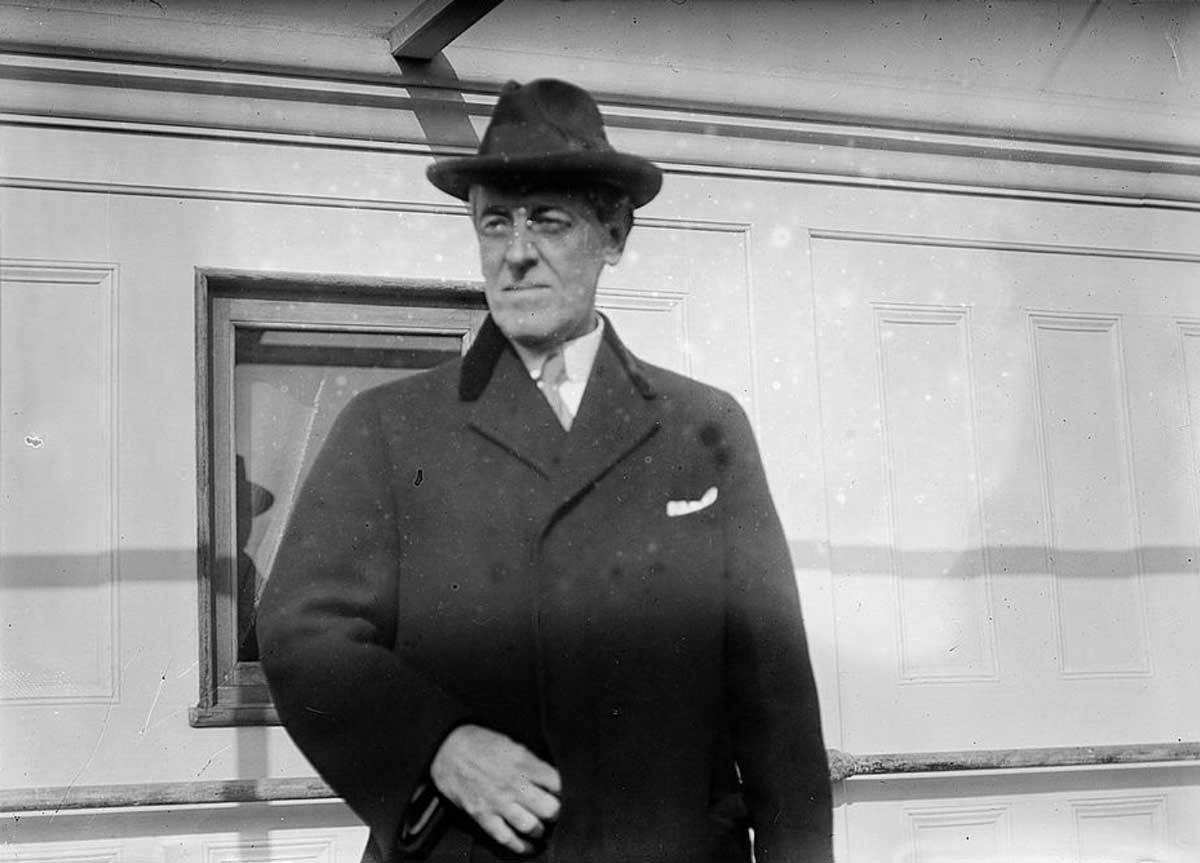
May 10, 1915: President Woodrow Wilson gives a speech at a citizen naturalization ceremony at the old Convention Hall in Philadelphia. It was titled "Americanism and the Foreign Born."
Three days earlier, the RMS Lusitania, a cruise ship of the Cunard Line, was sunk by a U-boat of the Imperial Germany Navy off the southern coast of Ireland. This resulted in the deaths of 1,198 people passengers and crew combined.
The German government insisted that Lusitania was carrying war munitions and ammunition, and that made the sinking justified. Most of the world, however, considered it an unfair act of war.
But Wilson didn't want to take America to war just yet. He said:
You have just taken an oath of allegiance to the United States. Of allegiance to whom? Of allegiance to no one, unless it be God. Certainly, not of allegiance to those who temporarily represent this great Government.
You have taken an oath of allegiance to a great ideal, to a great body of principles, to a great hope of the human race. You have said, "We are going to America," not only to earn a living, not only to seek the things which it was more difficult to obtain where you were born, but to help forward the great enterprises of the human spirit, to let man know that, everywhere in the world, there are men who will cross strange oceans, and go where a speech is spoken which is alien to them, knowing that, whatever the speech, there is but one longing and utterance of the human heart, and that is for liberty and justice.
The speech itself does not mention the Lusitania sinking directly, but rather only makes an oblique reference. Still, given the political tensions at the time, everyone who heard or read the speech knew that President Wilson was indeed referring to the Lusitania disaster and the question of whether the United States would go to war over the sinking. He said:
The example of America must be a special example. The example of America must be the example not merely of peace because it will not fight, but of peace because peace is the healing and elevating influence of the world and strife is not.
There is such a thing as a man being too proud to fight. There is such a thing as a nation being so right that it does not need to convince others by force that it is right.
Former President Theodore Roosevelt, who wanted to go to war with Germany over the Lusitania sinking, wasn't having it: "This is yellow!" Meaning, cowardly.
In 1916, Wilson ran for re-election on the slogan, "He kept us out of war." It was very close, but he won. Five months later, he could no longer ignore Germany's acts of war, and asked Congress for a Declaration of War.
The Convention Hall in which Wilson delivered the speech opened in 1899, and hosted the 1900 Republican Convention. A new Convention Hall opened adjacent in 1930, and it is this building that would be remembered as "Convention Hall" and "the Philadelphia Civic Center": Home to the Democratic Convention in 1936, the Republican Convention in 1940, both parties' Conventions in 1948, a Beatles concert in 1 964, and the NBA's Philadelphia Warriors and 76ers. The entire Civic Center complex was torn down in 2005, to make way for an extension of the University of Pennsylvania Hospital.
*
May 10, 1915 was a Monday. Denis Thatcher, paint company executive and husband of Margaret Thatcher, the 1st female Prime Minister of Britain, was born on this day.
At the time, baseball had 3 major leagues, and these games were played.
* In the only game played that day in the American League, the New York Yankees lost to the Boston Red Sox, 3-1 at the Polo Grounds. George "Rube" Foster outpitched Marty McHale. Tris Speaker went 1-for-4 with an RBI. Babe Ruth, in what turned out to be his 1st full season with the Red Sox, did not play in this game.
In the National League:
* The New York Giants lost to the Boston Braves, 14-9 at Fenway Park in Boston, where the Braves were playing between the closing of the South End Grounds and the opening of Braves Field. George Burns -- not the later comedian -- went 4-for-5 with an RBI for the Giants. But Braves pitcher George "Lefty" Tyler not only went 8 innings for the win, he went 4-for-5 with 4 RBIs at the plate.
* The Brooklyn Robins -- as the Dodgers were known when Wilbert Robinson managed them from 1914 to 1931 -- beat the Philadelphia Phillies, 5-0 at Ebbets Field. William "Wheezer" Dell pitched a 3-hit shutout, making me wonder if his nickname had originally been "Whizzer."
* The Pittsburgh Pirates beat the St. Louis Cardinals, 6-4 at Forbes Field in Pittsburgh.
And the entire Federal League was in action:
* The Brooklyn Tip-Tops lost to the Kansas City Packers, 4-3 at Washington Park in Brooklyn. That ballpark was home to the Brooklyn Dodgers from 1898 to 1912. It was torn down after this season, although part of its outfield wall still stands alongside 3rd Avenue.
* The Newark Peppers lost to the Chicago Whales, 10-5 at Harrison Park, across the Passaic River from Newark, in Harrison, Hudson County, New Jersey. It was on the opposite side of the Pennsylvania Railroad -- now Amtrak, New Jersey Transit and PATH -- tracks from where Red Bull Arena stands today.
* The Pittsburgh Rebels beat the Baltimore Terrapins, 10-4 at Terrapin Park in Baltimore. After the FL's collapse, the International League's Baltimore Orioles moved into Terrapin Park, renaming it Oriole Park, remaining there until it burned down in 1944. They moved into Baltimore Municipal Stadium, which was converted into Memorial Stadium, which became the home of the AL's version of the Orioles.
* And the St. Louis Terriers beat the Buffalo Blues, 5-3 at the International Fair Association Grounds in Buffalo.


No comments:
Post a Comment