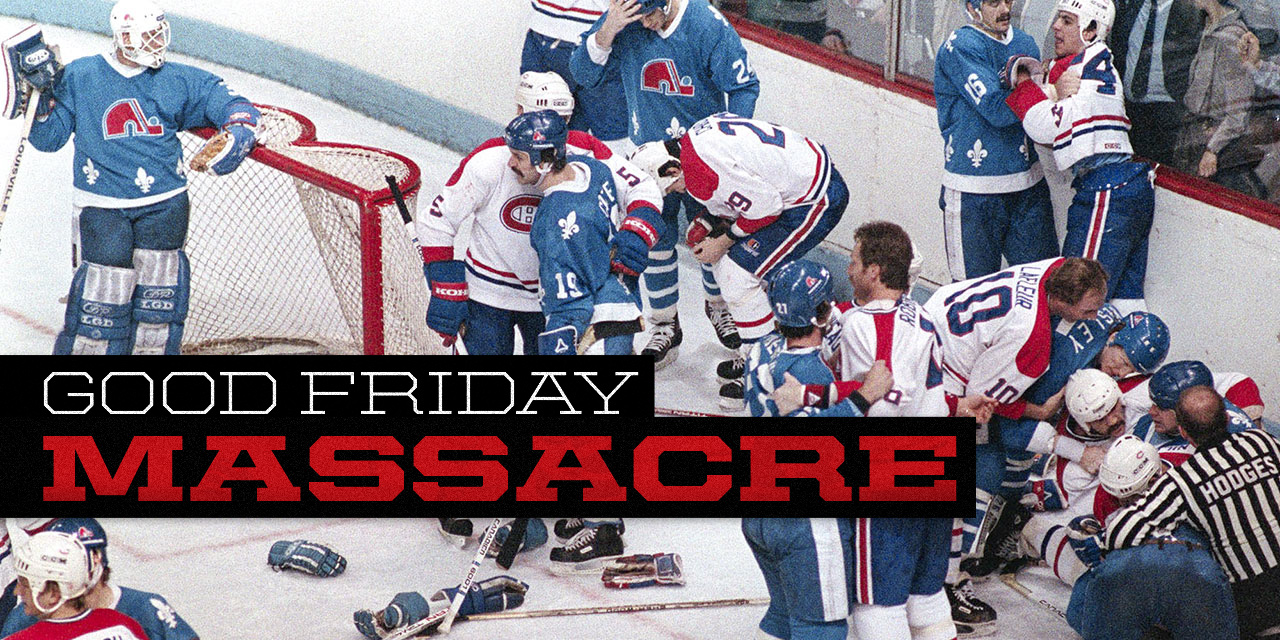
April 20, 1984: One of hockey's nastiest rivalries turns into an epic brawl. It happened 2 days before Easter, on Good Friday, so it became known as the Good Friday Massacre -- or, since it was in Quebec, it got the French name La Bataille du Vendredi Saint.
The Montreal Canadiens are the only team in the National Hockey League older than the League itself: The team was founded in 1909, the NHL in 1917. In 1924, the Montreal Maroons were founded, and, until the Maroons folded in 1938 (despite winning the Stanley Cup in 1926 and 1935), there was a perception in the city that the Maroons were the team of rich, white-collar and Anglophone (English-speaking) Montreal; while the Canadiens were seen as the team of poor, blue-collar Francophones (French-speakers).
This was emphasized by the fact that the Canadiens' corporate name was Le Club de Hockey Canadien. They were often identified as Les Canadiens (pronounced CAN-ah-DIEN), or Les Habitants (OHB-ee-TAHNT), or the Habs. A "Habitant" was an early French settler of Quebec, and it was suggested that the H in the team's "CH" logo stood for "Habitant." It never did, and wasn't even a "CH": It was an "HC," for "Hockey Canadien."
When Maurice Richard, a.k.a. the Rocket, came out of the Noveau-Bordeaux neighborhood on the city's North Side, and became their star in World War II and the postwar era, including the introduction of television to Canada, the perception that he was the best player in the League, and was from Montreal and French, made him the biggest icon that French Canada has ever had -- ahead of longtime Prime Ministers Wilfrid Laurier (1896-1911) and Pierre Trudeau (1968-84, father of current Prime Minister Justin Trudeau).
When opponents -- players, on-ice officials, and NHL President Clarence Campbell, and they all seemed to be Anglophones -- attacked him, either physically or officially, the people of Quebec took it personally, as an attack on them, on their Frenchness, on their otherness. This culminated in the Rocket Richard Riot in 1955.
Time passed, Richard retired, and the era of Quebec nationalism began. The drive to make the Province of Quebec independent of Anglophone Canada has had its ups and downs, and was based not in Montreal, the largest city in the Province (and the 2nd-largest city in the country, behind Toronto), but in the Provincial capital, Quebec City.
In 1972, the World Hockey Association was formed. Rather than compete with the NHL in Montreal, where the Canadiens had won 13 of the last 27 Stanley Cups, the WHA put a team in Quebec City. Despite the fact that "Nordic" suggests Northern Europe, especially Germany and Scandinavia, the team was named the Quebec Nordiques.
Several Canadien stars, including Jean Béliveau and Jacques Plante, had played minor-league hockey at the Colisée de Québec, which became the home of the Nordiques. (To this list would soon be added Guy Lafleur.) So, in the beginning, the Nords took on as many former Habs players as they could, in the hopes of attracting fans and using those players' experience to benefit their younger players. (This never works, as the early New York Mets and the early New Jersey Devils can tell you.) They even made the Rocket their 1st head coach. Richard discovered that he hated coaching, and quit after only 2 games, losing the 1st and winning the 2nd, and never coached another game at any level.
When the NHL absorbed the Nords and 3 other WHA teams in 1979, the Provincial government, led by Premier René Lévesque, was setting up the 1st sovereignty referendum, which failed, 60 percent to 40. But the battle between the all-Francophone Quebec City and the mixed-language, more-commercially-important Montreal got intense.
The Canadiens won the Cup in 1973, and 4 straight from 1976 to 1979. The Nordiques won the WHA title in 1977, and reached the Final in 1975. In 1982, only their 3rd season in the NHL, they beat the Canadiens in the 1st round of the Playoffs, reaching the Conference Finals before losing to the New York Islander dynasty.
Games between the Provincial rivals were rough, both on the ice and in the stands, and it began to resemble hooligan rucks in European soccer. Game 4 of that '82 series, won by the Canadiens, featured a combined 251 penalty minutes, including 159 from a single fight in the 1st period.
They faced each other again in the 1984 Adams Division Final. They split the 1st 2 games in Quebec City, the Nords winning Game 1, 4-2; and the Habs winning Game 2, 4-1. They split the next 2 in Montreal, the Habs winning Game 3, 2-1; and the Nords winning Game 4, 4-3 on an overtime goal by Bob Berglund.
Back in Quebec in Game 5, the Canadiens won, 4-0. So, in order to win the series, the Nordiques had to win Game 6 at the Forum and Game 7 at the Colisée.
Game 6 was played on April 20, Good Friday. A big part of Quebec nationalism had been tied up in the Roman Catholic Church, so strong in French-speaking cultures, but some of this nationalism resisted ties to the Church, just as modern France has embraced the separation of church and state, which is written into the Constitution of Canada.
So calling the event "the Good Friday Massacre" or its French-language equivalent has little to do with religion: While previous French-Canadians saw attacks on themselves, their Province, and the Canadiens, especially coming from the national Parliament in Ottawa or the big businesses and banks of Toronto, as attacks on their Frenchness and their Catholicism, this was more Quebec nationalism vs. Canadian nationalism; Lévesque and his Parti Québécois vs. Trudeau and his Liberal Party; establishment team vs. insurgent team, or team for the establishment vs. team for insurgents.
The game practically began with a fight: Mike McPhee of the Habs and Wilf Paiement of the Nords were called for fighting just 23 seconds into the game. Slovakian star Peter Šťastný scored about 5 minutes later, in the 1st period, to make it 1-0 Nordiques. That goal came on a 5-on-3 power play, after Craig Ludwig had been called for tripping and Jean Hamel for an illegal stick. The Nords were called for 6 penalties in the period, the Habs 5.
There were no goals in the 2nd period, but loads of rough stuff. Ludwig and Šťastný's brother Anton were disciplined for fighting with each other. Then, at the end of the period, with the score still 1-0 Quebec, it all went off. Dale Hunter, one of the dirtiest players in the game's modern era -- his brother Mark was on the Canadiens -- flattened the Canadiens' Guy Carbonneau from behind, and the punches began to fly.
And they wouldn't stop. This included a fight between goaltenders, which always catches attention. But this one may have been unique in hockey history: It was the backup goalies who fought, Richard Sévigny of Montreal and Clint Malarchuk of Quebec. It wasn't just one big fight, but several individual fights, including another of the dirtiest players of that era, Chris Nilan of the Canadiens, taking on whoever he could grab.
Hamel and the Nords' Louis Sleigher fought. As referee Bruce Hood separated them, Sleigher reached out with a left hook, and sucker-punched Hamel in the eye. Hamel went down like a ton of bricks, unconscious, and never played another regular-season game: He was out for the rest of the Playoffs, and reinjured the eye during the next season's preseason exhibitions, and had to quit.
Hood spent the intermission sorting out the penalties. When the teams came back onto the ice for the 3rd period, longtime Forum public address announcer Claude Mouton began reading the penalties, in French and in English -- in other words, taking twice as long as would be expected. Defenseman Larry Robinson told the media that some of the dismissed players felt they "might as well take some guys with me," and Carbonneau thought, "They had nothing to lose." And so, they started a new round of fighting. This one even included the Hunter brothers fighting each other.
A funny thing happened on the way to this game becoming one of the greatest disgraces in hockey history: Not only were there no more penalties in the game, but it turned into a show by the Canadiens. Michel Goulet scored on the power play early in the 3rd period, but it was all Montreal after that. The Habs got 2 goals from Hall-of-Famer Steve Shutt to tie it, and then from Rick Green, John Chabot and Carbonneau, before Paiment got a consolation goal for the Nordiques. Final score: Canadiens 5, Nordiques 3.
The Canadiens advanced to the Prince of Wales Conference Finals, but the remaining players from the 1976-79 dynasty could not overcome the Islanders, who had won their own 4 straight Cups and were undergoing their "Drive For Five." The Habs gave it a good shot, but the Isles won in 6. In the Clarence Campbell Conference Finals, the Edmonton Oilers swept the Minnesota North Stars in 4 straight. And, in a 5-game victory in the Stanley Cup Finals, the Oilers' ended the Islanders' dynasty and began their own.
The Nordiques never reached the Stanley Cup Finals, and for the 1995-96 season, they were moved to Denver to become the Colorado Avalanche -- and only then did they trade for Quebec City native Patrick Roy, the great goaltender who had backstopped 2 Canadiens Cup wins, and then win the Cup.
The Habs haven't won the Cup since 1993 (it's called the Curse of Saint Patrick, although Roy is no saint), and Quebec City has a new arena and is actively trying to get an expansion team or a moved team. This rivalry may be reborn in the next few years.
*
April 20, 1984 was, as previously stated, a Friday. The Patrick Division Final had already been decided in the Islanders' favor. Also on this day, in the Norris Division Final, Game 6, the St. Louis Blues beat the Minnesota North Stars, 4-0 at the St. Louis Arena, but the Stars won Game 7. And in the Smythe Division Final, Game 6, the Calgary Flames beat the Edmonton Oilers, 5-4 at the Saddledome in Calgary, on an overtime goal by Lanny McDonald, but the Oilers won Game 7.
There were 3 games played in the NBA that night:
* The New Jersey Nets beat the Philadelphia 76ers 116-102 at The Spectrum in Philadelphia.
* The Los Angeles Lakers beat the Kansas City Kings, 109-102 at The Forum outside Los Angeles in Inglewood, California.
* And the Portland Trail Blazers beat the Phoenix Suns, 122-116 at the Veterans Memorial Coliseum in Portland.
These games were played in Major League Baseball:
* The New York Yankees beat the Texas Rangers, 4-1 at Yankee Stadium. Ron Guidry outpitched Dave Stewart. Don Mattingly went 3-for-4, and Ken Griffey Sr. had 2 RBIs.
* The New York Mets beat the Philadelphia Phillies, 3-1 at Veterans Stadium in Philadelphia. Steve Carlton started for the Phils, but he was 39 years old, and his start was no longer a sure "Win Day." Tim Leary, the opposing starter, hit a home run off him.
With 2 outs in the top of the 10th, Phils relief pitcher Al Holland gave up a walk to Jose Oquendo, a single to Keith Hernandez, and an RBI single to George Foster, then, with Darryl Strawberry at bat, balked Hernandez home.
* The Boston Red Sox beat the Oakland Athletics, 3-1 at Fenway Park in Boston.
* The Baltimore Orioles beat the Minnesota Twins, 4-2 at Memorial Stadium in Baltimore. The O's won it in the bottom of the 10th thanks to 2 future Hall-of-Famers: Cal Ripken hit a single, and Eddie Murray hit a home run.
* The Atlanta Braves beat the Houston Astros, 8-7 at Atlanta-Fulton County Stadium.
* The California Angels beat the Toronto Blue Jays, 10-6 at Exhibition Stadium in Toronto. Reggie Jackson went 0-for-6 with 3 strikeouts, but he did also have a walk. Rod Carew went 2-for-4 with an RBI. The Jays' bullpen collapsed in the top of the 13th, thanks to 3 doubles, a single, a sacrifice fly and a wild pitch.
* The Kansas City Royals beat the Cleveland Indians, 6-4 at Cleveland Municipal Stadium.
* The Detroit Tigers beat the Chicago White Sox, 3-2 at Tiger Stadium in Detroit.
* The Chicago Cubs beat the Pittsburgh Pirates, 5-4 at Wrigley Field in Chicago. Mel Hall singled home the winning run in the bottom of the 10th inning.
* The Seattle Mariners beat the Milwaukee Brewers, 5-0 at Milwaukee County Stadium. Jim Beattie pitched a 4-hit shutout.
* The Los Angeles Dodgers beat the San Diego Padres, 8-2 at Dodger Stadium in Los Angeles.
* The San Francisco Giants beat the Cincinnati Reds, 6-4 at Candlestick Park in San Francisco.
* And the Montreal Expos were supposed to play the St. Louis Cardinals at Busch Memorial Stadium in St. Louis, but the game was rained out. It was made up as part of a doubleheader the next day. The Expos won both games, 6-3 and 4-0. The 2nd game was shortened to 5 innings by rain. David Palmer of th Expos hadn't allowed a baserunner, but this was not an official perfect game.


No comments:
Post a Comment