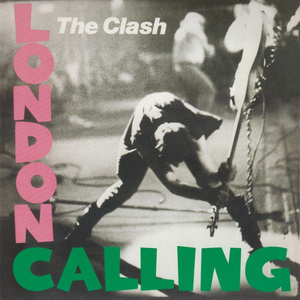
December 14, 1979: The Clash release their album London Calling. It is considered the leading work in British rock's transition from punk rock to New Wave, and one of the greatest albums in rock and roll history.
Their fans called them "the only band that matters": Lead singer and rhythm guitarist Joe Strummer, lead guitarist Mick Jones (not to be confused with the man of the same stage name who was lead guitarist for the American band Foreigner), bass guitarist Paul Simonon, and drummer Nicky "Topper" Headon.

Left to right: Mick Jones, Paul Simonon,
Topper Headon and Joe Strummer
Mick Gallagher of The Blockheads was added for keyboards. Also playing on the album were The Irish Horns: Ray Bevis on tenor saxophone, John Earle on tenor and baritone saxophone, Chris Gower on Trombone, and Dick Hanson on trumpet and flugelhorn. The album was produced by Guy Stevens.
The cover showed Simonon, although a righthanded player, slamming his bass to the floor lefthanded. The word "LONDON" in vertical all-pink letters, and "CALLING" in horizontal all-green letters, was patterned after Elvis Presley's 1st album in 1956.
The Irish Horns were brought in because the bandmembers liked New Orleans-style rhythm & blues, and wanted to experiment with combining that style with their own. They also brought Caribbean influences in, reggae and ska.
They began recording in August 1979, 3 months after British voters elected the most conservative government the United Kingdom had seen since World War I. The new Prime Minister, Margaret Thatcher, had promised to tackle the longstanding problems of a stagnant economy -- which had been in place before the Labour Party last took over in 1974, so the last Conservative Party government wasn't blameless -- but the measures she took clobbered the labor unions, and made her, depending on whether you had money or not, either the most beloved or the most despised person in the country.
The Clash were no longer kids: Strummer was 27 years old, the other members 24. But they were still able to reach England's young people with songs about unemployment, urban decay, drugs, and racial strife.
The title track was about fear of nuclear war, or some other nuclear disaster, written in the wake of the Three Mile Island near-disaster in Pennsylvania the previous March. The song seemed to have done some direct good: The line is, "London is drowning, and I live by the river!" In fact, the Thames Barrier, designed to prevent flooding of Central London and the East End, had been planned for some time. It was completed in 1982.
"Spanish Bombs" is also about war, specifically the Spanish Civil War of the late 1930s, and the memorials to the artists and musicians who commemorated it. "Lost in the Supermarket" was about runaway consumerism, at a time when most people the bandmembers had grown up with couldn't afford the rising prices. "Clampdown" was about Thatcher's crackdown on factory workers and their unions.
"Rudie Can't Fail" was sympathetic toward black Jamaican immigrants in Britain. So was "The Guns of Brixton," which predated the riots in that South London area in 1981 and 1985. The title of the album's last song, "Train in Vain (Stand By Me)" was confusing: It had nothing to do with the Ben E. King doo-wop standard "Stand By Me"; and, like many of Bob Dylan's songs, didn't include the title in the lyrics, as the words "train in vain" do not appear. Mick Jones said, "The track was like a train rhythm, and there was, once again, that feeling of being lost." This song became the only one on the album to be a hit in on the American charts.
The album sold over 5 million copies, 1 million of them in America. It is regarded as the band's greatest work, and perennially ranks in the Top 20 of all-time greatest albums lists.
*
December 14, 1979 was a Friday. Elsewhere in England, soccer star Michael Owen was born.
Baseball was out of season. Football was in midweek. There were 8 games played in the NBA:
* The New Jersey Nets beat the New York Knicks, 118-105 at the Rutgers Athletic Center (now the Jersey Mike's Arena) in Piscataway, New Jersey.
* The Atlanta Hawks beat the Philadelphia 76ers, 103-98 at The Spectrum in Philadelphia.
* The Boston Celtics beat the Milwaukee Bucks, 97-94 at the Boston Garden.
* The Indiana Pacers beat the Washington Bullets, 111-109 at the Market Square Arena in Indianapolis.
* The Kansas City Kings beat the Utah Jazz, 103-87 at the Kemper Arena (now the Hy-Vee Arena) in Kansas City.
* The San Diego Clippers beat the Denver Nuggets, 112-108 at the San Diego Sports Arena (now the Pechanga Arena). Lloyd Free, later to change his name to World B. Free, led all scorers on the night with 37 points.
* The Los Angeles Lakers beat the Detroit Pistons, 138-122 at The Forum outside Los Angeles in Inglewood, California.
* And the Seattle SuperSonics beat the Houston Rockets, 109-101 at the Kingdome in Seattle.
And there were 3 games in the NHL:
* The Atlanta Flames beat the Minnesota North Stars, 3-2 at The Omni in Atlanta.
* The Edmonton Oilers beat the Montreal Canadiens, 5-3 at the Northlands Coliseum in Edmonton.
* And the Vancouver Canucks beat the Colorado Rockies, 5-3 at the Pacific Coliseum in Vancouver.


No comments:
Post a Comment