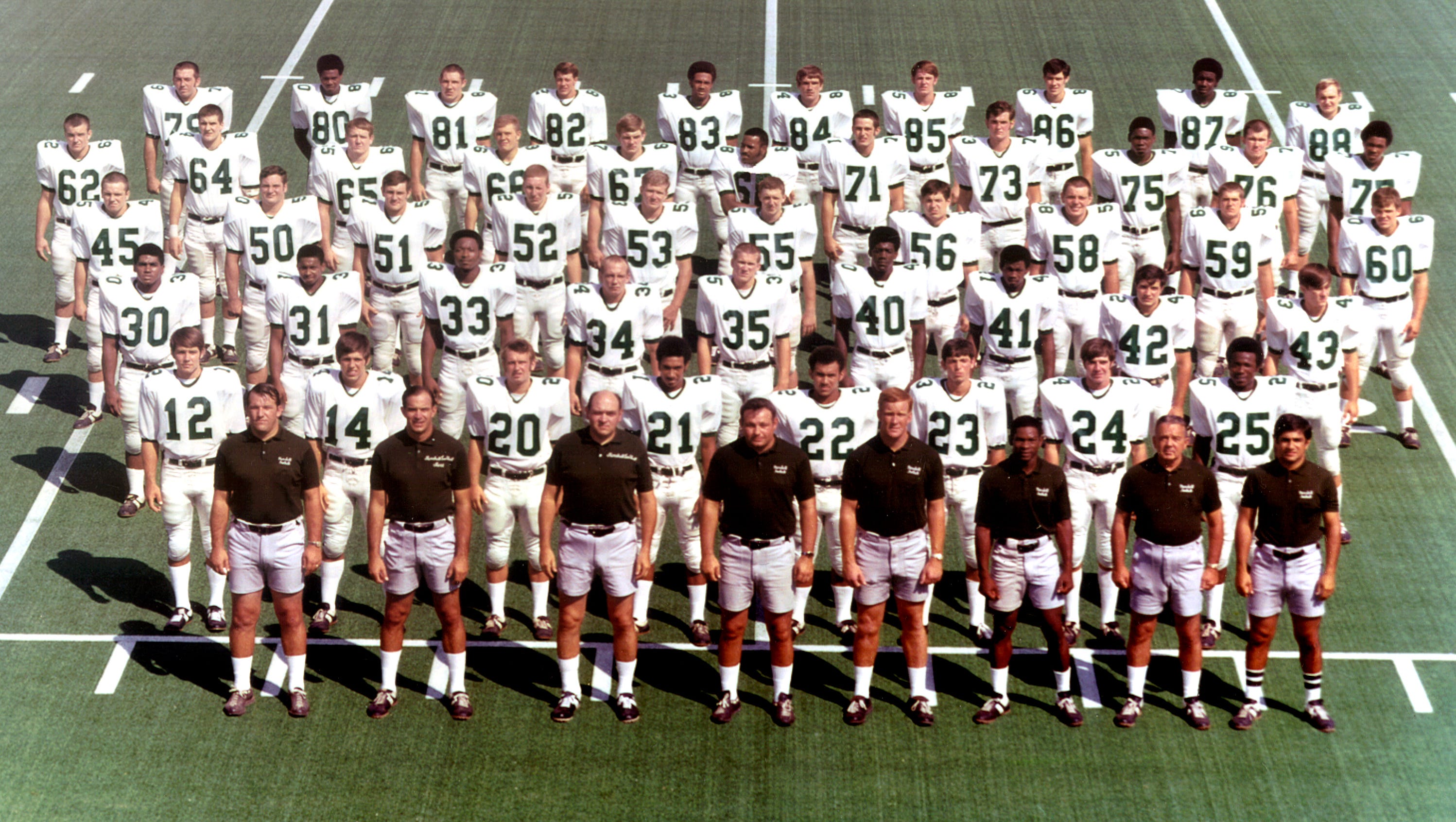
November 14, 1970: Southern Airways Flight 932, a DC-9, crashes outside Huntington, West Virginia, near the campus of Marshall University. All 75 people on board are killed, including 37 players on the Marshall football team, and 8 members of the coaching staff, including head coach Rick Tolley. At 30 years old, he wasn't much older than his players.
It had been just 43 days since the Wichita State University football team was nearly wiped out by a plane crash, with 31 dead. The Marshall crash remains the worst sports-related tragedy in American history.
It had been just 43 days since the Wichita State University football team was nearly wiped out by a plane crash, with 31 dead. The Marshall crash remains the worst sports-related tragedy in American history.
Thankfully, we have been spared the kind of disasters seen in international soccer, such as the one that would happen a few weeks later, on January 2, 1971, at Ibrox Stadium in Glasgow, Scotland: 66 people died in a crush of fans between host Rangers and their arch-rivals, Celtic.
Marshall University was founded in 1837, and named for John Marshall, who had recently died after a long tenure as Chief Justice of the United States. It is located in Huntington, West Virginia, on a bank of the Ohio River, near a 3-way State border with Chesapeake, Ohio and Ashland, Kentucky. They began playing football in 1895, 4 years after West Virginia University, in Morgantown at the other end of the State.
The Thundering Herd were returning from Greenville, North Carolina, where they'd lost 17-14 to East Carolina University. Their one remaining game, away to Ohio University (not Ohio State), was canceled, and they finished 3-6. The Ohio Bobcats were usually considered their main rivals, and "the Battle for the Bell" was always the last game of the season -- until now.
The Herd had beaten Morehead State of Morehead, Kentucky; Xavier University of Cincinnati; and Kent State near Cleveland, a school which had its own tragedy the preceding May 4, the shooting of 13 students, 4 of them fatally, by Ohio National Guardsmen during a protest against the Vietnam War.
Marshall had lost to the University of Toledo, Miami University of Ohio, the University of Louisville, Western Michigan, Bowling Green of Ohio and, mere hours before their deaths, East Carolina.
*
Jack Lengyel, 36, had been the head coach at the College of Wooster outside Cleveland for the preceding 5 seasons. He was hired to rebuild the Marshall team. There were 9 players on the 1970 team who did not board the ill-fated flight. They would form the core of the team that Marshall attempted to field for 1971.
The NCAA granted waivers for "fifth-year seniors" who had not yet gradated, and for freshmen, then prohibited to play varsity sports, a restriction that the NCAA would universally lift the next year. The team was filled out with 35 walk-ons. One was Blake Smith, who had never even attended a football game. He became the placekicker.
President Richard Nixon, a football fan, wrote the team a letter, including these words: "Friends across the land will be rooting for you, but whatever the season brings, you have already won your greatest victory by putting the 1971 varsity on the field." Lengyel read the letter to the team at the start of the 1st day of practice.
September 18, 1971: Marshall played its 1st game since the crash. They traveled to Morehead State, and lost, 29-6 at Jayne Stadium. Although this game was a 4-touchdown loss, the Morehead fans gave the Herd's one touchdown a standing ovation.
September 25, 1971: Marshall won. They hosted Xavier University of Cincinnati at Fairfield Stadium in Huntington, and won, 15-13.
They next lost to Miami in Oxford, Northern Illinois in DeKalb, the University of Dayton at home, and Western Michigan in Kalamazoo. But on October 30, they won again, 12-10 at home to Bowling Green. They then traveled to Kent and lost to Kent State, lost at home to Toledo, and lost at home to Ohio, 30-0.
They went 2-8, never scored more than 18 points in any game, gave up 66 points to Miami and 43 to Toledo, and were shut out in 5 of their last 6 games. But, in spite of losing nearly everybody from the season before, and not to graduation, they ended up winning only one fewer game than they had in 1970.
In 2006, the film We Are Marshall was released, starring Matthew McConaughey as Lengyel, who is still alive, at age 87.
Lengyel continued to coach the team until 1974. Marshall continued to struggle, but began to turn it around in the mid-1980s, making the Playoffs in Division I-AA (now known as the Football Championship Subdivision, of FCS).
They advanced to the Championship Game in 1987, but lost 43-42 to Northeast Louisiana. They made the Quarterfinals in 1988; built a new stadium in 1990, the 38,227-seat Joan C. Edwards Stadium, with the playing surface named James F. Edwards Field for her husband, also a major donor to the school; got back to the Final in 1991, but lost 25-17 to Youngstown State of Ohio; and finally took home the prize in 1992, winning a rematch with Youngstown, 31-28.
They returned to the Final in 1993, but Youngstown took the rubber match, 17-5. Marshall reached the Semifinal in 1994, and the Final again in 1995, losing 22-20 to Montana. They beat Montana in a Final rematch in 1996, 49-29, for their 2nd National Championship.
Formerly members of the Mid-American Conference and the Southern Conference, in 2005 they joined Conference USA. They've won Conference Championships in 1925, 1928, 1931, 1937, 1988, 1994, 1996, 1997, 1998, 1999, 2000, 2002 and 2014; and Division titles short of the Conference title in 2001 and 2013.
Due to changing conference affiliations, their rivalry with Ohio isn't played every year, although it was played last year, and were scheduled to play this year before the COVID-19 epidemic canceled all non-conference games. They will next play in 2025. Ohio leads "The Battle for the Bell," 33-21-6.
After playing each other in 1911, 1914, 1915 and 1923, the 2 biggest football-playing schools in the Mountaineer State, WVU and Marshall, didn't play each other again until 1997, and then not again until 2006 -- again, mainly due to conference affiliation. They then played "The Friends of Coal Bowl" every year from 2006 until 2012. They've played each other 12 times, and West Virginia have won them all.
Marshall's other major rivalry, if it can be called a "rivalry" at all, is with East Carolina, the team their 1970 team was returning from when it perished. They didn't play each other again until 1978, then not again until 2001. But they played every year from 2005 to 2013, before conference affiliations split them up. East Carolina leads the rivalry, 10-5. A moment of silence is held before every game between the teams.
On November 14, 2020, the 50th Anniversary of the crash, Marshall beat Middle Tennessee State, 42-14 at Joan Edwards Stadium, making them 8-0 on the season. But they lost their last 3 games: To Rice, to Alabama-Birmingham in the Conference USA Championship Game, and to the University of Buffalo in the Camellia Bowl in Montgomery, Alabama on Christmas Day, finishing 7-3 and as C-USA East Division Champions.
*
November 14, 1970 was a Saturday. Some other college football games of note on the day:
* Number 1 Notre Dame beat Georgia Tech, 10-7 at Notre Dame Stadium in South Bend, Indiana.
* Number 2 Texas beat Texas Christian (TCU), 58-0 at Amon G. Carter Stadium in Fort Worth. This big road win, combined with the Fighting Irish' struggle at home, pushed the Longhorns to Number 1.
* Number 3 Ohio State beat Purdue, 10-7 at Ross-Ade Stadium in West Lafayette, Indiana.
* Number 4 Nebraska beat Kansas State, 51-13 at Memorial Stadium in Lincoln, Nebraska.
* Number 5 Michigan beat Iowa, 55-0 at Michigan Stadium in Ann Arbor.
* Rutgers beat Holy Cross, 37-7 at Rutgers Stadium in Piscataway, New Jersey.
* And Princeton lost to Yale, 27-22 at the Yale Bowl in New Haven, Connecticut.
In high school football, my alma mater, East Brunswick, beat New Brunswick, 18-10 at what would be named Jay Doyle Field in East Brunswick. A win over Sayreville the next week clinched a Conference Championship.
There were 6 games played in the NBA that day:
* The New York Knicks beat the Philadelphia 76ers, 126-94 at Madison Square Garden.
* The Baltimore Bullets beat the Boston Celtics, 122-101 at the Baltimore Civic Center (now the CFG Bank Arena).
* The Milwaukee Bucks beat the expansion Buffalo Braves, 116-107 at the Buffalo Memorial Auditorium.
* The Chicago Bulls beat the Atlanta Hawks, 120-116 at the Alexander Memorial Coliseum in Atlanta. Bob Love of the Bulls scored 39 points to lead all scorers on the day.
* The San Diego Rockets beat the Detroit Pistons, 112-101 at the San Diego Sports Arena (now the Pechanga Arena).
* And the other 2 expansion teams played each other: The Portland Trail Blazers beat the Cleveland Cavaliers, 126-116 at the Veterans Memorial Coliseum in Portland, Oregon.
There were 4 games played in the ABA:
* The Virginia Squires beat the Miami Floridians, 119-97 at The Scope in Norfolk.
* The Indiana Pacers beat the Carolina Cougars, 128-119 at the Greensboro Coliseum.
* The Kentucky Colonels beat the Texas Chaparrals, 149-132 at Freedom Hall in Louisville Dan Issel had 37 points and 24 rebounds.
* And the Utah Stars beat the Pittsburgh Condors, 106-102 at the Salt Palace in Salt Lake City.
And there were 5 games played in the NHL:
* The New York Rangers lost to the Chicago Black Hawks, 2-1 at the Chicago Stadium.
* The Pittsburgh Penguins beat the California Golden Seals, 6-1 at the Civic Arena in Pittsburgh.
* The Toronto Maple Leafs beat the Boston Bruins, 3-2 at Maple Leaf Gardens in Toronto.
* The Montreal Canadiens and the St. Louis Blues played to a tie, 1-1 at the St. Louis Arena.
* The expansion Vancouver Canucks and the Minnesota North Stars played to a tie, 3-3 at the Metropolitan Sports Center in the Minneapolis suburb of Bloomington, Minnesota.
* The Detroit Red Wings, the Los Angeles Kings, the Philadelphia Flyers, and the other expansion team, the Buffalo Sabres, were not scheduled.


No comments:
Post a Comment