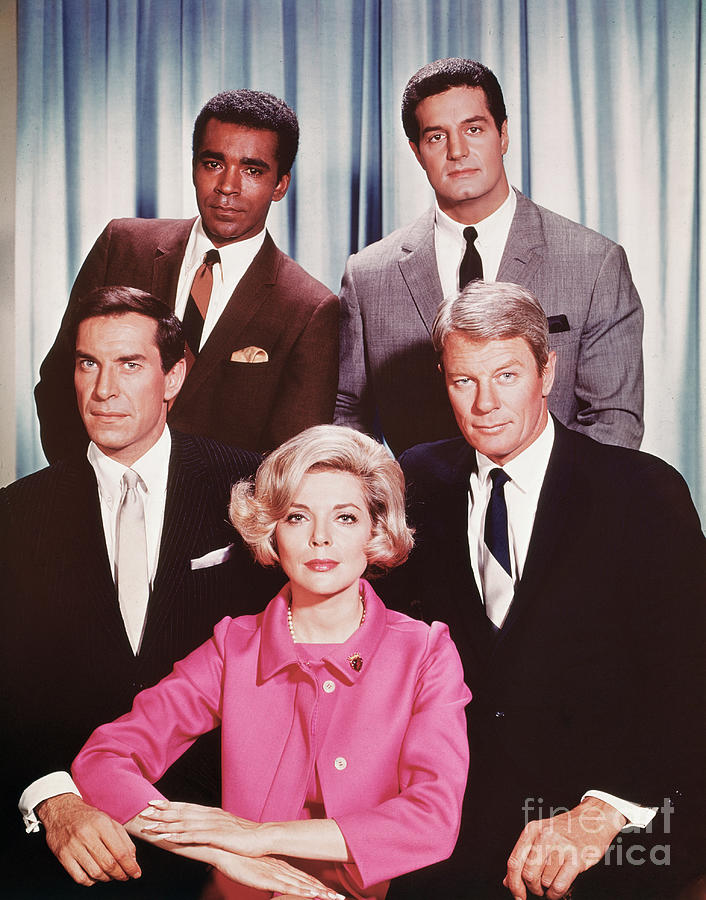
Top: Greg Morris and Peter Lupus.
Bottom: Martin Landau, Barbara Bain and Peter Graves.
September 17, 1966: Mission: Impossible premieres on CBS, part of American show business' attempts to copy Britain's James Bond franchise, attempts which also included the TV series The Man from U.N.C.L.E., and spoofs like the TV series Get Smart and Dean Martin's Matt Helm films.
With Argentine composer Lalo Schifrin giving it one of the great TV theme songs of all time, the premise was shown at the beginning of each episode. Before I get to that, I should point out that, originally, the leader of the Impossible Missions Force, or IMF, was Dan Briggs. But his portrayer, Steven Hill, was an Orthodox Jew, and the production schedule had to be worked around the fact that he could not work from 4:00 PM on Friday until after dark on Saturday. So, for the 2nd season, he was replaced by Peter Graves, brother of Gunsmoke star James Arness (the family name was Aurness), as Jim Phelps.
Phelps would find a hidden tape recorder, along with an envelope that contained photos and information necessary for the mission. The voice, never identified by either name or position, but played by Robert C. "Bob" Johnson, began, "Good morning, Mr. Phelps," and described the people in the photos. "Your mission, Jim, should you choose to accept it, is to... " Phelps was never shown declining a mission, but there were occasions where the voice said, "Your mission, Jim, which I one I feel that you must accept... "
The tape would end with, "As always, should you, or any of your IM Force be caught or killed, the Secretary will disavow any knowledge of your actions. This tape will self-destruct in five seconds. Good luck, Jim." Phelps would then stop the tape, and it would start smoking. The expression "self-destruct" was coined by the show's writers. In a 1969 episode, Star Trek would use the term "auto-destruct," perhaps to avoid being seen as copying Mission: Impossible, but "self-destruct" became the preferred term in the genre of crime and spy fiction.
It was never explained what "the Secretary" was Secretary of, but, since the missions were usually on foreign soil, it can be safely presumed that it was the Secretary of State of the United States -- in real life at the time, Dean Rusk (1966-69) or William P. Rogers (1969-73). During the course of the show, no disavowal was ever necessary.
Next came "the dossier scene," in which Phelps takes an oversized, leather-bound folder out of a locked drawer, with dossiers of the available IMF agents. He would make his selections, and toss them on a coffee table. It was considered an honor for a CBS executive or staffer to have their picture in a rejected dossier.
The agents he usually suggested were Rollin Hand (Martin Landau), an actor with disguise, magic and escape skills; Cinnamon Carter (Barbara Bain, then Landau's real-life wife), a model and actress; Barney Collier (Greg Morris), an electronics genius, then considered a big step forward for a black actor; and Willy Armitage (Peter Lupus), a world-record weightlifter whose strength was a significant asset on missions. There would sometimes be a "guest agent," often a doctor, particularly a specialist in a condition known to afflict the target.
Series creator Bruce Geller wanted to keep the focus on the team's capers, and so the agents were rarely if ever seen in their "real" lives. We never really found out anything about them, such as where they were from, or how they met Phelps and got hired.
The action would commence, usually in a far-off country, often one made-up to avoid actual Cold War storylines (there were episodes set in the Soviet Union, but never in China or Vietnam), and it would seem to be an "impossible" mission, but Phelps would know exactly what each agent could do to make it possible.
And, with determination but rarely with losing control of their emotions, they would pull it off, and the episode would end with them driving off, not waiting around to see the effects. The "target" would often be seen getting arrested, but never tried or executed. Or, if the "target" was someone to help, would be seen to have been helped. (Dragnet, the police series revived at around the same time, would do follow-ups as a postscript, but M:I did not.)
There would be no return from a final commercial, to show them discussing their exploits in a bar, or in Phelps' apartment, or anywhere else. Rather, they were just shown getting away from the mission, observing what would later be NCIS Rule Number 11: "When the job is done, walk away."
Occasionally, there would be an "off-the-books" mission: One of the agents would be captured, and the others would have to rescue them; or one of the agents would make it personal, as in when an occasional longtime friend of Phelps was killed, or when Barney's brother was.
Morris and Lupus were the only actors to stay with the series through its entire run, although Graves stayed for the length once he took over from Hill. Landau and Bain left after 3 seasons, despite Bain winning the Emmy Award for Best Actress all 3 seasons. They later co-starred on the science fiction series Space: 1999, but, sadly, later divorced.
Replacing Landau's Rollin Hand as magician and master of disguise was Leonard Nimoy, available since his role as Spock had been canceled with Star Trek. He played "The Great Paris." No other name was ever given for the character, and it's not even clear whether Paris is part of his real name.
Ironically, Landau had been Paramount's original choice to play Spock, but series creator Gene Roddenberry really wanted Nimoy, who had been a "character actor" to that point. In hindsight, Hand did seem to be a character with his emotions well under control, like Spock, and Nimoy seemed to play Paris the same way. While Paris didn't have the same personal connection to Phelps that Spock had with Captain Kirk, he was every bit as competent as Spock -- and Hand. After publishing an autobiography titled I Am Not Spock, Nimoy joked that he might have to write a sequel, titled I Am Not Paris, Either.
Bain was not officially replaced at first: There had to be a woman in the cast, but in Season 4, it was a series of guest stars, and only one was used twice: Lee Meriwether as Tracey (no last name mentioned). In Season 5, the show brought in Lesley Ann Warren as Dana Lambert, an actress like Cinnamon Carter.
In Seasons 6 and 7, Lynda Day George replaced her, as Lisa Casey, whose career as a cosmetologist made her a mistress of disguise, making her, effectively, a replacement for Bain, Warren, Landau and Nimoy, who had left after Season 5. George had to step aside during Season 7, due to her pregnancy, but she must have liked the role, since she named her daughter Casey. Her place was taken by Barbara Anderson, formerly of Ironside (and Lenore Karidian on Star Trek), as Mimi Davis.
In Season 5, Sam Elliott came in to play Dr. Douglas Robert, a replacement for Willy. Most episodes that season had Lupus or Elliott, but not both, as the producers wanted to phase Willy out. But fans erupted in anger, deluging the network with angry mail, and so Lupus was kept.
Another change for Season 5, 1970-71, was the switch to more domestic missions, since taking all those people and all that equipment to foreign countries was expensive. It also helped eliminate some of the Cold War subtext, as missions tended to go after organized crime -- or, as Knight Rider would later put it, "a crusade to champion the cause of the innocent, the helpless, the powerless, in a world of criminals who operate above the law," making the IMF less a CIA-type agency, and more like the FBI. To avoid real-life trouble for the show, the voice on the tape would always use the term "the syndicate," never "Mafia" or "mob"; and the subject of pursuit would usually be an ethnicity other than Italian.
In 1973, after 7 seasons, the show was canceled -- not by CBS, but by the show's studio, Paramount Pictures, because it could make more money syndicating the reruns, as it was doing with Star Trek, and would later also do with The Odd Couple.
In 1983, NBC premiered The A-Team, starring George Peppard and Laurence Tureaud, a.k.a. Mr. T. Like the IMF, the A-Team was a group of people, each with a particular skill, working together to pull off the most difficult of jobs.
Unlike the IMF, they already knew each other from the start. Also unlike the IMF, they were not only not sanctioned by the federal government, they were on the right from it, as they were all prisoners who escaped from a U.S. Army stockade near the end of the Vietnam War. It was basically Mission: Impossible meets The Fugitive.
Like the later CBS series(es) The Equalizer, they were the group that private citizens could turn to when no one else could help -- as the show's opening said, "If you can find them." That was another difference between the A-Team and the IMF: The A-Team was willing to help the public, while the IMF remained secret. The A-Team was an M:I tailored for the Reagan Years: Long on noise, explosions and braggadocio; with little understanding of, or caring for, the concept of subtlety, which was often critical on IMF missions. It ran for 4 seasons.
In 1988, inspired by the success of Star Trek: The Next Generation, also a Paramount series, ABC brought Mission: Impossible back, with Graves as the only returning regular. But his new team did include Phil Morris, Greg's son, as Grant Collier, Barney's son and fellow tech whiz. And Bob Johnson returned as the voice giving the team their assignments, this time on a disc (which, of course, self-destructed 5 seconds after the end). Greg Morris returned for a few episodes as Barney, and Lynda Day George came back for 1 episode as Lisa Casey, but none of the other regulars did, or were even mentioned.
The premise was that, after his protégé and successor as leader of the IMF was killed, Phelps was called out of retirement, and asked to form a new IMF team and track down the assassin. In addition, his new team had Grant Collier; Nicholas Black (Thaao Penglis), a disguise expert and actor, the Hand/Paris equivalent; Max Harte (Antony Hamilton), a strongman, the Armitage equivalent; and Casey Randall (Terry Markwell), a model-turned-agent, the Carter/Tracey/Lisa Casey equivalent.
The continuation series lasted 2 seasons, but kept getting moved around ABC's schedule, so it never got any footing with viewers. But it had one interesting distinction: Randall was captured and killed during the course of a mission. The episode ends with a shot of her dossier, and a red graphic falls over it, reading, "DISAVOWED." She was replaced by Shannon Reed (Jane Badler), a former Secret Service Agent.
The series filmed in Australia due to tax breaks, which explained the casting of Australian actors Penglis, Hamilton and Badler.
In 1996, Tom Cruise began making a series of Mission: Impossible movies. These films are despised by fans of the original series, since the 1st of them depicted Jim Phelps (played there by Jon Voight) as a traitor to America. Cruise has now made 6 of these films, with 2 more set to be released in 2023 and 2024, respectively.
The 1st of these films was the last movie ever seen by Greg Morris, who died of cancer not long thereafter. He walked out early, telling the press, "It's an abomination."
Bruce Geller, the original series' creator, died in a plane crash in 1978, only 47 years old. Antony Hamilton died of AIDS in 1995. Greg Morris died in 1996, Peter Graves in 2010, Leonard Nimoy in 2015, Steven Hill in 2016, Martin Landau in 2017. As of September 17, 2022, Barbara Bain, Peter Lupus, Sam Elliott, Lee Meriwether, Lesley Ann Warren, Lynda Day George, Barbara Anderson, and theme composer Lalo Schifrin are still alive. (UPDATE: Schifrin died in 2025.)
Because Graves and James Arness, who played Marshal Matt Dillon on Gunsmoke, were brothers, I'd like to believe that Phelps is Dillon's great-grandson. It would make sense, since Dillon and Phelps were both government agents. But that relationship is just my theory, and not canon. Although, since both series were on CBS, theoretically, it could have been mentioned, and a "flashback" episode could have shown Arness with a post-Civil War version of the IMF. Or maybe Barney could have built a time machine...
*
September 17, 1966 was a Saturday. Paula Jones was born. She was a figure in the pursuit of scandals to try to bring down President Bill Clinton in the 1990s. Talk about an impossible mission.
These baseball games were played:
* The New York Yankees lost to the Minnesota Twins, 4-2 at Yankee Stadium. Al Downing was cruising until the 6th, when he melted down and allowed 4 runs. Clete Boyer hit a home run, but Jim Kaat otherwise handcuffed the Yankees, doomed to their only last-place finish between 1912 and 1990. Mickey Mantle only appeared as a pinch-hitter, and reached on an error.
* The New York Mets lost to the San Francisco Giants, 6-4 at Candlestick Park in San Francisco. Willie McCovey won it with a home run in the bottom of the 10th inning, making Frank Linzy a winning pitcher after Juan Marichal had pitched 9 innings. Willie Mays went 1-for-5.
* The Boston Red Sox beat the California Angels, 3-1 at Fenway Park in Boston. Carl Yastrzemski hit a home run.
* The Chicago White Sox beat the Baltimore Orioles, 3-1 at Memorial Stadium in Baltimore. Frank Robinson hit a home run off Tommy John. Five days later, the Orioles clinched their 1st American League Pennant, the 1st major league Pennant by a Baltimore team in 70 years.
* The Atlanta Braves beat the Cincinnati Reds, 3-1 at Atlanta Stadium (later Atlanta-Fulton County Stadium). Felipe Alou hit a home run. Hank Aaron went 0-for-3, but did draw a walk. Joe Torre went 1-for-4 with an RBI. Pete Rose went 2-for-4.
* The Cleveland Indians beat the Detroit Tigers, 6-2 at Tiger Stadium in Detroit. Al Kaline went 0-for-4.
* The St. Louis Cardinals beat their arch-rivals, the Chicago Cubs, 6-5 at Wrigley Field in Chicago. Lou Brock went 0-for-4. Ernie Banks went 3-for-4 with an RBI.
* The Houston Astros beat the Philadelphia Phillies, 11-2 at the Astrodome in Houston.
* The Pittsburgh Pirates beat the Los Angeles Dodgers, 9-5 at Dodger Stadium in Los Angeles. Willie Stargell and Donn Clendenon hit home runs for the Buccos. Roberto Clemente went 0-for-3, but did draw 2 walks.
* And the Kansas City Athletics and the Washington Senators were rained out at District of Columbia Stadium (now Robert F. Kennedy Stadium) in Washington. The game was never made up.
There was also college football played that day. This was the opening week of the season for most teams. Notre Dame, which ended up the National Champion, was not among them: They debuted the next week. So did Alabama, the preseason Number 1. So did New Jersey's teams, Rutgers and Princeton, against each other: Princeton won. Among the games played on this day:
* Number 2 Michigan State beat North Carolina State, 28-10 at Spartan Stadium in East Lansing, Michigan.
* Number 3 Nebraska beat Texas Christian (TCU), 14-10 at Memorial Stadium in Lincoln, Nebraska.
* Number 4 UCLA beat Pittsburgh, 57-14 at the Los Angeles Memorial Coliseum.
* Number 5 Arkansas beat Oklahoma State, 14-10 at War Memorial Stadium in Little Rock.
* Number 8 Purdue beat Ohio University (not Ohio State), 42-3 at Ross-Ade Stadium in West Lafayette, Indiana.
* Number 9 USC beat surprisingly unranked Texas, 10-6 at Memorial Stadium in Austin, Texas.
* Army beat Kansas State, 21-6 at Michie Stadium in West Point, New York.
* Navy beat Boston College, 27-7 at Navy-Marine Corps Memorial Stadium in Annapolis, Maryland.
* Penn State, in its 1st game with Joe Paterno as head coach, beat Maryland, 15-7 at Beaver Stadium in State College, Pennsylvania.
Also, in English soccer, Arsenal and Blackpool played to a 1-1 draw at Highbury in North London.


No comments:
Post a Comment