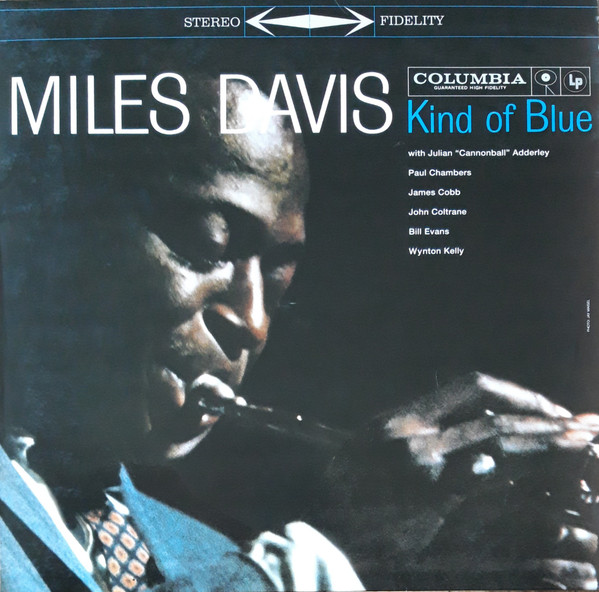
August 17, 1959: Miles Davis releases Kind of Blue. It is the biggest-selling album in jazz history, certified in 2019, on its 60th Anniversary, by the Recording Industry Association of America as having sold 5 million copies.
Trumpeter Davis began releasing albums under his own name in 1951, and had previously used "Blue" in a title in 1953, with Blue Period, a reference not only to jazz having grown out of the blues, but to the paintings produced by a clinically depressed Pablo Picasso in Paris from 1901 to 1904.
And Davis did for jazz what Picasso did for art: He dragged it kicking and screaming into the modern world, with albums titled Walkin', Cookin', Relaxin', Workin', Steamin', 'Round About Midnight, Miles Ahead, Milestones and Porgy and Bess.
Like Picasso, Davis was always looking for the next step. So, on March 2, 1959, with a 2nd session on April 2, he gathered saxophonists John Coltrane (tenor) and Julian "Cannonball" Adderley (alto), bass fiddler Paul Chambers, drummer Jimmy Cobb, and pianist Bill Evans at Columbia Records' 30th Street Studio in New York on March 2, with an additional session on April 22.
Evans had joined Davis on Milestones in 1958, and served as his arranger on that and on Kind of Blue -- only 2 albums, but enough to make their combination a legend, as Davis shifted from what had been called "hard bop" to "modal jazz." Having Coltrane and Adderley on the album, both of whom went on to became stars leading their own groups, makes Kind of Blue something like "The Avengers of Jazz."

Left to right: Evans, Chambers, Davis, Coltrane, Adderley
Side One consisted of "So What," at 9 minutes and 22 seconds, probably Davis' best-known song; "Freddie Freeloader," based on the character by comedian Red Skelton; and "Blue in Green." Side Two was 11 1/2 minutes of "All Blues" and 9 1/2 minutes of "Flamenco Sketches," which presaged Davis' next album, Sketches of Spain. Because "Freddie the Freeloader" was more of a blues song, Davis had Wynton Kelly play piano on it instead of Evans. Evans is listed as co-writer with Davis of "Blue in Green" and "Flamenco Sketches," while Davis is listed as sole writer of the others.
Davis continued making modal jazz albums until 1969, when Sly & the Family Stone performed at Woodstock, and their combination of jazz and rock blew his mind. He shifted gears again, and recorded Bitches Brew, and continued his "fusion" of jazz and rock until his death. He refused to play his earlier work, saying, "They were done in that era, the right hour, the right day, and it happened. It's over... What I used to play with Bill Evans, all those different modes, and substitute chords, we had the energy then, and we liked it. But I have no feel for it anymore. It's more like warmed-over turkey."
Nearly everybody on the album, including Davis himself, had been a serious drug user, although both Davis and Coltrane had kicked heroin by the time it was recorded. Coltrane, whose 1964 A Love Supreme often contends with Kind of Blue among jazz fans for the title of best album ever, died of cancer in 1967, only 40 years old. Chambers was hooked on heroin, and it contributed to his death from tuberculosis in 1969, at 33. Kelly had epilepsy, and died in 1971 due to a particularly violent seizure, only 39. Adderley suffered a stroke and died in 1975, just 47. Evans suffered from cirrhosis, an ulcer and cocaine addiction, and died in 1980, just 51. Davis died in 1991, from a cerebral hemorrhage at 65. Cobb was the last survivor of the musicians on the album, living until 2020, when lung cancer took him at age 91.
*
August 17, 1959 was a Monday. These baseball games were played that day:
* The St. Louis Cardinals beat the Philadelphia Phillies, 5-4 at Connie Mack Stadium in Philadelphia. Stan Musial did not play.
* The Pittsburgh Pirates beat the Chicago Cubs, 7-6 at Forbes Field in Pittsburgh. Roberto Clemente went 2-for-3 with an RBI. Ernie Banks went 2-for-4 with a home run and 3 RBIs.
* The San Francisco Giants beat the Cincinnati Redlegs, 6-3 at Crosley Field in Cincinnati. This was the last of 7 seasons in which the Reds were known as the Redlegs, due to the stupidity of McCarthyism. Willie Mays went 0-for-3, but drove in a run with a sacrifice fly. Frank Robinson went 1-for-4.
* The Detroit Tigers beat the Cleveland Indians, 5-4 at Briggs Stadium in Detroit. The ballpark was renamed Tiger Stadium in 1961. Al Kaline went 0-for-4. This was the only game in the American League: The New York Yankees, the Baltimore Orioles, the Boston Red Sox, the Chicago White Sox, the Kansas City Athletics and the Washington Senators were not scheduled.
* A doubleheader was split at Milwaukee County Stadium. The Milwaukee Braves beat the Los Angeles Dodgers in the opener, 8-1. Bob Buhl was the winning pitcher, and Sandy Koufax, who hadn't yet found the control that would make him the best pitcher in baseball from 1962 to 1966, wsa knocked out of the box in the 2nd inning. Hank Aaron (off Clem Labine), Eddie Mathews and Joe Adcock (both off Koufax) hit home runs. The Dodgers won the nightcap, 6-3. Don Zimmer hit a home run.
Novelist Jonathan Franzen was born on this day. So was David Koresh, the leader of the Branch Davidian cult that murdered 4 federal agents outside Waco, Texas in 1993, before the FBI closed in, leading Koresh to kill himself and his remaining followers.


No comments:
Post a Comment