Saturday, October 1, 2022

October 1, 1940: The Pennsylvania Turnpike Opens

October 1, 1940The 1st section of America's 1st true superhighway, the Pennsylvania Turnpike, opens between Irwin and Carlisle. It was extended to Philadelphia and Pittsburgh in 1950, to the New Jersey and Ohio Turnpikes in 1954, and the Northeast Extension to Scranton opened in 1957.
Today, it runs 360 miles, using what is now Interstates 70, 76 and 276 (going west to east). It costs $86.50 to drive its entire length using cash, but only about half that, $42.80, using E-Z Pass.
Since the 1950s, it has been used by travelers to get to the games of the Philadelphia and Pittsburgh sports teams, although the main Penn State campus is considerably north of it. Interstate 99 connects the campus with the Turnpike's Exit 146 in Bedford, 77 miles away; and with Exit 161 on Interstate 80, 13 miles away.
Unlike its stepbrother in New Jersey, the Pennsylvania Turnpike isn't a pop culture touchstone, although Billy Joel mentioned it in his song "You're My Home," and the road was used as a backdrop in the 2009 film The Road.
*
October 1, 1940 was a Tuesday. There were no scores on this historic day. Baseball was between the regular season and the World Series, which started the next day, and would be won in 7 games by the Cincinnati Reds over the Detroit Tigers. Football was in midweek. The NBA hadn't been founded yet. And it was too soon for the NHL.

October 1, 1939: Marvel Comics #1

October 1, 1939: Marvel Mystery Comics #1, produced by Timely Comics, premieres. By 1950, the company would take the name Marvel Comics. The issue now usually referred to as just "Marvel #1" featured Prince Namor of Atlantis, the Sub-Mariner; the original version of the Human Torch, an android; a gun-toting crimefighter called the Angel; and Ka-Zar the Great, a Tarzan ripoff.

In Fantastic Four #4, May 1962, as part of Marvel's attempt to re-establish itself as DC Comics' main rival, and perhaps even its superior, the new Human Torch, Johnny Storm of the titular hero team, finds the long-lost, amnesiac Sub-Mariner, and restores his memory, but with terrible results. Namor is often referred to as comic books' 1st "anti-hero": A man who helps when he feels like it, but also causes great harm.

In X-Men #1, September 1963, a new superhero named the Angel would be introduced, a man with wings who could fly. Aside from the name, and large wealth, this new Angel, Warren Worthington III, has nothing in common with his predecessor, a private detective named Thomas Halloway.

Marvel #1 sold for 10 cents, equivalent to about $2.10 today. If you can find a copy in good condition today, it will set you back about $350,000.

*

October 1, 1939 was a Sunday. It was the last day of baseball's regular season. In other words, if the film The Natural were a true story, the next day would have been the Playoff for the National League Pennant, and Roy Hobbs shooting out the lights with a walkoff home run.

In real life, these games were played:

* The New York Giants beat the Boston Bees, 5-0 at National League Park in Boston. This was during the 1936-40 experiment in changing names, an experiment that failed: Everyone still called the team the Boston Braves and the ballpark Braves Field, so they switched back. Harry Gumbert pitched a 4-hit shutout. Mel Ott, the leading Giant of his generation, did not play in this game.

* The Brooklyn Dodgers beat the Philadelphia Phillies, 3-2 at Ebbets Field.

* A doubleheader was split at Forbes Field in Pittsburgh. The Cincinnati Reds won the opener, 9-1, getting 3 hits each from Billy Werber and Ival Goodman, and 2 hits each from Lonny Frey, Frank McCormick, Harry Craft, Wally Berger and Billy Meyers.

The Pittsburgh Pirates won the nightcap, 8-0. Ken Heintzelman pitched a 4-hit shutout. Paul Waner went 3-for-5 with an RBI, and Maurice Van Robays went 2-for-5 with 3 RBIs.

* A doubleheader was split at Briggs Stadium in Detroit. The Cleveland Indians won the 1st game, 8-3, with Bob Feller as the winning pitcher. The Detroit Tigers won the 2nd game, 1-0, called after 5 innings due to darkness. (Briggs Stadium was the last ballpark in the American League to get lights, in 1948. It was renamed Tiger Stadium in 1961.) Over the 2 games, Lou Boudreau went 2-for-5 with 2 walks and an RBI, while Hank Greenberg went 1-for-7.

* The Chicago Cubs beat their arch-rivals, the St. Louis Cardinals, 2-1 at Wrigley Field in Chicago.

* The St. Louis Browns beat the Chicago White Sox, 4-3 in 10 innings at Sportsman's Park in St. Louis. This season finale might have been the highlight of the Browns' season even without the dramatics, because it put them out of their misery: They finished 43-111.

* The New York Yankees and the Boston Red Sox had each completed their schedule the day before, against each other. The Yankees went on to sweep the Reds in the World Series.

* The Philadelphia Athletics and the Washington Senators had each completed their schedule the day before, against each other.

October 1, 1937: The Marihuana Tax Act

October 1, 1937: The Marihuana Tax Act of 1937 -- that's how the drug usually spelled "marijuana" was spelled in this case -- goes into effect. It placed a tax on the sale of cannabis, designed to make the drug harder to obtain. It may have been a response to the 1936 film Reefer Madness, an early exploitation film.

(Oddly, I can't fid a release date for the film, only a year, 1936. If I could find an exact date, I would do an entry on the film.)

This law was overturned in the 1969 Supreme Court case Leary v. United States. In 1970, as part of President Richard Nixon beginning "The War On Drugs," Congress repealed it, but replaced it with what they hoped would be more effective legislation.

There's an old saying: "Wish in one hand, poop in the other, and see which hand fills up faster."

*

October 1, 1937 was a Friday. There were 5 baseball games played that day:

* The New York Yankees lost to the Boston Red Sox, 4-2 at Yankee Stadium. The game was shortened to 7 innings due to rain. Louis "Bobo" Newsom outpitched Lefty Gomez.

* The Brooklyn Dodgers beat their arch-rivals, the New York Giants, 7-4 at Ebbets Field.

* The Pittsburgh Pirates beat the Cincinnati Reds, 6-3 at Forbes Field in Pittsburgh.

* The St. Louis Cardinals beat their arch-rivals, the Chicago Cubs, 4-1 at Wrigley Field in Chicago.

* And the Detroit Tigers beat the St. Louis Browns, 14-4 at Sportsman's Park in St. Louis. Hank Greenberg went 3-for-5 with 2 home runs and 6 RBIs. He finished the season with 184 RBIs, 1 short of the American League record set by Lou Gehrig of the Yankees in 1931.

October 1, 1933: Babe Ruth Pitches for the Last Time

October 1, 1933: The baseball regular season ends, and, with the day's games meaning nothing in either League's standings, Babe Ruth pitches for the last time, in order to draw a big crowd in the finale of a season in which the New York Yankees did not win the American League Pennant. It doesn't work: Only 20,000 fans come out.
The Babe goes the distance against his former team, the Red Sox. He gives up 5 runs on 12 hits and 3 walks, with no strikeouts. But the Yankees win, 6-5. Ruth also hits his 34th home run of the season, the 686th of his career, and retires with a career won-lost record of 94-46.
October 1, 1933 was a Sunday. These other baseball games were played:
* The Brooklyn Dodgers beat their arch-rivals, the New York Giants, 5-2 at Ebbets Field. Joe Hutcheson hit a home run. Bill Terry, the Giants' player-manager, did not put himself into the game. Mel Ott went 0-for-3.
* The American League Champion Washington Senators closed out their regular season with a 3-0 loss to the Philadelphia Athletics at Griffith Stadium in Washington. Rube Walberg of the A's and Ray Prim of the Senators both threw goose eggs for 10 innings, but singles by Doc Cramer and Jimmie Foxx in the top of the 11th gave Connie Mack's club the win.
The game ended with a pinch-hitting appearance by Nick Altrock, who did not reach base. The Senators coach was 57 years old, the oldest player in MLB history to that point. (Only Satchel Paige, who pitched an inning at 59 in 1965, has been older.)

His last previous appearance had been in 1924, when, at 47, he became the oldest player ever to hit a triple. He had debuted as a pitcher in 1898, so this makes him the last remaining player from the 19th Century, and the 1st man to play in MLB in 5 different decades. (Minnie Mi
ñoso of the Chicago White Sox would match that in 1980.)
He won 23 games in 1905 and 20 in 1906, so he was a good pitcher for a while. He helped the Boston Red Sox win the World Series in 1903 and the Chicago White Sox do it in 1906. He was a coach for the Senators from 1912 to 1953, 42 straight seasons, a record for a single franchise. He died in 1965, age 88.
* Both Leagues' seasons ended with a Triple Crown winner -- and both in Philadelphia. In the AL, Foxx batted .356 with 48 home runs and 163 RBIs. In the National League, Chuck Klein of the Phillies batted .368 with 28 homers and 120 RBIs. However, the Phillies lost to the Boston Braves, 4-1 at Braves Field in Boston.
* The Pittsburgh Pirates swept a doubleheader from the Cincinnati Reds, 7-5 and 6-5 at Redland Field. (The next year, the ballpark was renamed Crosley Field.) Pie Traynor doubled Woody Jensen home to win the 2nd game in the top of the 10th inning.
* The Detroit Tigers beat the Cleveland Indians, 5-3 at Navin Field in Detroit. (The ballpark was later renamed Briggs Stadium and Tiger Stadium.) Hank Greenberg did not play for the Tigers. (No, it wasn't Yom Kippur.)
* The Chicago White Sox beat the St. Louis Browns, 5-1 at Comiskey Park in Chicago.
* And the Chicago Cubs beat the St. Louis Cardinals, 7-1 at Sportsman's Park in St. Louis.
There were also 3 games played in the NFL:
* The New York Giants beat the Green Bay Packers, 10-7 at Borchert Field in Milwaukee. It was the 1st time the Packers had played a "home game" in Wisconsin's largest city.
* The Portsmouth Spartans beat the Chicago Cardinals, 7-6 at Universal Stadium in Portsmouth, Ohio. The Spartans became the Detroit Lions the next season.
* And the Chicago Bears beat the Boston Redskins, 7-0 at Wrigley Field in Chicago. The Redskins moved to Washington in 1937.

October 1, 1932: Babe Ruth's Called Shot

 
October 1, 1932: Game 3 of the World Series is played at Wrigley Field in Chicago. There was bad blood between the New York Yankees and the Chicago Cubs, because the Cubs had acquired former Yankee shortstop Mark Koenig late in the season, he'd helped them win the Pennant, and the team had announced that, whatever their individual players' shares of the World Series money would be, he would get only half as much.

The Yankees, including Babe Ruth himself, publicly called the Cubs cheap, and there was some rough stuff in the 1st 2 games at Yankee Stadium. When Ruth and his wife Claire got off the train at Union Station in Chicago, Cub fans were waiting for them, throwing garbage at them, and spitting on them. Neither was naive: The Babe had been treated badly before, and Mrs. Ruth, under her maiden name of Claire Hodgson, was an actress, and was used to rough customers. But this was over the line.
Wrigley Field, 1932

In Game 3, the Yankees took a 4-1 lead, including home runs by Ruth and Lou Gehrig (in that case, not back-to-back). But the Cubs tied it up in the bottom of the 4th. Ruth led off the top of the 5th, and the Cub fans were abusing him like crazy. In the Cubs dugout, the "bench jockeying" was nasty as well.

Ruth was no stranger to this. Because of his large, wide nose and big lips, there had been suggestions that he was part black. Research into his family history showed him to be almost completely German -- in fact, because his grandparents were born in Pennsylvania, before moving to Baltimore, they were "Pennsylvania Dutch" -- ethnically Amish, if practicing Catholics.

But that didn't stop people from indulging in rumors, and one of the names he was sometimes called was "(N-word) Lips." On one memorable occasion, which may be apocryphal, he heard this particular insult, walked over to the opposing dugout, and said, "Listen, you guys, call me 'bastard' or 'cocksucker,' or whatever you want, but lay off the personal stuff, would ya?"

Charlie Root was pitching for the Cubs, and he threw a called strike. The Babe didn't like the pitch, and the Cubs' bench jockeying got worse. A home movie -- sadly, silent, and with all the crowd noise, we probably wouldn't be able to hear what the players were saying, anyway -- shows Ruth waving his right hand at the Cub dugout, a classic "Ah, go on, ya bum" gesture.

The way the story is usually told, including on a newsreel by Ruth himself, there were only 3 pitches in this at-bat. In fact, Root's next 2 pitches were out of the strike zone, and called balls. His 4th pitch was called a strike. The home movie shows Ruth pointing directly at Root -- twice. His arm is not extended. Contrary to legend, he is not pointing at a spot beyond the outfield fence, as if to say, "I'm going to hit the next pitch there."

But he is sending a message. Cubs catcher Gabby Hartnett claimed Ruth said, "It only takes one." Another source said Ruth said, "You got one more, kid!" (To the Babe, who was terrible with names, if you were a young guy, you were "Kid"; if you were older, you were "Doc"; and if he didn't like you, or sometimes even if he did, you were "You son of a bitch!") Gehrig, in the on-deck circle, told a reporter that what Ruth yelled at Root was, "I'm gonna hit the next pitch right down your goddamned throat!"

So, yes, Babe Ruth called his shot.

Root threw him one more pitch. The Babe crushed it to dead center field. Longtime Cub observers said it was the longest home run ever hit in Wrigley Field to that point. The now-familiar center field scoreboard wouldn't go up until 1937, and no player has ever hit it with a home run. Supposedly, Roberto Clemente once missed it by less than a foot. Had it been there in 1932, the Babe's blast might have hit it.

The crowd knew that the Babe had made his point, and, like the Russian fans turning from Drago to Balboa in Rocky IV, switched sides, and cheered him as he rounded the bases, making a few more gestures, as if to say, "I told you so!"

For the rest of their lives, all the Cubs who had been interviewed on the subject said he didn't "call his shot." Charlie Root said that if Ruth had done that, "I'd have put one on his ear, and knocked him on his ass." Offered the chance to play himself in The Babe Ruth Story, the awful 1948 film starring William Bendix, Root, who went 201-160 for his career and died in 1970, said, "Not if you're going to show him pointing," and turned it down.

For the rest of their lives, all the Yankees who had been interviewed on the subject said he did it, including Charlie Devens, who pitched for the Yankees from 1932 to 1934, and was the last living player from the team.

There was one exception: Frank Crosetti, the Yankees' shortstop. I used to think that was why Crosetti never appeared at Old-Timers' Day between 1968, his last season as a Yankee coach, and 2002, when he died. It turned out that he simply didn't accept the invitation, preferring not to cross the country from his home in Stockton, California.

Franklin Delano Roosevelt, Governor of New York, and running for President, threw out the ceremonial first ball at the game, and according to a reporter covering his campaign, threw his head back and laughed when Ruth hit the home run. But through his entire 12-year Presidency, FDR never publicly offered his opinion on whether Ruth had "called his shot."

Francis Cardinal Spellman, then the Archbishop of New York, was at the game, and he said Ruth did it. So did John Paul Stevens, then a 12-year-old Chicago schoolkid, later a Justice of the U.S. Supreme Court, and a Cub fan to the end of his life in 2019. If a Cub fan could admit it, then that's good enough for me.

The next batter was Gehrig, and he also hit his 2nd home run of the game. The Yankees hung on to win, 7-5, and completed the sweep the next day.

It was Ruth's 10th World Series, and his 7th World Series win. And it was his 15th home run in World Series play. In each case, it would be his last. The Washington Senators would win the American League Pennant in 1933, and the Detroit Tigers in 1934 and 1935. Ruth retired early in the 1935 season. In 1936, Joe DiMaggio made his Yankee debut, teaming with Gehrig to start a new dynasty.

Ruth's Called Shot remains, along with Bobby Thomson's 1951 Pennant-winning "Shot Heard 'Round the World," one of the two most talked-about home runs in baseball history, more so even than the World Series Game 7-winning shot by Bill Mazeroski in 1960, or the home runs that broke Ruth's records: Single-season, 61 by Roger Maris in 1961, then 70 by Mark McGwire in 1998, then 73 by Barry Bonds in 2001; and career, 715 by Hank Aaron in 1974, then 756 by Bonds in 2007.

UPDATE: Among the Yankees' many traditions is Monument Park at Yankee Stadium. From this 1932 team, they have honored right fielder George "Babe" Ruth, and 1st baseman Lou Gehrig, with Monuments. They have honored manager Joe McCarthy, catcher Bill Dickey, and pitchers Charles "Red" Ruffing and Vernon "Lefty" Gomez with Plaques. McCarthy never wore a number, but the team retired Number 3 for Ruth, 4 for Gehrig, and 8 for Dickey. They have also honored team owner Jacob Ruppert and general manager Ed Barrow with Plaques.

Along with each of the preceding, 3rd baseman Joe Sewell is in the Baseball Hall of Fame. But it is for his earlier playing for the Cleveland Indians, and he is not honored in Monument Park.

The Cubs have a team Hall of Fame. Inducted from their 1932 Pennant winners have been catcher Charles "Gabby" Hartnett, 2nd basemen Rogers Hornsby and Billy Herman, 3rd baseman Stan Hack, left fielder Riggs Stephenson, right fielder Hazen "Kiki" Cuyler, pitcher Charlie Root, manager Charlie Grimm, team owner Philip K. Wrigley, executive Margaret Donahue, and public address announcer Pat Pieper.

*

Of course, this was the only baseball game of the day. And it was the off-season for the NHL. And the NBA hadn't been founded yet.

But October 1, 1932 was a Saturday, so while all the NFL games played that weekend were played the next day, there were college football games played, including 2 major rivalries.

The University of Michigan opened its season by beating Michigan State University, 26-0 at Michigan Stadium in Ann Arbor. This was the depth of the Depression, so only 33,786 fans came into what has since been nicknamed "The Big House," then seating 85,752, to see the Wolverines blank the Spartans. The Michigan went on to win the Big Ten Conference.

Another Big Ten team, the University of Minnesota, played its 1st game under head coach Bernie Bierman. They beat South Dakota State, 12-0 at Memorial Stadium in Minneapolis. Over the next 9 seasons, 1933 to 1941, Bierman would lead the Golden Gophers to 7 Conference Championships and 5 National Championships.

The University of Southern California beat Washington State University, 20-0 at the Los Angeles Memorial Coliseum. Only 35,000 paid to get into the 100,000-seat Coliseum. USC would go on to win the Pacific Coast Conference, a forerunner of today's Pac-12.

In a rivalry later to be known as "The Backyard Brawl," the University of Pittsburgh beat West Virginia University, 40-0 at the old Mountaineer Field in Morgantown, West Virginia. (Built in 1924, it was replaced with a new Mountaineer Field, now named Milan Puskar Stadium, elsewhere on campus in 1980.)

Pitt had no conference to win, but were invited to play USC in the Rose Bowl on January 2, 1933. USC left no doubt as to who was the better team, winning 35-0. But the various outlets that selected National Champions in those days were divided, some picking USC, some picking Michigan. Under the current format, USC would have played Michigan in the Rose Bowl to decide it.

The University of Notre Dame did not play that day, opening their season a week later. Army beat Furman University 13-0 at Michie Stadium in West Point, New York. Navy lost to the College of William & Mary, 6-0 at Thompson Stadium in Annapolis, Maryland.

In New York City, Columbia beat Lehigh 41-6 at Baker Field in Manhattan. Fordham beat the University of Baltimore, 69-0 at Fordham Field in The Bronx. New York University beat Hobart College, 33-0 at Ohio Field in The Bronx.

In New Jersey, Rutgers beat Pennsylvania Military Academy, 20-6 at Neilson Field in New Brunswick. And Princeton beat Amherst College at Palmer Stadium in Princeton.

Also, Arsenal beat Blackpool, 2-1 at Bloomfield Road, in Blackpool, Lancashire.

October 1, 1965: The Indonesia Coup Attempt

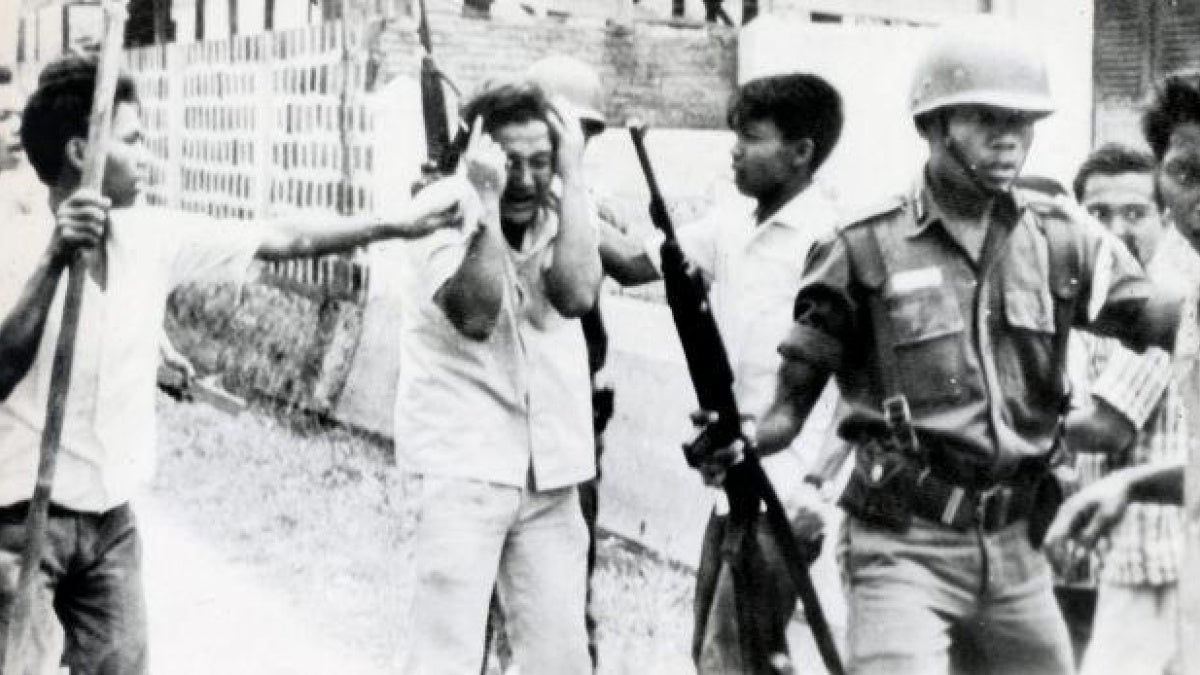
October 1, 1965: Members of the 30 September Movement assassinate 6 Indonesian Army Generals in an abortive coup d'état in the national capital of Jakarta.

At 7:00 AM, Radio Republik Indonesia broadcast a message from Lieutenant-Colonel Untung Syamsuri, the commander of the Presidential guard, stating that the 30 September Movement, an internal army organization, had taken control of strategic locations in Jakarta, with the help of other military units, in order to forestall a coup attempt by a "General's Council" aided by America's Central Intelligence Agency (CIA), intent on removing President Sukarno on 5 October, which Indonesia celebrates as "Army Day."

Sukarno took up residence in the Bogor Palace, a presidential palace in Bogor, East Java, while Omar Dhani and D.N. Aidit, implicated in the coup, fled the country. Led by Suharto, commander of the Army's Strategic Reserve, the army regained control of all the installations previously held by forces of the 30 September Movement.

In the days and weeks that followed, the army, socio-political, and religious groups blamed the coup attempt on the Communist Party of Indonesia (PKI). Soon, a mass purge was underway, which resulted in the imprisonment and deaths of actual or suspected Communist Party members and sympathizers. It is believed that at least 500,000 people were killed as a result of these reprisals. (The country's population was about 100 million at the time; in 2022, it's about 275 million.)

The United States and other Western states have steadfastly denied any responsibility for the terrible violence that followed the attempted coup of October 1, 1965. That violence, they have maintained, was the product of domestic political forces over which outside powers had little, if any, influence. Later evidence proved this to be a lie.

In 1978, Australian novelist Christopher Koch published The Year of Living Dangerously, about the experiences of his brother, journalist Philip Koch, during those events. In 1982, another Australian, director Peter Weir, filmed a movie version.

The legacy of Kusno Sosrodihardjo, a.k.a. Sukarno, the 1st President of Indonesia, is, to say the least, complicated. He sided with Japan in World War II, because they were fighting the natives' Dutch colonial overlords. Once The War ended, he declared independence, with himself as President, but it took 4 years for the Netherlands to agree to let what they called "the Dutch East Indies" go.

But it was hard to keep such a large, diverse, spread-out island nation together. In 1959, Sukarno introduced what he called "Guided Democracy," which was a lot more guided than democratic. The 1965 coup sent the nation into chaos. Finally, in 1967, General Suharto removed Sukarno from power, and he was still under house arrest when he was hospitalized prior to his death in 1970. Suharto was even worse, and had to resign under pressure in 1998, living until 2008.

*

October 1, 1965 was a Friday. Basketball and hockey seasons were a few days away. No games were played in the NFL or the AFL. There was 1 notable college football game played: The University of Southern California (USC) beat Oregon State, 26-12 at the Los Angeles Memorial Coliseum.

And these baseball games were played:

* The Pittsburgh Pirates beat the Chicago Cubs, 2-1 at Forbes Field in Pittsburgh. Roberto Clemente went 1-for-4. Ernie Banks went 0-for-4.

* A doubleheader was split at Cleveland Municipal Stadium. The Baltimore Orioles won the opener, 2-0. Dave McNally pitched a 2-hit shutout. The Cleveland Indians won the nightcap, 3-2. Between the 2 games, Brooks Robinson went 2-for-7 with a walk and an RBI.

* The Chicago White Sox beat the Kansas City Athletics, 6-1 at Comiskey Park in Chicago.

* The Houston Astros beat the St. Louis Cardinals, 4-2 at the Astrodome in Houston. Lou Brock went 0-for-4. Steve Carlton pitched a scoreless 8th inning.

* The Milwaukee Braves beat the Los Angeles Dodgers, 2-0 at Dodger Stadium in Los Angeles. Denny Lemaster pitched a 5-hit shutout. Hank Aaron went 0-for-1 with 2 walks. The next day, though, the Dodgers beat the Braves, and clinched the National League Pennant.

* The Cincinnati Reds beat the San Francisco Giants, 17-2 at Candlestick Park in San Francisco. A bad loss for the Giants, worse in terms of the Pennant chase than it was in terms of the final score. The Reds got home runs from Frank Robinson, Gordy Coleman, Deron Johnson and Pete Rose. 

For the Giants, Willie Mays went 1-for-3 with a walk. Warren Spahn pitched to 3 batters in the top of the 17th inning. He walked Johnny Edwards, Leo Cardenas reached on an error, and Sammy Ellis singled. Those would be the last batters Spahn ever faced.

* The New York Mets and the Philadelphia Phillies were rained out at Shea Stadium. The game was made up as part of a doubleheader the next day. The Phillies won the 1st game, 6-0. Jim Bunning pitched a 2-hit shutout. The 2nd game went 18 innings, before the rain came back and the umpires called it. In other words, in 1 day, the Mets played 27 innings, and didn't score 1 single solitary run.

* The Detroit Tigers and the Washington Senators were rained out at District of Columbia Stadium in Washington. (It was renamed Robert F. Kennedy Memorial Stadium in 1969.) The game was made up as part of a doubleheader the next day. The Tigers swept, 9-1 and 6-2. Al Kaline was injured, and did not play in either game.

* And the New York Yankees, the Boston Red Sox, the Los Angeles Angels and the Minnesota Twins were not scheduled.

October 1, 1928: Joseph Stalin Implements His 1st Five-Year Plan

1932 propaganda poster featuring Stalin:
"The Victory of Socialism in Our Country Is Guaranteed"

October 1, 1928: Soviet dictator Joseph Stalin institutes his first "five-year plan" for the Soviet Union's economy. It turns out to be great for him, as it increases his control over the economy, and thus over the lives of the people. It turns out to be disastrous for them.

This 1st plan was developed on the theory of the productive forces: Increasing industrial capacity to increase production, thus creating greater supply. Ironically, this leftist plan would also form the basis of the American right-wing's "supply-side economics."

When the plan began, the Soviet Union was 5th in the world in industrial production, despite being the world's largest country by land, and its 3rd by population, behind China and British-controlled India. When Stalin pronounced it completed on December 31, 1932 -- 9 months short of 5 years -- the country had moved to 2nd in industrial production, trailing only America.

But the plan led to a famine in the Winter of 1932-33, killing up to 7 million people, hitting western Russia, the Ukraine, and Belarus especially hard. Millions more were weakened to the point of permanent disability. Anti-Communists the world over considered this to be genocide, and made it part of their ideology that Communism killed more people than Fascism. Which is true, unless you bring proportion into play: In countries where Fascism ruled, greater percentages of the people were killed or imprisoned than under Communism.

But the industrial improvement meant that, when Nazi Germany invaded the Soviet Union in 1941, the industry was ready to fight them, even though Stalin had ordered the execution of many military leaders in his "Great Purge" of 1937-38. That nearly cost the Soviets to lose their front of World War II. But the sheer numbers of soldiers and equipment, and the Russian Winter, meant that the Nazis could be pushed back, giving America, Britain, France and the exile armies the chance to beat the Nazis in North Africa, Italy, and, eventually, Western Europe.

Stalin instituted a 2nd five-year plan almost immediately after pronouncing the 1st one a success. There would be several five-year plans approved by Soviet dictators, the last by Mikhail Gorbachev in 1991. But that plan died at the end of the year, along with the country.

*

October 1, 1928 was a Monday. Actors Laurence Harvey and George Peppard were born on this day.

Baseball's regular season had ended the day before, and the World Series would not begin until October 4. The New York Yankees went on to sweep the St. Louis Cardinals. The NFL was done with its games for the weekend. The NHL season wouldn't start for another 2 months. And the NBA hadn't been founded yet. So there were no scores on this historic day.

December 31, 1999 & January 1, 2000: The Millennium

December 31, 1999:  The Millennium arrives. The people of planet Earth survived. At a terrible cost. But we hadn't destroyed ourselves. ...