
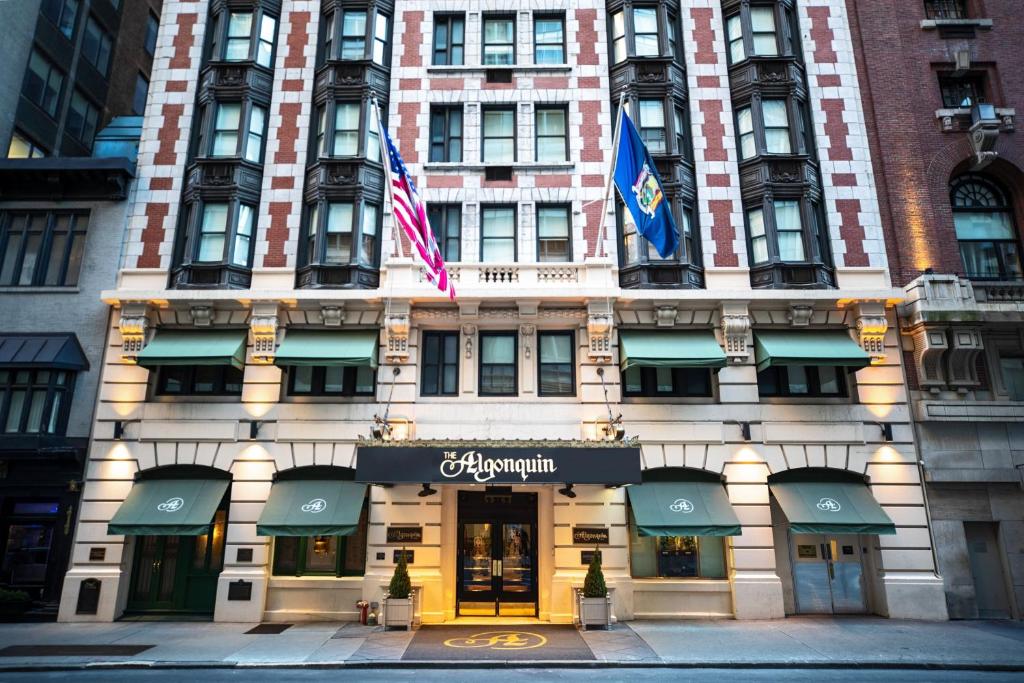
June 19, 1919: A luncheon is held at the Pergola Room at the Algonquin Hotel, at 59 West 44th Street in Midtown Manhattan. It is regarded as the beginning of what became known as the Algonquin Round Table.
The luncheon was organized as a practical joke carried out by theatrical press agent John Peter Toohey. Annoyed at Alexander Woollcott, drama critic for The New York Times, for refusing to plug one of Toohey's clients, Eugene O'Neill, in his column, organized it, supposedly to welcome Woollcott back from World War I, where he had been a correspondent for the military newspaper Stars and Stripes.

Alexander Woollcott
Instead, Toohey used the occasion to poke fun at Woollcott on a number of fronts. Woollcott's enjoyment of the joke and the success of the event prompted Toohey to suggest that the group in attendance meet at the Algonquin each day for lunch.
The group first gathered in the Algonquin's Pergola Room, later called the Oak Room, at a long rectangular table. As they increased in number, Algonquin manager Frank Case moved them to the Rose Room and a round table.
Initially the group called itself "The Board" and the luncheons "Board meetings." After being assigned a waiter named Luigi, the group re-christened itself "Luigi Board." Finally, they became "The Vicious Circle," although "The Round Table" gained wide currency, after a caricature by cartoonist Edmund Duffy of the Brooklyn Eagle portrayed the group sitting at a round table and wearing armor, like King Arthur's knights.
In addition to Toohey and Woollcott, the charter members included husband & wife writers Heywood Broun and Ruth Hale; playwrights Marc Connelly, George S. Kaufman and Robert E. Sherwood; Broadway producer Brock Pemberton and his brother, publicist Murdock Pemberton; humorist and actor Robert Benchley; newspaper columnist Franklin Pierce Adams, known for his tribute to the Chicago Cubs, "Baseball's Sad Lexicon," a.k.a. "Tinker to Evers to Chance"; Dorothy Parker, screenwriter and drama critic; and Harold Ross, an editor who went on to found The New Yorker magazine in 1925, and published the work of many of the others.
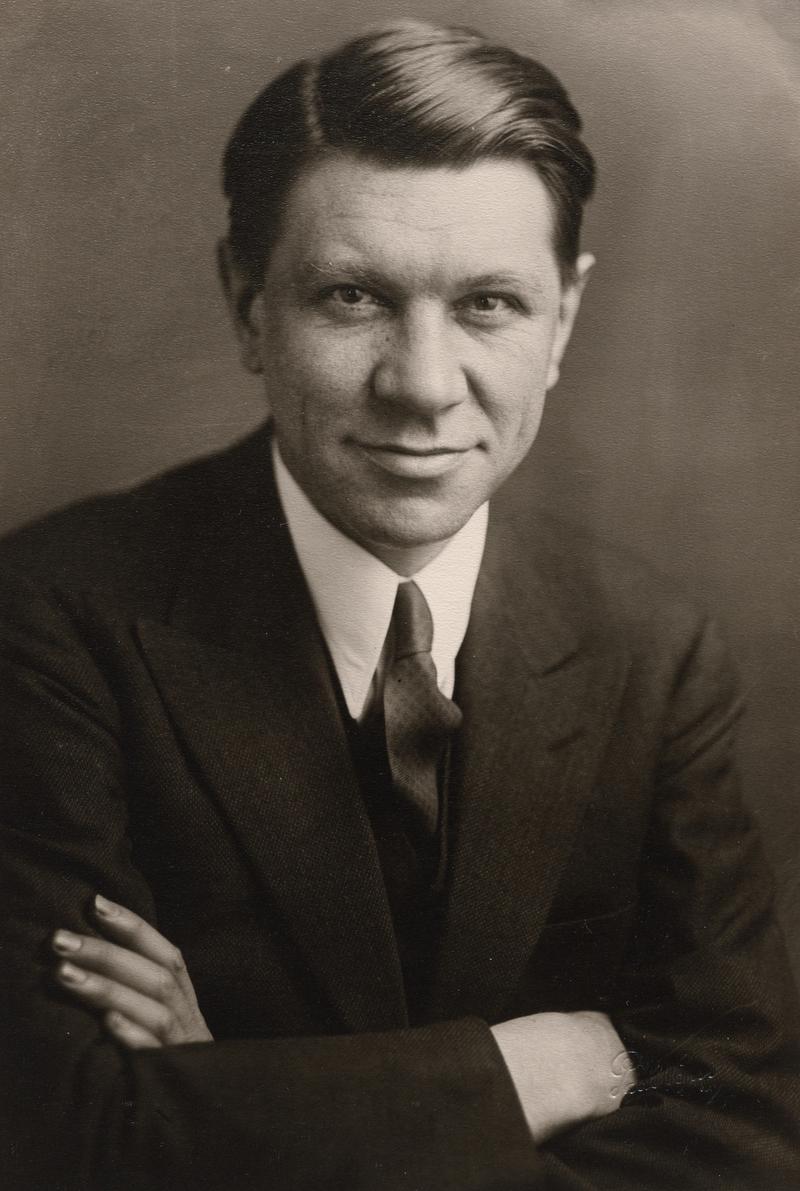
Membership was not fixed, and some charter members left, new ones were admitted, and some left and returned. Others included Ross' wife, journalist Jane Grant; playwrights Noël Coward, Edna Ferber, Donald Ogden Stewart and Beatrice Kaufman, married to George; writer Katherine Sproehnle; comedian Harpo Marx, but none of his brothers; actresses Tallulah Bankhead, Blyth Daly, Eva Le Gallienne, Margalo Gillmore, Estelle Winwood and Peggy Wood; theatrical director Norman Bel Geddes; and screenwriter Herman J. Mankiewicz.
For his column, Adams accepted submissions from other writers, giving them a leg up in their careers, including Benchley, Parker, Ferber, George S. Kaufman, Moss Hart, Edna St. Vincent Millay, John O'Hara, and, most notably, James Thurber. Parker admitted of Adams, "He raised me from a couplet." Parker dedicated her 1936 publication of collected poems, Not So Deep as a Well, to F.P.A.
The Round Table members were renowned for their wit and their witticisms. Beyond any doubt, the leader was Woollcott. He would greet people by saying, "Hello, Repulsive!" And that was his friends. Of a pianist who was also a known quipster, he said, "There's nothing wrong with Oscar Levant that a miracle can't fix." He said of French writer Marcel Proust, "Reading Proust is like lying in someone else's dirty bath water." He called Los Angeles "Seven suburbs in search of a city." He claimed the drink Brandy Alexander was named for him.
But "Dottie" Parker was nearly a match for him. She called his apartment "Wit's End." She's best known for the line, "Men seldom make passes at girls who wear glasses." She said, "Beauty is only skin deep; ugly goes all the way to the bone." Reviewing a 1931 play for The New Yorker, she began, "House Beautiful is play lousy." (Kaufman could also be unsparing in reviews, having had a few bad ones himself: Of another play premiering in 1931, Vanities, he said, "I saw the play at a disadvantage: The curtain was up.")

Having survived an abortion from an affair while her husband was out of town, Parker found out that a friend who had left New York City had given birth to a child out of wedlock. She wrote, "Congratulations. We all knew you had it in you." (She would divorce and remarry, but never had a child, suffering 2 miscarriages in her 40s.) In 1933, former President Calvin Coolidge died. When told, Parker said, "How can you tell?"
Most of them were liberal. In 1927, Parker was among the demonstrators outside the Boston prison where Nicola Sacco and Bartolomeo Vanzetti were executed. Later on, in 1957, she said of Ayn Rand's magnum opus of selfishness, Atlas Shrugged, "This is not a novel to be tossed aside lightly. It should be thrown with great force." When she died, without any heirs, she left her estate to Dr. Martin Luther King Jr.
Some group members were openly gay, such as Coward and Le Gallienne. Bankhead was bisexual, calling herself "ambisextrous," and apparently had a fling with Le Gallienne. Bankhead underwent an emergency hysterectomy in 1934, because she'd contracted gonhorrhea, which she said she got from a co-star, believed to have been either Gary Cooper or George Raft. She was unrepentant, telling the press, "Don't think that this has taught me a lesson!"
Others were suspected of being gay, like Woollcott and Ferber, simply because they seemed to have had no romantic attachments at all. Once, after Coward joked about how Ferber's suit made her resemble a man, she replied, "So does yours."
Through the Roaring Twenties, the group met, drank, dished gossip, and told stories, some of them true. Benchley admitted that before he met Parker, he never drank, smoked, or cheated on his wife; after meeting her, he'd done all three, including with Parker.
But Harpo's brother, Groucho Marx, oldest and leader of the Marx Brothers, despite his own famously sharp wit, didn't like being with the Round Table members: "The price of admission is a serpent's tongue and a half-concealed stiletto." It may have been the Round Table that inspired him to say, "I don't want to belong to any club that would have me as a member." Parker herself was quoted as saying:
The Crash of 1929, the dawn of the Great Depression, and the move of some members to Los Angeles to write for "talking pictures" doomed the group. Ferber said she realized it was all over when she arrived at the Rose Room for lunch one day in 1932, and found the group's table occupied by a family from Kansas.
In 1940, George S. Kaufman and Moss Hart wrote a play, The Man Who Came to Dinner. The character of Sheridan Whiteside was based on Woollcott, and he was the first to play him. In the 1942 film version, Whiteside was played by Monty Woolley. Bette Davis starred as Maggie Cutler, Whiteside's secretary, apparently an original character. The Ann Sheridan character, Lorraine Sheldon, was based on Broadway actress Gertrude Lawrence; Reginald Gardiner's Beverly Carlton on Coward; and Jimmy Durante's Banjo on Harpo Marx.
Hart married actress Kitty Carlisle. Mankiewicz, who would write the film Citizen Kane with Orson Welles, was the father of screenwriter Don Mankiewicz and political operative Frank Mankiewicz. Broun and Hale were the parents of sportscaster Heywood Hale Broun. Benchley's grandson, Peter Benchley, wrote the novel that became the film Jaws. Bel Geddes' daughter, Barbara Bel Geddes, played Eleanor "Miss Ellie" Ewing on the TV show Dallas.
Ruth Hale and Heywood Broun divorced in 1933. The following year, Hale was the first to go, dying of an intestinal fever, only 47 years old. Broun followed in 1939, of pneumonia, only 51. Antibiotics were not yet widely available. Alexander Woollcott suffered a heart attack on the air during a 1943 radio show, and died later that night, at 56.
Robert Benchley and Beatrice Kaufman died in 1945, John Peter Toohey in 1946, Brock Pemberton in 1950, Harold Ross in 1951, Herman J. Mankiewicz in 1953, Robert E. Sherwood in 1955, Norman Bel Geddes in 1958, Franklin P. Adams in 1960, George S. Kaufman in 1961, Harpo Marx in 1964, Blyth Daly in 1965, Dorothy Parker in 1967, Edna Ferber and Tallulah Bankhead in 1968, Jane Grant in 1972, Noël Coward in 1973, Katherine Sproehnle in 1976, Peggy Wood in 1978, Donald Ogden Stewart and Marc Connelly in 1980, Murdock Pemberton in 1982, Estelle Winwood in 1984, Margalo Gillmore in 1986, and Eva Le Gallienne in 1991.
Aviva Slesin won an Academy Award for Best Documentary for her 1987 film about the Round Table, The Ten-Year Lunch. Heywood Hale Broun narrated it.
In 1994, the film Mrs. Parker and the Vicious Circle premiered. It starred Jennifer Jason Leigh as Parker, Campbell Scott as Benchley, Sam Robards and Martha Plimpton as the Rosses, Lili Taylor as Ferber, Nick Cassavetes as Sherwood, David Thornton and Leni Parker as the Kaufmans, Tom McGowan as Woollcott, Chip Zien as Adams, Gary Basaraba and Jane Adams as the Brouns, Matt Malloy as Connelly, Jake Johannsen as Toohey, David Gow as Stewart, and J.M. Henry as Harpo.
The 12-story Algonquin Hotel, named for a Native American tribe and nicknamed "The Gonk" for short, opened in 1902, and is still open. In 2019, in honor of the Round Table's Centennial, they offered a special dinner deal in the Rose Room, for $19.19.
*
June 19, 1919 was a Thursday. These baseball games were played:
* The New York Yankees lost to the Cleveland Indians, 4-3 at the Polo Grounds. Tris Speaker went 0-for-2 with 2 walks.
* The New York Giants beat the St. Louis Cardinals, 7-1 at Robison Field in St. Louis. Benny Kauff went 3-for-4 with a home run and 4 RBIs. Rogers Hornsby went 3-for-4.
* The Brooklyn Dodgers -- or the Robins, as they were known when Wilbert Robinson managed them from 1914 to 1931 -- beat the Chicago Cubs, 4-1 at Weeghman Park in Chicago. (That ballpark was renamed Cubs Park in 1920 and Wrigley Field in 1926.) Zack Wheat went 1-for-5.
* The Boston Red Sox beat the St. Louis Browns, 2-1 at Fenway Park in Boston. Babe Ruth went 2-for-3 with a walk. George Sisler went 1-for-3 with a walk.
* The Philadelphia Athletics beat the Detroit Tigers, 2-1 at Shibe Park in Philadelphia. Ty Cobb did not enter the game.
* The Chicago White Sox beat the Washington Senators, 5-4 at Griffith Stadium in Washington. Shoeless Joe Jackson went 1-for-3 with a walk and 2 RBIs. Eddie Collins went 3-for-3 with a walk.
* The Pittsburgh Pirates beat the Boston Braves, 6-5 at Forbes Field in Pittsburgh.
* And the Cincinnati Reds beat the Philadelphia Phillies, 4-1 at Redland Field in Cincinnati. (That ballpark was renamed Crosley Field in 1934.)


No comments:
Post a Comment