Tuesday, February 1, 2022

February 1, 1936: "We Are All Keynesians Now"

February 1, 1936: John Maynard Keynes, already the world's leading economist, publishes his magnum opus, The General Theory of Employment, Interest and Money. It became the defining economic publication of the 20th Century, and led to the expression, "We are all Keynesians now."

Keynes (pronounced "keenz") was born on June 5, 1883 in Cambridge, Cambridgeshire, England, where his father, John Neville Keynes, taught "moral science" (an umbrella term that covered what a 21st Century American might call "the humanities") at Cambridge University. The son graduated from the school, having distinguished himself in many ways, but especially as a mathematical genius.

Harry Gordon, a Canadian economist who also graduated from Cambridge, wrote that Keynes was always confident he could find a solution to whatever problem he turned his attention to, and retained a lasting faith in the ability of government officials to do good. He began work in Britain's Civil Service in 1906, and by 1909 was already having articles published in The Economic Journal. That publication made him its editor just 2 years later.

His work with the Treasury kept him from having to serve in World War I. He traveled to the postwar Conference of Versailles in 1919, and his observations of the way the defeated Germany was treated by the victorious powers, including his own country, worried him. His book The Economic Consequences of the Peace predicted that the harsh penalties would cause Germany to rise up again, and start a new war in 20 years. He was almost exactly right on the timing. (He wasn't the only one: Premier Georges Clemenceau of France also said it would last 20 years.)

He continued to serve on government committees. He was deeply critical of the British government's austerity measures during the Great Depression. He believed that budget deficits during economic downturns were a good thing, and a natural product of an economic slump. He wrote, "For Government borrowing of one kind or another is nature's remedy, so to speak, for preventing business losses from being, in so severe a slump as the present one, so great as to bring production altogether to a standstill."

At the height of the Great Depression, in 1933, Keynes published The Means to Prosperity, which contained specific policy recommendations for tackling unemployment in a global recession, chiefly counter-cyclical public spending. The Means to Prosperity contains one of the first mentions of the multiplier effect.

While it was addressed chiefly to the British Government, it also contained advice for other nations affected by the global recession. Copies were sent to the newly elected President Franklin D. Roosevelt and other world leaders. The work was taken seriously by both the American and British governments, and helped pave the way for the later acceptance of Keynesian ideas, though it had little immediate practical influence.

In 1936, he published his magnum opus, The General Theory of Employment, Interest and Money. It challenged the ideas of neoclassical economics that held that free markets would, in the short to medium term, automatically provide full employment, as long as workers were flexible in their wage demands. He argued that aggregate demand (total spending in the economy) determined the overall level of economic activity, and that inadequate aggregate demand could lead to prolonged periods of high unemployment, and since wages and labor costs are rigid downwards, the economy will not automatically rebound to full employment.

In other words, Keynes understood that there was no free market, and there never had been, and there never would be, until all people were free to go to market.

In spite of being left of center in economic thought, he opposed Communism. He supported women's rights and the decriminalization of homosexuality. However, he also supported eugenics. In 1942, he was created 1st Baron Keynes.

Someone once asked Keynes if his theories would be harmful in the long run. His answer was, "In the long run, we are all dead." He died on April 21, 1946, at the age of 62, at his farmhouse near Firle, East Sussex, England. Both of his parents outlived him. He had married, but had no children, so, with his death, his bloodline and his brief baronetcy became extinct. Did he have any regrets? At least one: His last words were, "I wish I had drunk more champagne."

By the late 1930s, leading Western economies had begun adopting Keynes's policy recommendations. Almost all capitalist governments had done so in the years following World War II. In a 1965 interview for Time magazine, the conservative economist Milton Friedman reluctantly admitted, "We are all Keynesians now."

That would change in the 1970s, as conservative economists like Friedman and Friedrich Hayek began an ascendancy. Conservative governments took hold all over the world: Menachem Begin in Israel in 1977; Deng Xiaoping coming to power in China in 1978, and leading it away from strict Communism and toward free-market ideas; Margaret Thatcher in Britain, Joe Clark in Canada (but only for a few months, as it turned out), and the Islamic revolution in Iran, all in 1979; Ronald Reagan in America, in 1980; and Helmut Kohl in West Germany, in 1982.

Keynes' reputation seemed to be restored in the 1990s, as all of those countries, except for China and Iran, became more liberal again. In 1999, Time magazine named him the greatest economist of the 20th Century.

*

February 1, 1936 was a Saturday. Baseball and football were out of season. The NBA hadn't been founded yet. There were 2 games played in the NHL. The Detroit Red Wings beat the Montreal Canadiens, 3-1 at the Montreal Forum. And the Toronto Maple Leafs beat the Chicago Black Hawks, 3-2 at Maple Leaf Gardens in Toronto. Nick Metz scored the winning goal, 8:29 into overtime.

And in English soccer, Arsenal beat Staffordshire team Stoke City, 1-0 at the Arsenal Stadium, a.k.a. Highbury, in North London.

February 1, 1922: The Murder of William Desmond Taylor

February 1, 1922: William Desmond Taylor is murdered at his home in Los Angeles. He was a few weeks shy of his 50th birthday. The murder remains officially unsolved.

He was born on April 26, 1872 in Carlow, Ireland, with the name William Cunningham Deane-Tanner. He became an actor, moved to New York, married actress Ethel May Harrison, and had a daughter named Ethel Daisy, before getting divorced.

After the divorce, he changed his name to William Desmond Taylor, and went west, where Hollywood was beginning. From 1913 to 1915, he acted in 27 films; from 1914 to 1922, he directed 59. In 1918, with World War I ongoing, he enlisted in the Canadian Expeditionary Forces, but the Armistice was signed while he was at sea, heading to Europe. He saw no combat, but met the minimum requirement to say he "did his part." He went back to directing, and seemed to be popular.

On the morning of February 2, 1922, he was found dead in his home at the Alvarado Court Apartments, at 404-B South Alvarado Street, in the affluent Westlake neighborhood of Los Angeles. He had been shot in the back. An autopsy showed it had happened the night before.

Clearly, it wasn't a robbery gone wrong: There was $78 in his pockets, and various other valuable items that could have been stolen were found safe. There were rumors that Taylor had been afflicted with mental illness -- supposedly, his divorce was connected to a disappearance in 1908 -- and had upset various people in Hollywood. With the Fatty Arbuckle case ongoing, this murder increased the poor light in which the film industry was being seen, with one newspaper editorial calling the area "our American Sodom and Gomorrah."

Also found on the body was a locket containing a photograph of actress Mabel Normand. It soon got out that Taylor and Normand were having an affair. Normand told the police she had been at Taylor's house at 7:45 PM on the night of the murder, and did not suspect that anything was going to go wrong. She was addicted to cocaine, and it has been suggested that her dealer may have killed Taylor. Given the greed of drug dealers, and the fact that so many valuables were lying around, this is hardly conclusive.

Faith MacLean, Taylor's next-door neighbor said the wife of actor Douglas MacLean, heard a noise at 8:00 (after Normand left), and saw someone going through Taylor's front door. Because of this person's apparent size, Mrs. MacLean thought it was a woman disguised as a man.

One suspect who fit that description was Mary Miles Minter, a 19-year-old actress who had written Taylor love letters, but her feelings were never reciprocated. But her mother, Charlotte Shelby, neither the first nor the last Hollywood "stage mother" to be incredibly manipulative of her child/client, didn't know that, and believed there was an affair. Both were accused of the murder, but there wasn't enough evidence to charge either one.

A more likely suspect was Edward Sands, who had worked as Taylor's valet and cook until 7 months before the murder. While Taylor was in Europe in the Summer of 1921, Sands had forged his name on checks and wrecked his car. Following the murder, Sands was never seen or heard from again.

So the murder of William Desmond Taylor, said to be the 1st murder that ordinary Americans seemed interested in from coast to coast, not only went unsolved, but there was never even enough evidence to arrest a single suspect. To this day, 100 years later, we don't know.

*

February 1, 1922 was a Wednesday. Baseball and football were out of season. Professional basketball barely existed. There were 2 games played in the NHL. The Ottawa Senators beat the Montreal Canadiens, 4-2 at the Ottawa Arena. And the Toronto St. Patricks beat the Hamilton Tigers, 5-4 at the Barton Street Arena in Hamilton, Ontario.

The Tigers went out of business in 1925. The Senators became the St. Louis Eagles in 1934, and went out of business after one more season. The St. Patricks became the Maple Leafs in 1927.

Monday, January 31, 2022

February 1, 1920: The Royal Canadian Mounted Police Are Formed

February 1, 1920: The Royal Canadian Mounted Police are formed. It is the result of a merger between the Dominion Police, which was responsible for federal law enforcement, intelligence, and parliamentary security; and the Royal North-West Mounted Police, which had been responsible for colonial policing in the Canadian West.

The new police service inherited the paramilitary, frontline policing-oriented culture that had governed the RNWMP, which had been modelled after the Royal Irish Constabulary, but much of the RCMP's local policing role had been superseded by provincial and municipal police services.

The RNWMP, founded in 1873, just 6 years after Confederation, were the original "Mounties," and had the red jackets and the familiar campaign hats, the Stetson "Boss of the Plains." But they never used the motto "The Mountie always gets his man," made famous in the movies.

They were honored in popular culture through characters that were usually upper-class gentlemen, doing their moral duty in serving the British Empire on the fringes of civilisation, as the British and the Canadians have always "spelt" it. This was embodied in such characters as Corporal Connor, Sergeant Preston of the Yukon, Nelson Eddy's 1936 Rose Marie character Sergeant Bruce, and the cartoon character Dudley Do-Right.

As police services are the constitutional responsibility of the Provinces and Territories of Canada, the RCMP's primary responsibility is the enforcement of federal criminal law, and sworn members of the RCMP have jurisdiction as a peace officer in all Provinces and Territories of Canada. However, the service also provides police services under contract to 8 of Canada's 10 Provinces, all except the 2 largest, Ontario and Quebec; all 3 of Canada's Territories, more than 150 municipalities, and 600 Indigenous communities.

In addition to enforcing federal legislation and delivering local police services under contract, the RCMP is responsible for border integrity; overseeing Canadian peacekeeping missions involving police; managing the Canadian Firearms Program, which licenses and registers firearms and their owners; and the Canadian Police College, which provides police training to Canadian and international police services.

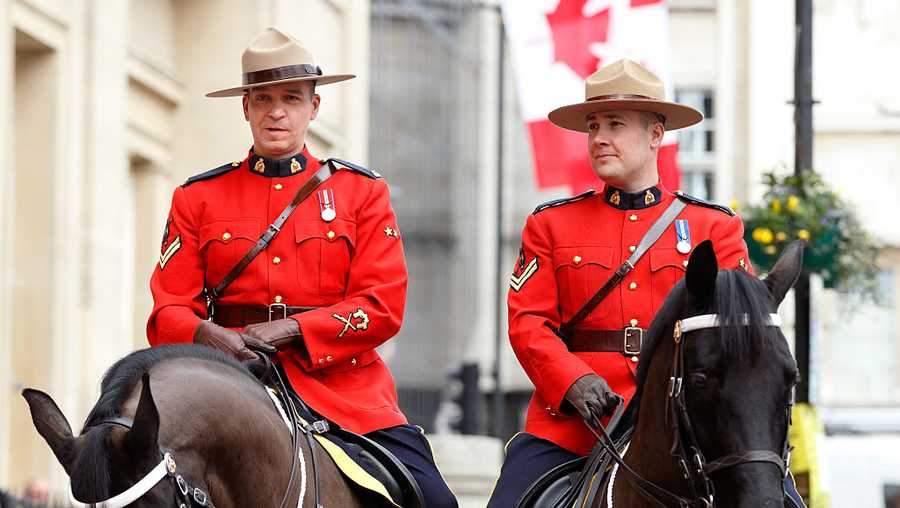
The Mounties are a fully modern police force. Although they still wear Stetson hats, much like most American States' State Troopers, the Red Serge -- red jackets, black pants, high leather Strathcona boots and black gloves -- is now a dress uniform only, and they wear what Americans would recognize as standard police uniforms, or even plainclothes. The use of horses were discontinued from regular field use in the late 1930's. Women were not appointed as RCMP officers until 1974.
A modern RCMP officer and his car

Despite its modernity, the RCMP retains its "Royal" name, as Canada retains its place in the British Commonwealth. With Canada's dual-language system, the Mounties are known in French as le Gendarmerie royale du Canada, or GRC for short, or la police montée.

It would be easy to think of the Mounties as Canada's version of America's Federal Bureau of Investigation (FBI). But it isn't. The Canadian Security Intelligence Service (CSIS) is the country's primary national intelligence agency, both domestic (which makes it equivalent to the FBI) and abroad (which makes it equivalent to the Central Intelligence Agency, the CIA). The RCMP and the CSIS certainly work together, but they do not have the same function.

Since citizens' band (CB) radio of the 1970s labeled American State Troopers "Smokeys" or "Bears" because their hats reminded them of park rangers and Smokey Bear, I wondered if Canadian CB users called Mounties "Horses." They didn't. They were simply "Mounties." But American CB users did often call County Sheriff officers "County Mounties."

*

February 1, 1920 was a Sunday. Baseball and football were out of season. Professional basketball barely existed. And the NHL had no games scheduled. So there were no scores on this historic day. 

February 1, 1905: The U.S. Forest Service Is Founded

February 1, 1905: President Theodore Roosevelt creates the United States Forest Service, under the banner of the U.S. Department of the Interior. As its 1st Chief, he appoints Gifford Pinchot, previously the Chief of the Division of Forestry under the Department of Agriculture. Pinchot would later serve as Governor of Pennsylvania.

TR was the 1st President to be an active environmentalist. Before he took office in 1901, there were only 4 National Parks: Yellowstone, mostly in Wyoming, founded in 1872; Sequoia and Yosemite, both founded in California in 1890; and Mount Rainier, in Washington State, founded in 1899. He founded 3: Crater Lake, in Oregon, in 1902; Wind Cave, in South Dakota, in 1903; and Mesa Verde, in Colorado, in 1906. It would, however, take until 1916 for the National Park Service to be founded, also under the Department of the Interior.

TR worked closely with Pinchot, and his Secretary of the Interior, James R. Garfield, son of President James A. Garfield, to enact a series of conservation programs. In addition to the Forest Service, he signed the Antiquities Act of 1906, under which he proclaimed 18 new U.S. National Monuments. He also established the first 51 bird reserves, 4 game preserves, and 150 National Forests. The area of the United States he placed under public protection totals approximately 230 million acres.

The Forest Service is headquartered at the Sidney R. Yates Building, named for a longtime Democratic Congressman from Illinois, at 1400 Independence Avenue SW in Washington.

*

February 1, 1905 was a Wednesday. Baseball and football were out of season. Professional basketball barely existed. And the Ottawa Silver Seven were between Stanley Cup challenges from the Dawson City Nuggets and the Rat Portage (later Kenora) Thistles. So there were no scores on this historic day.

February 1, 1896: "La Bohème" Premieres

Giacomo Puccini

February 1, 1896: Giacomo Puccini's opera La Bohème premieres at Teatro Regio (the Royal Theater) in Turin, Italy. Only 28 years old, Arturo Toscanini is the conductor.

The libretto was written by Luigi Illica and Giuseppe Giacosa. They would also collaborate to write the libretti for Puccini's operas Tosca in 1900 and Madama Butterfly in 1904. As credited on its title page, the libretto for La Bohème is based on Henri Murger's 1851 novel, Scènes de la vie de bohème (Scenes of the Bohemian Life), a collection of vignettes portraying young bohemians living in the Latin Quarter of Paris in the 1840s, in the latter years of the July Monarchy.

The opera's libretto focuses on the relationship between Rodolfo and Mimì, ending with her death. Also like the play, the libretto combines two characters from the novel, Mimì and Francine, into the single character of Mimì. Evangelista "Evan" Gorga played Rodolfo in the premiere, and Cesira Ferrani played Mimi. Ferranira had previously played the title role in Puccini's 1893 opera Manon Lescault.
Cesira Ferrani

In 1946, 50 years after the opera's premiere, Toscanini conducted a commemorative performance of it on radio with the NBC Symphony Orchestra. A recording of the performance was later released by RCA Victor on vinyl record, tape and compact disc. It is the only recording ever made of a Puccini opera by its original conductor.

In 1959, one of the songs from the opera, "Musetta's Waltz," was adapted by songwriter Bobby Worth for the pop song "Don't You Know?" It became the biggest hit for singer Della Reese.

Giuseppe Giocosa in 1906, Luigi Illica in 1919, Giacomo Puccini in 1924, Cesira Ferrani in 1943, and Arturo Toscanini and Evan Gorga in 1957.

The original Teatro Regio was built in 1740, and was destroyed by fire in 1936. A new Teatro Regio opened on the site of the original in 1973.

In 1965, Franco Zeffirelli staged it for Italian television. In 1990, Australian producer Baz Luhrmann staged it in his own country, moving the story up to 1957 but keeping it in Paris. In 2002, he staged this version on Broadway. But it had already been adapted for Broadway in 1996, by Jonathan Larson, as the musical Rent, with the deadly disease of tuberculosis being replaced by AIDS.

*

February 1, 1896 was a Saturday. Baseball and football were out of season. Basketball barely existed. Hockey season was in progress. The Ottawa Hockey Club, forerunners of the original Ottawa Senators, beat the Montreal Victorias, 3-2 at the Rideau Rink in Ottawa. And the Quebec Hockey Club, forerunners of the Quebec Bulldogs, beat the Montreal Hockey Club, 3-1 at the Quebec Skating Rink.

In English soccer, Woolwich Arsenal, which would evolve into the North London team I would one day support, lost to Burnley F.C., 6-1 at Turf Moor in Burnley, Lancashire.

January 31, 2011: Transfer Windows Gone Wild

Fernando Torres

January 31, 2011: European soccer has two "transfer windows," in which players can be purchased from other teams. The Summer window, at the start of the season, usually closes on the afternoon of September 1. The January window, in mid-season, usually closes on the afternoon of February 1.

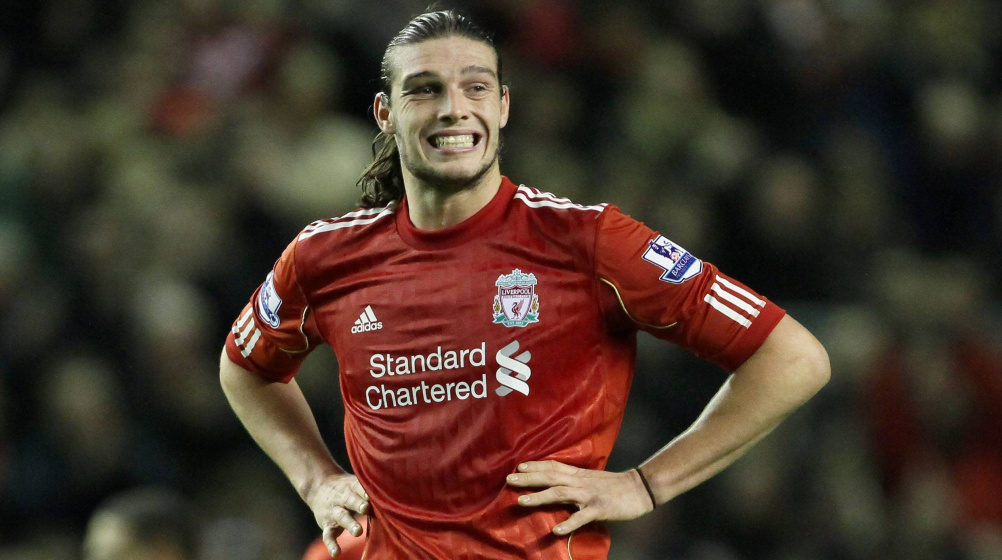
On this "Deadline Day," Liverpool Football Club sell their best player, forward Fernando Torres, to West London team Chelsea Football Club for £50 million. Then they buy Newcastle United forward Andy Carroll for £35 million. Both sums are, at the time, considered huge.

At first, it looks like a bad deal for both teams: Carroll was given the Number 9 shirt worn by Liverpool legends Torres, Robbie Fowler, Ian Rush, Steve Heighway and Ian St. John. But he turned out to be a bust, with first a ponytail (along with his pony face), then a "man-bun." In only 3 seasons, he was hurt more than he played, and scored just 11 goals. Liverpool did reach the Finals of both domestic cups in 2012, winning the League Cup but losing the FA Cup, but Carroll had little to do with that. He was sold to West Ham United in 2013, and and remained a bust.
Andy Carroll

Torres, a member of the Spain team that had won the 2010 World Cup and Euro 2008 (and would win Euro 2012 with him,) had been beloved at Liverpool, though they never won a trophy with him. (They finished a close 2nd in the Premier League in 2009.) Selling him seemed symbolic of a decline that took a few years to overcome. At Chelsea, his great talent seems to vanish. But by May 2013, Torres had recovered to help Chelsea win a UEFA Champions League, an FA Cup (that 2012 Final over Liverpool), and a UEFA Europa League.

Soon, even greater sums were being demanded for great players. In 2009, Real Madrid had already bought Cristiano Ronaldo from Manchester United for £80 million. In 2013, they bought Gareth Bale from Tottenham Hotspur for £86 million. In 2016, Manchester United paid £89 million to get Paul Pogba from Juventus, thus breaking the €100 million barrier. Then, in 2017, Paris Saint-Germain blew right past the £100 million barrier, doubling it, paying £200 million to FC Barcelona for Neymar. Through January 31, 2022, no team has come within £37 million of that.

*

January 31, 2011 was a Monday. Baseball was out of season. The NFL was between the Conference Championship Games and the Super Bowl, which the Green Bay Packers would win over the Pittsburgh Steelers. And the NHL was in its All-Star Break: The day before, in the All-Star Game, a team captained by Nicklas Lidstrom of the Detroit Red Wings beat one captained by Eric Staal of the host Carolina Hurricanes, 11-10 at the RBC Center (now the Lenovo Center) in Raleigh, North Carolina.

There were 7 games played in the NBA:

* The New Jersey Nets beat the Denver Nuggets, 115-99 at the Prudential Center in Newark.

* The Miami Heat beat the Cleveland Cavaliers, 117-90 at the American Airlines Arena (now the Kaseya Center) in Miami. Dwyane Wade scored 34 points. LeBron James scored 24 against his once-and-future team.

* The Memphis Grizzlies beat the Orlando Magic, 100-97 at the FedEx Forum in Memphis.

* The Indiana Pacers beat the Toronto Raptors, 104-93 at the Conseco Fieldhouse (now the Gainbridge Fieldhouse) in Indianapolis.

* The Dallas Mavericks beat the Washington Wizards, 102-92 at the American Airlines Arena in Dallas.

* The Utah Jazz beat the Charlotte Bobcats, 83-78 at the EnergySolutions Arena (as the Delta Center was then known) in Salt Lake City, Utah.

* And the Los Angeles Clippers beat the Milwaukee Bucks, 105-98 at the Staples Center (now the Crypto.com Arena) in Los Angeles.

January 31, 1993: Jimmy Johnson's "Double" Restores the Dallas Cowboys

January 31, 1993: The Dallas Cowboys beat the Buffalo Bills, 52-17 at the Rose Bowl in the Los Angeles suburb of Pasadena, California. It is the 3rd straight Super Bowl loss for the Bills, and the 1st Super Bowl win for the Cowboys in 15 years, the 1st since their rebuild following their 1989 purchase by Jerry Jones.

But it is more than that: By being the winning coach, Jimmy Johnson becomes the 1st head coach ever to win both a college football National Championship and a Super Bowl. Paul Brown had previously been the only head coach ever to win both a college football National Championship and an NFL Championship: 1942 Ohio State; 1950, 1954 and 1955 Cleveland Browns.

Johnson, then 49 years old and from Port Arthur, Texas, had played as a defensive lineman on the University of Arkansas' 1964 team that won a share of the National Championship. He later served as an assistant coach at Louisiana Tech, Wichita State, Iowa State, Oklahoma, Arkansas and the University of Pittsburgh.

He was named head coach at Oklahoma State in 1979, and got them into the Independence Bowl in 1981, and won the Astro-Bluebonnet Bowl in 1983. In 1984, he was named head coach at the University of Miami, getting them into the 1985 Fiesta Bowl, the 1986 Sugar Bowl, and the 1987 Fiesta Bowl, before winning the National Championship in 1987, completing an undefeated season with the 1988 Orange Bowl. He followed that with an 11-1 season and another Orange Bowl win. Overall, his record as a college coach was 81-34-3.

Jerry Jones had been an Arkansas classmate of Johnson's, and hired him as Cowboys boss after firing the legendary Tom Landry. It took time to build, but, with quarterback Troy Aikman, running back Emmitt Smith, receiver Michael Irvin, and a strong defense, it took them just 3 seasons to get into the Playoffs, and a 4th to get into the Super Bowl.

(UPDATE: Michael Wilbon,  as a columnist for The Washington Post, covered the press conference in which Jones announced he bought the team and fired Landry. In a 2025 appearance on ESPN's Pardon the Interruption, he said, "It was crude, it was thuggish, and it worked.")

The Cowboys led 14-7 after the 1st quarter, and 28-10 at the half. In the 3rd quarter, the Bills closed to within 31-17. But it got ugly thereafter. With 5 minutes left in regulation, the Cowboys were up 52-17, had already returned 2 fumbles for touchdowns, and were just 1 touchdown away from setting new Super Bowl records for most points and largest margin of victory.

The Bills were on the Cowboys' 31-yard line, and looked close to a consolation score. But, with the Cowboys having already knocked starting quarterback Jim Kelly out of the game, Jim Jeffcoat stripped the ball from backup Frank Reich. Leon Lett picked the ball up, and looked like he would return it for the touchdown that would make it 58, potentially 59, to 17.

Except he celebrated too early, and was waving the ball around in the air. Bills receiver Don Beebe ran like a bat out of hell, and managed to strip the ball away from Lett at the Bills' 1-yard line. The play was ruled a touchback, and the Bills got the ball back. It ended 52-17.

In the locker room, Jimmy Johnson yelled his catchphrase: "How 'bout them Cowboys!" He would yell it a few more times the next season, making it back-to-back Super Bowl wins. He would then have a falling-out with Jerry Jones, and we may never know who decided that Johnson should go.

Jones hired former University of Oklahoma coach Barry Switzer. After 2 years, he won Super Bowl XXX, making him the 2nd coach to be both an NCAA and an NFL Champion. Pete Carroll, of the University of Southern California and the Seattle Seahawks, has become the 3rd coach to do the NCAA & NFL "Double."

Johnson served as head coach of the Miami Dolphins from 1996 to 1999, making the Playoffs 3 times, but never winning a Playoff game. Overall, his NFL record was 80-64. He and Jones have made peace, and Jones inducted him into the Cowboys' Ring of Honor. Johnson has spent his time since coaching as a panelist on Fox NFL Sunday. The Cowboys have not been to a Super Bowl since the 1996 season.

*

January 31, 1993 was a Sunday. Baseball was out of season. The NBA, not wanting to compete with the Super Bowl for TV ratings, scheduled only 1 game, but it was their biggest rivalry, between their 2 most historic teams: The Los Angeles Lakers beat the Boston Celtics, 96-87 at the Boston Garden.

There were 3 games played in the NHL:

* The Montreal Canadiens beat the Philadelphia Flyers, 6-4 at the Montreal Forum.

* The Pittsburgh Penguins and the Washington Capitals, played to a tie, 2-2 at the Capital Centre in the Washington suburb of Landover, Maryland.

* The Edmonton Oilers beat the Buffalo Sabres, 5-4 at the Buffalo Memorial Auditorium. Kelly Buchberger scored the winning goal, 46 seconds into overtime.

December 31, 1999 & January 1, 2000: The Millennium

December 31, 1999:  The Millennium arrives. The people of planet Earth survived. At a terrible cost. But we hadn't destroyed ourselves. ...