January 10, 1982: It is a hinge moment in the National Football League, the end of one era, and the beginning of another.
From 1966 to 1981, 16 seasons, under head coach Tom Landry, the Dallas Cowboys had made the Playoffs 15 times (missing only in 1974), won their Division 12 times, won 18 postseason games, reached 11 NFL or NFC Championship Games, reached 5 Super Bowls, and won 2 of them. They had produced Hall-of-Famers, great comebacks on offense, and a united known as "the Doomsday Defense."
They had won Super Bowl VI in 1972, and Super Bowl XII in 1978, and also lost Super Bowls V, X and XIII. Following their Super Bowl XII win, they began advertising themselves as "America's Team." There was some reason for that: They had gained a nationwide following. Part of this was due to CBS, which had the NFC's TV contract at the time, putting them on TV nearly every week, to the point where people who hated the Cowboys said that "CBS" stood for "Cowboys Broadcasting System."
Ask fans of the New York Giants, the Philadelphia Eagles and the Washington Redskins who their arch-rivals were, and they wouldn't say any of the other nearby teams. It was the team that, geographically speaking, didn't belong in the NFC East, but was. They would all have said, "The Dallas Cowboys," possibly with a qualifier starting with the letter F or the letter G.
And the retirement of Hall of Fame quarterback Roger Staubach, following the 1979 season, didn't slow them down much. In 1980 and 1981, with Danny White having replaced him, and still having Hall-of-Famers like running back Tony Dorsett and linebacker Randy White, they again reached the NFC Championship Game in those seasons. For 1980, they lost to the Philadelphia Eagles. For 1981, they would play the San Francisco 49ers.
The 49ers began play in 1946, in the All-America Football Conference. In 1950, they entered the NFL. For most of their early history, they were usually good, but never anything special. They won the AAFC Western Division title in 1949, but lost the league's Championship Game to the Cleveland Browns. They tied for the Western Division title in 1957, but lost a Playoff to the Detroit Lions. They won the NFC Western Division in 1970, '71 and '72, but lost to the Cowboys all 3 times, the 1st 2 in the NFC Championship Game.
And then they collapsed. In 1978, they finished just 2-14. In 1979, team owner Edward J. DeBartolo Jr. hired Stanford coach Bill Walsh as head coach and general manager. Walsh had been an assistant coach for the Cincinnati Bengals, and thus a student of team owner Paul Brown, who, as head coach of the Browns in the 1940s and '50s, revolutionized football offense.
(Eddie DeBartolo developed shopping malls, including the Brunswick Square Mall in my hometown of East Brunswick, New Jersey, along with his father, Edward Sr., who owned the NHL's Pittsburgh Penguins. The family is from Youngstown, Ohio, slightly closer to Pittsburgh than to Cleveland.)
Walsh began rebuilding the team. In 1979, they finished 2-14 again. Then Walsh drafted Notre Dame quarterback Joe Montana. (Both Edward DeBartolos were also Notre Dame graduates.) The improvement was noticeable, as they went 6-10 in 1980.
But nobody imagined the jump that would occur in 1981. After a 1-2 start -- losing to the Lions in Detroit, beating the Chicago Bears at home, and losing to the Falcons in Atlanta -- the Niners nearly ran the table, to finish 13-3. Their only loss was 15-12 at home to the Browns. They avenged their loss to the Falcons, clobbered the Cowboys 45-14 at Candlestick Park, and beat their arch-rivals, the Los Angeles Rams, twice.
They won the NFC West for the 1st time in 9 years. In the Division Playoff, they beat the New York Giants, 38-24 at Candlestick. Now, they were set to play the Cowboys for a trip to Super Bowl XVI. If the Cowboys were to win, it would be their 6th World Championship Game. For the 49ers, it would be their 1st.
*
But first, at 1:00 PM Eastern Time, the Cincinnati Bengals hosted the San Diego Chargers at Riverfront Stadium in Cincinnati, for the AFC Championship.
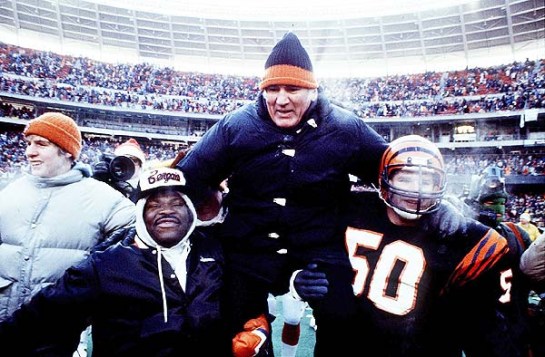
Eight days earlier, the Chargers had beaten the Miami Dolphins at the Orange Bowl, in an overtime thriller that was dangerously hot and humid. The weather conditions for this game couldn't have been more different. It was 9 degrees below zero Fahrenheit, and the wind chill factor dropped it to 59 below. It was the coldest game in NFL history, even colder than the 1967 NFL Championship Game in Green Bay, known as the Ice Bowl. By the coldest coincidence in NFL history, Forrest Gregg, the Hall of Fame offensive tackle who was key for the Packers in the Ice Bowl, was the head coaching of the Bengals in this game.
This one became known as the Freezer Bowl. And Cincinnati isn't even known for being especially cold, unlike its cross-State rival Cleveland. Nevertheless, 46,302 people showed up for this game.
For going from the dry heat of San Diego to the humidity of Miami to the frigidity of Cincinnati, the Chargers should have gotten hazard pay. They committed 4 turnovers, the Bengals jumped out to a 10-0 lead in the 1st quarter, and the game was never really in doubt. The Bengals won, 27-7, and were AFC Champions for the 1st time. After going through this kind of game again, and being carried off the field by his players, Gregg must have been glad that the ensuing Super Bowl XVI was going to be under a dome.
*
The NFC Championship Game kicked off at 2:00 Pacific Time, 5:00 Eastern Time. Candlestick Park was infamous for its winds, and baseball games there, especially at night, could be cold -- although not as cold as Cincinnati was on this day, or as cold as Green Bay has been for many Packers games. In fact, it was 52 degrees and sunny, with hardly any wind. I've often said that San Francisco is the only city in America with baseball weather in football season and football weather in baseball season.
Candlestick Park, set up for football
The Cowboys' 1st drive came to nothing. Montana made the most of this, and took the Niners downfield, resulting in an 8-yard touchdown pass to Freddie Solomon. The Cowboys came back with a field goal by Rafael Septién. The 49ers fumbled on their next possession, leading to Danny White throwing a 26-yard touchdown pass to Tony Hill. After 1 quarter, it was 10-7 Dallas.
In the 2nd quarter, Everson Walls of the Cowboys intercepted Montana in the end zone. Timing is everything, I suppose: This is not the play from the game for which we remember Walls. But the 49ers forced the Cowboys to punt, and Montana threw a 20-yard touchdown pass to Dwight Clark. Now, it was 14-10 San Francisco. And this is not the play from the game for which we remember Montana and Clark, either.
For years, fans complained that the Cowboys got favorable calls from the officials. Ronnie Lott, a rookie who went on to become perhaps the greatest defensive back of all time, intercepted a pass, but this was wiped out by a pass interference call. So, instead of 49er ball, it was a 35-yard Cowboy gain. And Tony Dorsett scored on a 5-yard run to make it 17-14 Dallas.
Late in the half, the 49ers recovered a fumbled punt in Dallas territory, but on a later play, Clark was called for an illegal block, and Montana then fumbled the ball away. Early in the 3rd quarter, Montana had another turnover, as he was intercepted by Randy White. But Danny White was then intercepted by Bobby Leopold, and this time, the Montana got the job done, driving the Niners until Johnny Davis ran 2 yards for a touchdown. It was 21-17 San Francisco.
Septién kicked a field goal early in the 4th quarter to make it 21-20. And Walls recovered a fumble, and Danny White threw a 21-yard touchdown pass to Doug Cosbie, and it was 27-21 Dallas. Walls intercepted Montana again, but the Cowboys couldn't convert, and had to punt. The 49ers got the ball back at their own 11, with 4:54 left in regulation.
What followed was one of the epic drives in NFL history. It included 30 yards of rushing by Elliott, and Solomon rushing for 15 and catching 2 passes for 18. With 58 seconds left, the Niners were at 3rd-and-goal on the Cowboy 6.
Walsh pulled a play out of the old Paul Brown playbook. He called it "Change Left Slot - Sprint Right Option." He had his offense practice it many times. But it had never been done with Clark as the 1st choice.
Montana took the snap. He rolled to his right. But Solomon was covered. He saw Clark in the end zone, and threw. Clark was covered by Walls, but jumped. He made what became known as The Catch. "I don't know what got me up there," Clark said. "It must have been God, or something." He got it: Touchdown, 49ers. Ray Wersching kicked the extra point, and it was 28-27 49ers.
But there were still 51 seconds to play, and the Cowboys only needed a field goal. And the Niners needed a key tackle by rookie cornerback Eric Wright on Drew Pearson to prevent a touchdown. On the next play, Lawrence Pillers sacked Danny White, forcing a fumble, which was recovered by Jim Stucky. Game over.
The photo at the top, by Walter Iooss Jr., became the cover of Sports Illustrated. It made Clark a legend, even if he wasn't as good as receiver as Solomon, or his later teammates Jerry Rice, Russ Francis or John Taylor. He died in 2018, from the effects of Lou Gehrig's disease.
*
On WNBC-Channel 4, sports anchor Marv Albert asked the station's news personalities who they thought would win the upcoming Super Bowl XVI: The Bengals, or the San Francisco 49ers. Co-anchor Sue Simmons said, "Cincinnati, because their helmets knock me out!"
After a losing season in 1982, the 49ers reached the NFC Championship Game in 1983, losing to the Redskins. In 1984, they went 15-1 in the regular season, and won Super Bowl XIX, beating the Miami Dolphins.
Having drafted Rice, they reached the Playoffs in 1985, 1986 and 1987. They won Super Bowl XXIII, winning a rematch with the Bengals; and Super Bowl XXIV, beating the Denver Broncos. Montana became the greatest quarterback of all time, and Rice the greatest receiver. DeBartolo, Walsh, Montana, Rice, Lott, Fred Dean and Charles Haley have been elected to the Pro Football Hall of Fame. Policy, Roger Craig, Randy Cross and Guy McIntyre should probably also be elected.
In the 1990 NFC Championship Game, the 49er dynasty game to an end, as they lost to the New York Giants, who went on to win Super Bowl XXV. Everson Walls, burned by The Catch, was a key figure on that Giants defense, so he gained a measure of redemption.
While this was going on, the Cowboys were falling apart, sold, and rebuilt. In 1992, '93 and '94, the Cowboys played the 49ers in the NFC Championship Game. The Cowboys won for '92 and '93, winning Super Bowls XXVII and XXVIII.
The 49ers won in 1994, with Steve Young having taken over at quarterback for Montana, and led them to win Super Bowl XXIX. They did so with former Chicago Bears Super Bowl MVP Richard Dent, and longtime New Orleans Saints linebacker Rickey Jackson, who won his 1st title. Both of them probably secured their Hall of Fame elections with this win. The 49ers also had Deion Sanders that season, but he signed with the Cowboys the next season, and they won Super Bowl XXX, without having to go through the 49ers in the Playoffs. Both teams remained Playoff-capable for the rest of the 1990s.
In 2019, a poll ranked the Dwight Clark Game 2nd on a list of the 100 Greatest Games of the NFL's 1st 100 years. The Freezer Bowl was ranked 67th.
Super Bowl XVI was played at the Silverdome in the Detroit suburb of Pontiac, Michigan. The 49ers beat the Bengals, 26-21.
UPDATE: The 49ers have a team Hall of Fame. From the 1950s, they have inducted founding owner brothers Tony and Vic Morabito, quarterback Y.A. Tittle; running backs Joe Perry, John Henry Johnson and Hugh McElhenny; receivers Gordie Soltau and R.C. Owens, offensive tackle Bob St. Clair, and defensive tackle Leo Nomellini. Tittle, Perry, Johnson, McElhenny, Soltau, Owens, St. Clair, Nomellini, quarterback Frankie Albert, running back Ollie Matson, receiver Billy Wilson and coach Lawrence "Buck" Shaw have been elected to the Bay Area Sports Hall of Fame (BASHOF).
From the 1960s and 1970s, they have inducted quarterback John Brodie, defensive tackle Charlie Krueger, linebacker Dave Wilcox, and cornerback Jimmy Johnson -- not to be confused with the later Dallas coach, and no relation to John Henry Johnson. Brodie, Wilcox, Johnson and receiver Gene Washington have also been inducted into BASHOF.
From the Super Bowl teams of the 1980s, they have inducted quarterback Joe Montana, running backs Roger Craig and Tom Rathman; receivers Dwight Clark, Jerry Rice and John Taylor; tight end Brent Jones, defensive end "Mean" Fred Dean, linebacker Charles Haley, cornerback Ronnie Lott, head coach Bill Walsh, assistant coach George Seifert, executive John McVay and Eddie DeBartolo. Montana, Craig, Clark, Rice, Jones, Lott, Walsh, McVay, Seifert, DeBartolo, linebacker Keena Turner and executive Carmen Policy were also inducted into BASHOF.
From the Super Bowl XXIX winners of the 1994-95 season, they have inducted Rice, Taylor, Jones, Seifert (now head coach), McVay, DeBartolo, quarterback Steve Young, and defensive tackle Bryant Young (no relation). Both Youngs have also been inducted into BASHOF. Among players since that last Super Bowl win, the 49ers have inducted receiver Terrell Owens, running back Frank Gore, and linebacker Patrick Willis. Willis has also been inducted into BASHOF.
The Bengals have a Ring of Honor. From their early days, they have inducted cornerback Lemar Parrish. From their 1981 AFC Champions, they have inducted founding owner Paul Brown, quarterback Ken Anderson, receiver Isaac Curtis, guard Dave Lapham, offensive tackle Anthony Muñoz, and cornerback Ken Riley.
From their 1988 AFC Champions, they have inducted Brown, Muñoz, quarterback Norman "Boomer Esiason, and defensive tackle Tim Krumrie. From the 1990s, they have inducted running back Corey Dillon and offensive tackle Willie Anderson. From the 2000s, they have inducted receiver Chad "Ochocinco" Johnson. They have not yet inducted any players from the 2010s, or from their 2021 AFC Champions.
*
January 10, 1982 was a Sunday. Actor Paul Lynde, most famous as the center square on the game show The Hollywood Squares, died that day.
In addition to the Conference Championship Games, there were 4 games played in the NBA that day:
* The New York Knicks lost to the Washington Bullets, 129-126 at Madison Square Garden.
* The Boston Celtics beat the Detroit Pistons, 134-124 at the Boston Garden. Larry Bird scored 40 points and had 16 rebounds. This was before the Pistons became "The Motor City Bad Boys" and replaced the Celtics as the dominant team in the NBA's Eastern Conference. Isiah Thomas was just a 20-year-old rookie.
* The Milwaukee Bucks beat the Los Angeles Lakers, 118-107 at The Forum outside Los Angeles in Inglewood, California.
* And the Houston Rockets beat the Portland Trail Blazers, 111-109 at the Portland Memorial Coliseum. Moses Malone scored 34.
And there were 2 games played in the NHL. The St. Louis Blues beat the Boston Bruins, 3-2 at the Boston Garden. And the Detroit Red Wings beat the Minnesota North Stars, 4-1 at the Joe Louis Arena in Detroit.



No comments:
Post a Comment