
December 10, 1937: Burdine Stadium opens in Miami. It will later be renamed for the annual college football extravaganza it hosted, on or around each New Year's Day: The Orange Bowl.
Roddy Burdine ran Burdine's department store in Miami from 1911 until his death in 1936, and his civic contributions helped Miami to grow into a major city. After his death, the city named the stadium it was building after him.
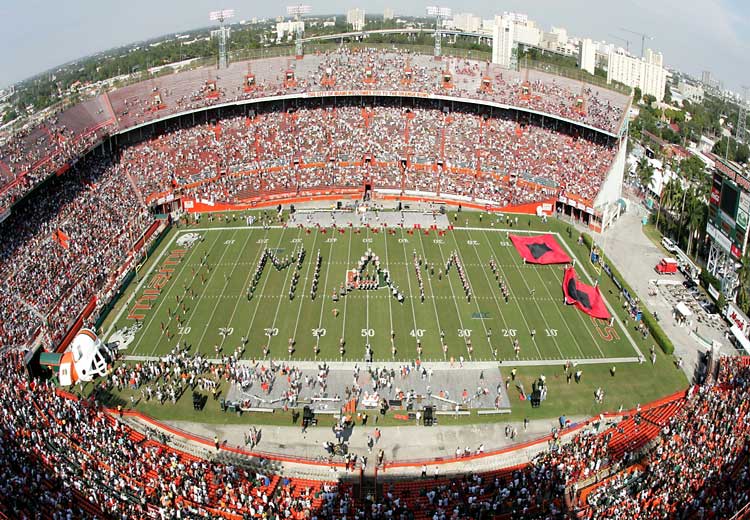
It was on a large block bounded by Northwest 3rd Street to the south, Northwest 16th Avenue to the west, Northwest 6th Street to the north, and Northwest 14th Avenue to the east, the end of the stadium that formed the open end of the horseshoe. Miami Park had already hosted football games on this site, including the 1st 3 Orange Bowl games in 1935, '36 and '37. On December 10, 1937, the 23,330-seat Burdine Stadium opened with the team that would play there the longest, the University of Miami, losing to the University of Georgia, 26-0.
The stadium was renamed the Orange Bowl in 1959, and was steadily expanded until reaching 76,062 in 1955, and 80,010 in 1968. Modernization included wider seats, which kept the capacity to around 75,000 from 1981 onward. In 1970, the natural grass was torn up, and replaced with an artificial turf called PolyTurf, but it only lasted until 1975.
In 1946, the All-America Football Conference was founded, and with it, the 1st major league sports team in the South, the Miami Seahawks. They were badly underfunded, went just 3-11, and moved before the next season, becoming the Baltimore Colts. Pro football returned in 1966, with the Miami Dolphins. They played there until 1986, then moved into Joe Robbie Stadium in suburban Miami Gardens in 1987.
The Orange Bowl hosted Super Bowl II in 1968: Green Bay Packers 33, Oakland Raiders 14; Super Bowl III in 1969: New York Jets 16, Baltimore Colts 7, in one of the greatest upsets in pro football history; Super Bowl V in 1971: Baltimore Colts 16, Dallas Cowboys 13; Super Bowl X in 1976, Pittsburgh Steelers 21, Dallas Cowboys 17; and Super Bowl XIII in 1979, Steelers 35, Cowboys 31.
/cdn.vox-cdn.com/uploads/chorus_image/image/55898287/77092866.0.jpg)
Facing east, with palm trees,
and downtown Miami in the background
The Orange Bowl game was first played at Joe Robbie Stadium in 1997, played there again in 1998, moved back to its namesake stadium in 1999, and has been played at the Miami Gardens facility, now named Hard Rock Stadium, from 2000 onward. The University of Miami Hurricanes stayed at the Orange Bowl a bit longer, finally making the move in 2008.
The Hurricanes played in the Orange Bowl game on their home field in 1946, beating Holy Cross; 1951, losing to Clemson; 1984, famously beating Number 1 Nebraska to take a would-be National Championship away from them; 1988, beating Number 1 Oklahoma to win another National Championship; 1989, beating Nebraska again, but only finishing Number 2; 1992, beating Nebraska again, this time as Number 1 and the favorites to win the National Championship; and 1995, again threatening to take the National Championship away from Nebraska, but this time Nebraska redeemed themselves.
(Since the game moved to the suburbs, the Hurricanes have played in it in 2004, beating arch-rival Florida State for the 2nd time that season; and in 2017, losing to Wisconsin.)
And, just as the Hurricanes opened the stadium with a loss, so, too, did they close it with one, on November 10, 2007, losing to the University of Virginia, 48-0. The stadium was demolished in 2008, and the new home of the Miami Marlins, now named LoanDepot Park, opened on the site in 2012.
*
December 10, 1937 was a Friday. Baseball was out of season. The NBA hadn't been founded yet. The NHL season was underway, but no games were scheduled. The NFL Championship Game was played 2 days later, with the Washington Redskins beating the Chicago Bears. And Miami's loss to Georgia was the only college football game played. So it was the only score on this historic day.


No comments:
Post a Comment