
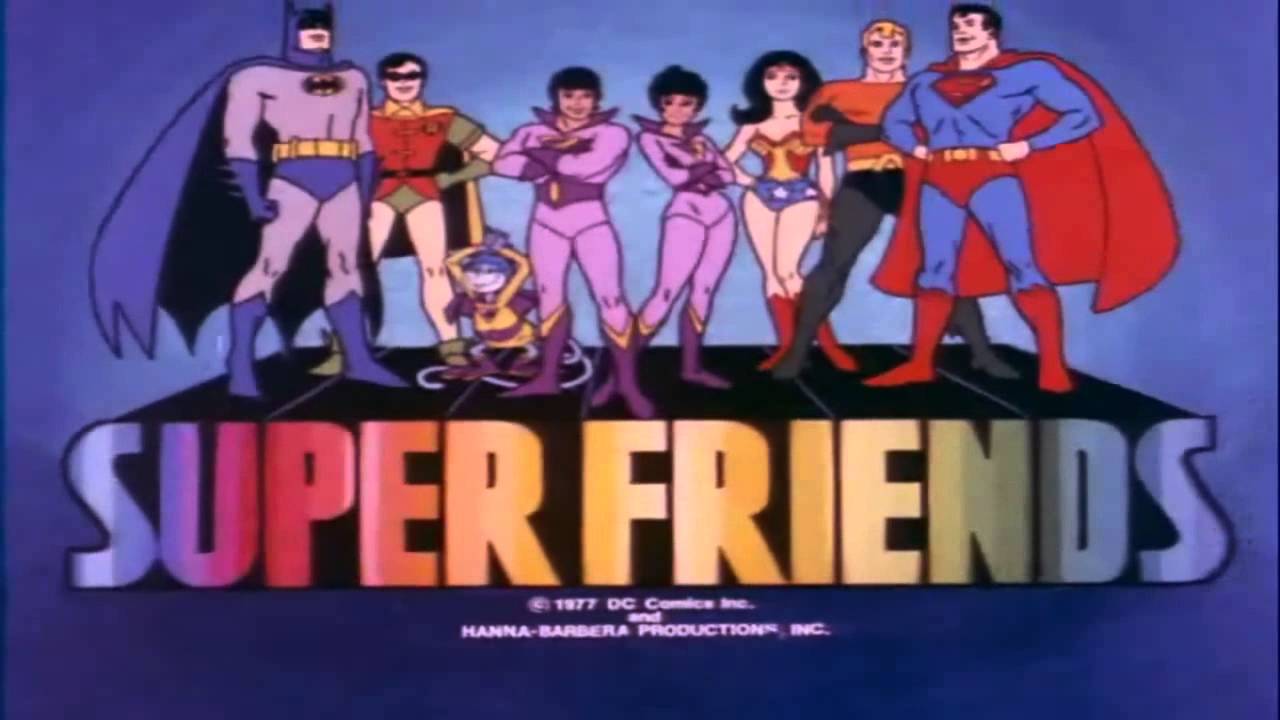
Left to right: Wonder Dog, Aquaman, Robin, Batman,
Superman, Wonder Woman, Wendy and Marvin.
Note the early '70s bell-bottom pants on both teenagers.
September 8, 1973: Super Friends premieres on ABC, based on the superheroes of DC Comics. Produced by Hanna-Barbera Productions, it runs in one form or another until 1986. The animation was crude by today's standards, but, as a kid, I didn't care.
The original series, narrated by Ted Knight, a.k.a. Ted Baxter of The Mary Tyler Moore Show -- "Later, at the Hall of Justice... " -- was kid-centric. Wendy Harris (voiced by Sherry Alberoni) and Marvin White (Frank Welker) were ordinary teenagers, who had no powers, but considered themselves superheroes, or at least detectives, in training.
They had a dog named Wonder Dog (also voiced by Welker, who specialized in voicing cartoon dogs), whose only special abilities were a higher intelligence than most dogs and, sort of, the ability to talk. They were taken in by the Super Friends, who can be recognized as a subset of the Justice League.
It's understandable that the show used Superman (Danny Dark), Batman (Olan Soule), Robin (Casey Kasem) and Wonder Woman (Shannon Farnon). After all, Kal-El/Clark Kent, Bruce Wayne and Princess Diana of Themiscyra/Diana Prince are what are now called "the DC Trinity"; and, as the original Robin, Dick Grayson was Batman's sidekick. It had only been 5 years since the Adam West Batman series had gone off the air, and this version of the Dynamic Duo was more like West and Burt Ward than like later "Dark Knights" and their "Boy Wonders."
Less obvious as a choice to round out the main superhero cast was Aquaman (Norman Alden). For those of you who only know later versions, showing him with long hair and looking more like Marvel Comics' Thor -- or in the darker-skinned, dark-haired, long-haired, tattooed version played by Jason Momoa in the DC Extended Universe movies -- his appearance as a very pale white man with short but curly hair might make him seem like an anachronism.
There were occasional visits from other superheroes. Knight also voiced The Flash. Alden also voiced Green Arrow and Plastic Man. But each of these characters appeared in only one episode. In flashback sequences, we saw Superman's Kryptonian parents, Jor-El (Kasem) and Lara (Farnon); and his earthly parents, Jonathan Kent (Soule) and Martha Kent (Farnon again).
In later versions, Dark would also play Batman's ally, Gotham City Police Commissioner James Gordon. Farnon would also play Wonder Woman's mother, Queen Hippolyta; Superman's girlfriend and Daily Planet co-worker, Lois Lane; and, from Greek mythology, goddess of love Aphrodite and monster Medusa.
Super Friends taught me to read closing credits. I noticed that Robin sounded an awful lot like Shaggy from Scooby-Doo, Where Are You? So I looked at the credits of both shows, and wrote them down, and found two names in common: Kasem and Welker. When I found out from other shows that Welker was also the voices of Fred from Scooby, Astro from The Jetsons, Dynomutt the Dog Wonder (with Laugh-In's Gary Owens as the Batman-like Blue Falcon) and the title character in Jabberjaw, that narrowed him down to Marvin and Wonder Dog, and showed me that Kasem was Robin.
In the 1976-77 TV season, ABC's The Krofft Supershow had a segment titled Electra Woman and Dyna Girl, played by soap opera star Deidre Hall and car pitchwoman (as "Mean Mary Jean") Judy Strangis, respectively. This show copied Wonder Woman by having female superheroes, copied Batman by having an older hero and a younger sidekick with a corny catchphrase ("Electra-Wow!"), and copied Superman by making them reporters in civilian life. And Alden, the voice of Aquaman, played Frank Heflin, who was less their version of Batman and Robin's butler/all-around tech whiz Alfred than he was Oscar Goldman to their Six Million Dollar Man and Bionic Woman.
Only one season of 16 episodes of Super Friends was made, although they continued to be shown in reruns. But the ABC success of Lynda Carter's Wonder Woman series and Electra Woman and Dyna Girl, and The Shazam/Isis Hour on CBS, gave ABC and Hanna-Barbera the idea to try again.
In 1977, they brought us The All-New Super Friends Hour. Noting that the core audience was a little older, Wendy, Marvin and Wonder Dog were phased out. Phased in were the Wonder Twins. They were teenagers, from the planet Exor, and they were obviously geared toward not just older kids and teenagers, but Trekkies, because they looked like Vulcans: Vaguely Asian faces, the same hairstyles, and pointed ears.
Left to right: Batman, Robin, Gleek, Zan,
Jayna, Wonder Woman, Aquaman, Superman
Unlike Wendy, Marvin and Wonder Dog, Zan (Michael Bell) and Jayna (Liberty Williams) had powers. Not a mind-meld or a nerve pinch like Vulcans. When they touched their hands, and said, "Wonder Twin powers, activate!" Jayna could say, "Shape of... " any animal, and transform into that animal. Zan could say, "Form of... " any version of water, from ice to boiling water to fog to a solid wall of liquid water.
Suddenly, Aquaman's sea-based powers didn't seem so silly: Zan was mainly comic relief. But if that wasn't enough, they had a pet monkey named Gleek (also voiced by Bell), with a rubber tail that could be used as a weapon and, if he spun it in the air like a helicopter's rotor, he could use to fly.
It still wasn't a full Justice League of America, but there were, again, cameos from other heroes, usually one guest appearance per episode. Barney Phillips took over as The Flash (the Barry Allen version). Michael Rye voiced Green Lantern (the Hal Jordan version). Jack Angel voiced Hawkman, and Farnon voiced Hawkgirl (never "Hawkwoman"). Wally Burr voiced The Atom.
Then there were the heroes created just for this series, having never before appeared in comic books. This was an attempt to appear diverse, or, as we would now say, multicultural. But the characters, all too often, seemed like stereotypes anyway.
While there were black superheroes before this, including DC's electric-powered Black Lightning and the John Stewart version of Green Lantern, they didn't use any of them for Super Friends. They wanted to use Black Lightning, but there was a legal wrinkle that prevented them from doing so. So, they created Black Vulcan (Buster Jones). No, it wasn't a black version of Star Trek's Mr. Spock: Basically, he was Black Lightning, with electric powers and a somewhat different black-and-gold costume. That and the name allowed them to meet the legal requirements. (The original Vulcan was the Roman name for the god of fire, known as Hephaestus to the ancient Greeks.)
The Asian hero was Samurai (also Jack Angel), who had wind-based powers, similar to the DC character Red Tornado. And there was a Native American hero, Apache Chief (also Michael Rye). He could grow to enormous size, which also gave him super strength and near-invulnerability. But their costumes were little better than how John Wayne would have imagined their peoples.

Clockwise from top: Superman, Hawkman, Samurai, Green Lantern,
Robin, Batman, Wonder Woman, Aquaman, Flash,
Jayna, Zan, Gleek, Black Vulcan and Apache Chief.
The Hall of Justice was based on Union Terminal in Cincinnati,
hometown of the owners of Hanna-Barbera Productions,
Taft Broadcasting (and related to President William Howard Taft).
For the 1978-79 season, Challenge of the Superfriends (one word) was made. Now, the denizens of the Hall of Justice are a full 11-member Justice League of America (JLA): Superman, Batman, Robin, Wonder Woman, Aquaman, Flash, Green Lantern, Hawkman, Black Vulcan, Samurai and Apache Chief. (But no Green Arrow, Plastic Man, Hawkgirl or Wonder Twins. By this point, Plastic Man had gotten his own show.)
And now, they had regular enemies, with a headquarters looking like Star Wars character Darth Vader's helmet (come on, let's call a spade a spade) rising out of a swamp: The Legion of Doom. Its members:
* Lex Luthor (Stanley Jones), arch-enemy of Superman. (In this series, Jones also did the voices of Superman's fathers, Jor-El and Jonathan Kent. What Sigmund Freud would have thought of that, I have no idea.)
* Bizarro (Bill Callaway), imperfect duplicate of Superman.
* Brainiac (Ted Cassidy, formerly Lurch on The Addams Family and the narrator of the opening sequence to CBS' The Incredible Hulk), robotic enemy of Superman. (Cassidy died of heart trouble during the season, only 46 years old.)
* Mr. Mxyzptlk (another Frank Welker role), magical enemy of Superman.
* Solomon Grundy (Jimmy Weldon), an incredibly strong and durable zombielike creature that debuted in the 1940s an enemy of the "Golden Age" Green Lantern, Alan Scott, but later became an enemy of Superman and, occasionally, other heroes.
* The Toyman (another Frank Welker role), enemy of Superman, but hardly on the same level as the preceding.
* The Riddler (Michael Bell, also Zan and Gleek), enemy of Batman. (The Riddler was chosen because they couldn't get the legal rights to use the Joker or the Penguin. It's just as well: The Riddler is smarter than either one.)
* The Scarecrow (Don Messick), enemy of Batman. (Messick was also the original voice of Scooby-Doo.)
* The Cheetah (Marlene Aragon), catlike arch-enemy of Wonder Woman.
* Black Manta (also Ted Cassidy), arch-enemy of Aquaman.
* Sinestro (also Don Messick), arch-enemy of Green Lantern.
* Gorilla Grodd (Stanley Ralph Ross), a member of The Flash's "Rogues Gallery." (Ross had been a writer on the 1966-68 Batman series, and a co-creator of the 1975-79 Wonder Woman series.)
* Captain Cold (Dick Ryal), also a Flash enemy. (Cold's sometimes partner, at the other extreme of temperature, Heat Wave, never appeared. Nor did the Flash's true nemesis, Professor Zoom, a.k.a. the Reverse-Flash. In a flashback sequence, Ryal also voiced Abin Sur, the dying Green Lantern who gave his power ring to Hal Jordan.)
* The Pied Piper (Bob Hastings), also a Flash enemy.
* Giganta (Ruth Forman), a giantess created for the series. Being a woman, she would seem to be an opponent for Wonder Woman. However, an episode explained that she got her powers at the same time, and from the same source, that Apache Chief got his, making for a dual origin story.
New versions of the series would continue until 1986, by which point I was too old to watch. But there would be live-action versions to come, with Superman getting 4 movies and 2 TV shows (Superboy and Lois & Clark: The New Adventures of Superman, plus a Supergirl movie), Batman getting 4 movies, and The Flash getting a single-season TV series on CBS. There would be the NBC special Legends of the Superheroes in 1979, which had the first live-action versions of The Flash, Green Lantern, The Atom and Hawkman. However, a typically small TV special-effects budget rendered it ridiculous.
Superman: The Movie came out in late 1978, and when Lois Lane (Margot Kidder) meets Superman (Christopher Reeve) for the first time, she asks him, "Who are you?" Not yet having been named Superman (in this version, it was Lois who gave him the name in her article), he says simply, "A friend." It may not have been intentional, but, in hindsight, it seems like an "Easter Egg" for Super Friends fans like me.
In 1992, Batman: The Animated Series would launch "The DC Animated Universe," which ran until 2006. Among the other series included in it were Superman: The Animated Series, The New Batman Adventures, Batman Beyond (set in a future with an elderly Bruce Wayne training a teenager, Terry McGinnis, to be a new, updated Batman, rather than the latest in a long line of Robins), Justice League and Justice League Unlimited. These shows were definitely meant for older kids, who would understand the dark themes of the Batman mythos, not little kids.
A 1997 Justice League of America movie would have only second-tier heroes, including the first live-action version of J'onn J'onzz, the Martian Manhunter, because getting the legal rights to use Superman, Batman and Wonder Woman would have been prohibitively expensive. Between 2005 and 2010, The CW's Superman prequel series Smallville would feature the first live-action versions of Aquaman, Green Arrow, and the Wonder Twins, plus new versions of some other heroes.
And, in 2020, in the last episode of The CW's Crisis On Infinite Earths, a Justice League consisting of Superman (Tyler Hoechlin), Supergirl (Melissa Benoist), Batwoman (Ruby Rose), The Flash (Grant Gustin), the White Canary (Caity Lotz), the Martian Manhunter (Dorian Harewood) and Black Lightning (Cress Williams) gathered for the first time, with an empty seat at the table in memory of Green Arrow (Stephen Amell), who had sacrificed his life to restart the multiverse.
Their building looked like the Hall of Justice. And at the end, while the old Super Friends theme played, the camera panned up to an open cage marked "GLEEK." I have to say, despite having just turned 50, I got a kick out of that.
*
September 8, 1973 was a Saturday. These games were played in Major League Baseball:
* The New York Yankees beat the Milwaukee Brewers, 15-1 at the original Yankee Stadium, in its last month before closing for a 2-season renovation. George "Doc" Medich went the distance for the win. Graig Nettles hit a home run (not a big surprise), as did Fred "Chicken" Stanley (a huge surprise).
* The New York Mets lost to the Montreal Expos, 3-1 at Jarry Park in Montreal. Steve Rogers -- no, not Captain America -- outpitched Tom Seaver.
* The Detroit Tigers beat the Boston Red Sox, 6-1 at Fenway Park in Boston. Al Kaline did not play. He was better off than Carl Yastrzemski, who went 0-for-5.
* The Pittsburgh Pirates beat the Philadelphia Phillies, 5-3 at Veterans Stadium in Philadelphia. Willie Stargell went 3-for-3 with an RBI. Rookie Mike Schmidt went 2-for-3 with a walk and an RBI.
* The Atlanta Braves beat the Cincinnati Reds, 3-2 at Atlanta Stadium (later Atlanta-Fulton County Stadium). Hank Aaron hit the 709th home run of his career. Dusty Baker and Davey Johnson, both now better known for being managers, also homered for the Braves. For the Reds, Joe Morgan hit a home run, but Pete Rose and Johnny Bench each went 0-for-3 with a walk.
* The Baltimore Orioles beat the Cleveland Indians, 6-1 at Cleveland Municipal Stadium. Brooks Robinson went 3-for-4 with a solo homer. Jim Palmer went the distance for the win.
* The Chicago Cubs beat the St. Louis Cardinals, 3-1 at Wrigley Field in Chicago. Ron Santo homered for the Cubs. Lou Brock went 1-for-3 with a walk and 2 stolen bases.
* The Minnesota Twins beat the Chicago White Sox, 6-2 at Metropolitan Stadium in the Minneapolis suburb of Bloomington, Minnesota. Neither Harmon Killebrew nor Rod Carew played for the Twins in this game.
* The California Angels swept a doubleheader from the Kansas City Royals at Royals Stadium (now Kauffman Stadium) in Kansas City, 9-6 and 4-3. Frank Robinson went 1-for-10 with an RBI for the Angels. George Brett, who had made his major league debut a month earlier, did not appear in the opener, and only appeared in the nightcap as a pinch-runner and a defensive replacement, never coming to bat.
* The Texas Rangers beat the Oakland Athletics, 4-3 at Arlington Stadium in the Dallas suburb of Arlington, Texas. Reggie Jackson went 0-for-1, then left the game due to an injury.
* The San Diego Padres beat their arch-rivals, the Los Angeles Dodgers, 9-6 at Dodger Stadium in Los Angeles. Jerry Morales doubled home the winning run in the top of the 11th inning.
* And the Houston Astros beat the San Francisco Giants, 9-7 at Candlestick Park in San Francisco.
Since it was Saturday, there was college football. However, most teams, including Number 1 USC, Number 2 Ohio State, Number 3 Texas, Number 5 Michigan, Number 6 Alabama, Number 7 Penn State and unranked Navy, opened the next week. Number 8 Notre Dame, unranked Army, and, locally, Rutgers opened the week after that; and Princeton and Columbia the week after that.
The only game this week involving a Top 5 team also happened to involve another Top 10 team: Number 4 Nebraska beat Number 10 UCLA, 40-13 at Memorial Stadium in Lincoln, Nebraska. It was the Cornhuskers' 1st game under head coach Tom Osborne.
Also, Arsenal lost 2-0 at home at Highbury to Leicester City.


No comments:
Post a Comment