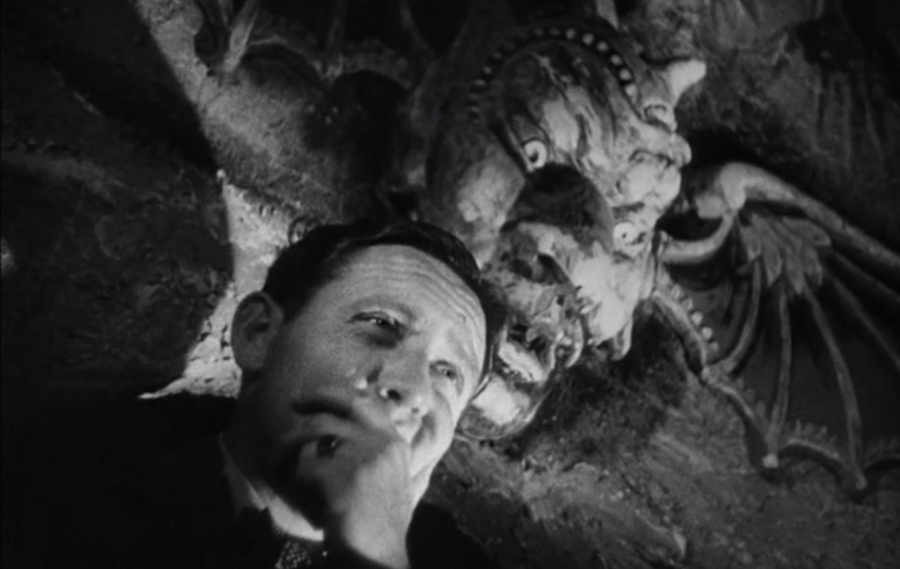
No wonder Spencer Tracy later played priests
in Boys Town and Angels with Dirty Faces.
August 23, 1935: The film Dante's Inferno premieres, the last film produced by Fox Film Corporation before merging with Twentieth Century Pictures, forming 20th Century-Fox Film Corporation.
It was directed by Harry Lachman, who got his start as a painter, honored by France with their Legion d'Honneur, and then as a set designer for films. He directed 37 films between 1928 and 1942, before giving it up and returning to painting. He died in 1975.
Spencer Tracy plays Jim Carter, a former stoker, who takes over a fairground show, run by "Pop" McWade (Henry B. Walthall), which depicts scenes from Dante's Inferno. He marries Pop's niece Betty (Claire Trevor), and they have a son, Alexander.
The show becomes a great success, with Carter making it larger and more lurid. An inspector declares the fair unsafe, but Carter bribes him into silence. There is a partial collapse at the fair which injures Pop. Recovering in the hospital, he admonishes Carter, and we see a 10-minute vision of the Inferno, Hell as imagined by Dante. Undeterred, Carter establishes a new venture with an unsafe floating casino, only for disaster to strike again at sea. Since Carter was ultimately punished for his misdeeds, the Hays Code allowed the film's version of Hell to be portrayed, as a foreshadowing.
The film is loosely based on the Divine Comedy, an epic poem written between 1308 and 1321 by Dante Aligheri. At the time, and even into the time of William Shakespeare, a "comedy" was not something funny, merely a story with a happy ending. And the Divine Comedy sure didn't look, early on, like it would have one.
The poem explores the condition of the soul following death, and portrays a vision of divine justice, in which individuals receive appropriate punishment or reward based on their actions. It describes Dante's travels through Hell, Purgatory, and Heaven
Allegorically, the poem represents the soul's journey towards God, beginning with the recognition and rejection of sin (Inferno), followed by the penitent Christian life (Purgatorio), which is then followed by the soul's ascent to God (Paradiso).
Dante draws on medieval Catholic theology and philosophy, especially Thomistic philosophy, derived from the Summa Theologica, written by Thomas Aquinas and left unfinished at the time of his death in 1274, nearly half a century earlier.
In the poem, the pilgrim Dante, age 35 -- "halfway along our life's path," so perhaps he's having what would now be called a "midlife crisis" -- is accompanied by three guides: Virgil, who wrote the Aeneid and lived through the Roman transition from Republic to Empire in the 1st Century BC, who represents human reason, and who guides him for all of Inferno and most of Purgatorio; Beatrice, who may have been based on Beatrice Portinari, a wealthy banker's daughter Dante had fallen in love with but couldn't have, who died at age 25, and represents divine revelation, grace, and faith, and who guides him from the end of Purgatorio onwards; and Saint Bernard of Clairvaux, a 12th Century French abbot, co-founder of the Knights Templar, who represents contemplative mysticism, and devotion to St. Mary, mother of Jesus, guiding him in the final cantos of Paradiso.
The Gates of Hell include a phrase that has lived in human memory for 700 years: "Abandon all hope, ye who enter here." There is an edge area, called Limbo, home to "virtuous pagans," people stay who should have been allowed to enter Heaven, but cannot, because they lived in the time before Christ. As examples, Dante gives Virgil himself, his contemporaries Julius Caesar (who was certainly not virtuous) and Cicero, and the great philosophers of classical Greece: Socrates, Plato and Aristotle.
But then, there are nine "circles of Hell," in which people's punishments get worse depending on the nature of their sins, and the punishments are considered appropriate. For example, fortune-tellers and soothsayers must walk with their heads on backwards, unable to see what is ahead, because that was what they had tried to do in life.
The 9th circle is reserved for the worst sin of all: Betrayal. And at the very bottom is the Devil himself. He is forever chewing on three damned souls: Those of Judas, who betrayed Jesus; and Brutus and Cassius, who betrayed the other great hero of medieval Italy, Julius Caesar.
This would seem at odds with Dante's admiration for Cicero, whose relationship with Caesar was complicated, going back and forth between support and opposition. He was pleased that Caesar was assassinated, thinking it would save the Republic. But Brutus and Cassius didn't let Cicero in on their conspiracy, for fear he would betray them to Caesar. And Mark Antony, who picked up Caesar's fight, and within 3 years of Caesar's assassination, Cicero was assassinated, and Brutus and Cassius were defeated in battle by Antony and Caesar Augustus, and committed suicide rather than be captured. Antony and Augustus would later split, and Augustus would win and establish the Empire. Neither is mentioned in the Divine Comedy.
Dante and Virgil escape Hell by sliding down the Devil's body, and ascend out of the undergloom to the Mountain of Purgatory on the far side of the world. The Mountain is on an island, and has seven terraces, corresponding to the seven deadly sins: Pride, Envy, Greed, Wrath, Sloth, Lust and Gluttony.
The classification of sin here is more psychological than that of the Inferno, being based on motives, rather than actions. It is also drawn primarily from Christian theology, rather than from classical sources. However, Dante's illustrative examples of sin and virtue draw on classical sources, as well as on the Bible and on contemporary events.
As Virgil is a "virtuous pagan," he can take Dante no further, so it is Beatrice who brings him from the Purgatorio to the Paradiso, with its 9 celestial spheres. The seven lowest spheres of Heaven deal the four cardinal virtues: Prudence, Fortitude, Justice and Temperance; then the three theological virtues: Faith, Hope and Charity. (The numbers 7 and 9 both feature in the story a few times.)
Dante meets and converses with several great saints of the Church, including Thomas Aquinas, Bonaventure, Peter and John the Evangelist. Near the end, Beatrice departs, and Bernard of Clairvaux takes over as the guide. The story ends with Dante seeing the Triune God: Father, Son and Holy Spirit. He admits that the vision of Heaven he receives is merely the one his human eyes permit him to see, and thus his personal vision.
Dante had been born in Florence, around 1265. During his time, most Northern Italian city states were split into two political factions: The Guelphs, including Dante's family, who supported the Papacy, and the Ghibellines, who supported the Holy Roman Empire. He became a physician, and held some political offices.

After the Battle of Campaldino on June 11, 1289, in which Dante fought on the victorious Guelph side, the Guelps split into the White Guelphs, supporting the Pope, to whom Dante stayed loyal, and the Black Guelphs, who wanted more freedom. The Black Guelphs took over Florence in 1301, and Dante was exiled the following year. In 1312, Henry VII, the Holy Roman Emperor, invaded Florence and defeated the Black Guelphs. But he died of a fever the next year, ending Dante's chances of ever returning to Florence, and he remained in Verona. (The story of Romeo and Juliet took place in Verona, and is said to have occurred at around this time.)
A local prince invited Dante to live in Ravenna, where he died of malaria on September 14, 1321, at the age of 56. He appears to have finished the Divine Comedy not long before his death. But it would be 1472 before a printed edition appeared. Some historians consider that appearance to be the beginning of the Italian Renaissance.
Because of his reaction to the leading forces of the time, the Protestant Reformation looked upon Dante as a hero. In 1841, the Scottish historian Thomas Carlyle, known for promoting "The Great Man Theory of History," wrote of Dante, "He is world-great not because he is worldwide, but because he is world-deep... Dante is the spokesman of the Middle Ages; the Thought they lived by stands here, in everlasting music."
In 1921, in honor of the 600th Anniversary of his death, Pope Benedict XV promulgated an encyclical naming Dante as one "of the many celebrated geniuses of whom the Catholic faith can boast" and the "pride and glory of humanity." In 1965, in honor of the 700th Anniversary of his birth, Pope Paul VI promulgated a motu proprio celebrating him. In 2008, the Municipality of Florence officially apologized for expelling him over 700 years earlier. (Even Galileo didn't have to wait that long for a Papal apology.)
There are many references to Dante's work in literature. Franz Liszt was one of many composers to write works based on the Divine Comedy. He inspired multiple statues by the sculptor Auguste Rodin. In 2021, London's Royal Opera House staged The Dante Project, a ballet based on the Divine Comedy.
The sheer scope of the poem makes a single film covering the whole thing problematic. The 1935 Dante's Inferno became the best-known attempt at covering even part of it, until 1975, when Piero Paolo Pasolini's film Salò, or the 120 Days of Sodom, was released, horrifying viewers, with one critic calling it "the sickest film ever made." It was heavily influenced by the Inferno, and, by a macabre coincidence, was also completed just before the author's death, in 1975. Unlike Dante, who managed to avoid it, Pasolini was murdered.
*
August 23, 1935 was a Friday. These baseball games were played:
* The New York Yankees beat the St. Louis Browns, 6-3 at Sportsman's Park in St. Louis. Lou Gehrig hit a 3-run home run in the top of the 13th inning, making Johnny Murphy a winning pitcher in relief of Lefty Gomez.
* The New York Giants lost to the Chicago Cubs, 7-4 at the Polo Grounds. Larry French outpitched Clydell "Slick" Castleman. Augie Galan went 4-for-5 with a walk and an RBI. Stan Hack went 4-for-4 with a walk. For the Giants, 1st baseman and manager Bill Terry went 1-for-5, and Mel Ott went 0-for-4.
* The Brooklyn Dodgers were swept in a doubleheader by the St. Louis Cardinals, 6-1 and 11-5 at Ebbets Field. Neither Dizzy Dean nor his brother Paul, who hated the nickname "Daffy," pitched in either game, although the winning pitcher in the nightcap had a name that would live in history -- music history. His name was Phil Collins.
Over the 2 games, Terry Moore went 6-for-8 with a walk and an RBI, future Dodger shortstop and manager Leo Durocher went 5-for-10 with 2 RBIs, Pepper Martin went 3-for-10 with 4 RBIs, Joe Medwick went 4-for-10 with an RBI, and Cards 2nd baseman and manager Frankie Frisch went 3-for-10 with 2 RBIs.
* The Pittsburgh Pirates beat the Boston Braves, 7-5 at Braves Field in Boston. 3rd baseman and manager Harold "Pie" Traynor and shortstop Joseph "Arky" Vaughan each went 1-for-4 with a walk, right fielder Paul "Big Poison" Waner went 3-for-5, center fielder Lloyd "Little Poison" Waner went 2-for-5, and each of them had an RBI.
* The Cleveland Indians beat the Philadelphia Athletics, 10-1 at League Park in Cleveland. Mel Harder outpitched Carl Doyle. Joe Vosmik and Hal Trosky hit home runs for the Tribe. Jimmie Foxx went 1-for-4 with an RBI for the A's.
* The Detroit Tigers beat the Boston Red Sox, 6-0 at Navin Field (later Briggs Stadium and Tiger Stadium) in Detroit. Lynwood "Schoolboy" Rowe pitched a 4-hit shutout. In his own cause, he went 2-for-4 with a home run and 3 RBIs. Hank Greenberg went 0-for-4, but had an RBI on a sacrifice fly. Mickey Cochrane, catcher and manager, went 1-for-3 with a walk.
* The Washington Senators beat the Chicago White Sox, 4-3 at Comiskey Park in Chicago. Les Tietje walked John Stone with the bases loaded, forcing Heinie Manush home with the winning run in the top of the 10th inning.
* And, with the Great Depression in mind, the Cincinnati Reds and the Philadelphia Phillies agreed to move their game set for today, at Baker Bowl in Philadelphia, to the next day, in the hopes that a Saturday doubleheader would bring a bigger crowd. If so, we'll never know if it worked, because the attendances for both Thursday afternoon and Saturday afternoon were not recorded. The Reds swept, 9-5 and 13-2.


No comments:
Post a Comment