
June 19, 1970: "I'm 30 years old, and I have these dreams." With those words, Jim Bouton, once a star pitcher on the New York Yankees, but now a marginal major leaguer due to injury and a reputation as an oddball, began his diary of the 1969 baseball season, which was published in book form on this day, with the title of Ball Four: My Life and Hard Times Throwing the Knuckleball in the Big Leagues.
Nobody, not even Jim himself, had any idea of the impact that this book would have. It's almost as if the Major League Baseball pitching career that he had already had was becoming secondary. But then, as much as he loved baseball, Bouton was not all about it. He understood that it is often (Cliché Alert) a microcosm of life, but it is not life and death.
Bouton was born on March 8, 1939 in Newark, New Jersey, and grew up in nearby suburban Rochelle Park, Bergen County, and then in suburban Chicago Heights, Illinois. He got a baseball scholarship to Western Michigan University, in Kalamazoo. He was signed by the New York Yankees for $30,000.
When he reached the major leagues in 1962, he was given uniform Number 56, a very high number for the time. Later that season, clubhouse manager Pete Sheehy said he could now receive a smaller number, recommending 29. Jim said that he would rather keep 56, to remind him of just how difficult it is to stay in the major leagues.
Jim went 7-7 that year. The Yankees won the World Series, and he got a ring, but he did not appear in the Series. In 1963, just 24 years old, he went 21-7 with a 2.53 ERA, and made the All-Star Game for what turned out to be the only time. His fastball and gruff demeanor on the mound earned him the alliterative nickname "Bulldog" Bouton. Fans also loved that his unusual pitching motion caused his hat to frequently fly off his head.
In 1964, he went 18-13, helping the Yankees win a tight Pennant race, and won Games 3 and 6 of the World Series against the St. Louis Cardinals, but the Yankees lost Game 7. As Spring Training 1965 began, Jim was about to turn 26, and had a good fastball, legendary teammates, postseason experience, a career record of 46-27 -- and a salary of $26,500, an increase of $8,000 over the previous season. (A salary of $26,500 in 1965 would be about $254,000 in 2022 money.)
But he hurt his elbow that year, one of many injuries that seemed to strike the old Yankee Dynasty at once. The Yankees finished 6th, and, for reasons that were almost entirely not his fault, Jim went 4-15. That was when the nastier side of the old Yankee organization reared its head. When Jim was winning, his class clown antics got him labeled "colorful." His teammates didn't mind his intellectualism, his lefty politics, his outspokenness, or his impersonation of comedian Frank Fontaine in his "Crazy Guggenheim" role on The Jackie Gleason Show. But when he was losing, they acted like those things did bother him, and they didn't want to know him.
By 1968, the Dynasty was dead. The Seattle Pilots, an expansion team that was going to begin play the next season, bought him from the Yankees, and assigned him to their top farm team, so that he could get work. As Spring Training came in 1969, he was about to turn 30, and he didn't know if he had enough left to make even a brand-new expansion team.
Another way that Jim was different was that he was friends with Leonard Shecter of the New York Post, one of the new breed of sportswriters nicknamed "The Chipmunks." Most Yankees hated him, because he was critical of them. Bouton and Shecter agreed that most books "written by ballplayers" (always dictated to a sportswriter, who would arrange it so that it only made the player look good) were sappy, sanitized stories, usually about the big names, and that it would be more interesting if a marginal player wrote a book about just how hard it was to make a living in baseball.
This was not a new idea: Jim Brosnan, a decent but not great pitcher, kept a diary in 1959, a season which saw him get traded from the Cardinals to the Cincinnati Reds. It was published as The Long Season, and got praise from some sources, and disdain from the baseball establishment, which presaged what Bouton would later go through. So there was precedent.
This was not a new idea: Jim Brosnan, a decent but not great pitcher, kept a diary in 1959, a season which saw him get traded from the Cardinals to the Cincinnati Reds. It was published as The Long Season, and got praise from some sources, and disdain from the baseball establishment, which presaged what Bouton would later go through. So there was precedent.
Jim began writing notes at the Pilots' training camp in Tucson, Arizona. Just as he started writing, 2 things happened that would shape public perception of the book. One was that he negotiated his contract for the season, at a time when players were bound by baseball's reserve clause, which (as the owners defined it) bound them to a team for life, unless traded or released. Jim used the opportunity to describe his struggles to get what he thought he was worth from the Yankees. Given his current status, and the Pilots' financial struggles, Jim knew he couldn't get a big salary, and when they offered him $22,000, he took it without haggling.
The other big thing that happened was that Mickey Mantle retired, after 18 years of heroics and injuries. Jim told about how well Mickey had treated him. He also told about how Mickey could be juvenile and drunk, and not nice to young autograph seekers. (I wonder if he ever told any of them to "Take a hike, son.")
He also told about how ballplayers were womanizers and Peeping Toms (engaging in "beaver shooting"), about their drinking, about their use of pep pills (a.k.a. "greenies"), and how they could do all kinds of things that were in poor taste.
 be
beJim Bouton in a Seattle Pilots away uniform,
at Tiger Stadium in Detroit
He began to suspect that manager Joe Schultz, pitching coach Sal Maglie, and general manager Marvin Milkes didn't trust him, because he was an oddball throwing an oddball pitch (the knuckleball -- not the screwball).
Maglie had a legitimate case: He was once not just a great pitcher, with one of the best curveballs of his time. He was also a former New York Giant, and one of Jim's heroes. But Milkes was out of his depth as a baseball executive.
And Schultz should have understood marginal players better, as he was one, a backup catcher in the 1940s. He was a coach on the St. Louis Cardinals' 1960s Pennant winners, but he seemed to forget that he was no longer working for Cardinals owner and beer baron Gussie Busch. He was always telling his players, "Zitz 'em, and go pound some Budweiser!" He was a company man even after leaving the company. (Jim said, "I've never zitzed anybody before. It sounds like fun.")
Apparently, it wasn't just Milkes being a typical baseball GM of the time, cheap as hell for the sake of greed. Owners Max and Dewey Soriano, brothers, really couldn't afford to buy the team and keep it going. At the end of Spring Training 1970, they finally gave up, and sold the team to Milwaukee car dealer Bud Selig, who quickly got permission to move them, and a week later, they debuted in the regular season as the Milwaukee Brewers.
The fact that the team's operation was so ridiculous, that they only existed for that 1 season, makes the Pilots seem more like a team in a rebel league, like the American Basketball Association of 1967-76, the World Hockey Association of 1972-79, or the World Football League of 1974-75. Those facts, and the fact that the current Seattle team, debuting in 1977, is named the Mariners, not the Pilots, makes Ball Four seem like a novel, played up for laughs and absurdity, as if the Pilots never actually existed. But they did.
That a player they were trying to push around fought back at least as hard just deepened the baseball establishment's anger toward him. He had just gone even further in violating what had become known as "the sanctity of the clubhouse." That was why the players were angry at him.
Jim would plead his case for more appearances, even starts, and Joe would nod, munch on a liverwurst sandwich, and tell Jim what he wanted to hear, and then not do it. Schultz was fired after that season, and remained a coach in the majors through 1976, but never managed again except on an interim basis with the 1973 Detroit Tigers.
"Establishment" players on the Pilots, like shortstop Ray Oyler and pitcher Fred Talbot (a former Yankee teammate) tended to stay away from Jim. Other oddballs, like pitcher Mike Marshall and outfielder Steve Hovley, gravitated toward him.
The Pilots had talent. Oyler was an exceptional fielder, though he couldn't hit a lick. Outfielder and former National League batting champion Tommy Davis, had helped the Los Angeles Dodgers win the 1963 World Series, before an ankle injury curtailed his career and made him unavailable for their runs to the 1965 and '66 Series. 1st baseman Don Mincher had helped the Twins win the 1965 Pennant. Pitchers Bouton, Talbot, Marshall and Steve Barber, who had helped the Baltimore Orioles win the 1966 World Series, had all had their days in the Sun -- and Marshall, once away from this team, and converted to a reliever, would have many more
But injuries (including Barber's remark, "My arm's not sore, it's just a little stiff"), Schultz's bad managing, and Milkes' penny-pinching doomed the team to a 64-98 finish, 6th and last place in the AL West, in that 1st season of Divisional Play.
Apparently, it wasn't just Milkes being a typical baseball GM of the time, cheap as hell for the sake of greed. Owners Max and Dewey Soriano, brothers, really couldn't afford to buy the team and keep it going. At the end of Spring Training 1970, they finally gave up, and sold the team to Milwaukee car dealer Bud Selig, who quickly got permission to move them, and a week later, they debuted in the regular season as the Milwaukee Brewers.
The fact that the team's operation was so ridiculous, that they only existed for that 1 season, makes the Pilots seem more like a team in a rebel league, like the American Basketball Association of 1967-76, the World Hockey Association of 1972-79, or the World Football League of 1974-75. Those facts, and the fact that the current Seattle team, debuting in 1977, is named the Mariners, not the Pilots, makes Ball Four seem like a novel, played up for laughs and absurdity, as if the Pilots never actually existed. But they did.
In a 2000 interview with baseball historian Rob Neyer for ESPN.com, Jim, unaware of my assessment, backed it up:
The Pilots existed for only one year. It's almost a magical story. They're like "Brigadoon." It's a Major League Baseball team that, in many respects, exists only within the pages of a book. It's like a fictional baseball team, so the characters in the book have almost become like fictional characters.
And they were perfect for the book. It was gold. Everyone one of those players was an interesting story, in one way or another. You had rookies, and you had grizzled veterans...
It was a perfect cast of characters, almost as if somebody had said, "This team's not going to win any games, but if someone writes a book, this'll be a great ballclub."
By the time that they moved, Jim was long gone. On August 24, the Pilots traded him to the Houston Astros. The difference was huge: Jim went from a dysfunctional 1st-year expansion team trying and failing to stay out of last place, in a 30-year-old but already antiquated ballpark, in front of an average of 8,400 fans a night; to an 8th-year team in its 1st Pennant race (but they tailed off in September, finishing 81-81), in the then-modern Astrodome, in front of 18,000 much more enthusiastic fans a night.
Jim began the 1970 season on the Astros' big-league roster, and things seemed to be going, if not especially well, then at least smoothly. Then came May, and Look magazine published an excerpt from Ball Four. The excerpt included the sensational "Mantle wasn't such a great guy" part. (The magazine went out of business the next year. No, I'm not blaming Bouton for that.)
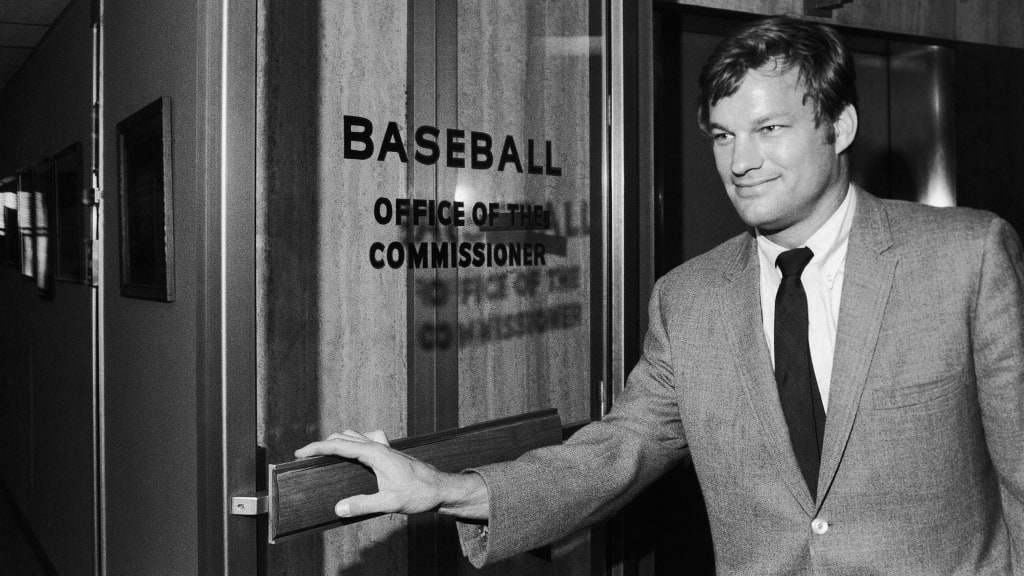
The public reaction was horrible. Jim was booed in every ballpark. Commissioner Bowie Kuhn summoned Jim to his Midtown Manhattan office. They met on June 1. Kuhn told Jim to disavow the book before it could be published in full form: Say that he'd made a lot of it up, or that Shecter had made a lot of it up, or that Shecter had manipulated into saying it.
Jim refused to lie, and wouldn't back down. He said it was all true. He said that any player whose marriage was now on the rocks because of what he wrote was probably not in a particularly strong marriage anyway. He said that he didn't name names when it came to actually cheating on wives.
Jim refused to lie, and wouldn't back down. He said it was all true. He said that any player whose marriage was now on the rocks because of what he wrote was probably not in a particularly strong marriage anyway. He said that he didn't name names when it came to actually cheating on wives.
He went further than simply defending himself and his work: He struck back, and said that he purposely left a lot of things out, like certain players going for underage girls, or spouting racist and anti-Semitic remarks, and that he was actually trying to protect the sport from what would have happened had he named names with such things.
Like Muhammad Ali, Tommie Smith and Curt Flood
at the time, and like Colin Kaepernick many years later,
Jim was willing to stand for something,
even if it meant sacrificing everything.
That a player they were trying to push around fought back at least as hard just deepened the baseball establishment's anger toward him. He had just gone even further in violating what had become known as "the sanctity of the clubhouse." That was why the players were angry at him.
The team owners were angry at him because he depicted them as greedy and petty, revealing their secrets to keeping salaries low -- in his words, because, "I was showing just how hard it was to make a living in baseball." Bouton testified in Curt Flood's trial, which unsuccessfully challenged the reserve clause, by reading passages from Ball Four.
America had decided that it couldn't handle the truth, and Jim Bouton was telling it. He recalled a game in Cincinnati, with the Reds' Pete Rose, who had become a part of the baseball establishment, yelling at him, "Fuck you, Shakespeare!" When Mantle was asked about him, instead of getting nasty, he stayed in character, and took the funny road out, saying, "Jim Who?"Bouton said the backlash wasn't getting to him. But on July 29, with a record of 4-6 and an ERA of 5.40, despite having pitched decently in 9 of his last 11 outings, he was sent down to the minor leagues. The knuckleball didn't work there, either.
Bouton left baseball at the height of the controversy, to become a sportscaster, but made a comeback, and returned to the major leagues at age 39, as a September callup with the 1978 Atlanta Braves, even winning a game.
Bouton closed the book with these words: "You spend a good piece of your life gripping a baseball and in the end it turns out that it was the other way around all the time." I've felt the same way about the book itself.
In 1994, after getting out of rehab for his alcoholism, Mantle called Bouton. He wasn't home, but Mantle left a message on his answering machine, saying he was never angry at him for having written the book, or saying what he said in it.
There was a rumor that Mantle was the reason that Bouton was never invited back to Yankee Stadium for Old-Timers Day. Mantle told him that it wasn't him. In 1998, after the deaths of Mantle due to liver failure and Jim's daughter, Laurie Bouton, in a car crash, Jim's son, Michael, wrote an open letter to the Yankees, appearing in The New York Times, asking the Yankees to invite Jim to Old-Timers Day, to make amends, and to comfort him in his time of need.
They did. He was introduced, and got a standing ovation from a crowd of 55,638, including myself. He also pitched in the Old-Timers Game, presumably throwing a knuckleball, and losing his hat on purpose.
Jim Bouton died on July 10, 2019, during the 50th Anniversary of the season portrayed in the book.
*
June 19, 1970 was a Friday. Rahul Gandhi, the son, grandson and great-grandson of Prime Ministers of India, and later the Leader of their political party, was born on this day.
The World Cup was between its Semifinals and its Final, in which Brazil beat Italy, 4-1 at Estadio Azteca in Mexico City.
These Major League Baseball games were played:
* The New York Yankees lost to the Boston Red Sox, 7-4 at Fenway Park in Boston. Sonny Siebert outpitched Stan Bahnsen. Carl Yastrzemski, Reggie Smith and Mike Andrews hit home runs for the BoSox, Roy White for the Yankees.
* The New York Mets beat the Philadelphia Phillies, 13-3 at Shea Stadium. Tom Seaver went the distance, striking out 11 and walking none. Jim Bunning didn't get out of the 1st inning, allowing 7 runs.. Ken Boswell and Wayne Garrett hit home runs for the Mets. This was the Phils' last season at Connie Mack Stadium, formerly Shibe Park. The next season, they moved into Veterans Stadium.
* The Baltimore Orioles swept a doubleheader from the Washington Senators, 12-10 and 3-2 at Memorial Stadium in Baltimore. Over the 2 games, Brooks Robinson went 1-for-9 with a walk and 2 RBIs, and Frank Robinson went 3-for-8 with a home run, 2 walks and 2 RBIs. Merv Rettenmund won the 2nd game by singling home Davey Johnson in the bottom of the 13th inning.
* The Atlanta Braves swept a doubleheader from the Houston Astros, 7-6 and 4-2 at Atlanta Stadium (later Atlanta-Fulton County Stadium). Hank Aaron went 2-for-8 with 2 RBIs, including his 573rd career home run. Doug Rader hit 2 home runs for the Astros in the nightcap, which suggests that he hadn't read what Bouton wrote about him. Bouton did not get into either game.
* The Pittsburgh Pirates beat the Montreal Expos, 8-4 at Forbes Field in Pittsburgh. Neither Roberto Clemente nor Willie Stargell played, and Bill Mazeroski only appeared as a pinch-hitter (not, as you might think, as a defensive replacement), although he did get a hit. Just 10 days later, the Pirates played their last game at Forbes Field. Just 17 days after that, they played their 1st game at Three Rivers Stadium.
* The Cleveland Indians beat the Detroit Tigers, 4-2 at Cleveland Municipal Stadium. Al Kaline went 0-for-2 with 2 walks.
* The Los Angeles Dodgers beat the Cincinnati Reds, 6-1 at Crosley Field in Cincinnati. The Reds' only run came on a solo home run by Johnny Bench, who went on to win the National League's Most Valuable Player award. Pete Rose went 1-for-4 with a walk. Just 5 days later, the Reds played their last game at Crosley Field. Just 6 days after that, they played their 1st game at Riverfront Stadium.
* The St. Louis Cardinals beat their arch-rivals, the Chicago Cubs, 5-3 at Wrigley Field in Chicago. The Cards led 3-1 going into the bottom of the 8th, but the Cubs got a run in the 8th and another in the 9th, to send the game to extra innings. The game went 17 innings, in a ballpark that didn't have lights. Fortunately, they were 3 days short of the longest day of the year. In the top of the 17th, with the bases loaded and 2 out, Ted Simmons singled home Lou Brock and Dick Allen (in his only season with St. Louis).
Al Hrabosky, "the Mad Hungarian," was the winning pitcher. The losing pitcher for the Cubs was former Pilot Steve Barber. His arm must have been sore, or at least a little stiff. (Ball Four reference.)
* The Kansas City Royals beat the Minnesota Twins, 5-1 at Kansas City Municipal Stadium. Harmon Killebrew went 0-for-4, but Rod Carew went 3-for-4 with an RBI.
* The San Diego Padres beat the San Francisco Giants, 6-3 at San Diego Stadium (later renamed Jack Murphy Stadium and Qualcomm Stadium). Willie Mays went 0-for-2 with 2 walks.
* The former Pilots, the Milwaukee Brewers, beat the California Angels, 5-2 at Anaheim Stadium (now Angel Stadium of Anaheim).
* And the Chicago White Sox beat the Oakland Athletics, 4-2 at the Oakland Coliseum. Reggie Jackson went 1-for-3 with a walk.


No comments:
Post a Comment