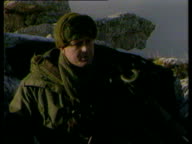
Major Dawson
June 14, 1982: "I see a white flag over Stanley!" So said Major Bill Dawson, in a scene that, like the flag-raising on Iwo Jima, was re-enacted, this time for television instead of for film. In fact, what he saw wasn't a white flag: It was laundry on a clothesline.
Nevertheless, the myth essentially became reality: Argentina soon surrendered to Britain, and the Falklands War was over.
The Falkland Islands are about 500 miles east of the coast of Argentina, and nearly 8,000 miles from Britain. By that measure, it would make sense if they belonged to Argentina. But, historically, such things don't make much sense.
John Strong, a British captain who became the 1st European to find them, in 1690, named them for the Treasurer of the Royal Navy, who funded his journey: Anthony Carey, 5th Viscount Falkland. France claimed them in 1764, and surrendered their claim to them to Spain in 1766. The British came, and Spain gave them up in 1774.
Argentina gained their independence from Spain in 1816, and claimed the Islands, giving them the name Islas Malvinas, which is based on the name the French gave them: Îles Malouines, naming them after their point of departure in France, Saint-Malo. But they never had the military strength to take the Islands away from Britain.
In 1976, a Fascist military junta gained control of Argentina. Despite a propaganda campaign that included victory in soccer's 1978 World Cup on home soil, the country's economy was in tatters, in part because thousands of people had been taken out of it by being imprisoned and "disappeared."
Leopoldo Galtieri was installed as President on December 22, 1981, and, like so many dictators of troubled countries, he decided his country needed a win. Admiral Jorge Anaya suggested taking the Falklands, thinking that the British would decide that the Islands weren't worth fighting for.

Leopoldo Galtieri
On April 2, Argentina invaded and captured the Falkland Islands, and nearby South Georgia Island. It was a stunning success: Not since Spain had been kicked out of Latin America in the 1820s had a South American nation won such a victory.
Except the 2,247 people living on the Islands thought they were worth fighting for, and they got word to London that they wanted to stay under British law and British culture. Prime Minister Margaret Thatcher promised them that they would be liberated.
.jpg?utm_source=en.wikipedia.org&utm_campaign=index&utm_content=original)
On April 8, President Ronald Reagan, not wanting an intercontinental war, sent Secretary of State Alexander Haig, a former 4-star U.S. Army General, to London, to try to work out a peace deal. Thatcher, Reagan's greatest international ally, said no: All Argentine troops must be removed, and if they would not remove their own troops, Britain would do it for them. On April 11, Haig gave up and flew home.
On April 25, the Royal Navy and the Royal Marines retook South Georgia Island. Thatcher said, "Just rejoice at that news, and congratulate our forces and the Marines!" Galtieri could have accepted the message, and gotten out of the Falklands, to avoid a complete defeat. He didn't.
On May 2, the submarine HMS Conqueror sank the ARA General Belgrano, killing 323 Argentine sailors. Two days later, the destroyer HMS Sheffield was sunk by Argentina's 2nd Naval Air Fighter/Attack Squadron, killing 20 men. It was the 1st sinking of a Royal Navy vessel since 1945, and a reminder that this war would not be as easy as "The Iron Lady" had hoped.
On May 21, Argentine planes sank the frigate HMS Ardent, killing 22. On May 25, Argentine planes sank the destroyer HMS Coventry, resulting in 20 deaths. And on June 12, the destroyer HMS Glamorgan was hit by a missile. It wasn't sunk, but 13 sailors were killed.
But on May 21, British troops landed at San Carlos Water on the north coast of East Falkland Island. (There are 2 main Islands, East and West, and several much smaller islands.) They moved quickly, until June 14, when the surrender became official -- regardless of whether there was actually a white flag, the traditional symbol of surrender, or at least of truce.
To make matters worse for Argentina, their soccer team, which had won the World Cup in 1978, flopped in the 1982 edition. They got to the Second Group Stage, making them 1 of the last 12 teams, but lost to Italy and to arch-rivals Brazil. What was worse, the tournament was in Spain, a post-Fascist Spain, so they were reading newspapers in their own language, with no reason to be pro-Junta, and they were reading the truth about what, and how, their country was doing back home, and it shocked them that they were playing for both a military and an economy that was in freefall.
Britain lost 255 men. Argentina lost 649 men, lost the Islands, and lost face. Thatcher's popularity soared, and she easily led the Conservative Party to an election victory in 1983. She rewarded the Islanders by heavily investing in their infrastructure.

The Flag of the Falkland Islands.
Still British.
Galtieri was removed from power by the Junta on June 17. The next year, free elections were held, democracy was restored, and he was arrested. He was convicted in 1986, and served 3 years in prison before being pardoned. In 2002, he was arrested on new charges, but was deemed to ill to be tried, and was still under house arrest in Buenos Aires when he died in 2003, at the age of 76.
In the 1985 Trial of the Juntas, Admiral Anaya was acquitted of war crimes. He was placed under house arrest in 2005, but, like Galtieri, was deemed to ill to be tried, and was still under house arrest in Buenos Aires when he died in 2008, at 81.

Anaya's opposite number was Admiral John Fieldhouse, a 54-year-old Leeds native. He was rewarded for his command victory by being named First Sea Lord and Chief of Naval Staff, promoted to Admiral of the Fleet in 1985, retired in 1989, and was named Baron Fieldhouse of Gosport in 1990. He died in 1992.

I can find no record of what happened to Major Bill Dawson after he thought he saw a white flag over Stanley.
Chile, like Argentina under a Fascist military government, had been threatening them with war over the rights to islands off the coasts of both countries, and had provided aid to the British war effort. In 1984, Argentina's new democratic government signed an agreement, basically giving Chile's President Augusto Pinochet everything he wanted.
Some Argentines saw their country's defeat of England in the 1986 World Cup, thanks to Diego Maradona's "Hand of God" goal, as revenge for the Falklands War. Certainly, the soccer rivalry between the nations has remained intense. England had introduced the sport to them, as they had to many countries around the world. They had also introduced Argentina to rugby, and they remain the most successful country at that sport in South America.
Argentina has since had conservative governments, but never another Fascist and/or military government. They have threatened to take the Falklands again, but it has never gone past the talking stage. As of a census taken in 2021, the Islands' population is 3,662. In 2013, a sovereignty referendum was held. Out of 1,650 eligible voters, 1,516 voted. The Yes side, the side that wanted to remain under British law, won, 1,513 to 3. That is not a typographical error: One thousand, five hundred and thirteen voted Yes, and three voted No.
*
June 14, 1982 was a Monday. The World Cup was underway in Spain. Two games were played that day. Brazil beat the Soviet Union, 2-1 at Estadio Ramón Sánchez-Pizjuán in Seville. And Italy and Poland played to a 0-0 draw at Estadio Abanca Balaídos in Vigo.
And these Major League Baseball games were played:
* The New York Yankees beat the Boston Red Sox, 5-1 at Yankee Stadium. Ron Guidry outpitched Dennis Eckersley. Dave Collins, acquired because George Steinbrenner wanted to build a new, post-Reggie Jackson team around speed, hit a home run instead. It was Dave Winfield, signed the previous year for his power, who hit a single and stole a base. Carl Yastrzemski went 1-for-3 with a walk and an RBI.
* The New York Mets beat the Pittsburgh Pirates, 2-1 at Three Rivers Stadium in Pittsburgh. Pete Falcone outpitched Don Robinson. Ellis Valentine hit a home run for the Mets, Bill Madlock for the Pirates. Willie Stargell, in his last season, did not play.
* The Baltimore Orioles beat the Milwaukee Brewers, 9-4 at Memorial Stadium in Baltimore. Scott McGregor outpitched Moose Haas. Eddie Murray went 1-for-3 with a walk and an RBI. Rookie Cal Ripken Jr. went 1-for-4. Robin Yount went 1-for-4. Paul Molitor went 0-for-3 with a walk.
* The Oakland Athletics beat the Toronto Blue Jays, 4-2 at Exhibition Stadium in Toronto. Rickey Henderson went 1-for-4 with a stolen base.
* The Cleveland Indians swept a doubleheader from the Detroit Tigers, 5-0 and 2-1 at Cleveland Municipal Stadium. Len Barker pitched a 4-hit shutout.
* The Chicago Cubs beat the Philadelphia Phillies, 12-11 at Wrigley Field in Chicago. One of many Phils-Cubs shootouts where the wind seemed to be blowing out at "The Friendly Confines." Fergie Jenkins outpitched Steve Carlton. The Cubs got home runs from Bump Wills, Jody Davis and Leon Durham. The Phillies got them from Pete Rose, Mike Schmidt and Garry Mathews.
* The St. Louis Cardinals beat the Montreal Expos, 2-1 at Busch Memorial Stadium in St. Louis. Bob Forsch outpitched Bill Gullickson.
* The Kansas City Royals beat the Minnesota Twins, 3-0 at Royals Stadium (now Kauffman Stadium) in Kansas City. Paul Splittorff allowed 5 hits over 8 innings, and Dan Quisenberry finished the 5-hit shutout. George Brett went 2-for-4 with a solo home run.
* The Houston Astros beat the Atlanta Braves, 9-0 at the Astrodome in Houston. Joe Niekro pitched a 6-hit shutout.
* The Los Angeles Dodgers beat the San Diego Padres, 4-3 at Jack Murphy Stadium in San Diego. Dusty Baker hit a home run in the top of the 11th inning. Steve Howe was the winning pitcher, in relief of Fernando Valenzuela.
* The Seattle Mariners beat the Texas Rangers, 4-0 at the Kingdome in Seattle. Jim Beattie allowed 3 hits over 6 innings, and Mike Stanton (not the later Braves and Yankees reliever) finished the 3-hit shutout.
* And the California Angels, the Chicago White Sox, the Cincinnati Reds and the San Francisco Giants were not scheduled.


No comments:
Post a Comment