
April 21, 1951: Bill Barilko becomes hockey's version of Bobby Thomson -- nearly 6 months before Thomson becomes baseball's version of Barilko.
Barilko was a 24-year-old defenseman of Ukrainian descent, from the mining town of Timmins, Ontario. He had already helped the Toronto Maple Leafs win the Stanley Cup in 1947, 1948 and 1949. The 1951 Stanley Cup Finals against the Montreal Canadiens was unusual in that every game went to overtime.
Game 1, at Maple Leaf Gardens in Toronto, was won 5 minutes and 51 seconds in, on a goal by Sid Smith. Game 2 in Toronto was won after 2:55 by the Canadiens' Maurice Richard, a.k.a. "The Rocket," the greatest and most popular player in the sport at the time. The action shifted to the Montreal Forum, but the Leafs won Game 3 4:47 into overtime on a goal by Ted Kennedy. Then they won Game 4 5:15 into overtime on a goal by Harry Watson.
(Unlike the longtime U.S. Senator from Massachusetts and brother of President John F. Kennedy, who was one of many men named Edward who ended up being nicknamed "Ted" or "Teddy," the man who scored the Game 3 winner was born Theodore Samuel Kennedy, was nicknamed "Teeder," and was the Leafs' Captain at the time.)
The series returned to Toronto for Game 5. There was no scoring in the 1st period. Richard scored midway through the 2nd period, but Tod Sloan tied it back up. Paul Meger gave the Canadiens a 2-1 lead less than 5 minutes into the 3rd period, but Sloan equalized with just 32 seconds left in regulation.
At the 2:53 mark of overtime, Barilko, much like Bobby Orr would be in overtime of Game 4 of the 1970 Finals, was tripped up, but still managed to get a shot off. It went past Canadien goalie Gerry McNeil, and the Leafs won the game 3-2, and the series 4-1.
"It was as clean as a hound's tooth," Toronto Daily Star writer Red Burnett said. "McNeil never had a chance." Hockey fans tend to blame goaltenders who give up big goals considerably less than baseball fans blame pitchers who give up big home runs. And so, McNeill, who would be the starting goalie when the Habs won the Cup in 1953, before giving way to Jacques Plante, would not live in infamy. He lived until 2004.
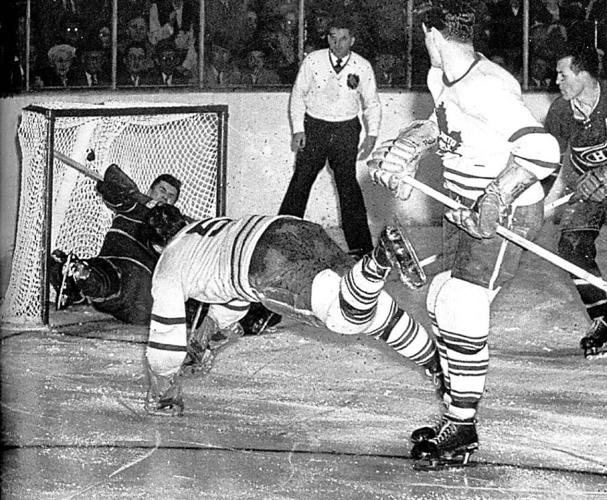
The most familiar photo of the goal, taken by Nat Turofsky
It was the Leafs' 4th Cup in the last 5 years, and their 10th overall. At the time, no other team had more: The Canadiens had 6.
Another angle, showing Barilko's face,
and that of Maurice Richard, who clearly knows it's over.
The Leafs were a great team, with 4 players who went on to be elected to the Hockey Hall of Fame: Centers Kennedy and Max Bentley, defenseman Fern Flaman, and goaltender Walter "Turk" Broda. Barilko could have become another of them: He was a classic "defensive defenseman," a hard checker who enjoyed rough play. He wasn't regarded as dirty, so no one begrudged him his status as a national hero across Canada -- at a time when there were only 6 teams in the National Hockey League, and just 2 of them in Canada, the Leafs and the Canadiens.
In 1998, The Hockey News released their list of the
100 Greatest Hockey Players. Bentley was ranked 48th, Kennedy 57th, Broda 60th. In 2017, each of them was named to the NHL's 100th
Anniversary 100 Greatest Players.
A little over 4 months after his epic goal, Barilko went on a fishing trip with his dentist, Henry Hudson. Hudson was a licensed pilot, and he took Barilko on a Fairchild 24 floatplane, from Timmins to Waskaganish, Quebec, on James Bay.
There was some irony in this. James Bay is an extension of Hudson Bay, where an earlier Henry Hudson, the discoverer of the river in New York that would be named for him, disappeared in June 1611, on a voyage to find the Northwest Passage.
Barilko and Hudson caught a few fish, and, the weekend over, on August 26, 1951, they boarded the Fairchild. Hudson headed it back for Timmins, about 400 miles away.
They never arrived. Plane disappearances in the northern reaches of North America were nothing new. The last attempt at the 1st nonstop flight between the European and North American continents before Charles Lindbergh successfully did it took off from France, and was believed to have been crashed in the woods of northern Maine, or the Canadian Province of New Brunswick, and has still never been found. But this was different: Bill Barilko, the man who had won the most recent Stanley Cup, a new national hero, was missing.
Barilko did not live long enough to build a Hall of Fame career. But the Leafs did retire his Number 5. Or, at least, they thought they had: In 1992, someone working in the front office discovered that, while no player had worn it in 41 years, there had never been an official retirement ceremony for it. One was held on October 17, 1992.
The Leafs stopped winning. Over the next 7 seasons, of the 14 available places in the Stanley Cup Finals, 7 were won by the Canadiens (in other words, they made it every year), 4 by the Detroit Red Wings, and 3 by the Boston Bruins. The Leafs rebuilt, and got back to the Finals in 1959 and 1960, but lost to the Canadiens both times.
On April 22, 1962, the Leafs won the Cup again, dethroning the Chicago Black Hawks in the Finals. Had Barilko not died, he would have been 35 years old, and could still have been playing. Certainly, Leafs head coach and general manager George "Punch" Imlach was known to favor veterans.
Just 45 days after that Cup win, on June 6, helicopter pilot Ron Boyd was flying about 60 miles north of Cochrane, Ontario, when he spotted the wreckage of a plane. He reported it, and it was discovered to be Dr. Henry Hudson's Fairchild 24. His body, and Barilko's, were remarkably well preserved in the cold after 11 years. The wreck and the records were examined, and it was determined that Hudson's inexperience as a pilot, too much cargo (too many fish?), and bad weather doomed the plane.
There was something poetic about Barilko being found only after the Leafs won the Cup again, beginning a run of 3 straight, and 4 in 7 years -- at which point Barilko would have been 40 and, knowing Imlach, could still have been getting game time.
But since the last of those Cups, in 1967, they have never even reached the Stanley Cup Finals again. This time, there was no harbinger of trouble, like a plane crash. It was just bad management.
*
April 21, 1951 was a Saturday. The NBA Championship was also decided that day, and also in overtime, but in a Game 7. The Rochester Royals defeated the New York Knicks, 79-75 at the Edgerton Park Arena in Rochester, New York. I have a separate entry for that event.
There were also Major League Baseball games played that day:
* The New York Yankees beat the Washington Senators, 8-7 at Griffith Stadium in Washington. The Yankees led 5-0 going into the bottom of the 6th inning, but Frank "Spec" Shea imploded. Allie Reynolds was brought in to stop the bleeding, but couldn't, and the Senators scored 7 runs.
But in the top of the 8th, Mickey Mantle, who had made his major league debut only 4 days earlier, doubled home Phil Rizzuto with the winning run. Joe DiMaggio, the man that right fielder Mantle was being groomed to replace in center field, also had an RBI double. Tom Ferrick ended up as the winning pitcher.
* The Brooklyn Dodgers beat the New York Giants, 7-3 at the Polo Grounds. Jackie Robinson hit a home run off Larry Jansen. Ralph Branca won the game in relief of starting pitcher Chris Van Cuyk. For the 1st 3/4 of the season, the Dodgers would have the edge over the Giants. Even the arrival of Willie Mays from the minor leagues in May didn't help much at first. But in mid-August, things began to change, resulting in the game that would make Bobby Thomson the Bill Barilko of baseball.
* The Boston Red Sox beat the Philadelphia Athletics, 6-3 at Fenway Park in Boston. Ted Williams hit a home run.
* The Boston Braves beat the Philadelphia Phillies, 8-6 at Shibe Park in Philadelphia.
* The Cincinnati Reds beat the Pittsburgh Pirates, 8-3 at Crosley Field in Cincinnati.
* The Detroit Tigers beat the Chicago White Sox, 7-6 at Comiskey Park in Chicago.
* The Cleveland Indians beat the St. Louis Browns, 9-1 at Cleveland Municipal Stadium.
* And a game at Sportsman's Park in St. Louis was rained out, and rescheduled for June 29. And they still couldn't find a winner: The Chicago Cubs and the St. Louis Cardinals were tied 6-6 after 9 innings, when it rained again, and it was called. The next day's game was rained out, too. Eventually, the June 30 game was made up, but the April 21/June 29 game never was.
Also, Arsenal drew with Bolton Wanderers, 1-1 at Highbury in North London.
And actor Tony Danza was born on this day.


No comments:
Post a Comment