October 21, 2015: "The Future" arrives. The "future" part of the film Back to the Future Part II, a film made and released in 1989, took place on this date.
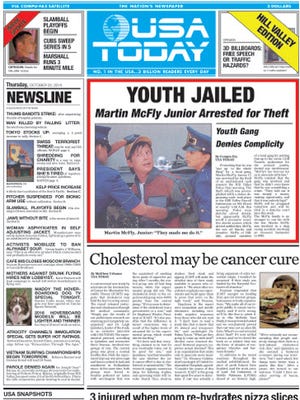
What predictions did the film get right, and what did they get wrong? Using the newspaper photo above, and some other things mentioned in the future sequence, we can get an idea.
Right: USA Today has changed its logo.
Wrong: They didn't use the one shown here. I wish they had: Their actual new one is stupid.
Right, sort of: "Cholesterol may be cancer cure." We do now know about "good cholesterol," as opposed to "bad cholesterol." "Good cholesterol" isn't a cure for cancer, but it does help with good health.
Wrong: A female President. In 2008, Hillary Clinton showed that it's possible. And, if she had simply said words to the effect of, "I voted for the Iraq War, and I was wrong," she would have won the Democratic nomination, and she would have won the general election, and she probably would have been re-elected as Barack Obama was.
Right: USA Today has changed its logo.
Wrong: They didn't use the one shown here. I wish they had: Their actual new one is stupid.
Right, sort of: "Cholesterol may be cancer cure." We do now know about "good cholesterol," as opposed to "bad cholesterol." "Good cholesterol" isn't a cure for cancer, but it does help with good health.
Wrong: A female President. In 2008, Hillary Clinton showed that it's possible. And, if she had simply said words to the effect of, "I voted for the Iraq War, and I was wrong," she would have won the Democratic nomination, and she would have won the general election, and she probably would have been re-elected as Barack Obama was.
But she didn't admit she was wrong in Iraq, and Obama was in the White House in 2015, watching the various contenders to succeed him, including Hillary, jockey for position for the next year's election. (Of course, we ended up with Donald Trump. And, in the "Evil 1985" that developed in this film, 1985 Biff Tannen, played by Thomas F. Wilson, was designed as a combination of 1977 Elvis Presley and 1989 Donald Trump -- and that's when we only knew Trump was a moderately horrible person.)
Right, sort of: "(something beginning with T) Bandits Strike." I'm not sure what this refers to, but recent years have seen an upsurge in pirate activity, especially on the Indian Ocean coast of Africa.
Wrong: "Queen Diana." The scriptwriters must have presumed that, in 2015, Queen Elizabeth II would be 89, and unlikely to still be alive; thus, Prince Charles would, by then, be King Charles III, and his wife would be Queen Diana.
They forgot that the Queen Mother was still alive at age 88, and in fact made it to 101. In 2015, Queen Elizabeth, while definitely looking old, seemed healthy, and very much with it. Even in 2022, at 96, having lost her husband, and now said to have "mobility issues," she's still doing the job.
Right, sort of: "(something beginning with T) Bandits Strike." I'm not sure what this refers to, but recent years have seen an upsurge in pirate activity, especially on the Indian Ocean coast of Africa.
Wrong: "Queen Diana." The scriptwriters must have presumed that, in 2015, Queen Elizabeth II would be 89, and unlikely to still be alive; thus, Prince Charles would, by then, be King Charles III, and his wife would be Queen Diana.
They forgot that the Queen Mother was still alive at age 88, and in fact made it to 101. In 2015, Queen Elizabeth, while definitely looking old, seemed healthy, and very much with it. Even in 2022, at 96, having lost her husband, and now said to have "mobility issues," she's still doing the job.
But that's not the hard part: No one could have guessed in 1989 that, in 1992, Princess Diana would have begun divorce proceedings with Charles; and that, in 1997, she would die. Come to think of it, why is Diana visiting the U.S., with no mention of Charles? Shouldn't the King and the Queen be coming, together?
Right, at least in 2015: "Swiss Terrorist Threat." Now, Switzerland isn't a base for terrorists these days, and it isn't exactly a target for terrorists, either. But plenty of places have been -- including Russia, which could hardly have been guessed when the movie was being made, as the Soviet Union was still in place. And, with the Swiss' secret banking system, and movements like Occupy Wall Street making their discontent known (although they haven't yet resorted to terrorism), is it really hard to believe that Switzerland could become a target?
Wrong, but not by as much as it first seemed: The Chicago Cubs win the 2015 World Series, by beating a Miami-based team whose logo is an alligator. For a moment, let's put aside the Cubs' inability to win a Pennant since 1945 and a World Series since 1908, and their failure to show up in the 1st 3 games of that year's NLCS against the Mets. After all, strange things have happened in baseball before, though not usually in the Cubs' favor. Let's talk logistics:
In 1989, it was hardly outrageous to suggest that Major League Baseball would have a team in Miami in the near future. Indeed, also released that year was Major League, in which the new owner of the Cleveland Indians said she had an offer from Miami to build a stadium for the Indians if she could get out of her lease at Cleveland Municipal Stadium. And, indeed, in 1991, MLB announced that a Miami team would begin play in the 1993 season. But the team would be called the Florida Marlins -- not the Gators, possibly due to issues with the University of Florida -- and would be in the National League, the same League as the Cubs, making a Cubs-Miami World Series impossible.
Granted, Commissioner Bud Selig has already moved the Milwaukee Brewers from the American League to the NL, and the Houston Astros from the NL to the AL. So it's not totally impossible that new Commissioner Rob Manfred would move the Marlins to the AL -- it might just boost attendance at Tampa Bay Rays games -- making a Cubs-Miami World Series possible. But it's highly unlikely.
The paper also says that the Cubs "sweep" the Series in 5 -- meaning the World Series, a best 4-out-of-7 competition since 1922, had become a best 5-out-of-9. But when the announcement goes up on the big screen in Courthouse Square, somebody says it was, "Four in a row." So whoever wrote that line didn't consult with whoever was making up the front page of the paper.
Right, at least in 2015: "Swiss Terrorist Threat." Now, Switzerland isn't a base for terrorists these days, and it isn't exactly a target for terrorists, either. But plenty of places have been -- including Russia, which could hardly have been guessed when the movie was being made, as the Soviet Union was still in place. And, with the Swiss' secret banking system, and movements like Occupy Wall Street making their discontent known (although they haven't yet resorted to terrorism), is it really hard to believe that Switzerland could become a target?
Wrong, but not by as much as it first seemed: The Chicago Cubs win the 2015 World Series, by beating a Miami-based team whose logo is an alligator. For a moment, let's put aside the Cubs' inability to win a Pennant since 1945 and a World Series since 1908, and their failure to show up in the 1st 3 games of that year's NLCS against the Mets. After all, strange things have happened in baseball before, though not usually in the Cubs' favor. Let's talk logistics:
In 1989, it was hardly outrageous to suggest that Major League Baseball would have a team in Miami in the near future. Indeed, also released that year was Major League, in which the new owner of the Cleveland Indians said she had an offer from Miami to build a stadium for the Indians if she could get out of her lease at Cleveland Municipal Stadium. And, indeed, in 1991, MLB announced that a Miami team would begin play in the 1993 season. But the team would be called the Florida Marlins -- not the Gators, possibly due to issues with the University of Florida -- and would be in the National League, the same League as the Cubs, making a Cubs-Miami World Series impossible.
Granted, Commissioner Bud Selig has already moved the Milwaukee Brewers from the American League to the NL, and the Houston Astros from the NL to the AL. So it's not totally impossible that new Commissioner Rob Manfred would move the Marlins to the AL -- it might just boost attendance at Tampa Bay Rays games -- making a Cubs-Miami World Series possible. But it's highly unlikely.
The paper also says that the Cubs "sweep" the Series in 5 -- meaning the World Series, a best 4-out-of-7 competition since 1922, had become a best 5-out-of-9. But when the announcement goes up on the big screen in Courthouse Square, somebody says it was, "Four in a row." So whoever wrote that line didn't consult with whoever was making up the front page of the paper.
But wait: The Cubs didn't win the World Series in 2015, but they did come within 8 games of doing so. And they went on to win the World Series in 2016! It wasn't a sweep. Very much the other direction: It went to extra innings of Game 7. But they won it. First Pennant in 71 years, first World Series win in 108 years.
Right, sort of: "Pitcher Suspended for Bionic Arm Use." Okay, we don't yet have bionic arms. But players, including pitchers, are getting suspended for a form of cheating: Performance-enhancing drugs.
Wrong: Other sports. What's "slamball"? Sounds like it could be fun, but there's no explanation. And a 3-minute mile? On July 7, 1999, Hicham el Guerrouj of Morocco ran the mile in 3 minutes, 43.13 seconds. That was a new record -- and now it's an old record. It hasn't been seriously challenged since. If we couldn't run a mile in less than 3:43 between July 7, 1999 to October 20, 2022, I don't think even the most steroided-up middle-distance runner is going to do 2:59.anything in the foreseeable future.
Right: "Home Prices Increase." After the housing market became a cause (although hardly the biggest cause) of the 2008 economic crash, housing prices finally started to go back up in 2013. They have continued to rise since then.
Wrong: "Man killed by falling litter." Some yutz threw garbage out of his flying car, and it landed on someone and killed him. That's the thing nobody ever mentions when talking about future predictions of flying cars. Oil leaks from such vehicles wouldn't be good, either. And if there's a crash in the sky, the cars and their pieces would fall to earth. Uh-oh, maybe it's good that we don't have flying cars.
Actually, my mother pointed out that we do already have flying cars: They're called "helicopters." Maybe, but the average person can't afford a helicopter. And it's not like every workplace has parking spaces for them (helipads).
Right, sort of: "Kelp Prices Increase." Health foods have become more popular. But it's not yet at the level at which an increase in kelp prices would be news serious enough to cause worry.
Wrong: "Jaws Without Bite." The film shows a holographic ad for Jaws 19, directed by Max Spielberg, the son of original Jaws director Steven Spielberg and his former wife Amy Irving. In 1989, Max was 4 years old.
In 2022, he is 37. Although he has appeared in brief roles as an actor, he has not become a director, instead working in films' art departments and designing video games. And after Jaws: The Revenge (the 4th film in the series) tanked, there has not been another. Although I wouldn't put a reboot of the series out of the question. Then again, if Max wants his first blockbuster to be a reboot of his father's, well, "You're gonna need a bigger budget."
From sources other than the paper:
Right, mostly: A travel office has a poster saying, "SURF VIETNAM." If you've seen the film Apocalypse Now, you'll recognize this as an inside joke: Lt. Col. Bill Kilgore (played by Robert Duvall) has his soldiers take over a beach, so that they could take a little time off to surf. They would, he thinks, be safe from snipers, because "Charlie don't surf!" (Using the "military alphabet," the Vietcong became the VC, or "Victor Charlie.")
BTTF II suggested that, between 1989 and 2015, relations between the U.S. and Vietnam -- a nation that had been united and Communist since 1975 -- would have improved to the point where travel between the countries would actually be encouraged. Much like China, Vietnam has gotten to the point where it is Communist in name only, totalitarian but embracing free-market reforms. And they do offer tours of war-related sites in their country.
Sure enough, surfing has taken hold as a popular recreation there. And an American who wants to go to Vietnam today, presuming he can afford the trip, will almost certainly be able to do so.
Right, sort of: Virtual reality. In the scene in the Cafe '80s, Marty shows the kids how to play the (fictional) arcade game Wild Gunman. To this, they say that games played with your hands are for babies. Though kids nowadays are addicted to their smartphones (which really requires more finger movements than anything), playing games without your hands can be done.
Right: Drones. The rise of drones has had effects both useful and scary. Although they are not yet a common household item, to the point of taking our dogs for a walk, as seen in the movie, it is possible.
Actually, my mother pointed out that we do already have flying cars: They're called "helicopters." Maybe, but the average person can't afford a helicopter. And it's not like every workplace has parking spaces for them (helipads).
Right, sort of: "Kelp Prices Increase." Health foods have become more popular. But it's not yet at the level at which an increase in kelp prices would be news serious enough to cause worry.
Wrong: "Jaws Without Bite." The film shows a holographic ad for Jaws 19, directed by Max Spielberg, the son of original Jaws director Steven Spielberg and his former wife Amy Irving. In 1989, Max was 4 years old.
In 2022, he is 37. Although he has appeared in brief roles as an actor, he has not become a director, instead working in films' art departments and designing video games. And after Jaws: The Revenge (the 4th film in the series) tanked, there has not been another. Although I wouldn't put a reboot of the series out of the question. Then again, if Max wants his first blockbuster to be a reboot of his father's, well, "You're gonna need a bigger budget."
From sources other than the paper:
Right, mostly: A travel office has a poster saying, "SURF VIETNAM." If you've seen the film Apocalypse Now, you'll recognize this as an inside joke: Lt. Col. Bill Kilgore (played by Robert Duvall) has his soldiers take over a beach, so that they could take a little time off to surf. They would, he thinks, be safe from snipers, because "Charlie don't surf!" (Using the "military alphabet," the Vietcong became the VC, or "Victor Charlie.")
BTTF II suggested that, between 1989 and 2015, relations between the U.S. and Vietnam -- a nation that had been united and Communist since 1975 -- would have improved to the point where travel between the countries would actually be encouraged. Much like China, Vietnam has gotten to the point where it is Communist in name only, totalitarian but embracing free-market reforms. And they do offer tours of war-related sites in their country.
Sure enough, surfing has taken hold as a popular recreation there. And an American who wants to go to Vietnam today, presuming he can afford the trip, will almost certainly be able to do so.
Right, sort of: Virtual reality. In the scene in the Cafe '80s, Marty shows the kids how to play the (fictional) arcade game Wild Gunman. To this, they say that games played with your hands are for babies. Though kids nowadays are addicted to their smartphones (which really requires more finger movements than anything), playing games without your hands can be done.
Right: Drones. The rise of drones has had effects both useful and scary. Although they are not yet a common household item, to the point of taking our dogs for a walk, as seen in the movie, it is possible.
Wrong: Hoverboards. There was, in 2015, one particular machine that worked magnetically, on metal surfaces only. But skateboards that hover over the ground, and can be propelled by your trailing foot, and are available in your local toy store? They don't exist yet.
Right, possibly: Tranquilizer pills have become the drug of choice, where getting "tranked" has replaced getting drunk or high. This hasn't happened yet, although Ecstasy (or "molly," as Miley Cyrus calls it) seems to be young people's recreational drug of choice. But the big drug of the late 2010s turned out to be fentanyl, an opioid, and thus a downer. And with the nation as a whole getting angrier, it is not hard to imagine a calm-down drug becoming popular in the 2020s.
Wrong, mostly: Fashion. Teenage Marty McFly Jr., with the 1985-brought teenage Marty Sr. getting replicas from Doc Brown, wears a varsity-style jacket whose sleeves shrink to fit, and which automatically dries itself after getting wet. They also wear sneakers whose laces tie themselves: "Power laces, all right!" Neither is available today.
Later, we see the middle-aged Marty Sr. of 2015 wearing a suit with two neckties. And Doc Brown wears sunglasses that look like they're made out of reflective cardboard. Neither of these fashions is impossible today, but neither has either of them taken hold.
Right, possibly: Genetic manipulation. Marty Jr. looks like an exact duplicate of his father, and daughter Marlene also looks just like him, and not much like her mother Jennifer (Elisabeth Shue). Is Marty's ego so easily bruised that he needs to have his children look exactly like him?
It may now be possible to do this -- although it would suggest, as does the McFlys' nice suburban home, that the family is doing very well. We are led to believe that Marty's 1985 truck crash hurt his hand and ended his dream of becoming a guitar-cranking rock star. Yet, while he seems to be just another corporate drone, with a dull life, that job seems to pay pretty well. (Until he gets fired, that is.) He's certainly better off than his father George was in the pre-altered 1985.
Wrong: A Japanese economic takeover. Marty works for a company called Fujitsu. There is a real company by that name, a technologies services firm, although I hadn't heard of it by 1989. Then, in real life, Japan's economy was roaring, to the point where they were buying up American companies and American property left and right. Johnny Carson, in his Carnac the Magnificent persona, even did the following joke on The Tonight Show:
A: Tokyo, Los Angeles, New York.
Q: What are the three largest Japanese cities?
But the early 1990s recession, which the film's producers apparently didn't see coming, socked Japan every bit as hard as it did America. By 2015, Japan was relatively strong and stable compared with the early 1990s, but the idea of Japan becoming the world's leading economic superpower had become, and remains, ridiculous. China has been frequently predicted as such since that recession ended, but even that isn't all that likely in the next few years.
Right, sort of: Inflation. A "hoverconversion," making your car a flying car, can be done for $40,000 -- well, $39,999.95. In 2015, a new car, before you factored in options and trade-in value, cost around $25,000 to $30,000. So, presuming that turning your car into a flying car were possible, a cost of $40,000 wouldn't have been particularly hard to believe.
Wrong: Inflation didn't go up by nearly as much as expected. Indeed, prices are only about twice what they were in 1989: On the average, something costing $1.00 then would cost $1.92 in 2015, and $2.36 in 2022. That doesn't hold for everything, but, still, prices haven't gone up by insane amounts.
A single ride on the New York Subway cost $1.00 in 1989, and it costs $2.75 now. Back then, $4.00 would get you into a movie; now, $12.00. A gallon of gas averaged about $1.00 at the time, and today, in my hometown of East Brunswick, New Jersey, the average price was over $4.00 in 2010, and is again in 2022 -- but it was just $1.85 in 2015.
Right, possibly: Tranquilizer pills have become the drug of choice, where getting "tranked" has replaced getting drunk or high. This hasn't happened yet, although Ecstasy (or "molly," as Miley Cyrus calls it) seems to be young people's recreational drug of choice. But the big drug of the late 2010s turned out to be fentanyl, an opioid, and thus a downer. And with the nation as a whole getting angrier, it is not hard to imagine a calm-down drug becoming popular in the 2020s.
Wrong, mostly: Fashion. Teenage Marty McFly Jr., with the 1985-brought teenage Marty Sr. getting replicas from Doc Brown, wears a varsity-style jacket whose sleeves shrink to fit, and which automatically dries itself after getting wet. They also wear sneakers whose laces tie themselves: "Power laces, all right!" Neither is available today.
Later, we see the middle-aged Marty Sr. of 2015 wearing a suit with two neckties. And Doc Brown wears sunglasses that look like they're made out of reflective cardboard. Neither of these fashions is impossible today, but neither has either of them taken hold.
Right, possibly: Genetic manipulation. Marty Jr. looks like an exact duplicate of his father, and daughter Marlene also looks just like him, and not much like her mother Jennifer (Elisabeth Shue). Is Marty's ego so easily bruised that he needs to have his children look exactly like him?
It may now be possible to do this -- although it would suggest, as does the McFlys' nice suburban home, that the family is doing very well. We are led to believe that Marty's 1985 truck crash hurt his hand and ended his dream of becoming a guitar-cranking rock star. Yet, while he seems to be just another corporate drone, with a dull life, that job seems to pay pretty well. (Until he gets fired, that is.) He's certainly better off than his father George was in the pre-altered 1985.
Wrong: A Japanese economic takeover. Marty works for a company called Fujitsu. There is a real company by that name, a technologies services firm, although I hadn't heard of it by 1989. Then, in real life, Japan's economy was roaring, to the point where they were buying up American companies and American property left and right. Johnny Carson, in his Carnac the Magnificent persona, even did the following joke on The Tonight Show:
A: Tokyo, Los Angeles, New York.
Q: What are the three largest Japanese cities?
But the early 1990s recession, which the film's producers apparently didn't see coming, socked Japan every bit as hard as it did America. By 2015, Japan was relatively strong and stable compared with the early 1990s, but the idea of Japan becoming the world's leading economic superpower had become, and remains, ridiculous. China has been frequently predicted as such since that recession ended, but even that isn't all that likely in the next few years.
Right, sort of: Inflation. A "hoverconversion," making your car a flying car, can be done for $40,000 -- well, $39,999.95. In 2015, a new car, before you factored in options and trade-in value, cost around $25,000 to $30,000. So, presuming that turning your car into a flying car were possible, a cost of $40,000 wouldn't have been particularly hard to believe.
Wrong: Inflation didn't go up by nearly as much as expected. Indeed, prices are only about twice what they were in 1989: On the average, something costing $1.00 then would cost $1.92 in 2015, and $2.36 in 2022. That doesn't hold for everything, but, still, prices haven't gone up by insane amounts.
A single ride on the New York Subway cost $1.00 in 1989, and it costs $2.75 now. Back then, $4.00 would get you into a movie; now, $12.00. A gallon of gas averaged about $1.00 at the time, and today, in my hometown of East Brunswick, New Jersey, the average price was over $4.00 in 2010, and is again in 2022 -- but it was just $1.85 in 2015.
$45 for a bottle of Pepsi? Try $2.00. Even Starbucks doesn't charge more than $6.00 for a Venti (large) coffee drink. And while most people now (as opposed to 1955, when -- at least in the novelization -- Lou at Lou's Cafe was shocked to see teenage Marty with one) don't think anything of carrying $20 bills, most people prefer not to carry $50 bills (as Doc gave to Marty to order the Pepsi), and many stores refuse to take them.
Right: Pepsi and Pizza Hut are still in business. After the 1990-93, 2007-10 and 2020-21 recessions, no company staying in business permanently can ever again be taken for granted. But then, predicting consumer trends is harder:
Wrong: The Coffee Revolution. The rise of Starbucks, Dunkin Donuts, Tim Hortons, et al. wasn't predicted. In 1989, Starbucks was still limited to Seattle, Dunkin to the Northeast, and Timmy's to Canada.
Wrong: As I said earlier, no flying cars, and no highways in the sky. Although, as I pointed out, this may be a good thing.
Right: Advances in television. A screen the size of the one the McFlys have in 2015 is hardly impossible, and putting 6 shows at once on it can probably already be done. The novelization of the film has Marty Sr. telling Marty Jr. and Marlene, "When I was your age, if I wanted to watch 2 TV shows at once, I had to put 2 TVs together!" It's good to know that, even now, we can still give kids the old, "When I was your age... "
Wrong: Books no longer need dust jackets, because dust-repellent paper has been invented. The way the woman at the bookstore was describing it, this was not a new phenomenon in 2015. The book covered 1950 to 2000. Maybe, in their world, it was developed between 1985 and 2000. In real life, if it has yet been invented, it hasn't yet been publicized.
Right: Using your TV as a video telephone. It's pretty expensive, but it's being done today. This could also be a TV with a computer built in, allowing the kind of videoconferencing we now see with Skype and FaceTime.
Right: Tablets. In an attempt to save the historic courthouse clock tower, Marty is presented with a petition to sign on a flat, hand-held computer. These days, people use their tablets more (or in place of) their actual computers. After all, who wants to lug around a laptop?
Right: Google Glass. Marty's kids are just like kids today, totally distracted by technology at the dinner table. And while Google Glass may not be mainstream yet, the idea behind glasses that function as a computer and phone is exactly the concept behind the TV glasses of the film.
Wrong: Fax machines, fax machines everywhere. The fax was still a big thing in the late 1980s, and it was only at the tail end of 1989 that the World Wide Web began. It was only in 1994 that most people began hearing the words "the Internet," and even in 1996, it still sounded really funny to hear people say, "Double-you double-you double-you dot (fill in the blank) dot com."
BTTF II did not include references to the Internet because they simply didn't know. It was far easier to discuss horseless carriages (the original English term for automobiles) when predicting the future in 1885 (the year BTTF III went back to) than it was to discuss what the early 1990s would call "the information superhighway" in the late 1980s.
Wrong: Phone booths, phone booths everywhere. With smartphones being common, just try finding a payphone at all, never mind one in a booth. (Even in 1977, when Superman: The Movie was filmed, Christopher Reeve's Clark Kent thought a phone booth might be a good place to change into his Superman costume, but could only find a phone kiosk, and settled for a revolving door. So the decline of phone booths was already underway.)
Wrong, mostly: Medicine. Doc Brown said he went to "a rejuvenation clinic." Now, he didn't specifically say that he did this in 2015. But he did say the process, including changing his blood and replacing his spleen and colon, "added a good 30 or 40 years to my life!" (Yeah, right -- if you don't go back to 1885 and get shot by a desperado just 8 months after you arrive.)
When we meet the McFly family of 2015, George, 77 years old, has thrown his back out playing tennis, and is suspended upside-down by what looked to my 2015 eyes like a Roomba. No, that's not going to happen. And even if it does, is it really going to be good for a bad back?
Biff, 78, complains about his implants not working. There are various kinds of implants that make maladies easier to live with -- but they certainly don't spark the way Old Biff's do.
Wrong: Three-second meals in a microwave oven. It would be nice, but it hasn't happened yet.
Right: Suburbs are boring and sterile in 2015. Yes, they are, just as they were in 2000, in 1985 for BTTF's "present" and my high school days, in the 1970s when I was a kid, and even in 1955 when BTTF's "past" takes place.
Wrong: The legal system. Fifteen years in jail for a simple theft? It must be something that even Edward Snowden wouldn't be willing to steal. And all lawyers being abolished? Remember: In the 2015 that we actually got, a lawyer was President -- and this would have been true if Hillary had won, as well. If Mitt Romney had won in 2012, considering all his business and tax shenanigans, he wouldn't have gotten lawyers abolished, either. Nor would John McCain, had he won in 2008, given his past (the Keating Five banking scandal). Certainly, Trump needs lawyers. Most likely, this was the writers going for a cheap laugh.
Right, sort of: Marty having a visible physical difficulty. His 1985 truck crash (averted in BTTF III) left him with damage in his right hand, rendering him unable to play guitar as well as he had before.
Sadly, his portrayer, Michael J. Fox, has spent years dealing with Parkinson's disease. Meaning that, if a Back to the Future Part IV had been made for release in 2015, to dovetail with the earlier films as "future" becomes "present," the 54-year-old Fox would have been less able to play Marty than the 77-year-old Christopher Lloyd would have been to play Doc Brown.
When we meet the McFly family of 2015, George, 77 years old, has thrown his back out playing tennis, and is suspended upside-down by what looked to my 2015 eyes like a Roomba. No, that's not going to happen. And even if it does, is it really going to be good for a bad back?
Biff, 78, complains about his implants not working. There are various kinds of implants that make maladies easier to live with -- but they certainly don't spark the way Old Biff's do.
Wrong: Three-second meals in a microwave oven. It would be nice, but it hasn't happened yet.
Right: Suburbs are boring and sterile in 2015. Yes, they are, just as they were in 2000, in 1985 for BTTF's "present" and my high school days, in the 1970s when I was a kid, and even in 1955 when BTTF's "past" takes place.
Wrong: The legal system. Fifteen years in jail for a simple theft? It must be something that even Edward Snowden wouldn't be willing to steal. And all lawyers being abolished? Remember: In the 2015 that we actually got, a lawyer was President -- and this would have been true if Hillary had won, as well. If Mitt Romney had won in 2012, considering all his business and tax shenanigans, he wouldn't have gotten lawyers abolished, either. Nor would John McCain, had he won in 2008, given his past (the Keating Five banking scandal). Certainly, Trump needs lawyers. Most likely, this was the writers going for a cheap laugh.
Right, sort of: Marty having a visible physical difficulty. His 1985 truck crash (averted in BTTF III) left him with damage in his right hand, rendering him unable to play guitar as well as he had before.
Sadly, his portrayer, Michael J. Fox, has spent years dealing with Parkinson's disease. Meaning that, if a Back to the Future Part IV had been made for release in 2015, to dovetail with the earlier films as "future" becomes "present," the 54-year-old Fox would have been less able to play Marty than the 77-year-old Christopher Lloyd would have been to play Doc Brown.

Left to right: Theme writer-singer Huey Lewis,
Michael J. Fox, Christopher Lloyd, Lea Thompson, 2015
So Back to the Future Part II got a lot of things wrong. But, if you stretch things just a little, they got a lot of things right as well.
So, feel free to look at what they did get right, and say, "Great Scott!" Or, "Whoa, this is heavy."
But then, in the words of the now late, great Yogi Berra, "The future isn't what it used to be."
So, feel free to look at what they did get right, and say, "Great Scott!" Or, "Whoa, this is heavy."
But then, in the words of the now late, great Yogi Berra, "The future isn't what it used to be."
*
October 21, 2015 was a Wednesday. In real life, instead of winning the World Series on the day -- an expansion of the Playoff schedule hadn't been considered when the script was written -- the Chicago Cubs were eliminated from the postseason, as the New York Mets beat them, 8-3 at Wrigley Field, completing a 4-game sweep of the National League Championship Series. The Mets scored 4 runs in the 1st inning and 2 in the 2nd, and never looked back.
Game 5 was played in the American League Championship Series. The Toronto Blue Jays beat the Kansas City Royals, 7-1 at the Rogers Centre in Toronto. Two days later, back in Kansas City, the Royals won Game 6 to take the Pennant. In the World Series, they beat the Mets in 5 games. The Mets pulled off a unique feat: They blew leads in all 5 games of a World Series, including the 1 they ended up winning anyway. The Cubs did finally win the World Series the next year.
Football was in midweek. And the NBA season didn't start until October 27. But there were 8 games played in the NHL:
* In an "Original Six" matchup, the New York Rangers lost to the Montreal Canadiens, 3-0 at the Bell Centre in Montreal.
* The New York Islanders beat the Nashville Predators, 4-3 at the Barclays Center.
* The Washington Capitals beat the Chicago Blackhawks, 4-1 at the Verizon Center (now the Capital One Arena) in Washington.
* The Dallas Stars beat the Tampa Bay Lightning 5-3 at the Amalie Arena (now the Benchmark International Arena) in Tampa.
* The Florida Panthers beat the Buffalo Sabres, 3-2 at the BB&T Center (now the Amerant Bank Arena) in the Miami suburb of Sunrise, Florida.
* The Pittsburgh Penguins beat the Ottawa Senators, 2-0 at the Consol Energy Center (now the PPG Paints Arena) in Pittsburgh.
* The Minnesota Wild beat the Arizona Coyotes, 4-3 at the Gila River Arena (now the Desert Diamond Arena) in the Phoenix suburb of Glendale, Arizona.
* And the St. Louis Blues beat the Edmonton Oilers, 4-2 at the Northlands Coliseum (then known as Rexall Place) in Edmonton.


No comments:
Post a Comment