
Bobby Clarke (left, face partially obscured) and Bernie Parent
May 19, 1974: Both of North America's major hockey leagues decide their championships on this day. One is an old league with a new champion, led by a young captain and superstar. The other is a new league with a new champion, led by an old war-horse.
The Philadelphia Flyers were part of the NHL's "Great Expansion" of 1967, along with the Pittsburgh Penguins, the St. Louis Blues, the Minnesota North Stars, the Los Angeles Kings and the Oakland Seals. All of these teams, regardless of location, were placed in the newly-created Western Division, with the "Original Six" teams placed in the Eastern Division. The Flyers finished 1st in the West in 1968, but lost in the 1st round of the Playoffs. They struggled the next 4 seasons, missing the Playoffs in 2 and getting swept in the 1st round in the other 2.
There was 1 sign of hope. On December 11, 1969, the Flyers introduced what became one of the team's best-known traditions: Playing a recording of Kate Smith singing "God Bless America" instead of the National Anthem, "The Star-Spangled Banner" before games deemed to be important. The perception was that the team was more successful on these occasions, so the tradition grew. (Only the players, nearly every one of whom was still Canadian at that point, thought about that.)
The move was initially done by Flyers Promotion Director Lou Scheinfeld as a way to defray national tensions during the Vietnam War. Scheinfeld noticed that people regularly left their seats and walked around during the anthem, but showed more respect and often sang along to "God Bless America."
Noticing that his team was often physically outmatched, majority owner Ed Snider instructed general manager Bud Poile to acquire bigger, tougher players. While head coach Keith Allen soon after replaced Poile as general manager, this mandate eventually led to one of the most feared teams to ever take the ice in the NHL, with players like Ed Van Impe, Bob "Hound" Kelly, André "Moose" Dupont, and, the most feared of them all, Dave "the Hammer" Schultz.
The keystone of those teams was acquired when the Flyers took a chance on a 19-year-old diabetic from Flin Flon, Manitoba, Bobby Clarke, with their 2nd pick in the 1969 NHL Draft. Clarke certainly had the look of a 1970s NHL player: Big hair, missing teeth, tough, but talented, and never gave up.
Rough-house teams had been a part of the NHL since the beginning. As the 1970s dawned, the toughest team was Boston's "Big Bad Bruins." But the Flyers gained a reputation as the nastiest team in the history of the sport. On December 29, 1972, they played away to the Vancouver Canucks. Don Saleski put a chokehold on the Canucks' Barry Wilkins. But he was close enough to the stands that a fan was able to pull Saleski's hair. Backup goaltender Bobby Taylor went into the stands to get the fan, and was followed by teammates to even the odds a little, as they were still heavily outnumbered.
On February 9, 1973, the Flyers made their next visit to Vancouver, and several players were summoned to court to answer assault charges. The case was postponed until Summer. That night, in only the 2nd minute of play, Dupont high-sticked Bobby Schmautz, and the fans pelted him with eggs. Dupont was given a 5-minute major penalty, but the Flyers scored twice, and won, 10-5.
After the game, Dupont told the Philadelphia media, "It was a good day for us: We didn't go to jail, we beat up their chicken forwards, we scored goals, and we won. Now, the Moose drinks beer." That's a Philadelphia athlete if I ever heard one.
In an article for the Philadelphia Bulletin on January 3, Jack Chevalier and Pete Cafone labeled the Flyers, whose arena, The Spectrum, was on South Broad Street, "the Broad Street Bullies." With their head coach now being Fred Shero, a.k.a. "Freddy the Fog," the team was also nicknamed "Freddy's Philistines." When the football-themed movie The Longest Yard premiered the next year, the Flyers were also given the name of Burt Reynolds' prison football team: The Mean Machine.
Clarke was awarded the Hart Memorial Trophy as the NHL's Most Valuable Player, the 1st player on any of the 1967 expansion teams to receive it. Rick MacLeish became the 1st Flyer to score 50 goals in a season. And the Flyers beat the Minnesota North Stars in the Stanley Cup Quarterfinals, thanks to an overtime goal by Gary Dornhoefer in Game 5, in which, like the Bruins' Bobby Orr with his clinching goal in the 1970 Finals, he was tripped up and seemed to be flying in celebration. This goal was commemorated in a statue that was placed outside The Spectrum. The Flyers had taken a big step, but they weren't quite there yet: They lost the Semifinals to the Montreal Canadiens.
Just after the season ended, the Flyers regained goaltender Bernie Parent, who had left for the World Hockey Association. Over the next 3 seasons, Parent was as good as any goaltender has ever been, and is arguably the key figure in team history: With him, they won Stanley Cups; without him, they never have.
The Flyers won the West Division in 1974, the last season of the NHL's 2-division setup before another expansion and realignment. They swept the Atlanta Flames in the Quarterfinals, and outlasted the New York Rangers in 7 games to setup a Finals against Boston: It would be the 2 toughest teams of all time (or so modern fans have been led to believe), the Big Bad Bruins, Cup winners in 1970 and '72, vs. the Broad Street Bullies.
The Flyers had played in Boston 19 times, tying 2 and losing the others. And the Bruins would have home-ice advantage. So, in order to win the Cup, the Flyers would have to win at least 1 game at the Boston Garden. And they didn't want to leave that for Game 7. The Bruins won Game 1, 3-2. But with less than a minute to go in regulation in Game 2, Dupont tied the game, and Clarke won it in overtime. Now, the Flyers were going back home with a precious road win. In Philadelphia, the Flyers won Game 3, 4-1; and Game 4, 4-2. Back in Boston, the Bruins won Game 5, 5-1. But they still had to win in Philadelphia to force a Game 7 at home.
It was May 19, 1974. The game was televised nationally on NBC. The Flyers, not wanting to have to play a Game 7 at the Boston Garden, didn't take any chances. They announced that Kate Smith -- 67 years old, and 30 years past her peak of popularity, but enjoying her new connection with this hockey team, who was 36-3-1 when her record was played, for a winning percentage of .913 -- would sing "God Bless America" live. She did, and the ovation was huge.

To counteract this good-luck charm, the Bruins' 2 best players, Orr and Phil Esposito, skated over to her, and gave her a big bouquet of flowers. It was a nice gesture, but would it work?
At first, neither team's good-luck measures seemed to work. The game was scoreless 14 minutes in, with Parent and the Bruins' Gilles Gilbert -- Gerry Cheevers having temporarily left for the WHA -- fending off all attempts.
But at 13:58, Terry O'Reilly of the Bruins was sent to the penalty box for hooking. Then, at 14:22, Orr and Clarke, arguably the 2 best players in the game at this point, and not necessarily in that order, got into a shoving match. Both were sent to the sin-bin, giving the Flyers a 4-3 advantage on the ice. The Flyers won the ensuing faceoff, and, at 14:48 of the 1st period, Dupont fired a shot on goal. MacLeish tipped it with his stick, fooling Gilbert, and it went in. The Flyers led, 1-0.
That wouldn't be the last attempt, but it would be the only goal. Gilbert stopped 25 out of 26 shots, and Parent stopped 30 of 30. The Flyers became the 1st "Class of '67" team to win the Stanley Cup, and the 1st NHL team to win its 1st Stanley Cup since the 1936 Detroit Red Wings, 38 years earlier. Clarke received the Conn Smythe Trophy as Most Valuable Player of the Playoffs. Fans had run onto the ice, making it impossible for Clarke and Parent to carry the Cup around it, so all they could do was carry it back to their dressing room.
Two days later, on May 21, the Flyers had a parade up Broad Street. Ed Gudonis, a Philadelphia-based comedian and radio show host using the stage name Big Daddy Graham, was 21 at the time, and recalled trying to drive back from Sea Isle City on the Jersey Shore, and the closer he got to Philadelphia, the worse the traffic got. By the time he got back in, the parade was over. When the Flyers won the Cup again the next season, beating the Buffalo Sabres in 6 games, he made sure he was in the city for the parade, and he went to his grave insisting that there were more fans at the 1975 parade.
Kate Smith made her final public performance on May 23, 1985, before Game 2 of the Stanley Cup Finals, when the Flyers lost to the Edmonton Oilers, and lost the series in 5 games. She died the next year. The year after that, the team erected a statue of her outside The Spectrum. On one side was a plaque telling her life story; on the other, a plaque with the lyrics of "God Bless America," written by Irving Berlin and famously recorded by Smith in 1938.
The Flyers were swept by the Canadiens in the 1976 Finals, but Parent was awarded the Conn Smythe Trophy anyway. In 1979, he sustained an eye injury that forced him to retire. Since then, the Flyers have reached the Stanley Cup Finals in 1980, 1985, 1987, 1997 and 2010, and have usually been at least a good team. But they have never again won the Stanley Cup since their back-to-back titles of 1974 and 1975.
When the Flyers and the NBA's 76ers moved from The Spectrum to what's now named the Wells Fargo Center in 1996, the Smith statue, the Dornhoefer goal statue, and a statue of 76ers legend Julius "Dr. J" Erving were moved to the new arena. A statue of Clarke and Parent holding the Cup is also now outside the new arena, as is one of earlier Philadelphia basketball legend Wilt Chamberlain.
The Smith statue was covered and then removed in April 2019, due to criticism of lyrics in some of Smith's earlier songs that were perceived as racist. This may have been unfair, as some of those songs had also been sung by black singers. Smith's recording of "God Bless America" has not been played before Flyers home games since. The Flyers' record in such games is 100 wins, 29 losses and 5 ties, for a winning percentage of .765.
The Flyers established a team Hall of Fame in 1988. From the 1974 and/or '75 Stanley Cup Champions, they have elected Bobby Clarke, Bernie Parent, Bill Barber, Rick MacLeish, Barry Ashbee, Gary Dornhoefer, Reggie Leach, Joe Scott, Ed Van Impe, Joe and Jimmy Watson, Dave Schultz, owner Ed Snider, general manager Keith Allen, head coach Fred Shero and broadcaster Gene Hart.
Clarke, Parent, Barber, MacLeish, Leach, both Watson brothers, Snider, Allen, Shero, and broadcasters Hart and Lou Nolan have also been elected to the Philadelphia Sports Hall of Fame.
In 1998, The Hockey News released their list of the
100 Greatest Hockey Players. Clarke was ranked 24th, and Parent 63rd. In 2017, both were was named to the NHL's 100th
Anniversary 100 Greatest Players.
*
The Championship of the aforementioned WHA was also decided on that day. And if the thuggish Flyers winning the Stanley Cup wasn't enough of an embarrassment for the established NHL, the team that won the WHA title would be another.
Gordie Howe had debuted with the Detroit Red Wings in 1946. Between 1948 and 1966, he had helped them reach the Stanley Cup Finals 11 times, winning 4: In 1950, 1952, 1954 and 1955. In 1963, he became the NHL's all-time leader in goals. When a wrist injury convinced him to finally retire in 1971, at the age of 43, he had 786 goals.
He was given a job in the Wings' front office. Essentially, he was just a schmoozer, shaking hands with corporate clients at their arena, the Olympia Stadium, and allowing the Wings to put his magic name on their corporate letterhead. He grumbled about not having any actual input in the running of the organization. He wasn't the head coach, or an assistant coach, or the general manager, or the director of scouting, or anything of substance. In his words, he was "vice president in charge of paper clips."
Bill Dineen, a teammate of Gordie's on the '54 and '55 Cup winners, was named head coach of the WHA's Houston Aeros. Another '55 (but not '54) teammate, Larry Hillman, was his assistant. In the 1973 WHA Draft, Dineen took Gordie's sons Mark and Marty. To help the WHA get better publicity, Dineen asked Gordie to come out of retirement. He was willing to get surgery on his troubled wrist, and give it a shot.
Wings owner Bruce Norris told the Howes that if Gordie quit the Wings' front office and went to "the rebel league," not only would he be blackballed from the NHL, never to work in it again in any capacity, but that Mark and Marty would also be blackballed -- and since they were players just starting out, this would affect them much more.
In other words, he gave Gordie, and his wife, Colleen, also the agent for her husband and their sons, an anti-incentive that would have hurt them much more than Gordie's own blackballing would have. It may not be the biggest dick move in the history of hockey, but it's the best-known dick move in NHL history.
Few decisions in the history of sports have backfired this much. Gordie and Mark -- or Gordie and Marty -- became the 1st father and son teammates in professional hockey history. They played on a line together. Mark and Marty got the traditional rookie hazings, and Gordie did not use his influence to stop it. On the other hand, the sons referred to their father as "Gordie," and even called him that to his face, in their teammates' presence, knowing that if they called him "Dad," they'd never hear the end of it.
Attendance went up all over the WHA, as people wanted to see the Howes. It probably kept the league going long enough for a merger with the NHL to be plausible. The Aeros won the WHA West Division in 1974, swept Bobby Hull and the Winnipeg Jets in the Quarterfinals, beat the Minnesota Fighting Saints in 6 games in the Semifinals, and, on May 19, completed a 4-game sweep of the Chicago Cougars, to win the AVCO World Trophy as WHA Champions in 1974.
Attendance went up all over the WHA, as people wanted to see the Howes. It probably kept the league going long enough for a merger with the NHL to be plausible. The Aeros won the WHA West Division in 1974, swept Bobby Hull and the Winnipeg Jets in the Quarterfinals, beat the Minnesota Fighting Saints in 6 games in the Semifinals, and, on May 19, completed a 4-game sweep of the Chicago Cougars, to win the AVCO World Trophy as WHA Champions in 1974.
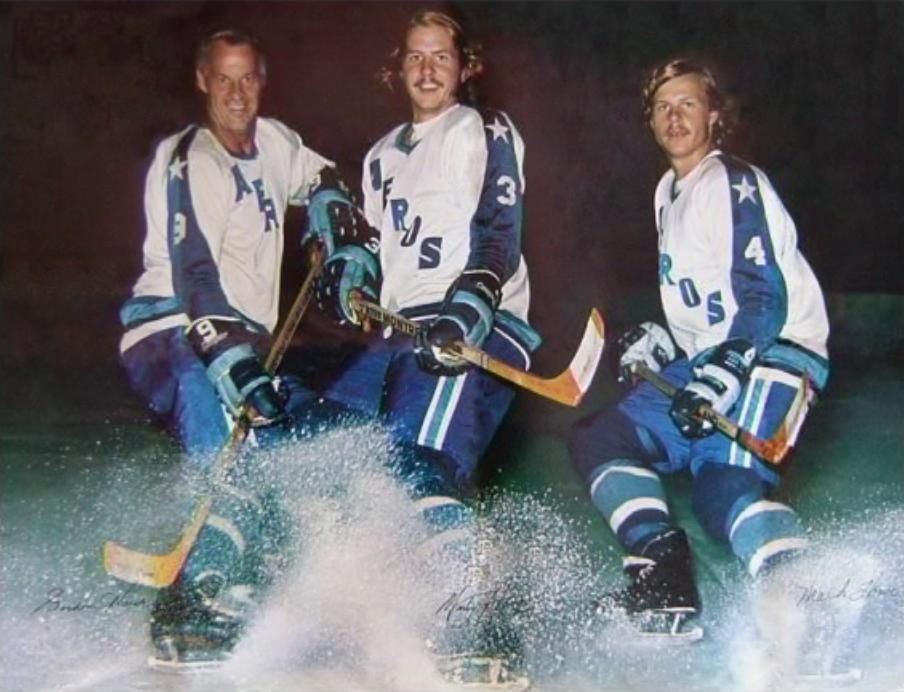
Gordie, Marty, Mark
And Gordie, age 46, was awarded the Gary Davidson Trophy as the league's Most Valuable Player. Davidson, the league's founder, and also the founder of the American Basketball Association and the World Football League, saw good public relations in taking his own name off, and renamed the award the Gordie Howe Trophy.
Like the Flyers, the Aeros would win their league's 1975 title, and reach the Finals again in 1976. Unlike the Flyers, they were beset by money woes, which forced them to sell all 3 Howes to the New England Whalers. When the NHL took on 4 WHA teams in 1979, the renamed Hartford Whalers were one of them, and all 3 Howes were still there, as Gordie embarked on 1 last season, his 32nd in the major leagues and his 26th under the NHL banner. Norris tried to assert his contract rights over Gordie, but the NHL overruled him. Mark would later become a defenseman, and join Gordie in the Hockey Hall of Fame.
*
May 19, 1974 was a Sunday. Football was out of season. The NBA season had ended 7 days earlier, with the Boston Celtics beating the Milwaukee Bucks in Game 7 of the Finals. The ABA season had ended 2 days before that, with the New York Nets beating the Utah Stars in the Finals, 4 games to 1. These Major League Baseball games were played:
* A doubleheader was split at Milwaukee County Stadium. The New York Yankees won the opener, beating the Milwaukee Brewers, 6-2, with Pat Dobson outpitching Jim Slaton. Ron Blomberg went 3-for-4 with an RBI for the Yanks. Rookie Robin Yount went 1-for-3 for the Brew Crew. The Brewers won the nightcap, 3-1, with Bill Champion outpitching Dick Woodson. Johnny Briggs hit a home run for the Brewers. Thurman Munson did not play in either game, with Rick Dempsey catching for the Yankees.
* The New York Mets were swept in a doubleheader by the Montreal Expos, 7-4 and 5-0 at Shea Stadium. Ernie McAnally pitched a 4-hit shutout in the 2nd game.
* The Boston Red Sox swept a doubleheader from the Baltimore Orioles, 11-2 and 6-4 at Memorial Stadium in Baltimore. Carl Yastrzemski went 5-for-7 with an RBI and 2 walks. Brooks Robinson went 1-for-7.
* A doubleheader was split at Three Rivers Stadium in Pittsburgh. The Philadelphia Phillies won the 1st game, 3-2. Jim Lonborg outpitched Dock Ellis. The Pittsburgh Pirates won the 2nd game, 2-1. Jerry Reuss outpitched Dick Ruthven. Over the 2 games, Willie Stargell went 2-for-8 with an RBI, and Mike Schmidt went 0-for-8.
* The Cleveland Indians swept a doubleheader from the Detroit Tigers, 2-1 and 9-4 at Cleveland Municipal Stadium. In his final season with the Tigers, Al Kaline went 0-for-4 in the 1st game, and didn't play in the 2nd game.
* The Oakland Athletics beat the Chicago White Sox, 8-3 at Comiskey Park in Chicago. Reggie Jackson went 2-for-3 with a walk, and was later replaced by "designated runner" Herb Washington. It didn't work: Washington didn't score, and Reggie's replacement as designated hitter, Deron Johnson, did not reach base in his only plate appearance. Jim "Catfish" Hunter won the game for the A's. Rich "Goose" Gossage, later to be a Yankee teammate of Reggie's and Catfish's, pitched 2 scoreless innings for the Pale Hose.
* A doubleheader was split at Metropolitan Stadium in the Minneapolis suburb of Bloomington, Minnesota. The California Angels won the 1st game, and the Minnesota Twins won the 2nd game, both ending 4-2. Nolan Ryan won the 1st game, striking out 12 and beating Bert Blyleven. Harmon Killebrew went 0-for-4 in the 1st game, and didn't play in the 2nd. Over the 2 games, Rod Carew went 5-for-8 with a walk and an RBI.
* The St. Louis Cardinals beat their arch-rivals, the Chicago Cubs, 6-5 at Busch Memorial Stadium in St. Louis. Bake McBride and Joe Torre hit home runs. Lou Brock went 2-for-4, and stole 2 bases, on his way to a new major league record of 118.
* The Texas Rangers beat the Kansas City Royals, 8-3 at Royals Stadium (later Kauffman Stadium) in Kansas City. George Brett only appeared as a pinch-hitter, and did not reach base.
* The Cincinnati Reds beat the Houston Astros, 7-1 at the Astrodome in Houston. Pete Rose went 0-for-5. Johnny Bench went 1-for-4 with a walk and an RBI.
* The Atlanta Braves beat the Los Angeles Dodgers, 4-2 at Dodger Stadium in Los Angeles. Hank Aaron went 1-for-4 with an RBI, but the Braves' only home run was hit by Ralph Garr.
* And a doubleheader was split at Candlestick Park in San Francisco. The San Francisco Giants won the 1st game, 8-2. The San Diego Padres won the 2nd game, 10-7. After not playing in the 1st game, Willie McCovey played for the Padres against the Giants, his once and future team, going 2-for-4 with a grand slam. The Padres won it in the 12th on a walk and an error. Over the 2 games, Dave Winfield went 6-for-10.


No comments:
Post a Comment