Saturday, October 1, 2022

October 1, 1965: "Dune" Is Published

Frank Herbert

October 1, 1965: Dune is published by Frank Herbert. It starts one of the most popular science fiction franchises.

Franklin Patrick Herbert Jr. was born on October 8, 1920 in Tacoma, Washington. He was reading newspapers by the age of 5, and developed an early interest in photography. He worked for newspapers in Oregon and Los Angeles, served in the U.S. Navy in World War II, and was briefly married and had a daughter. He went back home, and attended by dropped out of the University of Washington, but not before meeting Beverly Ann Stuart at a creating writing class. The only students in that class to sell any work for publication, they married and had sons Brian and Bruce.

Herbert then worked at newspapers in all 3 Pacific Coast States: Washington, Oregon and California. After selling some stories to science fiction magazines, he published his 1st novel, The Dragon in the Sea, in 1956. It was about a submarine crew going insane, and was critical of the oil industry.

He was able to devote himself wholeheartedly to his writing career, because his wife returned to work full-time as an advertising writer for department stores. In 1959, he was assigned to write a magazine article about sand dunes in the Oregon Dunes near Florence, Oregon. He got overinvolved, and ended up with far more raw material than needed for an article. The article was never written, but the novel Dune grew out of it. That is, it grew slowly: It took 6 years to write, and was longer than sci-fi novels tended to be: Many classics were short enough to fit into the category of "novella."

Dune's success opened other doors for him. He was the Seattle Post-Intelligencer's education writer from 1969 to 1972, and UW welcomed him back as lecturer in general studies and interdisciplinary studies. In 1973, he was director-photographer of the television show The Tillers.

Dune is set in the distant future, in a feudal interstellar society, descended from terrestrial humans, in which various noble houses control planetary fiefs. It tells the story of young Paul Atreides, whose family reluctantly accepts the stewardship of the planet Arrakis.

While the planet is an inhospitable and sparsely populated desert wasteland, it is the only source of melange or "spice," an enormously valuable drug that extends life and enhances mental abilities. Melange is also necessary for space navigation, which requires a kind of multidimensional awareness and foresight that only the drug provides. As melange can only be produced on Arrakis, control of the planet is a coveted and dangerous undertaking. As the saying goes, "He who controls the spice controls the universe."

The story explores the multilayered interactions of politics, religion, ecology, technology, and human emotion as the factions of the empire confront each other in a struggle for the control of Arrakis and its spice.

After that, he continued to succeed as a writer, mostly with books in the Dune series and with ecological and philosophical ideas. The series included Dune Messiah in 1969, Children of Dune in 1976, God Emperor of Dune in 1981, Heretics of Dune in 1984, and Chapterhouse: Dune in 1985. He had a 7th novel in mind, but he died on February 11, 1986, from pancreatic cancer, at the age of 65.

He lived long enough to see the 1st film version of Dune in 1984, with David Lynch directing and writing the screenplay. Kyle MacLachlan played Paul, and the film also included Francesca Annis, Leonardo Cimino, Brad Dourif, José Ferrer, Linda Hunt, Freddie Jones, Virginia Madsen, Siân Phillips, Jürgen Prochnow, Patrick Stewart, Dean Stockwell, Max von Sydow, Alicia Witt, Sean Young, and, in his 1st major acting role, the lead singer of the rock band The Police, Sting.

In 2021, a new film trilogy began, directed by Denis Villeneuve, and starring Timothée Chalamet as Paul. Other performers include Rebecca Ferguson, Oscar Isaac, Josh Brolin, Stellan Skarsgård, DAve Bautista, Zendaya, Charlotte Rampling, Jason Momoa and Javier Bardem.

(UPDATE: Dune: Part Two was released in 2024. Dune: Part Three, based on Dune Messiah, was released in 2026.)

*

October 1, 1965 was a Friday. It was the last weekend of baseball's regular season, and these games were played:

* The Pittsburgh Pirates beat the Chicago Cubs, 2-1 at Forbes Field in Pittsburgh. Roberto Clemente went 1-for-4. Ernie Banks went 0-for-4.

* A doubleheader was split at Cleveland Municipal Stadium. The Baltimore Orioles won the opener, 2-0. Dave McNally pitched a 2-hit shutout. The Cleveland Indians won the nightcap, 3-2. Between the 2 games, Brooks Robinson went 2-for-7 with a walk and an RBI.

* The Chicago White Sox beat the Kansas City Athletics, 6-1 at Comiskey Park in Chicago.

* The Houston Astros beat the St. Louis Cardinals, 4-2 at the Astrodome in Houston. Lou Brock went 0-for-4. Steve Carlton pitched a scoreless 8th inning.

* The Milwaukee Braves beat the Los Angeles Dodgers, 2-0 at Dodger Stadium in Los Angeles. Denny Lemaster pitched a 5-hit shutout. Hank Aaron went 0-for-1 with 2 walks. The next day, though, the Dodgers beat the Braves, and clinched the National League Pennant.

* The Cincinnati Reds beat the San Francisco Giants, 17-2 at Candlestick Park in San Francisco. A bad loss for the Giants, worse in terms of the Pennant chase than it was in terms of the final score. The Reds got home runs from Frank Robinson, Gordy Coleman, Deron Johnson and Pete Rose. 

For the Giants, Willie Mays went 1-for-3 with a walk. Warren Spahn pitched to 3 batters in the top of the 17th inning. He walked Johnny Edwards, Leo Cardenas reached on an error, and Sammy Ellis singled. Those would be the last batters Spahn ever faced, in the 750th and last game of his Hall of Fame career.

* The New York Mets and the Philadelphia Phillies were rained out at Shea Stadium. The game was made up as part of a doubleheader the next day. The Phillies won the 1st game, 6-0. Jim Bunning pitched a 2-hit shutout. The 2nd game went 18 innings, before the rain came back and the umpires called it. In other words, in 1 day, the Mets played 27 innings, and didn't score 1 single solitary run.

* The Detroit Tigers and the Washington Senators were rained out at District of Columbia Stadium in Washington. (It was renamed Robert F. Kennedy Memorial Stadium in 1969.) The game was made up as part of a doubleheader the next day. The Tigers swept, 9-1 and 6-2. Al Kaline was injured, and did not play in either game.

* And the New York Yankees, the Boston Red Sox, the Los Angeles Angels and the Minnesota Twins were not scheduled.

October 1, 1962: Johnny Carson's 1st "Tonight Show"

October 1, 1962: Johnny Carson, not quite 37 years old, debuts as host of The Tonight Show on NBC, broadcasting live from NBC's studio at 30 Rockefeller Center in Midtown Manhattan. The guests on his 1st show: Comedy legend Groucho Marx, 1920s music star Rudy Vallée, acting legend Joan Crawford, comedian (not yet film director) Mel Brooks and singer Tony Bennett.

Carson kept Ed McMahon as his announcer and sidekick for the entire length of the show. In 1966, he replaced Lyle "Skitch" Henderson as leader of the band, The NBC Orchestra, with trumpeter Carl "Doc" Severinsen, famed for his wild suits.
Doc and Johnny

In 1972, Carson took 2 big steps. He formed his own production company, so that he could preserve every show taped after that. Previously, NBC had taped over most of his old shows, due to the high cost of videotape. As a result, his 1st show has only been preserved on audio, and the Ed Ames tomahawk throw of April 27, 1965 is only on a black & white kinescope. Fortunately, the February 19, 1968 "Copper Clapper Caper" with Jack Webb has been saved on color videotape.

The other step was moving the show from New York to Los Angeles -- or, more specifically, to NBC's studio in what Rowan & Martin's Laugh-In had dubbed "Beautiful Downtown Burbank." It was a reflection of the fact that most of the big entertainers had established residence in the L.A. area, and that Hollywood, not Broadway, was now the center of the entertainment world. CBS' cancellation of The Ed Sullivan Show, broadcast from a studio on Broadway itself, the year before was the writing on the wall.

McMahon would introduce him as follows: "From Hollywood: The Tonight Show Starring Johnny Carson. This is Ed McMahon along with Doc Severinsen and the NBC Orchestra, inviting to join Johnny and his guests... " And he would name the guests, and announce, "And now, ladies and gentlemen, heeeeeeeeeeeeeeeere's Johnny!" It was more drawn-out than later New York Yankees broadcaster John Sterling's "Theeeeeeee Yankees win!" And then the show's theme would play, composed by singer Paul Anka. When it was done, with the tune of "Shave and a haircut, two bits!" Ed would usually yell, "Hi-yohhhhhhhh!" And the monologue would begin.
Ed and Johnny

The monologue usually ran about 7 minutes, and would begin with a few jokes about whatever was the top story of the day. Usually, the President of the United States, regardless of party or national popularity at the time, would come in for a couple of zingers, even if he hadn't done anything newsworthy that day. Occasionally, Johnny would start a joke by saying, "I've got good news and bad news," and Ed could be heard following it with, "Uh-oh!"

If a string of jokes didn't work, Johnny might start tapdancing, and the Orchestra would play "Tea for Two," and the audience would cheer. Sometimes, it wasn't his fault. Thursday audiences, for some reason, weren't very responsive; but Friday audiences, anxious to start the weekend, were usually raucous. Johnny might say, "We've got a good crowd tonight. You should have seen last night's crowd," and then tell a joke about them.

I'm not sure, but Johnny -- or, rather, Ed -- may have invented "How (adjective) is/was (subject)?" jokes. My theory is that, once, shortly after the '72 move, Johnny mentioned the weather, saying, "It was so hot in L.A. today!" and Ed said, "How hot was it?" and the audience laughed. So Johnny had to make up a joke on the spot, without help from his writers and the cue cards placed at the bottom of the stage. Some time later, according to this theory, he did it again one night, and someone in the audience, remembering the previous time, yelled out, "How hot was it?"

Johnny was definitely doing it by early 1974. I've seen an episode of Match Game that aired on October 29, 1973, with host Gene Rayburn reading a clue, saying, "Bertha was so fat!" and before he could finish, panelist Bert Convy, himself the host of several game shows, said, "How fat was she, Gene?" Before long, both shows were using it. But, barring further information, I can't be sure of who did it first.

Ed liked to do commercials, including for Budweiser beer (a product he enjoyed sampling offscreen) and Alpo dog food (which he, presumably, didn't try). Johnny hated segueing into commercials by mentioning, and sometimes even holding up, the product in question, and eventually had his contract renegotiated so that he didn't have to. It was the final blow to sponsor power on TV: After Johnny, every talk-show host wanted that same exemption, and got it.

Often, before the first guest, Johnny would do a sketch, with such characters:

* Carnac the Magnificent: This was a ripoff of first Tonight Show host Steve Allen's Answer Man, with the added shtick of Carnac being a turbaned, caped "strange visitor from the East." Ed would hand Johnny an envelope. Johnny would put the envelope up to the turban, as if to pull the answer from the index card in the envelope into his brain. He would give the answer. He would tear the envelope open. And then he would read the question/punchline. Example: Answer: "Sis boom bah." Question: "Describe the sound made when a sheep explodes."
"The winners." Rip. "Who are the Dodgers playing tonight?"

* Art Fern: A ripoff of Jackie Gleason's character Reginald Van Gleason III, Fern who would announce today's "Tea Time Movie," then do a commercial for some whacked-out local business, then show a tangled mess of lines standing in for a map of Los Angeles, giving directions: "You take the L.A. Freeway to the San Diego Freeway to the Harbor Freeway, until you get to the Slauson Cutoff. Get out of your car, and cut off your Slauson!" The second time in the sketch, he would unfold the map to reveal a picture of a fork, and the audience would yell along with him: "Until you get to... the fork in the road!" Along with him would be his well-endowed, squeaky-voiced Matinee Lady, originally Carol Wayne. She died under mysterious circumstances in 1985, and was replaced by Teresa Ganzel.
Johnny and Carol Wayne

(Incidentally, in 1974, the musicians' union was on strike, and so Doc couldn't appear on the air. Nor could Tommy Newsom, the saxophonist who led the band when Ed was unavailable and Doc had to do the announcing. And Ed got sick during the strike. So Carol Wayne did the announcing for 2 days, making her the only woman ever to announce, "Heeeere's Johnny!" And then he came out to no music, just appaluse.)

* Aunt Blabby: Another ripoff, this time of Jonathan Winters' Maude Frickert, she was a cantankerous old woman dressed in Victorian clothing, the way women would have dressed when she was young.

(If you're thinking that these ripoffs were unfair, let the record show that Allen, Gleason and Winters were all appeared on the show many times, as they were favorite guests of Johnny's.)

* Floyd R. Turbo: An ignorant yokel wearing flannel hunting gear, responding to a local TV news editorial.

Sometimes, he would do unrelated sketches, with actors known as The Mighty Carson Art Players. Actress Betty White would sometimes be involved. During the air-traffic controllers' strike of 1981, she played Jane to Johnny's Tarzan, telling him, "You're late!" and he said, "Not Tarzan's fault: Vine controllers strike!" And "Me Tarzan, King of Jungle!" was followed by Betty as Jane saying, "That wasn't exactly a royal performance you put on last night!" (I was 11. It took me years to get that joke.)

Johnny eventually cut back. On September 15, 1980, after the show had been an hour and a half, 11:30 PM to 1:00 AM, for most of its existence, going back to Steve Allen as host in 1954, it was cut to an hour, 11:30 to 12:30.

Although the show was faster-paced, it meant there would be fewer in-depth interviews. So there would be fewer newsmakers who weren't entertainers, fewer authors discussing their books, and fewer science figures, although astronomer Carl Sagan adapted well to the faster format. (Carson would sometimes impersonate Sagan, emphasizing the word "billions" the way he did.)

As the 1980s wore on, he was no longer taping on Mondays. Then, he wouldn't tape on Tuesdays, either. Twice a week, it was The Best of Carson airing at 11:30 PM. Well, what was NBC going to do, fire their biggest moneymaker? The show was making $60 million a year for NBC. (That's about $180 million in today's money.) It got to the point where, once, he introduced himself by saying, "My name is Johnny Carson. You all know me from The Best of Carson."

He liked to play tennis, and he liked to travel. This combined every Summer when he went to London for Wimbledon. In 1982, around the same time he did an impersonation of President Reagan in a re-working of Abbott & Costello's "Who's On First?" routine, he noted that Reagan had gone on vacation to his ranch outside Santa Barbara, and said, "Ronald Reagan spends more time in California than I do!"

(Reagan did once appear on the show, on January 3, 1975, just after his 2nd term as Governor of California. But while political candidates appeared on the show, no sitting President ever did while Carson was the host. Reagan had an inside man: Fred de Cordova, the show's director, had directed Reagan in the 1951 film Bedtime for Bonzo, about a man who adopts a chimpanzee.)

Whatever Johnny's personal tastes, he was willing to bring pretty much anybody on. Infamously, John Lennon and Paul McCartney of The Beatles (without George Harrison and Ringo Starr) appeared on May 14, 1968, but were very disappointed when baseball player-turned-NBC broadcaster Joe Garagiola, considerably squarer than Johnny, was the guest host. Eventually, all the individual Beatles except Lennon appeared as guests.

Musical guests ranged from classical to jazz to rock. Johnny was particularly fond of Bette Midler, and she became his last real guest, as his last show was basically a clip show.

Comedians knew that if Johnny liked you, you were going to make it. He helped make Joan Rivers a star, then his permanent guest-host and heir presumptive. But when Johnny wasn't ready to retire, Joan made a deal with Fox to do a competing show, and Johnny cut her off. From May 2, 1986, she did not appear on The Tonight Show again until February 17, 2014, shortly before her death, with Jimmy Fallon as host.

David Letterman and Jay Leno also had their 1st national TV appearances on Carson. Each guest-hosted for Johnny many times. Each thought he would succeed Johnny when he retired. Jay got the job. Dave was furious -- not with Johnny, but with Jay. Dave got a small measure of revenge: On the competing show he started on CBS in 1993, he got Johnny and Ed to appear, but Jay never got Johnny. (He did, however, get pre-Carson hosts Steve Allen and Jack Paar to come on.)

Also with their 1st national appearances on Carson: Steve Martin (a favorite of Johnny's, because they both started out as musicians), Jerry Seinfeld, Drew Carey and Robin Williams. Robin would be the last comedian on Johnny's version of the show, and they traded riffs on the 1992 Presidential election and the recent riot in Los Angeles.
Through immense change, from Kennedy to Clinton, from the Martin Luther King to Rodney King, from Sheriff Andy to Tim the Tool Man, from Lenny Bruce to Sam Kinison, from Elvis to Whitney, Carson was "The King of Late Night" for 30 years, winning 6 Emmy Awards and a Peabody Award, retiring on May 22, 1992.

Johnny Carson died in 2005. So did Skitch Henderson. Ed McMahon died in 2009. Groucho Marx and Joan Crawford both died in 1977. Rudy Vallée died in 1986. Fred de Cordova died in 2001. Tommy Newsom died in 2007. Joan Rivers and Robin Williams died in 2014. As of October 1, 2022, Doc Severinsen, Teresa Ganzel, Mel Brooks, Tony Bennett, Bette Midler, Jay Leno and David Letterman are still alive.

October 1, 1962 was also the day that James Meredith registered as the 1st black student at the University of Mississippi, under the protection of the federal government. I have a separate entry for that.

*

October 1, 1962 was a Monday. Actor Esai Morales was born.

It was the day of Game 1 of the National League Playoff, 11 years after the Giants and Dodgers did it in New York. Now, they do it in California, and Billy Pierce pitches a 3-hit shutout. He hardly needs to, as 2 homers by Willie Mays, and 1 each by Orlando Cepeda and Jim Davenport, give the San Francisco Giants an 8-0 win over the Los Angeles Dodgers at Candlestick Park.

October 1, 1962: James Meredith & JFK Integrate "Ole Miss"

October 1, 1962: James Meredith registers as a full-time student at the University of Mississippi. This is a very big deal, since he is the 1st black student at "Ole Miss."

Governor Ross Barnett had ordered the Mississippi National Guard to prevent this, and pro-segregation demonstrators were ready to beat or even kill Meredith if he tried.

Two days earlier, Ole Miss played the University of Kentucky at Memorial Stadium in Jackson, and won 14-0. Confederate flags were everywhere in the stands. At halftime, a gigantic Confederate flag was unveiled on the field. Fans chanted, "We want Ross!" Barnett went down to the field, took a microphone, and said, "I love Mississippi! I love her people! Our customs! I love and respect our heritage!" And he got a standing ovation.

President John F. Kennedy, on the insistence of his brother, Attorney General Robert F. Kennedy, federalized the Guard, and ordered them instead to protect Meredith and allow him to enroll. The racists rioted, and threw things at the Guardsmen, who fired back. Two men were killed. But the law prohibiting racial discrimination in enrollment at State-sponsored schools was upheld. On October 1, Meredith walked into the Lyceum, and became a student at the University of Mississippi.

Meredith, whose college credits from the all-black Jackson State University in Mississippi were carried over, received his degree from Ole Miss 10 months later.

The following Spring, the basketball team at Mississippi State University, who had won the Southeastern Conference Championship, was placed in the NCAA Tournament, to play Loyola University of Chicago, an integrated team. Barnett called the State Police, and told them to set up roadblocks to prevent the MSU Bulldogs from leaving the State to play that integrated team.

It didn't work: They snuck out of the State. And got to McGaw Hall, on the campus of Northwestern University in Evanston, Illinois, outside Chicago. And played Loyola. And lost the game. But they won a moral victory. Loyola became the 1st team with more black than white starters to win the National Championship.

At the time, State law prohibited Mississippi's Governors from succeeding themselves, so Barnett had to sit out the 1963 election. He ran again in 1967, and finished a distant 4th in the Democratic Primary, the 1st gubernatorial election in the State following the Voting Rights Act of 1965. He never won another office, and died in 1987 -- absolutely unrepentant, unlike such other civil rights opponents as George Wallace of Alabama, Strom Thurmond of South Carolina, Robert Byrd of West Virginia and Albert Gore Sr. of Tennessee.

Today, Meredith is 89, and has spent most of the 60 years since as a Republican. Ole Miss has honored him with a statue, and, like its rival Mississippi State, goes out of its way to recognize its role in civil rights, first as an opponent, then as a supporter.
Ole Miss still calls its teams the Rebels, but Confederate paraphernalia is no longer allowed on campus, and the "Colonel Reb" mascot has been retired.

This was also the day that Johnny Carson debuted as host of The Tonight Show. I have a separate entry for that.

*

October 1, 1962 was a Monday. Actor Esai Morales was born.

It was the day of Game 1 of the National League Playoff, 11 years after the Giants and Dodgers did it in New York. Now, they do it in California, and Billy Pierce pitches a 3-hit shutout. He hardly needs to, as 2 homers by Willie Mays, and 1 each by Orlando Cepeda and Jim Davenport, give the San Francisco Giants an 8-0 win over the Los Angeles Dodgers at Candlestick Park.

October 1, 1961: Canada's CTV Goes On the Air

October 1, 1961: CTV goes on the air in Canada. It was the 1st, and remains the only, true English-language competitor to the CBC, the Canadian Broadcasting Corporation. (Global Television Network trails them.)

In 1958, Prime Minister John Diefenbaker, thinking that CBC wasn't being fair to his Progressive Conservative Party government, passed the Broadcasting Act, establishing the Board of Broadcast Governors (BBG), taking over the CBC's role as the arbiter of radio and television broadcasting in the country. This broke the CBC's monopoly, and the new CTV accepted offers for licenses from new stations. The originals were, from East to West:

* CJCH-Channel 5, Halifax.
* CFTM-Channel 10, Montreal, in French.
* CFCF-Channel 12, Montreal, in English.
* CJOH-Channel 13, Ottawa.
* CFTO-Channel 9, Toronto.
* CJAY-Channel 7, Winnipeg.
* CBXT-Channel 5, Edmonton.
* CFCN-Channel 4, Calgary.
* CHAN-Channel 8, Vancouver.

They broadcast some Canadian programming, from situation comedies to game shows; but also some American shows, like The Rifleman and The Andy Griffith Show; the British police drama Maigret; and Whiplash, borrowed from the Australian network Seven, kind of a "Down Under" version of a Western.

Quincy Jones' 1962 composition "Soul Bossa Nova" became the network's theme song, which explains how it also became the theme song to the Austin Powers films, created by, directed by, and starring Toronto native Mike Myers.

Since 2000, CTV has been owned by BCE, Bell Canada Enterprises -- in other words, their phone company.

*

October 1, 1961 was a Sunday. These games were played on the final day of baseball's regular season:

* The New York Yankees beat the Boston Red Sox, 1-0 at Yankee Stadium. The only run of the game came in the 4th inning, when Roger Maris hit his record-breaking 61st home run of the season, off Tracy Stallard. Bill Stafford (3 hits over 6 innings), Hal Reniff (a perfect 7th) and Luis Arroyo (1 hit over 2) combined on a 4-hit shutout. I have a separate entry for this game.

* The St. Louis Cardinals beat the Philadelphia Phillies, 2-0 at Connie Mack Stadium in Philadelphia. Bob Gibson pitched a 6-hit shoutout. Stan Musial appeared only as a pinch-hitter, and did not reach base.
* The Pittsburgh Pirates beat the Cincinnati Reds, 3-1 at Forbes Field in Pittsburgh. Roberto Clemente did not play. Frank Robinson went 0-for-2 with a walk. Despite this game, the Reds had dethroned the Pirates as National League Pennant winners, and would face the Yankees in the World Series. The Yankees won in 5 games.
* The Los Angeles Dodgers beat the Chicago Cubs, 8-2 at Wrigley Field in Chicago. Ernie Banks went 1-for-4 with an RBI. Duke Snider drew a walk as a pinch-hitter.
* A doubleheader was split at Milwaukee County Stadium. The San Francisco Giants won the opener, 8-2. The Milwaukee Braves won the nightcap, 3-2. Al Spangler singled Hank Aaron home with the winning run in the bottom of the 10th inning. Over the 2 games, Aaron went 4-for-9, and Willie Mays went 3-for-7 with a home run and 3 RBIs.
* The Detroit Tigers beat the Minnesota Twins, 8-3 at Metropolitan Stadium in the Minneapolis suburb of Bloomington, Minnesota. Norm Cash hit a home run, and Al Kaline had an RBI double as a pinch-hitter. This was the Tigers' 101st win of the year, but the Yankees won 109 to take the American League Pennant.
For the Twins, completing their 1st season after being "the old Washington Senators," Harmon Killebrew went 0-for-3 with a walk, and relief pitcher Pedro Ramos hit a home run, 1 of 3 he hit on the season, and 1 of 15 he hit in a surprisingly powerful career for a pitcher who was mainly a reliever.
* The Kansas City Athletics beat "the new Washington Senators," 3-2 at Kansas City Municipal Stadium.
* After providing a venue for the Pacific Coast League's Los Angeles Angels from 1925 through 1957, and the major league expansion team with the same name this season, the West Coast version of Wrigley Field hosts its last professional baseball game. The Halos are defeated by the Cleveland Indians, 8-5 in front of 9,868 fans. Wrigley West will be torn down in 5 years, to make room for an eventual public playground and senior center.
* And the Baltimore Orioles and the Chicago White Sox completed their seasons the day before, against each other, with the O's winning, 4-3 at Memorial Stadium in Baltimore.
These games were played in the NFL:
* The New York Giants beat the Washington Redskins, 24-21 at District of Columbia Stadium in Washington. This was the 1st event at what would be renamed Robert F. Kennedy Stadium in 1969. I have a separate entry for that event. (The opener, not the renaming.)
* The football version of the St. Louis Cardinals beat the Philadelphia Eagles, 30-27 at Franklin Field in Philadelphia.
* The Baltimore Colts beat the Minnesota Vikings, 34-33 at Memorial Stadium in Baltimore.
* The Cleveland Browns beat the Dallas Cowboys, 25-7 at Cleveland Municipal Staidum.
* The San Francisco 49ers beat the Detroit Lions, 49-0 at Tiger Stadium in Detroit.
* The Green Bay Packers beat their arch-rivals, the Chicago Bears, 24-0 at Green Bay City Stadium (later renamed Lambeau Field).
* And the Los Angeles Rams beat the Pittsburgh Steelers, 24-14 at the Los Angeles Memorial Coliseum.
And in the American Football League:
* The New York Titans beat the Boston Patriots, 37-30 at the Polo Grounds. The Titans became the Jets in 1963, and the Patriots became the New England Patriots in 1971.
* The Dallas Texans beat the Houston Oilers, 26-21 at the Cotton Bowl in Dallas. The Texans became the Kansas City Chiefs in 1963, and the Oilers became the Tennessee Titans in 1999.
* The Oakland Raiders beat the Denver Broncos, 33-19 at Candlestick Park in San Francisco. The Raiders wouldn't actually play a game in Oakland until 1962, moved to Los Angeles in 1982, moved back to Oakland in 1995, and moved to Las Vegas in 2020.
* And, the day before, the San Diego Chargers beat the Buffalo Bills, 19-11 at War Memorial Stadium in Buffalo. This was the Chargers' 1st game as a San Diego team, after spending the AFL's founding year of 1960 in Los Angeles. They returned to Los Angeles in 2017. 

October 1, 1961: Roger Maris Hits 61 in '61

October 1, 1961: Roger Maris comes to bat for the New York Yankees in the bottom of the 4th inning, against Tracy Stallard of the Boston Red Sox, in the last game of the regular season. The game would seem to be meaningless, as the Yankees had clinched the Pennant on September 20.

It was far from meaningless. Maris had 60 home runs, tying the single-season record set by Babe Ruth in 1927. This game would be his last chance to break the record.

He was born in Hibbing, Minnesota in 1934, and grew up in Fargo, North Dakota. After playing with the Cleveland Indians in 1957 and '58, and then for the Kansas City Athletics, the Yankees acquired him after the 1959 season. In 1960, he hit 39 home runs, 2nd in the American League to teammate Mickey Mantle with 40, and was named the American League's Most Valuable Player, as the Yankees won the Pennant.

Then came 1961. Roger got off to a slow start, and late in April, manager Ralph Houk tinkered with the batting order, putting Roger 3rd and Mickey 4th. That did the trick: Mickey kept hitting well, and Roger, who couldn't be walked (intentionally or "unintentionally") for fear of bringing Mickey up with a man on base, saw better pitches to hit, and did he ever hit them. By the All-Star break, both men had over 30 home runs, and Ruth's record of 60 home runs in a season was in doubt.

This was the 1st season of a 162-game schedule, due to the expansion of the AL from 8 to 10 teams, after over 50 years of a 154-game schedule. Thus, Commissioner Ford Frick, who had been a good friend of the Babe's, said that the record books would have 2 separate entries for single-season records, in the event that such a record needed more than 154 games to be broken.

(This also became an issue the next season, though with much less fuss: Ty Cobb stole 96 bases with the 1915 Detroit Tigers, but Maury Wills of the Los Angeles Dodgers stole 104 -- but didn't get his 97th until after the 154th game.)

All the while, the New York media wouldn't let up, bothering Roger from the moment he walked out of his car as he arrived at the Stadium until the moment he got back into his car after the game. He was being bothered at home. Fans who didn't want to see Ruth's record broken booed him.

They would have preferred Mickey as the record-breaker, since Mickey was a career Yankee. (They must have forgotten that the Babe was not. This may have been the first-ever "True Yankee" debate, symbolized later by Thurman Munson & Reggie Jackson, and more recently by Derek Jeter & Alex Rodriguez.) The point was made that Roger was a .270 hitter, whereas the Babe hit .342 lifetime. They brought up the extra games, and the addition of pitchers due to expansion.

Had the Babe lived, he would have been 66 years old, not a terribly old man. I've got to believe that he would have said, "Anything that's good for baseball, and anything that's good for the Yankees, is good for me. If this kid can break my record, it'll help the Yankees win, and it's getting people talking about baseball, so I'm fine with it." Alas, he had died in 1948, and the writers never figured out that attacking Roger did nothing to protect the Babe's legacy.

It got so bad that Roger was getting death threats in the mail, and at least one telephoned threat to kidnap his children. It got so bad that his hair started falling out. (This sounds like a legend, to exaggerate what really happened, but it has been well-documented.) Still, the media kept treating him like dirt, partly because he was threatening the sacred record of the beloved Babe, partly because, unlike the Babe and the Mick, he wasn't the kind of man who liked a lot of attention.

(When Hank Aaron approached Ruth's career record of 714 home runs in 1973, Roger was the only man who had an understanding of what Hank was going through, although in Roger's 1961 case there wasn't a racial aspect to it. By then living in Florida, where the closest MLB team was Hank's Atlanta Braves, Roger took his kids up there to see Hank play, and praised him for his great career and his courage in standing up to the abuse. Hank, of course, got to 715 early in the 1974 season, and finished with 755, which stood until 2007 when it was broken, with "help," by Barry Bonds, who raised it to the current record of 762.)

In the 154th game, Roger hit his 59th home run, but that was it. He got to 60 on September 26. But, through Game 161 on September 30, no more. He would have one more game, 4 or 5 more at-bats.

The game started at 2:03 PM, and it was scoreless when Maris stepped to the plate against Tracy Stallard in the bottom of the 4th inning. Stallard's 1st pitch was outside, and the Yankee Fans, hoping that Stallard would give Maris something to hit, booed. His 2nd pitch was in the dirt for ball 2, and, as Yankee broadcaster and shortstop legend Phil Rizzuto noted, the boos got louder. Then, at 2:43 (confirmed by a photograph of the Stadium scoreboard), Stallard threw a fastball down the middle. Maris swung. Rizzuto had the call, on WPIX-Channel 11:

Here's the windup. Fastball, hit deep to right, this could be it! Way back there! Holy cow, he did it! Sixty-one for Maris! And look at the fight for that ball out there! Holy cow, what a shot! Another standing ovation for Roger Maris! Sixty-one home runs, and they're still fighting for that ball out there, people are climbing over each other's back. One of the greatest sights I've ever seen here at Yankee Stadium.

The ball fell into the right-field stands near the Yankee bullpen, about 375 feet. As Maris crossed the plate, a fan who has never been identified was on the field, shook his hand, and slapped him on the back. Maris' teammates kept pushing him out of the dugout to acknowledge the standing ovation that wouldn't end.

That would be the only run of the game. The Yankees won, 1-0. Bill Stafford pitched shutout ball for 6 innings, and was followed by Hal Reniff in the 7th and Luis Arroyo in the 8th and 9th, between them allowing just 4 hits and 1 walk.

Attendance: 23,154. That doesn't sound like much. It becomes more embarrassing when you consider that most of them seemed to be sitting in right field, hoping to catch the ball. Sam Gordon, a restaurant owner in Sacramento, California, had offered $5,000 (about $45,700 in today's money) for the ball, and they were hoping to cash in.

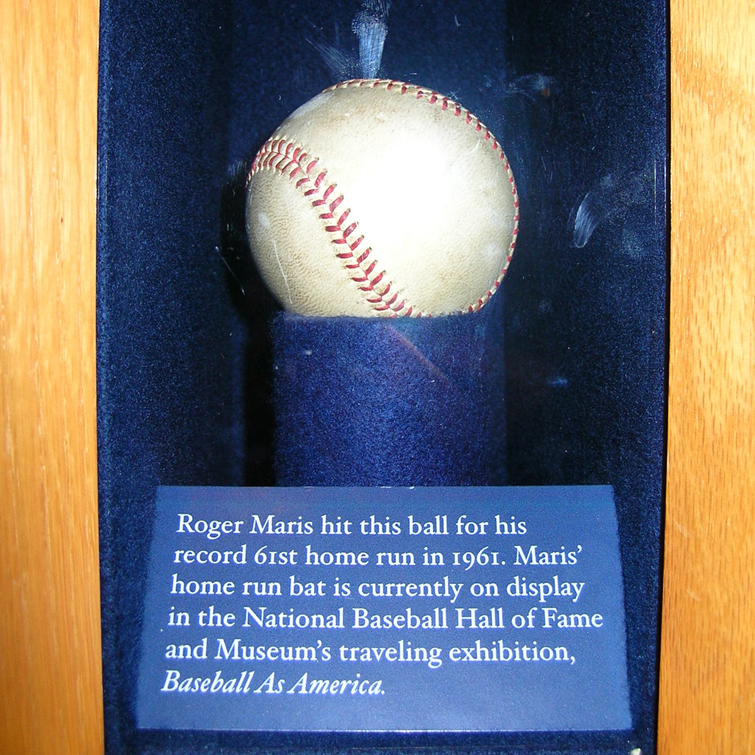
Sal Durante, a 19-year-old truck driver, caught the record-breaking ball. After the game, Durante was invited into the Yankee clubhouse to pose with Maris and the ball. Durante offered Maris the ball, but Maris declined, saying to get what you can for it.

Durante, who had brought his fiancée Rosemary to the game, bought her an engagement ring. Gordon paid for the Durante's honeymoon, put the ball on display in his restaurant for a while, and then gave it back to Maris. In 1973, Maris donated it to the Baseball Hall of Fame in Cooperstown, New York, where it rests today.
Still alive from this game, 61 years later: For the Yankees, Bobby Richardson, Tony Kubek, Héctor López and Jack Reed. For the Red Sox: Only their rookie left fielder, a 22-year-old native of Southampton, Long Island named Carl Yastrzemski.

Also still alive, in the Yankee dugout but not appearing in the game, was a rookie pitcher named Al Downing. In 1974, Downing gave up Hank Aaron's 715th home run. I don't know if anybody else was in the ballpark for both moments, but Downing was definitely the only one in uniform for both.

(UPDATE: López died on September 29, 2002; Reed on November 10, 2022; and Durante on December 1, 2022. Mrs. Durante died in 2014.)

One of my favorite trivia questions is, "Who played right field for the Yankees the day Roger Maris hit his 61st home run in 1961?" The easy answer is, "Roger Maris," but that's wrong. Mickey Mantle was sick, and Roger was playing center field that day. The right fielder? Backup catcher Johnny Blanchard.

Roger batted .269 that season, but his 61 home runs, 141 RBIs and 366 total bases all led the AL. In spite of his relationship with the New York writers, the Baseball Writers Association of America voted him MVP again. The Yankees won the World Series, beating the Cincinnati Reds in 5 games, and Roger hit another homer in the series.

The rest of his career was an anticlimax. How could it not be? He hit 33 home runs in 1962. He helped the Yankees win 5 straight Pennants, including the 1961 and 1962 World Series. He broke his hand early in the 1965 season, one of several injuries that caused the Yankees to fall apart that year and tumble from the top to the middle of the League, and the next year to the bottom. But Yankee management told him the injury was something less severe, and publicly suggested that he was faking the extent of the injury. This caused a breach between Roger and the Yankee management of the time that never healed, even after the hand did.

After the 1966 season, he was traded to the St. Louis Cardinals for 3rd baseman Charley Smith. 
Roger helped the Cardinals win the World Series in 1967, and another Pennant in 1968. He finished his career with a .260 batting average, 275 home runs and 851 RBIs. Decent totals, but not those of an all-time great.

Cardinals owner Gussie Busch gave him an Anheuser-Busch beer distributorship in Gainesville, Florida, and the family still lives there today. In 1978, by which point most people who felt he didn't deserve to break the record had either died or changed their minds, George Steinbrenner invited him back to Yankee Stadium. He appeared on Opening Day 1978, to raise the previous season's World Championship banner with Mantle, and got a standing ovation.
He attended Old-Timers' Day from 1978 to 1984, in the last of those getting his Number 9 retired and a Plaque for Monument Park. But he was beginning to suffer from cancer, and died in 1985. He did not live to see his record raised, through dubious means, to 70 by Mark McGwire in 1998, and then to 73 by Barry Bonds in 2001.

A Roger Maris Museum had also been dedicated in his hometown of Fargo, at the West Acres Regional Shopping Center. Roger said he would allow it as long as admission was free. It still is.

*

October 1, 1961 was a Sunday. It was also the day that District of Columbia Stadium, later renamed Robert F. Kennedy Memorial Stadium, opened in Washington; and broadcast network CTV went on the air in Canada. I have separate entries for those events.

These other games were played on the final day of baseball's regular season:

* The St. Louis Cardinals beat the Philadelphia Phillies, 2-0 at Connie Mack Stadium in Philadelphia. Bob Gibson pitched a 6-hit shoutout. Stan Musial appeared only as a pinch-hitter, and did not reach base.
* The Pittsburgh Pirates beat the Cincinnati Reds, 3-1 at Forbes Field in Pittsburgh. Roberto Clemente did not play. Frank Robinson went 0-for-2 with a walk. Despite this game, the Reds had dethroned the Pirates as National League Pennant winners, and would face the Yankees in the World Series. The Yankees won in 5 games.
* The Los Angeles Dodgers beat the Chicago Cubs, 8-2 at Wrigley Field in Chicago. Ernie Banks went 1-for-4 with an RBI. Duke Snider drew a walk as a pinch-hitter.
* A doubleheader was split at Milwaukee County Stadium. The San Francisco Giants won the opener, 8-2. The Milwaukee Braves won the nightcap, 3-2. Al Spangler singled Hank Aaron home with the winning run in the bottom of the 10th inning. Over the 2 games, Aaron went 4-for-9, and Willie Mays went 3-for-7 with a home run and 3 RBIs.
* The Detroit Tigers beat the Minnesota Twins, 8-3 at Metropolitan Stadium in the Minneapolis suburb of Bloomington, Minnesota. Norm Cash hit a home run, and Al Kaline had an RBI double as a pinch-hitter. This was the Tigers' 101st win of the year, but the Yankees won 109 to take the American League Pennant.
For the Twins, completing their 1st season after being "the old Washington Senators," Harmon Killebrew went 0-for-3 with a walk, and relief pitcher Pedro Ramos hit a home run, 1 of 3 he hit on the season, and 1 of 15 he hit in a surprisingly powerful career for a pitcher who was mainly a reliever.
* The Kansas City Athletics beat "the new Washington Senators," 3-2 at Kansas City Municipal Stadium.
* After providing a venue for the Pacific Coast League's Los Angeles Angels from 1925 through 1957, and the major league expansion team with the same name this season, the West Coast version of Wrigley Field hosts its last professional baseball game. The Halos are defeated by the Cleveland Indians, 8-5 in front of 9,868 fans. Wrigley West will be torn down in 5 years, to make room for an eventual public playground and senior center.
* And the Baltimore Orioles and the Chicago White Sox completed their seasons the day before, against each other, with the O's winning, 4-3 at Memorial Stadium in Baltimore.
These games were played in the NFL:
* The New York Giants beat the Washington Redskins, 24-21 at District of Columbia Stadium in Washington. This was the 1st event at what would be renamed Robert F. Kennedy Stadium in 1969. I have a separate entry for that event. (The opener, not the renaming.)
* The football version of the St. Louis Cardinals beat the Philadelphia Eagles, 30-27 at Franklin Field in Philadelphia.
* The Baltimore Colts beat the Minnesota Vikings, 34-33 at Memorial Stadium in Baltimore.
* The Cleveland Browns beat the Dallas Cowboys, 25-7 at Cleveland Municipal Staidum.
* The San Francisco 49ers beat the Detroit Lions, 49-0 at Tiger Stadium in Detroit.
* The Green Bay Packers beat their arch-rivals, the Chicago Bears, 24-0 at Green Bay City Stadium (later renamed Lambeau Field).
* And the Los Angeles Rams beat the Pittsburgh Steelers, 24-14 at the Los Angeles Memorial Coliseum.
And in the American Football League:
* The New York Titans beat the Boston Patriots, 37-30 at the Polo Grounds. The Titans became the Jets in 1963, and the Patriots became the New England Patriots in 1971.
* The Dallas Texans beat the Houston Oilers, 26-21 at the Cotton Bowl in Dallas. The Texans became the Kansas City Chiefs in 1963, and the Oilers became the Tennessee Titans in 1999.
* The Oakland Raiders beat the Denver Broncos, 33-19 at Candlestick Park in San Francisco. The Raiders wouldn't actually play a game in Oakland until 1962, moved to Los Angeles in 1982, moved back to Oakland in 1995, and moved to Las Vegas in 2020.
* And, the day before, the San Diego Chargers beat the Buffalo Bills, 19-11 at War Memorial Stadium in Buffalo. This was the Chargers' 1st game as a San Diego team, after spending the AFL's founding year of 1960 in Los Angeles. They returned to Los Angeles in 2017.

October 1, 1961: America's National Stadium

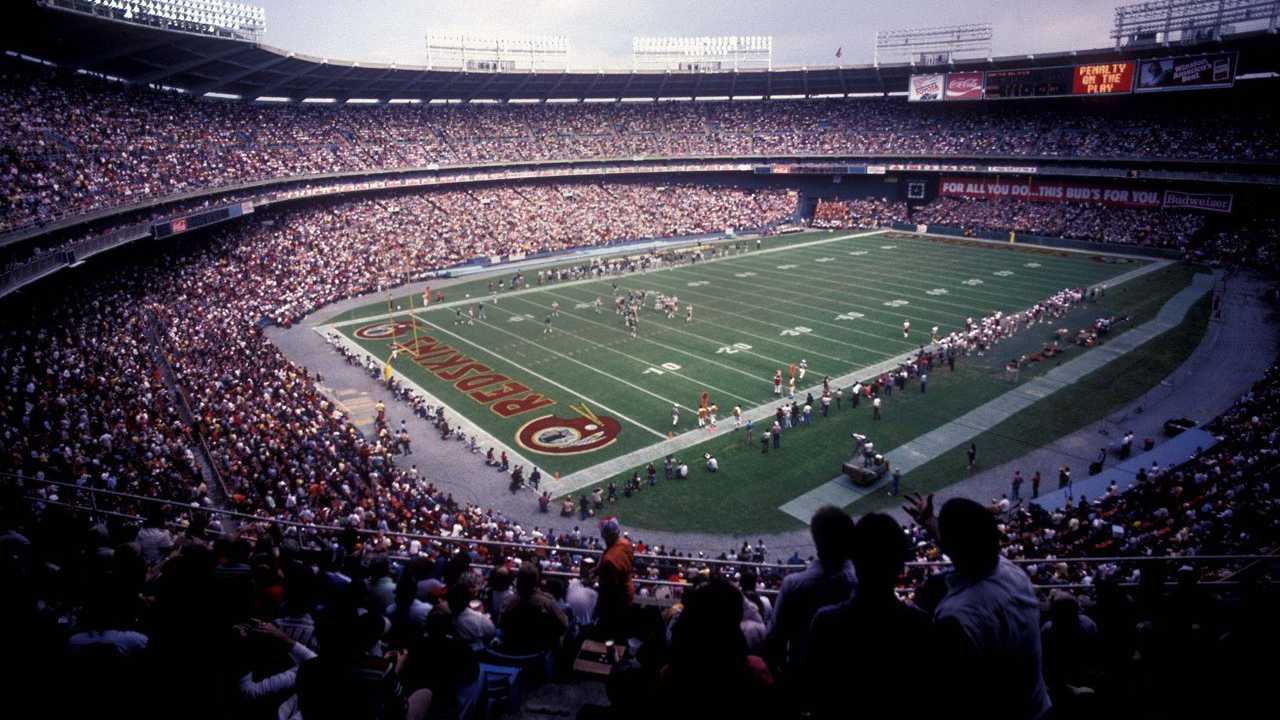
October 1, 1961: District of Columbia Stadium opens in Washington, D.C. The Washington Redskins lose to the New York Giants, 24-21.

As with most major American cities early in the 20th Century, the biggest stadiums were the baseball parks. The biggest stadiums built for football were on the campuses of State universities, which tended to be in or near State capitals, which were not necessarily the biggest city in their State.

In 1916, Representative George Hulbert, a Democrat, proposed the construction of a 50,000-seat "national stadium" -- not in New York City, where the Rochester native had practiced law, but in the nation's capital, Washington, D.C.. The idea was that it would host the 1920 Olympics, the Army-Navy football game, and Davis Cup tennis matches. It wasn't taken seriously.

Later, another Representative from New York, Representative Hamilton Fish III, and D.C.'s Director of Public Buildings and Parks, Ulysses S. Grant III -- the former's grandfather had been Secretary of State under the latter's grandfather -- decided to build a 100,000-seat national stadium, as a memorial to President Theodore Roosevelt, either on the island in the Potomac River that bore TR's name, or on the National Mall, as a bookend to the Lincoln Memorial. In addition to the preceding events, it was thought that Presidential Inaugurations could be held there. But Los Angeles won America's bid to host the 1932 Olympics, and, eventually, the National World War II Memorial became the Lincoln Memorial's bookend.

In 1944, a 9-man National Memorial Stadium Commission was appointed, and a site was chosen for a national stadium, next to the D.C. Armory, which opened in 1941, where East Capitol Street met the Anacostia River. But, with World War II still ongoing, getting Congress to fund a 100,000-seat stadium for the 1948 Olympics was impossible, and the Games were held in London.

In 1956, Representative Charles R. Howell, Democrat of New Jersey (I wasn't born yet, but, had I lived then where I live now, he would have been "my Congressman") proposed legislation funding a national stadium, after the National Capital Planning Commission re-proposed "the East Capitol Site."

Clark Griffith, longtime owner of baseball's Washington Senators, had recently died, leaving the team to his nephew, Calvin Griffith, and he didn't want to play at Griffith Stadium, a 27,000-seat stadium, expandable to only 35,000 for the NFL's Washington Redskins, and in a neighborhood that was growing increasingly black -- to the point where, after the ballpark was demolished, Howard University, the school known as "the Black Harvard," built its hospital on the site. It was thought that a national stadium could not only attract the Olympics and the Army-Navy Game, but save the Senators and Redskins from moving.

This time, Congress passed the District of Columbia Stadium Act, authorizing a 50,000-seat stadium, and President Dwight D. Eisenhower signed it into law on July 29, 1958. It was the 1st stadium built from scratch for both baseball and football -- up the Parkway, Baltimore repurposed the existing Municipal Stadium as Memorial Stadium for both sports in a conversion process from 1950 to 1954 -- and it opened in time for the Redskins to open the 1961 season there. (By a weird coincidence, both that stadium and DC/RFK Stadium would be built across the street from a school named Eastern High School.)

There was a snag, though: The Redskins were the last NFL team that hadn't racially integrated, and the stadium was on federal government property. When John F. Kennedy became President on January 20, 1961, he appointed Representative Stewart Udall of Arizona as Secretary of the Interior, overseeing the site. (Stew's brother, Morris "Mo" Udall, won his seat, and each of them had a son who went on to be elected to the U.S. Senate.) The Secretary told Redskins owner George Preston Marshall, a known racist, that he had to integrate the team, or he couldn't have D.C. Stadium. Marshall caved.

Griffith moved the Senators for the 1961 season, anyway, making them the Minnesota Twins. An expansion franchise was placed at Griffith Stadium for 1961, named the Washington Senators. D.C. Stadium became their home on April 9, 1962, and they beat the Detroit Tigers, 4-1. It hosted the 1962 and 1969 Major League Baseball All-Star Games. JFK threw out the ceremonial first ball at both Opening Day and the All-Star Game in 1962.
JFK is flanked by Vice President Lyndon Johnson
and White House aide Dave Powers. Also identifiable behind him:
Senators Hubert Humphrey, Everett Dirksen and Mike Mansfield;
and White House aide Larry O'Brien, later Chairman of the Democratic Party
(his offices at the Watergate were bugged in 1972) and NBA Commissioner.

On January 18, 1969, having served the entirety of the JFK and Lyndon B. Johnson Administrations, Secretary Udall announced that the stadium had been renamed Robert F. Kennedy Memorial Stadium, for JFK's brother and Attorney General, who had been elected to the Senate in 1964, had run for President in 1968, and, like JFK, had been assassinated. A formal rededication ceremony was held on June 7. (Most people dropped the "Memorial" when talking about it, and called it "RFK Stadium," or even just "RFK.")

On July 1, 1977, the Washington Metropolitan Area Transit Authority opened the Stadium-Armory subway station, serving RFK Stadium and the D.C. Armory on the Blue Line and the Orange Line, with the Silver Line later added. It was a bit of a walk, though: The station was at 19th and A Streets Southeast, a 10-minute walk from the Stadium, whose mailing address was 2400 East Capitol Street Northeast.

Not having subway access hurt the Senators, who left after the 1971 season, and, with a few exceptions such as preseason exhibitions and old-timers' games, baseball did not return until 2005. The Washington Nationals arrived, and remained through the 2007 season, then moved into Nationals Park.

The Redskins played there until 1996, building the NFL's most intimidating home-field advantage, reaching 4 Super Bowls, winning 3. Their last game there was on December 22, 1996, a 37-10 pasting of their arch-rivals, the Dallas Cowboys. Moving out to the far larger stadium in suburban Landover, Maryland turned the 'Skins from the team with the best home-field advantage in the NFL to the worst.
This seat would have been behind home plate
in the stadium's baseball configuration.
You can make out the dugouts.

Unlike most countries, the United States does not have an official "national stadium." RFK is the closest we come to it: Not only is it in the nation's capital, but it has hosted the national soccer team more times than any other venue, 24 times. (The Los Angeles Memorial Coliseum is 2nd, with 20; with the now-demolished Orange Bowl in Miami right behind, with 19.) Which become more amazing when you realize that the 1st such match wasn't until 1977, and the 2nd not until 1991. Why? Interest in the team was too low: RFK Stadium was too big for them until they reached the 1990 World Cup.

In those 24 matches, the U.S. won 15, lost 3, and drew 6. These matches include the 100th Anniversary match of the U.S. Soccer Federation, held on June 2, 2013, a 4-3 U.S. win over Germany. I was there -- it was hot and humid, and it had rained earlier -- and I took this photo.
This seat would have been in center field
in the stadium's baseball configuration.
Again, you can make out the dugouts.
After hosting the Washington Wolves and the Washington Diplomats of the old North American Soccer League, the latter including Dutch superstar Johan Cruyff, in 1996, RFK Stadium became the home of D.C. United, a charter team in Major League Soccer. It continued to be DCU's home through the 2017 season, after which they moved into Audi Field. DCU won the MLS Cup while playing there in 1996, 1997, 1999 and 2004, with the MLS Cup Final being played there in 1997, 2000 and 2007.
The last event at RFK Stadium was on October 22, 2017, a 2–1 D.C. United loss to the New York Red Bulls. It has been announced that RFK Stadium will be demolished in 2021. The 1st of the multi-purpose oval stadiums built in America in the 1960s, '70s and '80s, it is one of the last to still be standing. The only one still in use is the Oakland Coliseum, although the Astrodome is still standing.
In the 2014 film X-Men: Days of Future Past, Erik Lensherr, a.k.a. the supervillain Magneto (played in the flashback sequences by Michael Fassbender, and as an old man by Ian McKellen), ripped the circular stadium off its foundation, levitated it, and moved it across town, surrounding the White House, with the intention of killing President Richard Nixon. He failed. Computer-generated imagery was used to simulate the stadium's appearance in 1973, complete with period-appropriate advertising.
UPDATE: Demolition was delayed until 2025. That year, the District, the NFL, and the renamed Washington Commanders agreed on a deal to built a new stadium on the site, intending to open it in time for the 2030 season.
In "death," RFK Stadium still holds the record for most times hosting the U.S. Men's National Team (USMNT), with 24. The L.A. Coliseum is still 2nd, with 20. But Dignity Health Sports Park, in the Los Angeles suburb of Carson, California, has tied the Orange Bowl for 3rd, with 19. The Landover replacement for RFK Stadium, currently named Northwest Stadium? Only 2.
*
October 1, 1961 was a Sunday. This was also the day that television network CTV went on the air in Canada. I have a separate entry for that event.
These other games were played in the NFL:
* The football version of the St. Louis Cardinals beat the Philadelphia Eagles, 30-27 at Franklin Field in Philadelphia.
* The Baltimore Colts beat the Minnesota Vikings, 34-33 at Memorial Stadium in Baltimore.
* The Cleveland Browns beat the Dallas Cowboys, 25-7 at Cleveland Municipal Staidum.
* The San Francisco 49ers beat the Detroit Lions, 49-0 at Tiger Stadium in Detroit.
* The Green Bay Packers beat their arch-rivals, the Chicago Bears, 24-0 at Green Bay City Stadium (later renamed Lambeau Field).
* And the Los Angeles Rams beat the Pittsburgh Steelers, 24-14 at the Los Angeles Memorial Coliseum.
In the American Football League:
* The New York Titans beat the Boston Patriots, 37-30 at the Polo Grounds. The Titans became the Jets in 1963, and the Patriots became the New England Patriots in 1971.
* The Dallas Texans beat the Houston Oilers, 26-21 at the Cotton Bowl in Dallas. The Texans became the Kansas City Chiefs in 1963, and the Oilers became the Tennessee Titans in 1999.
* The Oakland Raiders beat the Denver Broncos, 33-19 at Candlestick Park in San Francisco. The Raiders wouldn't actually play a game in Oakland until 1962, moved to Los Angeles in 1982, moved back to Oakland in 1995, and moved to Las Vegas in 2020.
* And, the day before, the San Diego Chargers beat the Buffalo Bills, 19-11 at War Memorial Stadium in Buffalo. This was the Chargers' 1st game as a San Diego team, after spending the AFL's founding year of 1960 in Los Angeles. They returned to Los Angeles in 2017.
And it was the last day of baseball's regular season:
* The New York Yankees beat the Boston Red Sox, 1-0 at Yankee Stadium. The only run of the game came in the 4th inning, when Roger Maris hit his record-breaking 61st home run of the season, off Tracy Stallard. Bill Stafford (3 hits over 6 innings), Hal Reniff (a perfect 7th) and Luis Arroyo (1 hit over 2) combined on a 4-hit shutout. I have a separate entry for this game.
* The St. Louis Cardinals beat the Philadelphia Phillies, 2-0 at Connie Mack Stadium in Philadelphia. Bob Gibson pitched a 6-hit shoutout. Stan Musial appeared only as a pinch-hitter, and did not reach base.
* The Pittsburgh Pirates beat the Cincinnati Reds, 3-1 at Forbes Field in Pittsburgh. Roberto Clemente did not play. Frank Robinson went 0-for-2 with a walk. Despite this game, the Reds had dethroned the Pirates as National League Pennant winners, and would face the Yankees in the World Series. The Yankees won in 5 games.
* The Los Angeles Dodgers beat the Chicago Cubs, 8-2 at Wrigley Field in Chicago. Ernie Banks went 1-for-4 with an RBI. Duke Snider drew a walk as a pinch-hitter.
* A doubleheader was split at Milwaukee County Stadium. The San Francisco Giants won the opener, 8-2. The Milwaukee Braves won the nightcap, 3-2. Al Spangler singled Hank Aaron home with the winning run in the bottom of the 10th inning. Over the 2 games, Aaron went 4-for-9, and Willie Mays went 3-for-7 with a home run and 3 RBIs.
* The Detroit Tigers beat the Minnesota Twins, 8-3 at Metropolitan Stadium in the Minneapolis suburb of Bloomington, Minnesota. Norm Cash hit a home run, and Al Kaline had an RBI double as a pinch-hitter. This was the Tigers' 101st win of the year, but the Yankees won 109 to take the American League Pennant.
For the Twins, completing their 1st season after being "the old Washington Senators," Harmon Killebrew went 0-for-3 with a walk, and relief pitcher Pedro Ramos hit a home run, 1 of 3 he hit on the season, and 1 of 15 he hit in a surprisingly powerful career for a pitcher who was mainly a reliever.
* The Kansas City Athletics beat "the new Washington Senators," 3-2 at Kansas City Municipal Stadium.
* After providing a venue for the Pacific Coast League's Los Angeles Angels from 1925 through 1957, and the major league expansion team with the same name this season, the West Coast version of Wrigley Field hosts its last professional baseball game. The Halos are defeated by the Cleveland Indians, 8-5 in front of 9,868 fans. Wrigley West will be torn down in 5 years, to make room for an eventual public playground and senior center.
* And the Baltimore Orioles and the Chicago White Sox completed their seasons the day before, against each other, with the O's winning, 4-3 at Memorial Stadium in Baltimore.

December 31, 1999 & January 1, 2000: The Millennium

December 31, 1999:  The Millennium arrives. The people of planet Earth survived. At a terrible cost. But we hadn't destroyed ourselves. ...