Friday, September 30, 2022

September 30, 1991: "The Jerry Springer Show" Premieres

September 30, 1991: The Jerry Springer Show premieres. There had been controversial talk shows on TV before, but this was the beginning of "trash TV."

Gerald Norman Springer was born on February 13, 1944 in Highgate, and lived in East Finchley, both in North London, before moving as a child with his family to Kew Gardens, Queens, New York City. He was raised Jewish, and it would be decades before he found out that both of his grandmothers had died in Nazi concentration camps.

He got a degree in political science from Tulane University in New Orleans, and a law degree from Northwestern University outside Chicago. In 1968, he worked on Robert F. Kennedy's Presidential campaign. In 1970, while working at a Cincinnati law firm, he ran for Congress, and lost. The next year, he was elected to the City Council.

In 1974, he made the mistake of going across the river to Kentucky (where he figured he wouldn't be as well-known), and became the customer of a prostitute. He compounded the mistake by writing a check, easily traceable, for her services. The mistake was further compounded when the check bounced, and it became publicly known. He came clean, and resigned. In a city as conservative as Cincinnati, that would have appeared to mean the end of his political career.

But the next year, with the scandal having blown over, he won his seat back, and in 1977, he was chosen by the Council to serve as Mayor for a year. He ran for Governor of Ohio in 1982, but failed to win the Democratic nomination, and never ran for office again.

And if that were the whole story, it would be pretty interesting. But WLWT-Channel 5 hired him as a news commentator. This led, in 1991, to the creation of The Jerry Springer Show, which began as a ripoff of Phil Donahue's talk show, and then, as Emeril Lagasse might say, kicked it up a notch. Or maybe twelve notches. Although usually using NBC studios, the show aired in syndication throughout its run.

The topics were usually of an unsophisticated nature, such as infidelity and other relationship squabbles. From there, they might move into the bizarre: Sleeping with the wrong twin, liking sex in weird places, "My boyfriend is a Nazi," "My girlfriend is a witch," etc. Once all the guests had told their stories, there was usually a "question and answer" segment, where audience members asked guests questions. In earlier seasons, the questions tended to be serious. However, these questions gave way to insults as the show progressed.

Sometimes, there would be fights between guests. Sometimes, a guest would challenge an insulting studio viewer to say it to their face, and the viewer would oblige, and a fight would result. Like the referee at a hockey game, Jerry would let them fight for a moment, then send in the security officers. All the while, the studio audience would chant not the name of their favored combatant, but the host's name: "Jerry! Jerry! Jerry!"

He would end the show with a "Final Thought," giving a formal lecture, sitting by himself on the stage, on the principles of refined values in regards to the featured guests. The segment ended with the concluding statement, "'Til next time, take care of yourselves and each other," which was his sign-off line during his days as a newscaster in Cincinnati.

Critics hated the lowbrow nature of the show, citing Jerry's tilting toward the lowest common denominator of human society. Which is what the show's fans loved about it. In a 2000 interview, Jerry himself admitted, "I would never watch my show. I'm not interested in it. It's not aimed towards me. This is just a silly show."

Taping was moved from Cincinnati to the NBC Tower at 454 North Columbus Drive on the Near North Side of Chicago in 1992; and to the Stamford Media Center, at 61 Atlantic Street, in the New York City suburb of Stamford, Connecticut, in 2009, after the State of Connecticut offered the producers a big tax break.

In 2017, Springer and fellow talk show host Rickie Lake faced each other in the "Drop the Mic" rap battle segment on NBC's The Late Late Show with James Corden. Ricki got in some good zingers, including, "Jerry's the only person who hates Game of Thrones, because the biggest show about incest is no longer his own!" But Jerry won the battle, citing the fact that The Ricki Lake Show was brought back for a 2nd run, and canceled quickly: "Your comeback was derailed, and nobody cared! I'd try a comeback, too, you know, but... my show's still on the air."

And that was true, until the final episode aired on July 26, 2018, by Jerry's own choice: His contract was running out, he was 74 years old, and he was ready to retire.

What about Jerry's own family? It was actually too inspirational for his own show. In 1973, he married Micki Velton. In 1976, their daughter Katie was born, without nasal passages. This required immediate surgery. She is blind, and deaf in one ear. Yet she said her parents raised her as normally as possible. In 2006, she was teaching at a school for disabilities, and her father donated $230,000 to build a high-tech facility there, now known as Katie's Corner.

Jerry and Micki separated in 1994, but never divorced. Katie married a man named Adam Yenkin, and they have a son. She remained close to her father, including talking him into accepting an invitation to appear on the ABC reality show Dancing with the Stars when he didn't want to do it. She says, "Anyone who judges him based strictly on his show, they shouldn't. It's not who he is."

UPDATE: Jerry died on April 27, 2023, at 79, from pancreatic cancer. British newspaper The Guardian said he "changed U.S. television for better and worse." Steve Wilkos, the former Chicago cop who was his show's security director from 1994 to 2007, and thus became famous as well, said, "Other than my father, Jerry was the most influential man in my life. Everything I have today, I owe to Jerry. He was the smartest, most generous, kindest person I've ever known. My wife and I are devastated. We will miss him terribly."

*

September 30, 1991 was a Monday. On ABC Monday Night Football, the Washington Redskins beat the Philadelphia Eagles, 23-0 at Robert F. Kennedy Memorial Stadium in Washington.

The NBA and the NHL were out of season. These Major League Baseball games were played:

* The New York Yankees beat the Cleveland Indians, 3-0 at Cleveland Municipal Stadium. Scott Sanderson allowed 4 hits over 5 innings, John Habyan 1 over 2, and Greg Cadaret none over 2 to finish a 5-hit shutout. Don Mattingly went 1-for-4.

* The New York Mets lost to the Pittsburgh Pirates, 6-5 at Three Rivers Stadium in Pittsburgh. Steve Bell and Steve Buchele hit home runs, for the Pirates. Barry Bonds went 2-for-3 with a walk.

* The Philadelphia Phillies beat the Chicago Cubs, 6-5 at Veterans Stadium in Philadelphia.

* The California Angels beat the Toronto Blue Jays, 2-1 at the SkyDome (now the Rogers Centre) in Toronto.

* The Atlanta Braves beat the Cincinnati Reds, 4-0 at Riverfront Stadium in Cincinnati. John Smoltz allowed 2 hits over 8 innings, and Mike Bielecki finished a 3-hit shutout.

* The Detroit Tigers beat the Baltimore Orioles, 8-3 at Tiger Stadium in Detroit. Cal Ripken went 2-for-4.

* The Minnesota Twins beat the Chicago White Sox, 8-3 at the new Comiskey Park (now Rate Field) in Chicago.

* The Boston Red Sox beat the Milwaukee Brewers, 9-8 at Milwaukee County Stadium. Jack Clark and Phil Plantier hit home runs for the Red Sox. For the Brewers, Robin Yount did not play, Paul Molitor went 1-for-4, former Yankee 2nd baseman Willie Randolph went 4-for-5, and Greg Vaughn went 2-for-5 with a home run and 5 RBIs.

* The St. Louis Cardinals beat the Montreal Expos, 11-1 at Busch Memorial Stadium in St. Louis.

* The Kansas City Royals beat the Oakland Athletics, 8-4 at Royals Stadium (now Kauffman Stadium) in Kansas City. George Brett went 0-for-4 with a walk. Rickey Henderson went 0-for-3.

* A doubleheader was split at Arlington Stadium in the Dallas suburb of Arlington, Texas. The Seattle Mariners won the opener, 3-2. Jay Buhner won it with a home run in the top of the 11th. The Texas Rangers won the nightcap, 2-0. Ken Griffey Jr. went 1-for-4 with a walk and an RBI in the 1st game, and grounded out as a pinch-hitter in the 2nd game.

* The Los Angeles Dodgers beat the San Diego Padres, 7-2 at Dodger Stadium in Los Angeles. Tony Gwynn did not play for the Padres.

* And the Houston Astros beat the San Francisco Giants, 2-0 at Candlestick Park in San Francisco. For the Giants, Chris Gardner allowed 6 hits over 7 innings, and Rob Mallicoat and Xavier Hernandez finished the 6-hit shutout.

September 30, 1987: Roy Orbison's Black and White Night

Left to right: Roy Orbison, Bruce Springsteen, Elvis Costello

September 30, 1987: A rock concert is held in the Coconut Grove nightclub at the Ambassador Hotel in Los Angeles. This was the same room where Robert F. Kennedy gave his last speech before being assassinated.

Earlier in the year, Orbison had been among the 2nd class of inductees into the Rock and Roll Hall of Fame. Giving his induction speech was Bruce Springsteen. At that time, he said, "In '75, we got together to make Born to Run. I wanted lyrics like Bob Dylan that sounded like Phil Spector. But, most of all, I wanted to sing like Roy Orbison. Now, everybody knows that nobody sings like Roy Orbison."

A celebration of him was held at the Ambassador. Having gotten his start at Sun Records, like Elvis Presley, he was backed on this night by members of Elvis' Las Vegas band: Guitarists James Burton and John Wilkinson, bass guitarist Jerry Scheff, drummer Ronnie Tutt, and pianist Glen Hardin.

Among those also joining him, and singing backup, were Bruce Springsteen, Tom Waits, Elvis Costello, Jackson Brown, k.d. lang, Jennifer Warnes and Bonnie Raitt. As Orbison sang songs like "Only the Lonely," "Running Scared," "In Dreams," "Crying" and "It's Over," Springsteen, sitting on the stage, and already pretty accomplished himself, could be seen looking up, with a look on his face that said, "Oh my God, I'm backing up Roy Orbison!"

The show was closed with an extended version of Roy's biggest hit, the 1964 Number 1 hit "Oh, Pretty Woman." It was a reminder that Roy wasn't just a truly great singer, he was also a really good songwriter and a really good guitarist. (On an earlier song, "Candy Man," he also showed that he was a really good harmonica player.)

Orbison died on December 6, 1988, a little over a year after the concert. It has since been regularly broadcast, as Roy Orbison and Friends: A Black and White Night, on PBS, during the networks' pledge drives.

*

September 30, 1987 was a Wednesday. These Major League Baseball games were played that day:

* The New York Yankees lost to their arch-rivals, the Boston Red Sox, 7-0 at Yankee Stadium. The Sox scored 6 runs in the top of the 4th, knocking Al Leiter out of the box. Roger Clemens went the distance for Boston, striking out 13. Wade Boggs did not play.

The Yankees were limping to a frustrating end of a season where they were in 1st place as late as August 8, going 23-28 the rest of the way and finishing 9 games behind Detroit in the American League Eastern Division. Injuries to Willie Randolph and Dave Winfield proved key.

* The Mets lost to the Philadelphia Phillies, 4-3 at Veterans Stadium in Philadelphia. The Mets got home runs from Darryl Strawberry and Tim Teufel, but Luis Aguayo hit a home run to win the game in the bottom of the 10th. Jesse Orosco gave it up, ruining a good 9-inning performance by Dwight Gooden. Mike Schmidt also homered for the Phils, the 530th of his career.

Despite the close margin, the Mets' loss was even worse than the Yankees', because they entered the game 3 1/2 games behind St. Louis in the National League Eastern Division, with 4 games to play, so they still had a chance. The defending World Champions hadn't been in 1st place since April 24, but had stayed close the whole way. Just 2 days earlier, they were only 2 games behind the Cards.

* The Baltimore Orioles beat the Detroit Tigers, 7-3 at Tiger Stadium in Detroit. Eddie Murray went 0-for-4, but the O's got home runs from Cal Ripken Jr., Fred Lynn and Terry Kennedy.

* The Milwaukee Brewers beat the Toronto Blue Jays, 5-2 at Exhibition Stadium in Toronto. Robin Yount went 2-for-4 with an RBI, and Paul Molitor went 0-for-2 with 3 walks.

* A doubleheader was split at Three Rivers Stadium in Pittsburgh. The Pittsburgh Pirates won the opener, 5-3. The Chicago Cubs won the nightcap, 10-8.

This was part of a 7-game losing streak, including the last 4 to the Tigers, that would give the Tigers the AL East title, earning Toronto the nickname "The Blow Jays." Despite Division titles in 1989 and 1991, it would take until 1992 to get rid of the nickname.

* The Chicago White Sox beat the California Angels, 5-2 at Comiskey Park in Chicago.

* The Montreal Expos beat the St. Louis Cardinals, 6-1 at Busch Memorial Stadium. Despite the Mets' loss, the Cards couldn't finish the job. The next game, they would, beating the Expos the next day to clinch the NL East.

* The Kansas City Royals beat the Seattle Mariners, 7-3 at Royals Stadium in Kansas City. (It was renamed Kauffman Stadium in 1993.) George Brett went 2-for-5 with 3 RBIs.

* The Texas Rangers beat the Minnesota Twins, 2-1 at Arlington Stadium in the Dallas suburb of Arlington, Texas.

* The Atlanta Braves beat the Houston Astros, 3-1 at the Astrodome in Houston. The Braves scored 3 runs in the top of the 9th, as Dave Smith blew a save for Mike Scott, who had allowed just 3 hits in 8 innings.

* The Cincinnati Reds beat the San Diego Padres, 3-1 at Jack Murphy Stadium in San Diego. Tony Gwynn went 2-for-4.

* The San Francisco Giants beat their arch-rivals, the Los Angeles Dodgers, 3-0 at Dodger Stadium in Los Angeles. Mike Krukow (the future Giants broadcasting pitching 6 innings) and Joe Price combined on a 6hit shutout.

* And the Oakland Athletics beat the Cleveland Indians, 4-3 at the Oakland Coliseum.

September 30, 1984: “Murder, She Wrote” Premieres

September 30, 1984: Murder, She Wrote premieres on CBS, 2 days after Miami Vice premiered on NBC.

Obviously a takeoff on Agatha Christie's Jane Marple, Angela Lansbury plays Jessica Fletcher, who lives in the seaside community of Cabot Cove, Maine, and writes mystery novels under the pen name "J.B. Fletcher."

The opening montage originally showed her writing on an old manual typewriter. As the series went along for 12 seasons, she switched to an electric typewriter, and finally to a computer.

Jessica appears to be a New England native, but Lansbury was English on her father's side and Irish on her mother's, and that part of her heritage was written into the character, who had been born Jessica Beatrice MacGill. (MacGill was the maiden name of Lansbury's mother. "Jessica Beatrice" became "J.B.," as it is still common for women to use masculine, or gender-neutral, pen names to be taken more seriously as writers.)

Her husband Frank Fletcher is said to have died 2 years before the series began. She never had children, but had 2 sisters and 2 brothers, and thus had a lot of nieces and nephews, and they became associated figures, and sometimes even suspects, in the murders that seemed to follow her around.

I mentioned that Miami Vice had premiered 2 days earlier. Now, Miami is a city of 400,000 people, and it's had a crime problem for a long time. Cabot Cove is said on the show to have a population of 3,560, about 400 less than Crabapple Cove, the Maine hometown of M*A*S*H lead character Hawkeye Pierce (Alan Alda). And yet, there seemed to be as many murders in Cabot Cove as there were in Miami, with over 100 times the population. Derry, the Maine location of many of Maine native Stephen King's horror novels, is said to have about 35,000 people, 10 times the population of Cabot Cove, and 9 times that of Crabapple Cove.

The dichotomy reached a point where people began to joke that Jessica committed all those murders, to get material for her books. After all, murder seemed to follow her everywhere: To New York where she taught creating writing at NYU, to Hollywood, and to big cities and small towns all over the world. Even the Sheriff, Mort Metzger (played by Ron Masak), says to Jessica Fletcher that, in his first year in Cabot Cove, he had to deal with 5 murders, and nicknames the town the "death capital of Maine."

Don't go to Maine looking for Cabot Cove: The exterior shots were filmed in Mendocino, California, on the opposite coast. Derry isn't real, and its scenes have been filmed in Southern California and the Toronto area. Crabapple Cove also isn't real, and has never been depicted onscreen, big or small.

However, Cabot Cove's population is almost exactly that of another coastal town in Maine, Kennebunkport, Summer home of the Bush political family, and there is an inlet there named Cabot Cove. M*A*S*H creator Richard Hornberger (who wrote under the name of Richard Hooker) grew up in Bremen, on the Maine coast, which has a street named Crabapple Drive. But with about 800 residents, it's even smaller than any of the aforementioned towns.

Cabot Cove's ZIP Code was given as 03041. This Code is in use, but in Derry City, New Hampshire -- not anywhere in Maine, much less in Stephen King's fictional Derry. All Maine ZIP Codes begin with 04.

*

September 30, 1984 was a Sunday. Rapper T-Pain was born. And these Major League Baseball games were played:

* The New York Yankees beat the Detroit Tigers, 9-2 at Yankee Stadium. Don Mattingly finished the season with a .343 batting average, winning the American League batting title, edging fellow Yankee Dave Winfield at .340.

* The Cleveland Indians beat the Minnesota Twins, 7-4 at Cleveland Municipal Stadium.

* The California Angels beat the Texas Rangers, 1-0 at Arlington Stadium in the Dallas suburb of Arlington, Texas. Mike Witt pitches a perfect game. He is not related to major league stars Bobby Witt Sr. and Jr.

* The New York Mets lost to the Montreal Expos, 5-4 at the Olympic Stadium in Montreal. Bill Gullickson outpitched Ron Darling. This was the last game Gary Carter played for the Expos before the Mets traded for him, although he did return to the Expos for the end of his career. He went 2-for-3 with a walk and an RBI in this game. Dan Driessen hit a home run for the Expos. For the Mets, Darryl Strawberry went 2-for-4 with a home run, a walk, and 2 RBIs. George Foster also hit a home run.

* The Baltimore Orioles beat the Boston Red Sox, 5-3 at Fenway Park in Boston. Eddie Murray went 0-for-5. Cal Ripken went 2-for-4 with a walk. Dwight Evans went 3-for-5 for the BoSox.

* The Pittsburgh Pirates swept a doubleheader from the Philadelphia Phillies, 2-0 and 7-2 at Veterans Stadium in Philadelphia. In the opener, John Tudor allowed 2 hits over 5 innings, and 4 relievers finished a 3-hit shutout. Over the 2 games, Mike Schmidt went 1-for-8, including his 425th career home run.

* The Atlanta Braves beat the San Diego Padres, 4-3 at Atlanta-Fulton County Stadium. Tony Gwynn went 0-for-2 before being replaced.

* The Cincinnati Reds beat the Houston Astros, 7-6 at Riverfront Stadium in Cincinnati. Eddie Milner hit a sacrifice fly to score former Astro star César Cedeño with the winning run in the bottom of the 9th inning. Cedeño and Reds player-manager Pete Rose each went 3-for-5, and Rose added 3 RBIs.

* The Chicago Cubs beat their arch-rivals, the St. Louis Cardinals, 2-1 at Wrigley Field in Chicago. This completed the Cubs' 1st regular season qualifying for postseason play in 39 years, as they won the National League Eastern Division.

* The Milwaukee Brewers beat the Toronto Blue Jays, 4-0 at Milwaukee County Stadium. Bob Gibson (not that one) allowed 4 hits over 7 innings, and Ray Searage completed the 4-hit shutout. Robin Yount went 2-for-4 with 2 RBIs. Paul Molitor was injured and did not play.

* The  Los Angeles Dodgers beat their arch-rivals, the San Francisco Giants, 7-2 at Dodger Stadium in Los Angeles.

* The Oakland Athletics beat the Kansas City Royals, 8-2 at the Oakland Coliseum. Rickey Henderson went 0-for-2 with a walk. George Brett did not play.

* And the Seattle Mariners beat the Chicago White Sox, 5-3 at the Kingdome in Seattle.

Being a Sunday, these NFL games were played:

* The New York Giants lost to the Los Angeles Rams, 33-12 at Anaheim Stadium (now Angel Stadium of Anaheim).

* The New York Jets lost to the New England Patriots, not yet their arch-rivals, 28-21 at Giants Stadium at the Meadowlands.

* The Washington Redskins beat the Philadelphia Eagles, 20-0 at Robert F. Kennedy Stadium in Washington.

* The Tampa Bay Buccaneers beat the Green Bay Packers, 30-27 at Tampa Stadium.

* The Indianapolis Colts beat the Buffalo Bills, 31-17 at the Hoosier Dome in Indianapolis.

* The Dallas Cowboys beat the Chicago Bears, 23-14 at Soldier Field in Chicago.

* The Seattle Seahawks beat the Minnesota Twins, 20-12 at the Metrodome in Minneapolis.

* The Miami Dolphins beat the football version of the St. Louis Cardinals, 36-28 at Busch Memorial Stadium in St. Louis.

* The Kansas City Chiefs beat the Cleveland Browns, 10-6 at Arrowhead Stadium in Kansas City.

* The New Orleans Saints beat the Houston Oilers, 27-10 at the Astrodome in Houston.

* The Denver Broncos beat the Los Angeles Raiders, 16-13 at Mile High Stadium in Denver.

* The San Diego Chargers beat the Detroit Lions, 27-24 at Jack Murphy Stadium in San Diego.

* The San Francisco 49ers beat the Atlanta Falcons, 14-5 at Candlestick Park in San Francisco.

* And the next night, on ABC Monday Night Football, the Pittsburgh Steelers beat the Cincinnati Bengals, 38-17 at Three Rivers Stadium in Pittsburgh.

September 30, 1982: "Cheers" Premieres

Left to right: Nick Colasanto, Ted Danson, Shelley Long,
John Ratzenberger, Rhea Perlman, George Wendt

September 30, 1982: The situation comedy Cheers premieres on NBC. It was about Sam Malone (played by Ted Danson), a former relief pitcher for the Boston Red Sox, who ruined his career by excessive drinking, and now ran a bar in Boston.

This would seem to have been a bad idea, given his affliction, but he was good at it. The show was also about the bar itself, and the characters who were regular visitors.

A photograph of a Sox pitcher hangs on a post at the bar, purported to be Sam. It's actually an earlier Sox pitcher, Jim Lonborg, the American League Cy Young Award winner when the Sox won their "Impossible Dream" Pennant in 1967. This establishes Sam's uniform number as being the same as Gentleman Jim's, 16. In reality, on the Pennant-winning Sox of 1975, 16 was worn by outfielder Rick Miller.

Cheers is the 1980s in a nutshell. Here are the Top 10 Reasons:

1. Sam represents the excesses of the time, managing to skate through everything -- until he can't anymore. He wasn't quite "Sex, Drugs and Rock & Roll" personified, but he was a womanizer, a substance abuser (in his case, alcohol), and a lover of fast cars (to the end of the show, he drove a cherry-red 1964 Chrevolet Corvette).

After almost, but not quite, going through with his marriage ceremony to Diane Chambers (Shelley Long), he sees Diane accept a job across the country, and she says she'll be back in 6 months. Sam doesn't buy it, and he turns out to be right. He sells the bar, and buys a boat, which he handles badly, and it sinks on its maiden voyage. That was his "Crash of '87," although the story happened to him before it happened to Wall Street.

He goes back to work at the bar, but he's just a bartender, no longer the owner, and tries to scheme his way back into ownership. At first, it doesn't work. This represents the Eighties' "bill coming due" after the Wall Street Crash of '87, although, in real life, the economy didn't fall all at once. The Savings & Loan Scandal of 1989 had more to do with the recession of 1990-93 than the Crash did. Sam did get the bar back, but it took 3 years.

2. Diane represents mental illness, and President Ronald Reagan letting so many mentally ill people out on the street. She did annoy everyone, but she was clearly impaired. And she was not properly treated. The character of Dr. Frasier Crane (Kelsey Grammer) was introduced at the start of Season 3 as her therapist, but before his introductory episode was out, we found out he was also sleeping with her, which was a massive violation of medical ethics. The relationship didn't last much longer, since she went back to Sam after he went back on the wagon.

3. Coach represents the old ways that have seemingly been lost. Emblematic of this is that, aside from the Red Sox, the only time we find out which team once employed Ernie Pantusso, a.k.a. "Coach" (Nicolas Colasanto), was when he said he played for the St. Louis Browns' organization. The Browns moved to become the Baltimore Orioles in 1954, after winning just 1 Pennant and no World Series in more than half a century. So, by this point, any mention of them was as a hopeless relic.

4. Cliff represents Reagan Era paranoia. Mail carrier Cliff Clavin was a dedicated employee of the U.S. Postal Service. He was also a self-styled know-it-all, whose bluster wouldn't have lasted two minutes in the Internet era, when his "little known facts" would have been quickly exposed.

He was also one of the most politically conservative characters on TV, saying after George H.W. Bush became President in 1989, "Ever since Reagan left office, this country's gone to heck in a handcart." He was played by John Ratzenberger, and, as Cliff, he wasn't acting: He's like that in real life.

5. Norm represents the working class, who were told they would have it better now, but they really don't. On September 23, 1982, 7 days before the show premiered, Billy Joel released his album The Nylon Curtain, including the working man's lament "Allentown." On September 30, hours before the show premiered, Bruce Springsteen released his album Nebraska, including "Atlantic City." The American Dream wasn't coming true anymore, and keeping a job -- and, if not, getting a new one -- proved hard, even for a white-collar man like accountant Norm Peterson (George Wendt).

"Bars can be sad places," Norm once said. "Some people spend their whole lives in a bar. Yesterday, some guy came in, and sat down next to me for 11 hours." Cheers was his refuge from an uncaring world. Cheers was where people still cared about him. Like the theme song, written and sung by Gary Portnoy, said: "Sometimes, you wanna go where everybody knows your name, and they're always glad you came."

6. Frasier represents the ruling class, suddenly realizing that they don't rule as much as they thought they did. Like a similarly stuffy and bald medical man from Boston, Dr. Charles Emerson Winchester III (David Ogden Stiers on M*A*S*H), Frasier frequently reminded people that he graduated from Harvard University.

The fact that the spinoff series Frasier retconned him as actually being from Seattle doesn't change the perception that he fit in better in Boston. That show also changed his background: While his mother was a brilliant scientist, his father was a working-class cop. But viewers wouldn't know that until 1993, and watched Cheers thinking that Frasier was a Boston Brahmin like Charles.

7. Carla represents women, trying to have it every which way, and facing the consequences more than the men do. Carla Tortelli (Rhea Perlman) started the series with a nasty, cheating, no-good 1st husband and 5 kids. She ended it with one cheating ex-husband alive, another dead (not killed by her, although she was certainly capable of it), and 8 kids (1 with neither of them). No one on the show struggled more than Carla. Why? Was it because she was a woman?

Maybe not: Diane struggled less, and so did Rebecca Howe (Kirstie Alley), who managed the bar from Seasons 6 to 9, and then was assistant manager under Sam the rest of the way.) But Carla was the show's only married woman. (Despite a close call in the Season 5 finale, and another when she returned for the series finale, Diane and Sam never did marry each other.)

8. Woody represents the Rubes out in the Hinterlands, who just like having Reagan tell them all those nice stories about how wonderful things were, could be again, and eventually were again, except they were only words. Woody Boyd (Woody Harrelson) was brought in as a bartender after Colasanto died of cancer during Season 3. There he was in the big city, telling everybody how great life was on the farm in Indiana.

But this was no Radar O'Reilly on M*A*S*H: Unlike the Iowa-tied company clerk, Woody was even dumber than Coach. How dumb was he? Dumb enough to fall for a lot of Cliff's "little known facts." At least he meant well.

9. Rebecca represents all the good white people who bought into Reagan's myth, and were gradually betrayed by it. She went after one rich boss, played by Tom Skerritt; then another who bought him out, played by Roger Rees. Skerritt's character wouldn't even think about romancing her, while Rees' character did, but only when he could gain advantage from it.

She resisted all of Sam's smarmy advances... until after Sam bought the bar back (for 87 cents). Then, she went all in for the handsome, athletic guy with the great hair. (Of course, Reagan wasn't an alcoholic. His father and his brother were, though.)

10. The show ended in 1993, four months into Bill Clinton's first term, when we finally began to clean up the mess of the Reagan Years. The last scene shows Norm telling Sam he knew he wouldn't go off with Diane, because, "You always come back to your one true love." In Sam's case, for all his fooling around, his one true love wasn't a woman. It was the bar. Where he could be in charge, but he never lorded it over his friends. People like Carla, Norm, Cliff, Woody, even Frasier (at least until he moved back to Seattle).

In his Inaugural Address, Clinton said, "There is nothing wrong with America that cannot be cured by what is right with America." Sam figured out the bar was where he could balance freedom and responsibility, duty and friendship. He had found his calling. It wasn't baseball, or drinking, or fast cars, or women, and it certainly wasn't either Diane or Rebecca. It was being first among equals, in the place where everybody knew his name.

Despite the sign saying that Cheers was established in 1895, and the eventual revelation that it actually opened in 1889, the real-life bar it was based on, the Bull & Finch Pub, only opened in 1969, at 84 Beacon Street, across from Boston Common. On the show, the address was said to be 112 1/2 Beacon Street. The restaurant upstairs, Melville's, was based on the one upstairs at 84 Beacon, the Hampshire House.

In 2002, as part of a deal with NBC, the Bull & Finch's founding owner, Thomas Kershaw, renamed both the Bull & Finch and Hampshire House "Cheers Beacon Hill," allowing him to sell a lot more merchandise.

*

September 30, 1982 was a Thursday. Actors Lacey Chabert and Kieran Culkin were born. And these Major League Baseball games were played:

* The New York Yankees beat the Cleveland Indians, 7-5 at Cleveland Municipal Stadium. The Yankees scored 4 runs in the top of the 9th to come from behind to win, making Mike Morgan a winning pitcher in relief of Shane Rawley. Dave Winfield went 0-for-2 with 3 walks.

* The New York Mets lost to the Chicago Cubs, 3-1 at Shea Stadium. Gary Rajsich and future manager Bruce Bochy each got 3 hits for the Mets, but it wasn't enough.

* The Boston Red Sox beat the Milwaukee Brewers, 9-4 at Fenway Park in Boston. Carl Yastrzemski went 3-for-4. Robin Yount and Paul Molitor each went 2-for-5, and Molitor also had 2 RBIs.

On October 14, 1982, in only its 3rd episode, "The Tortelli Tort," Cheers aired an installment that started with the Yankees beating the Red Sox 5-0 at Fenway in a game watched at the bar. The last batter was the 43-year-old Yastrzemski, and Carla said, "Our prayers are answered!" But he popped up, and Carla yelled, "You old fossil!" She got up on top of the bar, and said, "Ladies and gentlemen, can I have your attention? I have an announcement to make: As of right now... " And the entire bar yells along with her, "Carla Tortelli is no longer a Red Sox fan! No, no, really, I mean it this time!" Because she had said that before.

The game shown on the TV at the bar was clearly at Fenway, with first Tommy John, then George Frazier pitching for the Yankees. John did pitch against the Red Sox at Fenway in 1982, and Frazier did relieve him in that game. But it was on June 9, the Sox won 3-2, and Frazier did not pitch to Yaz in the game, let alone get him to pop up for the final out. So the clips shown on the show had to be from different games.

* The Philadelphia Phillies beat the Montreal Expos, 5-4 at Veterans Stadium in Philadelphia. Garry Maddox singled Manny Trillo home in the bottom of the 9th inning to win it. Mike Schmidt went 0-for-4. Pete Rose went 1-for-3 with a walk.

* The Toronto Blue Jays beat the Minnesota Twins, 6-4 at Exhibition Stadium in Toronto. The Twins finished 60-102 that season, and rookie 1st baseman and local hero Kent Hrbek had been put on the cover of Sports Illustrated, calling him "BEST OF THE WORST."

* The Pittsburgh Pirates beat the St. Louis Cardinals, 7-2 at Three Rivers Stadium in Pittsburgh. Willie Stargell did not play. Three days later, he played his last game.

* The Baltimore Orioles beat the Detroit Tigers, 6-5 at Tiger Stadium in Detroit. The Orioles trailed the Brewers in the American League Eastern Division by 4 games with 5 to play, with the last 3 being between them at Memorial Stadium in Baltimore. They won 4 straight to make the finale the title decider, but the Brewers won it, for their 1st Division title.

* The Kansas City Royals beat the Oakland Athletics, 11-4 at Royals Stadium (now Kauffman Stadium) in Kansas City. George Brett went 1-for-3 with 2 walks. Rickey Henderson went 1-for-4.

* The Cincinnati Reds beat the San Diego Padres, 6-4 at Jack Murphy Stadium in San Diego. Johnny Bench did not play. Rookie Tony Gwynn singled as a pinch-hitter.

* The Los Angeles Dodgers beat the Atlanta Braves, 10-3 at Dodger Stadium in Los Angeles.

* The San Francisco Giants beat the Houston Astros, 7-6 at Candlestick Park in San Francisco.

* And the California Angels, the Chicago White Sox, the Seattle Mariners and the Texas Rangers were not scheduled.

September 30, 1973: The Last Game at the Pre-Renovation Yankee Stadium

September 30, 1973: The last game is played at Yankee Stadium before its renovation. The Yankees lose 8-5 to the Detroit Tigers.

The renovation was necessary, not because the Mets were talking about how much better Shea Stadium was, but because there were actual structural issues. The institution of Bat Day led to kids sitting in the upper deck, banging their bats on the floor, weakening the stadium structure.

So Mayor John Lindsay negotiated a deal in which the Department of Parks of the City of New York, which already owned Shea, bought both Yankee Stadium and the land on which it sat -- previously owned by separate entities -- and would renovate it, to reopen in time for the 1976 season. The Yankees would play the 1974 and '75 seasons at Shea.

This also forced the football Giants out of Yankee Stadium after 2 games, a 34-14 win over the Houston Oilers on September 16, and a 23-23 tie with the Philadelphia Eagles on September 23. The rest of their home schedule for 1973, and all of it for 1974, would be played 70 miles to the northeast, at the Yale Bowl in New Haven, Connecticut.

Lindsay, angry that the Giants had already negotiated a deal to build a stadium in the Meadowlands of New Jersey, in time for the 1976 season, denied them the use of Shea, so they had to look elsewhere. So they made the deal to play '73 and '74 at the Yale Bowl. Lindsay's successor, Abe Beame, had no such grudge, and allowed the Giants to play the 1975 season at Shea -- meaning that it was hosting both of New York's MLB teams and both of its NFL teams at the same time.

(In other words: In 1975, the New York Tri-State Area had 8 teams playing in 3 buildings: Shea Stadium had the Yankees, the Mets, the Giants and the Jets; Madison Square Garden had the Knicks and the Rangers; and the Nassau Coliseum had the Nets and the Islanders. In 2022, with the Devils making it 9 teams, they are playing in 7 separate buildings.)

With a new owner in George Steinbrenner, and a new general manager in Gabe Paul, who had built the Cincinnati Reds' Pennant winner of 1961; catcher Thurman Munson having come into his own, along with sluggers Bobby Murcer, Ron Blomberg and Graig Nettles; a rotation with Mel Stottlemyre, Fritz Peterson, and the newly-acquired former Cleveland ace Sam McDowell; Sparky Lyle and Lindy McDaniel out of the bullpen, Yankee Fans had a lot of hope that the last season of the old Stadium might mark a return to glory.

They were within 3 games of first place in the American League Eastern Division as late as August 19. Then they went on an 8-game losing streak that left them 10½ games out by August 29. They finished 80-82, in 3rd place, 17 games behind the Baltimore Orioles.

A 2009 episode of the ABC police drama Life On Mars, set in October 1973, mentioned that a murdered newspaper columnist had recently written a column titled, "Ten Reasons Why the Yankees Are a Joke." And to make matters worse, the day after the last game at the pre-renovation Yankee Stadium, the Mets won the National League Eastern Division, and the NL Pennant 9 days after that.

In preparation for the last game, in order to avoid the kind of damage that fans had done to other ballparks in their recent closures, the Monuments were removed from center field, and the Plaques from the wall, before the game.

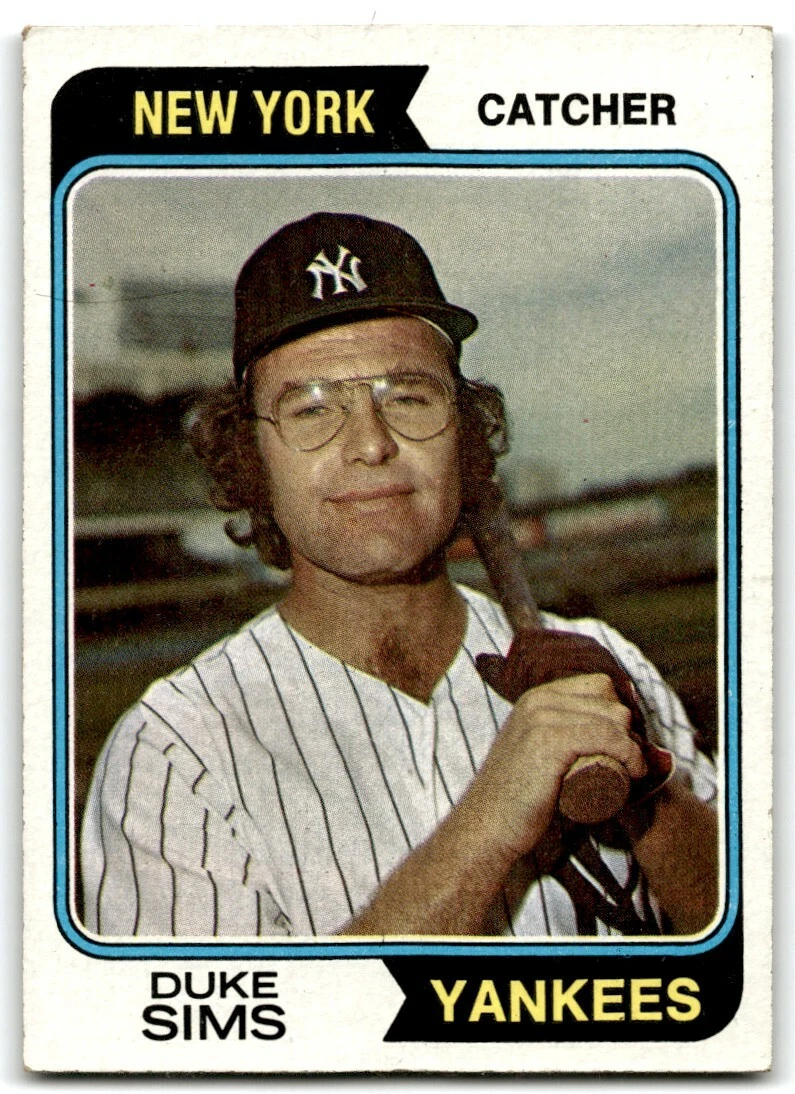
Duane "Duke" Sims, catching in the last game instead of Munson, hit the last home run, off Fred Holdsworth in the 7th inning. But McDaniel, in relief of Peterson, imploded in the 8th inning, allowing 6 runs, making a winning pitcher of John Hiller. 
Sims' 1974 Topps card. Topps, headquartered in New York,
tended to take players' card pictures there,
going back to the Polo Grounds.

It was McDaniel's last game for the Yankees, as he was subsequently traded to the Kansas City Royals for Lou Piniella.

The last play was 1st baseman Mike Hegan hitting a fly ball to, appropriately, center field, once patrolled by Joe DiMaggio and Mickey Mantle. This one is caught by the Tigers' Mickey Stanley. For all the greats who had played in Yankee Stadium, the only future Hall-of-Famer who played in this game was the Tigers' Al Kaline. He went 1-for-2, then, 39 years old, was replaced in the field.

Attendance: 32,238, in a Stadium whose capacity was then listed as 65,010.

After the game, Yankee manager Ralph Houk resigned, tired of Steinbrenner's meddling. Houk had managed the Yankees in the 1961, '62 and '63 seasons, winning the Pennant each time. Then he became the general manager for 1964, and after 1 more Pennant, everybody seemed to get old and/or hurt at once, and there was hardly anybody to replace them with, because the farm system had dried up.

In 1966, he resigned as GM, and his last act as such was to appoint himself back as field manager. The 1st time around, he had been "a players' manager." The 2nd time around, he was seen as too much of "a company man," and the younger players, used to the political activism of their peers, didn't like him. He got the Yankees to a 2nd-place finish in 1970, but 15 games behind the Baltimore Orioles. They were in the American League Eastern Division race late in both 1972 and '73, but they faded both times.

The '73 finale was his 1,757th and last game as Yankee manager, giving him a record of 944-806. He managed the Tigers from 1974 to 1978, and the Boston Red Sox from 1981 to 1984, but never came close to another postseason berth. Overall, he was 1,619-1,531 for his career.

George found finding a replacement for Houk difficult, as he tried to hire Dick Williams, who, after the subsequent World Series despite winning it, had quit as manager of the Oakland Athletics. A's owner Charlie Finley contended that Williams couldn't manage anywhere else as long as his contract with him was running. So George hired former Pittsburgh Pirate manager Bill Virdon. Houk was signed to manage the Tigers.

The day after the last game, the renovation began. Claire Ruth, the Babe's widow, was given home plate. Eleanor Gehrig, Lou's widow, was given the 1st base that was used in the last game. I've joked that Joe DiMaggio should have been given a square section of sod from center field, and Mickey Mantle should have been given the clubhouse's training table.
DiMaggio observing the renovation, 1974

The 1923-73 version of Yankee Stadium saw the home team win 27 American League Pennants and 20 World Series in 51 seasons. (The 1st 2 Yankee Pennants, 1921 and '22, came at the Polo Grounds.) It also hosted 3 NFL Championship Games in the pre-Super Bowl era: 1956, when the Giants beat the Chicago Bears; 1958, when the Giants lost to the Baltimore Colts in an overtime classic that has been called "The Greatest Game Ever Played"; and 1962, when the Giants lost to the Green Bay Packers.

It also hosted the Army-Navy Game in 1930 and '31; and 22 Army-Notre Dame games, including 1928, when Knute Rockne told his team to "Win one for the Gipper," and they did; and 1946, when both teams came in undefeated, and left that way, a "Game of the Century" that didn't live up to the hype, ending 0-0. And it hosted a long run of boxing champions, from Jack Dempsey to Floyd Patterson, including Joe Louis' 1938 knockout of Max Schmeling.

Remaining with the team until 1980, shortstop Fred Stanley was the last Yankee who had played a home game at the pre-renovation Stadium, although center fielder Bobby Murcer would be traded away and reacquired, playing his last game on June 11, 1983, nearly 10 years later.

*

September 30, 1973 was a Sunday. Other Major League Baseball games played on this day:

* The New York Mets split a doubleheader with the Chicago Cubs at Wrigley Field. The Cubs won the opener 1-0, with Rick Reuschel and Bob Locker combining for an 8-hit shutout. In the nightcap, Jerry Koosman was backed by 3 hits from Rusty Staub, 2 each by Wayne Garrett and Felix Millan, and a home run by Cleon Jones, as the Mets won 9-2.

The regular season should have been over, but the National League Eastern Division race was a wild one that no one seemed to want to win. The Mets ended the day 1 game ahead of the St. Louis Cardinals, a game and a half ahead of the Pittsburgh Pirates, 3 ahead of the Montreal Expos, and 4 ahead of the Cubs -- who finished closer to the Mets this time than they had in their in famous 1969 "September Swoon."

But because of rainouts, the race still wasn't decided. The Cards had completed their schedule, but the Mets had 2 games left to play, the Pirates 1. It was still possible for any of the 3 to win the Division.

* Because the Cardinals had beaten the Philadelphia Phillies, 3-1 at Busch Memorial Stadium in St. Louis.

* And the Pirates had beaten the Expos, 10-2 at Three Rivers Stadium in Pittsburgh. The next day, the Pirates would play a rainout makeup against the San Diego Padres at home, while the Mets would stay at Wrigley and play another doubleheader with the Cubs.

The Mets won the opener, 6-4, and clinched the Division. Until the 1986 Pennant, this would remain their only clincher on the road. (The 1969 and 1986 Division titles, the 1969 and 1973 Pennants, and the 1969 World Series win would all occur at Shea.) They beat the Cubs, and barely beat the rain, which canceled the nightcap, which was now unnecessary. It was made more so when the Pirates lost 4-3 to the Padres.

* Elsewhere on September 30, the Houston Astros beat the Atlanta Braves, 5-3 at Atlanta Stadium. (It was renamed Atlanta-Fulton County Stadium in 1975.) This was the 3,739th and last regular-season game managed by Leo Durocher, who was soon fired. He first managed with the 1939 Brooklyn Dodgers, while he was still an active player.

Hank Aaron got 3 hits, but none of them was a home run, so he finished the season with 713 career home runs. It would be a long off-season before he got the chance to break the career record then held by Babe Ruth. He hit Number 714 on April 4, 1974 in Cincinnati, and then Number 715 on April 8 at home to Los Angeles.

* The Boston Red Sox beat the Milwaukee Brewers, 3-2 at Fenway Park in Boston.

* The San Francisco Giants beat the Cincinnati Reds, 4-3 at Riverfront Stadium in Cincinnati.

* The California Angels beat the Minnesota Twins, 3-0 at Anaheim Stadium (now Angel Stadium). Frank Tanana pitched a 2-hit shutout, outdueling Bert Blyleven.

* The Texas Rangers beat the Kansas City Royals, 3-0 at Arlington Stadium in the Dallas suburb of Arlington, Texas. Pete Broberg allowed 7 hits, but kept the shutout.

* And the Chicago White Sox beat the Oakland Athletics, 1-0 at the Oakland Coliseum. The ChiSox won it in the top of the 10th, on a bases-loaded walk drawn by shortstop Russell "Bucky" Dent, who would later write his name in Yankee history. Speaking of which: Reggie Jackson did not play for the A's, but Catfish Hunter started, and did not get the decision. The A's would go on to beat the Mets in the World Series.

And there were NFL games played on the day:

* The New York Giants lost to the Cleveland Browns, 13-10 at Cleveland Municipal Stadium.

* The New York Jets lost to the Buffalo Bills, 9-7. It was the Bills' 1st game at their new stadium, south of the city, in suburban Orchard Park, New York. Originally known as Rich Stadium, for the Rich family of meat-product producers, O.J. Simpson and his teammates beat the Jets, 9-7.

The stadium was renamed Ralph Wilson Stadium for the team's founding owner in 1998, and, in 2015, was renamed New Era Field, as naming rights were bought by the New Era sports cap company. But New Era asked to be let out of the agreement in 2020. It was renamed Highmark Stadium. In 2026, it was torn down, and replaced by a new facility, also named Highmark Stadium.

* The Washington Redskins beat the Philadelphia Eagles, 28-7 at Veterans Stadium in Philadelphia.

* The Baltimore Colts beat the New Orleans Saints, 13-10 at Memorial Stadium in Baltimore.

* The Miami Dolphins beat the New England Patriots, 44-23 at the Orange Bowl in Miami.

* The Pittsburgh Steelers beat the Houston Oilers, 36-7 at the Astrodome in Houston.

* The Dallas Cowboys beat the football version of the St. Louis Cardinals, 45-10 at Texas Stadium in the Dallas suburb of Irving, Texas.

* The Minnesota Vikings beat the Green Bay Packers, 11-3 at Metropolitan Stadium in the Minneapolis suburb of Bloomington, Minnesota.

* The Kansas City Chiefs beat the Oakland Raiders, 16-3 at Arrowhead Stadium in Kansas City.

* The Chicago Bears beat the Denver Broncos, 33-14 at Mile High Stadium in Denver.

* The Cincinnati Bengals beat the San Diego Chargers, 20-13 at San Diego Stadium.

* The Los Angeles Rams beat the San Francisco 49ers, 40-20 at Candlestick Park in San Francisco.

* The next day, on Monday Night Football, the Detroit Lions beat the Atlanta Falcons, 31-6 at Tiger Stadium in Detroit. 

September 30, 1971: The Washington Senators' Riotous Farewell

September 30, 1971: The last Washington Senators game is played, against the New York Yankees at Robert F. Kennedy Memorial Stadium in Washington. Team owner Bob Short, having already moved the NBA's Minneapolis Lakers to Los Angeles in 1960, has announced he's moving the Senators to the Dallas area, to become the Texas Rangers. He complains about the low attendance, despite having the highest ticket prices in the American League, and no subway access to RFK Stadium. (Washington's Metro would not open until 1976.)
Frank Howard, the Senators' most popular player in their 2nd go-around of 1961-71, hits the last home run. Dick Bosman starts, and stands to be the winning pitcher, as the Senators lead 7-5 with 1 out left in the 9th. All he has to do is get Bobby Murcer out.
Frank Howard

But he can't, through no fault of his own. Angry fans from the "crowd" of 14,461 people storm the field. The umpires cannot restore order, and they forfeit the game to the Yankees. The next April, Bosman also started the team's 1st game as the Rangers.
Only 2 AL games have been forfeited since, both promotions that turned into fiascos: The Cleveland Indians' Ten-Cent Beer Night in 1974, and the Chicago White Sox' Disco Demolition Night in 1979. Rusty Torres, who turned 23 on this day, was also in uniform on each of those occasions.
That last season had been a difficult one for the Senators, even before the move was announced. Ted Williams had been named their manager in 1969, and the man who literally wrote the book on hitting (The Science of Hitting, published the next year) really improved their hitting, to the point where the Senators won 86 games. It was the best season in Washington baseball since 1945, when the original Senators, who moved to become the Minnesota Twins in 1961 and were replaced by this expansion team, won 87 and missed the Pennant by a game and a half.
But the Boston Red Sox legend couldn't improve the pitching, and soon, the hitters stopped listening to his authoritarian ways. The Senators won only 70 games in 1970. In 1971, they traded for Denny McLain, the former 2-time Cy Young Award winner whose shoulder injury and bad attitude rendered him nearly useless; and the rights to Curt Flood, who had refused to accept a trade from the St. Louis Cardinals to the Philadelphia Phillies, but was willing to come back and play in Washington, and was so rusty after sitting 1970 out that he had to retire.
The Senators won just 63 games, and while a solid core of fans missed them, the D.C. metropolitan area as a whole did not. As Richard Nixon, President at the time, was quoted as saying, "All anybody cares about in Washington is the Redskins." And since the Redskins won the NFC Championship in 1972, and stayed contenders for the next 20 years, this was one time when Nixon was right.
In 1973, the NBA's Baltimore Bullets moved down the Baltimore-Washington Parkway, and were successful for the next 10 years, including a Championship in 1978. The 1970s also saw a renaissance in basketball at the University of Maryland, located outside the District of Columbia, but inside the Capital Beltway.
In 1974, the NHL introduced the Washington Capitals, and, while they were terrible their first few years, they have usually been contenders since the mid-1980s. The 1980s also saw the rise of the basketball team at Georgetown University.
In 1984, President Ronald Reagan went to the MLB city closest to Washington at the time, Baltimore, and threw out the ceremonial first ball before the Orioles' home opener, restoring the old Washington tradition. Although the Orioles fell into decline after a generation of winning, including 3 World Series wins (including 4 Pennants from 1966 to 1971, which took many Maryland fans away and, indirectly, helped to doom the Senators), Washington insiders began making the trip up the Baltimore-Washington Parkway, and the Orioles became D.C.'s team as well as Baltimore's.
The Orioles' 1989 Playoff run, though ultimately unsuccessful, increased interest from Washington area fans. The building of Oriole Park at Camden Yards in 1992 moved them just 4 miles, but it also put them next to Interstate 95, the Baltimore-Washington Parkway, and Camden Station, all with access to D.C.
This whetted capital-area baseball appetites even more, and led to the 2004-05 move of the Montreal Expos, becoming the Washington Nationals. They played the 2005, '06 and '07 seasons at RFK Stadium before moving to Nationals Park. Being in the other League means their rivalry with the Orioles isn't as nasty as Yankees-Red Sox, Dodgers-Giants, or even Cubs-Cardinals. The fact that the teams are partners in the Mid-Atlantic Sports Network (the O's own 77 percent of MASN, and the Nats 23 percent) also helps.
The Nats finally started making the Playoffs in 2012, the 1st postseason for a Washington baseball team since the 1933 Senators, unless you count the Homestead Grays of the Negro Leagues, who split their "home games" between Washington and Pittsburgh. And in 2019, the Nats won the World Series, the 1st such win for Washington since the 1924 Senators.
The last active player for the "New Senators" was Toby Harrah, who played until 1986. The last active player for the "Old Senators," who became the Minnesota Twins in 1961, was Jim Kaat, who pitched until 1983.
*
September 30, 1971 was a Thursday. These 8 other Major League Baseball games were played that day:
* The New York Mets beat the St. Louis Cardinals, 6-1 at Shea Stadium. Tom Seaver gets the win, his 20th of the season, and will go on to win his 2nd Cy Young Award. A young right fielder named Ken Singleton, who had grown up in New York as a Met fan, hits 2 home runs. But he will become better known for playing for the Baltimore Orioles, and broadcasting for the Yankees.
No one knows it at the time, but this is the last game the Mets will play with Gil Hodges as their manager. At the end of Spring Training in 1972, he suffers a heart attack and dies, not quite 48 years old.
* The Chicago Cubs beat the Montreal Expos, 5-3 at Jarry Park in Montreal. The retiring Ernie Banks played his last game with the Cubs 4 days earlier.
* The Pittsburgh Pirates beat the Philadelphia Phillies, 4-3 at Veterans Stadium in Philadelphia. Roberto Clemente and Willie Stargell both went 1-for-4.
* The Atlanta Braves beat the Cincinnati Reds, 6-2 at Atlanta Stadium (later Atlanta-Fulton County Stadium). Pete Rose went 1-for-4. Both the Reds' Johnny Bench and the Braves' Hank Aaron got the day off.
* The San Francisco Giants beat the San Diego Padres 5-1, at what was then named San Diego Stadium. (It was later renamed Jack Murphy Stadium, Qualcomm Stadium, and SDCCU Stadium.) The Giants thus clinch the National League Western Division title. This turns out to be their only postseason berth between 1962 and 1987.
* The Chicago White Sox beat the Milwaukee Brewers, 2-1 at Comiskey Park in Chicago.
* The California Angels beat the Minnesota Twins, 3-2 at Metropolitan Stadium in the Minneapolis suburb of Bloomington, Minnesota.
* And the Los Angeles Dodgers beat the Houston Astros, 2-1 at Dodger Stadium in Los Angeles.
And actress Jenna Elfman was born.

September 30, 1967: SEC Football's Painful Integration

Nate Northington

September 30, 1967: For the 1st time, a black man plays football for a school in the Southeastern Conference. The circumstances become physically painful. They were already emotionally painful, and for a reason above and beyond the region's racist history.

The University of Kentucky, the northernmost school in the SEC, and far better known for their basketball program, which had already won 4 NCAA Tournaments, was the 1st school to break the barrier. They signed 2 black players: Running back Nate Northington and defensive end Greg Page.

But on August 22, 1967, in a preseason practice, Page was injured. His back was broken, and he was paralyzed. Northington, his dorm-mate, would have to go into the season's home opener, at home to the University of Mississippi (a.k.a. "Ole Miss"), as the lone black player in the game.
Greg Page

The season did not begin with that home opener. Kentucky started the season away to Indiana University -- a major rivalry in basketball, but not in football -- and Indiana won, 12-10. Page did not play in that game.

Things went from bad to worse. Complications from his condition killed Page the day before the game. He was only 19 years old. A moment of silence was held before the game at McLean Stadium in Lexington, Kentucky.

Northington played the 1st 3 plays against Ole Miss, but on the 3rd play, he separated his shoulder, and had to leave the game. Ole Miss won, 26-13. With Page dead and Northington injured, the Wildcats went 2-8, beating only West Virginia at home and, in their lone SEC win, Vanderbilt away.

Northington left the team after his sophomore season, and transferred to Western Kentucky University. In 1970, he scored a touchdown in WKU's rivalry game with Eastern Kentucky.

In September 2016, 50 years after Northington, Page, Wilbur Hackett and Houston Hogg debuted on Kentucky's freshman team, statues of the 4 of them were dedicated outside Kroger Field, which (under the name Commonwealth Stadium) replaced McLean Stadium in 1973. As of September 30, 2022, Northington is still alive.

Here's when the other SEC schools -- the ones in the league then, and the ones who have since entered the league -- integrated their football teams:

* Tennessee: Lester McClain, September 14, 1968.

* Florida: Leonard George and Willie Jackson, both debuting on September 12, 1970.

* Mississippi State: Robert Bell and Frank Dowsing, both debuting on September 12, 1970.

* Georgia Tech (left the SEC in 1963): Eddie McAshan, September 12, 1970. He became the 1st black quarterback for a major formerly all-white Southeastern university -- but not the 1st in the SEC.

* South Carolina (did not join the SEC until 1992): Jackie Brown, September 12, 1970. Same game in which McAshan debuted for Tech.

* Auburn: James Owens, September 19, 1970.

* Alabama: John Mitchell, September 10, 1971.

* Vanderbilt: Taylor Stokes, September 11, 1971.

* Georgia: Richard Appleby, Horace King, Chuck Kinnebrew and Larry West, all debuting on September 11, 1971.

* Tulane (left the SEC in 1965): Charlie Hall, Charles Inniss, Robert Johnson and John Washington, all debuting on September 11, 1971.

* Louisiana State (LSU): Mike Williams, September 16, 1972.

* And Mississippi (Ole Miss), not surprisingly, was the last one: Ben Williams, September 30, 1972.

*

September 30, 1967 was a Saturday. Actress Andrea Roth was born. And, in Philadelphia, their new arena, The Spectrum, opened. I have a separate entry for that event.

Among the other college football games played that day were these:

* Number 1 Notre Dame were upset by Number 10 Purdue, 28-21 at Ross-Ade Stadium in West Lafayette, Indiana.

* Number 2 Southern California (USC) beat Michigan State, 21-17 at Spartan Stadium in East Lansing, Michigan.

* The night before, Number 3 University of Houston beat Wake Forest, 50-6 at the Astrodome in Houston.

* Number 4 UCLA beat Washington State, 51-23 at the Los Angeles Memorial Coliseum.

* Number 5 Georgia beat Clemson, 24-17 at Memorial Stadium in Clemson, South Carolina.

* Number 7 Nebraska beat Minnesota, 7-0 at Memorial Stadium in Lincoln, Nebraska.

* Number 8 Texas lost to Texas Tech, 19-13 at Memorial Stadium in Austin, Texas.

* Number 9 Alabama beat Southern Mississippi, 25-3 at Ladd Stadium in Mobile, Alabama.

* Among the service academies, Army beat Boston College, 21-10 at Alumni Stadium, just outside Boston in Chestnut Hill, Massachusetts; Navy lost to Rice, 21-7 at Rice Stadium in Houston; and Air Force lost to the University of Washington, 30-7 at Falcon Stadium in Colorado Springs, Colorado.

* In New Jersey, Princeton beat Rutgers, 22-21 at Palmer Stadium in Princeton.

And in New Jersey high school football, East Brunswick, the school that would one day be my Alma Mater, beat Woodbridge, 14-0 at home, at the stadium that would one day be named Jay Doyle Field.

And these games were played in Major League Baseball:

* The Boston Red Sox beat the Minnesota Twins, 6-4 at Fenway Park in Boston. This was the next-to-last day of the regular season, and the Red Sox and Twins were battling the Detroit Tigers and the Chicago White Sox for the American League Pennant. Carl Yastrzemski of the Red Sox and Harmon Killebrew of the Twins each hit his 44th home run of the season. Neither of them homered the next day, so they finished in a tie for the AL home run lead.

With Yaz also leading the AL in batting average and runs batted in, that means that, despite only being tied for the home run lead, he was awarded the Triple Crown. There would not be another Triple Crown winner for 45 years.

At the time, the Red Sox' games were broadcast on WHDH-Channel 5. With the Sox involved in a Pennant race for the 1st time in a generation, the station went against protocol, which was to save money on videotape by taping over old games, and saved several games from that season. These clips were edited down into a highlight reel, except for the last 2 games, this one and the next day's. As a result, this Boston victory over Minnesota is, as far as is publicly known, the oldest surviving full color video broadcast of an MLB game.

* A doubleheader was split at Tiger Stadium in Detroit. The Detroit Tigers won the opener, 5-0. Mickey Lolich pitched a 3-hit shutout. The California Angels won the nightcap, 8-6. Over the 2 games, Al Kaline went 1-for-8 with a walk.

With this doubleheader, the AL standings now featured the Red Sox and the Twins tied for 1st place, with the Tigers only half a game back. The Red Sox and Twins played each other again the next day, with the winner assured of no worse than a Playoff for the Pennant the next day. The Tigers had another doubleheader, and if they swept it, they would have a Playoff with the Red Sox-Twins winner. As it turned out, the Red Sox beat the Twins, and the Tigers only split their doubleheader, so the Sox won the Pennant.

* The Washington Senators beat the Chicago White Sox, 4-0 at Comiskey Park in Chicago. The White Sox had been eliminated from the race when the Senators beat them the night before, so this game was meaningless -- except, perhaps, to Senators pitcher Frank Bertaina, who pitched a 5-hit shutout.

* The New York Yankees beat the Kansas City Athletics, 5-4 at Yankee Stadium. Mickey Mantle drove in the Yankees' 1st run with a groundout, and then left the game due to injury. Rookie Reggie Jackson did not play for the A's in this game. The next day, the Yankees won, 4-3. This was the last game for the A's representing Kansas City. The next season, they moved to Oakland.

* The New York Mets beat the Los Angeles Dodgers, 5-0 at Dodger Stadium in Los Angeles. Les Rohr pitched 8 shutout innings, and Ron Taylor completed a 7-hit shutout, to outpitch Don Drysdale. Ken Boswell hit a home run.

* The St. Louis Cardinals beat the Atlanta Braves, 3-1 at Atlanta Stadium (later Atlanta-Fulton County Stadium). In contrast to the AL, the Cardinals had the National League Pennant wrapped up several days earlier. Lou Brock went 3-for-4. Roger Maris went 1-for-4 with an RBI. Joe Torre went 1-for-3 with an RBI. Hank Aaron only appeared as a pinch-hitter, and struck out.

* The Houston Astros beat the Pittsburgh Pirates, 4-3 at Forbes Field in Pittsburgh. Roberto Clemente went 1-for-3 with a walk. Willie Stargell went 1-for-4 with an RBI.

* The Baltimore Orioles beat the Cleveland Indians, 5-2 at Cleveland Municipal Stadium. Frank Robinson went 0-for-4, and Brooks Robinson did not play.

* The Chicago Cubs beat the Cincinnati Reds, 9-4 at Crosley Field in Cincinnati. Ernie Banks went 4-for-5 with an RBI. Pete Rose went 1-for-5 with 2 RBIs. Rookie Johnny Bench did not play for the Reds in this game.

* And the San Francisco Giants swept a doubleheader with the Philadelphia Phillies, 3-2 and 1-0 at Candlestick Park in San Francisco. Willie McCovey hit a home run in the 1st game. Willie Mays went 0-for-4, and then did not play in the 2nd game. Three Giant pitchers -- Bill Henry (3 innings), Nestor Chavez (4, winning pitcher) and Lindy McDaniel (2, save) combined on a 4-hit shutout.

December 31, 1999 & January 1, 2000: The Millennium

December 31, 1999:  The Millennium arrives. The people of planet Earth survived. At a terrible cost. But we hadn't destroyed ourselves. ...