Sunday, May 1, 2022

May 1, 1933: Rockefeller Center Opens

May 1, 1933: Rockefeller Center opens in Midtown Manhattan, a complex bounded by 48th and 51st Streets, and 5th and 6th Avenues.

Many places in New York City have been described as "a city within a city," including the train stations, and skyscrapers such as the Empire State Building and the old and new World Trade Centers. But that was the stated idea of John D. Rockefeller Jr., son and namesake of the founder of Standard Oil and America's 1st billionaire.

Rockefeller Jr. became a director at some of the biggest businesses in America, including Standard Oil, U.S. Steel, and Chase Manhattan Bank. He bought the land from Columbia University. He intended the site to include a new building for the Metropolitan Opera, but they turned it down, staying at 39th and Broadway until moving to Lincoln Center in 1966.

But one of the few businesses doing well during the Great Depression was radio. Rockefeller made a deal with Radio Corporation of America (RCA), the owners of the National Broadcasting Company (NBC). This led to the project being nicknamed "Radio City." On December 27, 1932, Radio City Music Hall opened, on 6th Avenue between 50th and 51st.

The centerpiece of the complex was 30 Rockefeller Plaza, which became headquarters for RCA, including the main studios for NBC radio, and eventually television. The photograph titled Lunch Atop a Skyscraper was taken in the progress of building this tower.
It was named the RCA Building until 1988, when General Electric bought RCA; then the General Electric Building, or "the GE Building," until Comcast bought RCA from GE, and it's officially been the Comcast Building since. But everybody calls it "30 Rock." The building is 850 feet tall (making it the 5th-tallest in the City at the time), with 66 floors, and includes a rooftop garden restaurant and observation deck known as "Top of the Rock."

Among the 19 buildings in the complex, but not the original 14 that were built in the Art Deco style, is 75 Rockefeller Plaza, built in 1947, houses the offices of Major League Baseball. The other major leagues' offices are nearby: The NBA at 645 5th Avenue at 52nd, the NFL at 345 Park Avenue at 52nd, and the NHL at 1185 6th Avenue between 46th and 47th. Major League Soccer's offices are a bit of a longer walk, at 420 5th Avenue between 37th and 38th.

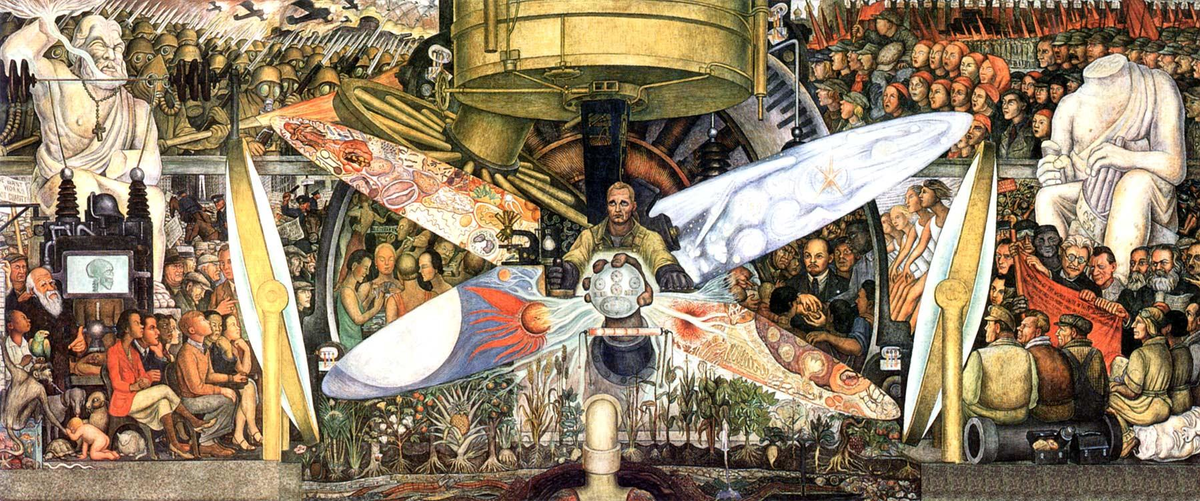
Rockefeller's son, Nelson Rockefeller, later a 4-term Governor of New York, a 3-time candidate for President, and President Gerald Ford's Vice President, was in charge of selecting the artwork for the complex. For the lobby at 30 Rock, he chose Man at the Crossroads by Diego Rivera.
But someone found out that the mural included images of Vladimir Lenin and a Soviet May Day parade. Nelson ordered it plastered over before Rivera could finish it. Rivera suspected that this would happen, and took black & white photos of it, so he could do it again later, which he did, in his native Mexico, under a new title: Man, Controller of the Universe. It was replaced by a mural by Catalan painter Josep Maria Sert.

A major feature of Rockefeller Center is the annual Christmas tree, between the front doors of 30 Rock and the below-street-level skating rink.

*

May 1, 1933 was a Monday. Football, basketball and hockey were all out of season. And there were only 2 baseball games played:

* The Pittsburgh Pirates beat the Philadelphia Phillies, 10-0 at Baker Bowl in Philadelphia. Bill Swift, no relation to the much later Seattle Mariners pitcher of the same name, allowed 9 hits, but kept the shutout. Arky Vaughan and Earl Grace each hit a grand slam.

* And the Cleveland Indians beat the Chicago White Sox, 8-1 at Cleveland Municipal Stadium.

May 1, 1931: The Empire State Building Opens

May 1, 1931: The Empire State Building opens in Manhattan, on 5th Avenue between 33rd and 34th Streets. It is the tallest building in the world.

The land had long been in the Astor family, which preceded the Rockefellers as New York's richest. In 1893, William Waldorf Astor opened the Waldorf Hotel on the site. In 1897, next-door, his cousin, John Jacob Astor IV, opened the Astoria Hotel. (John IV would die on the Titanic in 1912.)

In 1928, the Astor family, recognizing that the center of New York life had moved a bit uptown, decided to build a new hotel, and sold the property to Bethlehem Engineering Corporation. The old hotels were demolished the next year, and the new Waldorf-Astoria Hotel -- now "Waldorf Astoria New York" -- opened in 1931 at 301 Park Avenue, between 49th and 50th Streets, 7 blocks north of Grand Central Terminal (a tunnel would connect them for special guests, such as Presidents of the United States) and 2 blocks east of Rockefeller Center. At 625 feet, 47 stories, it was the tallest hotel in the world until 1963.

But it would be dwarfed by what would rise on its predecessor's site. Developer John Jakob Raskob (no relation to the John Jacob Astors) and Pierre S. du Pont (a cousin of Thomas Coleman du Pont, a major investor in the previous hotel) formed Empire State, Inc. The State of New York was officially known as the Empire State. The group wanted to build the tallest building in the world.

At the time, there was a mad scramble in the City. At the time, the tallest was the Woolworth Building, which opened in 1913 at 792 feet, 55 stories, at 233 Broadway in Lower Manhattan. A few blocks away, at 40 Wall Street, the Bank of Manhattan Trust was building what it hoped would be the tallest. But automaker Walter Chrysler was trying the same, at 405 Lexington Avenue at 42nd Street in Midtown, across from the Grand Central complex.

On May 1, 1930, the Bank of Manhattan Trust Building was finished: 927 feet high, 70 stories. But on May 27, Chrysler sprung a surprise: A spire, hidden within his Chrysler Building, emerged, and allowed his Building to become the world's 1st 1,000-foot skyscraper: 1,046 feet, 77 stories. 40 Wall had held the record for all of 26 days.

But Chrysler wouldn't hold the record for long, either. The original 1,050-foot plan for the Empire State Building was added onto, just in case Chrysler tried another dirty trick, like inserting a 6-foot rod up through the top of his spire. It wasn't just what the press called it, "The Race to the Sky": Essentially, it was a dick-measuring contest.

Excavation of the Waldorf-Astoria site began on January 22, 1930. Over 3,500 people worked on it, and 5 of them died. It was expected to cost $60 million to build, but it came in under budget: $40.9 million -- about $763 million in 2022 money.

Running the corporation for Raskob and the rest was Alfred E. Smith, former Governor of New York, and the Democratic Party's nominee for President in 1928. His days as a "great man" over, he needed something to do. He wasn't crazy about the job.

The Empire State Building opened on May 1, 1931. It was 1,250 feet high, with an outdoor observation deck at the 86th floor, and an indoor observation deck on the 102nd floor. At the opening ceremony, Smith was outshone by his former friend, and replacement as Governor, Franklin D. Roosevelt. Mayor Jimmy Walker also attended.

At one point, the official film of the event showed someone calling out, "Governor?" And FDR said, "Which one?" The only person not laughing at this was Smith. The feud between them would continue until Smith's death in 1944.

The top of the Art Deco masterpiece was intended as a mooring mast for airships, but it was never used as such, due to wind gusts providing a safety issue. And while the Great Depression hadn't yet started when construction did, by the time the building opened, things were pretty bad. They had difficulty renting space. It became known as the Empty State Building. (My grandmother, who was just short of turning 7 and living in Queens when it opened, told me this. A PBS documentary eventually confirmed the nickname.)

But in 1933, the film King Kong was released, helping to make the Building a legend. The movie's climax showed the big ape taking Ann Darrow, played by Fay Wray, in his hand, and climbing up the side of the Empire State Building. Spoiler alert for an 89-year-old movie: World War I-era biplanes try to shoot him down. He grabs one and throws it down into the street. Eventually, though, the fusillades of bullets gets to be too much for him, and he tumbles down.

The 1976 remake would see him atop the World Trade Center, while the 2005 version would be set in 1933 and put Kong atop the ESB, both computer-generated.

Still, the Depression put an end to The Race to the Sky. No one wanted to build the next Empty State Building. Towers would still go up in New York, including Rockefeller Center, with its centerpiece at 30 Rockefeller Plaza, formerly known as the RCA Building. It is this building, not the Empire State, whose construction included the famous photo Lunch Atop a Skyscraper by Charles C. Ebbets (no relation to Charles H. Ebbets, the former Brooklyn Dodgers owner who built the ballpark that bore his name). But no new record was even threatened.

By 1936, the Depression had eased enough that the building was turning a profit thanks to its observation decks. On July 28, 1945, a B-25 bomber got lost in fog, and crashed into the north side of the building, between the 79th and 80th floors. There were 14 people killed, but the Indiana limestone of the building held, and everything reopened 2 days later.

In 1951, with the building finally becoming profitable, Raskob sold it for $51 million. In 1953, a TV and radio antenna was completed, extending the building's height to 1,454 feet. On October 19, 1970, after 40 years, the Empire State Building lost its title as the tallest building in the world, as the construction of the World Trade Center surpassed it.

In 1964, floodlights were added on the 72nd floor, so that the building could be seen from the New York World's Fair. Since 1976, the floodlights have had specialized colors for special occasions: Red and green for the Christmas season, green for St. Patrick's Day, blue and white for when the Yankees win a World Series, blue and orange for the Mets in 1986, and so on. When no special occasion is on, the lights are simply white.

Each night, those lights were shut off at midnight, when the observation decks closed. I developed a trick: At 11:59 PM, I would stand outside the Port Authority Bus Terminal at 42nd Street and 8th Avenue, and tell a tourist that I could turn off the Empire State Building. I looked at my watch, waited as it creeped up to 11:59:59, pointed my finger at the building, and said, "Zap!" And the lights went out, right on time at 12:00:00. A less scrupulous person would have offered bets on it. I never did. The look on the tourist's face was worth it.

After September 11, 2001, I realized the trick would now be in bad taste. In 2010, the 601-foot Eleven Times Square went up on the opposite corner, blocking the view of the Empire State Building from 42nd and 8th, so the trick became impossible, anyway. Eventually, the Empire State began keeping the lights on until sunrise.

In 1980, the U.S. Postal Service gave the Empire State Building its own ZIP Code, 10118. The World Trade Center also got its own, 10048. So did the Chrysler Building, 10174.

In 1995, Donald Trump bought 40 Wall Street, and, naturally, renamed it the Trump Building. On September 11, 2001, the World Trade Center was destroyed, and Trump called in to a news organization, bragging that he now had the tallest building in New York. Like pretty much everything Trump says, it wasn't true: It was now the tallest building in Lower Manhattan, but the Empire State Building was still taller.

I visited the observation decks a few times when I was younger, when the price of admission was just $20. Today, it's $42 for the 86th Floor Observation Deck, and $75 for the Decks on both the 86th and the 102nd Floors.

As of May 1, 2021, the Empire State Building's 90th Anniversary, there are 14 completed buildings in New York City that are at least 1,000 feet high, as there is once again a building boom in Manhattan: 

1. One World Trade Center, 285 Fulton Street, opened 2014, 1,776 feet, 104 stories, tallest building in the Western Hemisphere, 6th-tallest in the world. The address "1 World Trade Center" used to belong to the North Tower of the old WTC. The South Tower was "2 World Trade Center."

2. Central Park Tower, 225 West 57th, Street, 2020, 1,550, 98, tallest residential building in the world.

3. Steinway Tower, 111 West 57th Street, 2021, 1,428, 84, known as "the world's most slender skyscraper."

4. One Vanderbilt, 1 Vanderbilt Avenue near Grand Central, 2020, 1,401, 59.

5. 432 Park Avenue (at 57th Street), 2015, 1,397, 85. Part of a section of 57th Street known as Billionaires' Row.

6. 30 Hudson Yards, 500 West 33rd Street, 2019, 1,270, 73. The Hudson Yards project might generate a lot of jobs and income for the City, but it's ruined the view of the City coming down the ramp heading into the Lincoln Tunnel. It even blocks the view of the...

7. Empire State Building, 350 5th Avenue, 1931, 1,250, 102.

8. Bank of America Tower, 1101 6th Avenue at 42nd Street, 2009, 1,200, 55. If you watched the TV show Younger, this building was used for exterior shots of the building that was home to Empirical Publishing.

9. 3 World Trade Center, 175 Greenwich Street, 2018, 1,079, 80. The address formerly belonged to the 1981-2001 Vista International Hotel/Marriott World Trade Center, adjacent to the Twin Towers.

10. 53W53, 53 West 53rd Street, 2019, 1,050, 77.

11. Chrysler Building, 405 Lexington Avenue at 42nd Street, 1930, 1,046, 77.

12. New York Times Building, 620 8th Avenue at 41st Street, 2007, 1,046, 52. Across from the Port Authority Bus Terminal.

13. One57, 157 West 57th Street, 2014, 1,004, 75.

14. 35 Hudson Yards, 532 West 33rd Street, 2019, 1,000 even, 72.

The World Trade Center officially opened in 1973, surpassing the Empire State Building. That was surpassed by the Sears Tower (now officially named the Willis Tower, but nobody calls it that) in Chicago in 1974. That lasted until 1998, when the Petronas Towers, another set of "Twin Towers," was built in Kuala Lumpur, Malaysia. They were surpassed in 2004 by Taipei 101, in Taipei, Taiwan.

And in 2007, Burj Khalifa opened in Dubai, United Arab Emirates. It is 2,717 feet high, with 154 stories. But, like the Empire State did, it is having trouble filling its space, as Dubai hasn't really recovered from the 2008-09 worldwide recession. Saudi Arabia is trying to build the Jeddah Tower, with the intention of making it at least 3,281 feet high -- the world's first building to be taller than one kilometer. But construction was halted in 2018, with the tower only 1/3rd finished, and it hasn't come any closer.

*

May 1, 1931 was a Friday. It was the off-season for the NFL and the NHL, and the NBA hadn't been founded yet. But a full slate of Major League Baseball games was played:

* The New York Yankees lost to the Philadelphia Athletics, 4-0 at Shibe Park in Philadelphia. George Earnshaw pitched a 3-hit shutout. Mule Haas and Mickey Cochrane hit home runs off George Pipgras. Babe Ruth did not play, and Lou Gehrig went 0-for-3.

* The New York Giants beat the Boston Braves, 5-0 at the Polo Grounds. Bill Walker pitched a 7-hit shutout, and was backed by home runs from Bill Terry, Johnny Vergez and Hughie Critz.

* The Brooklyn Robins beat the Philadelphia Phillies, 8-4 at Ebbets Field. This would be the last season as Brooklyn manager for Wilbert Robinson, for whom the team was named. The following year, they went back to the name they had in 1913, right before "Uncle Robbie" was hired: The Brooklyn Dodgers.

* The Boston Red Sox beat the Washington Senators, 10-4 at Fenway Park in Boston.

* The Pittsburgh Pirates beat the Cincinnati Reds, 5-4 at Forbes Field in Pittsburgh. Ben Sankey drew a bases-loaded walk off Ownie Carroll in the bottom of the 11th inning.

* The Detroit Tigers beat the Cleveland Indians, 4-2 at Navin Field in Detroit. That ballpark would be expanded and renamed Briggs Stadium in 1938, and renamed Tiger Stadium in 1961.

* The Chicago White Sox beat the St. Louis Browns, 8-2 at Comiskey Park in Chicago.

* And the St. Louis Cardinals beat the Chicago Cubs, 6-2 at Sportsman's Park in St. Louis. 

May 1, 1926: Hakoah at the Polo Grounds

Béla Guttmann

May 1, 1926: A crowd of 46,000 files into the Polo Grounds in New York to watch an all-star team from the American Soccer League beat Hakoah Wien, 3-0. It remains the largest crowd to watch a soccer game in America until Pelé and the New York Cosmos move into Giants Stadium, 51 years later.

Hakoah -- a Hebrew word meaning "strength" -- was an All-Jewish sports club based in Vienna, the capital of Austria. It was founded in 1909, countering the then-popular idea of "muscular Christianity" with "muscular Judaism." It sponsored teams in several sports, and in 1925, its soccer team won the national title. They went on a tour of the United States, including that game at the Polo Grounds.

Their best player was centerback Béla Guttmann. He was born on January 27, 1899 in Budapest, the capital of Hungary. He starred for the team now known as MTK Budapest. Escaping his homeland's anti-Semitism, in 1922 he moved to Vienna, and played for Hakoah Wien. In 1923, they went to London, and beat West Ham United, 5-1 at Upton Park in the East End. While the Hammers, who had reached the FA Cup Final that season, had played a largely reserve team against Hakoah, this still made Hakoah the 1st team from the European Continent to defeat an English team in England.

Their 1926 U.S. tour inspired some of the players to stay in America. Guttmann played for the Brooklyn Wanderers at Ebbets Field, and the soccer version of the New York Giants at the Polo Grounds; and founded New York Hakoah, who played at Dexter Park in Queens, and are still in existence today, albeit at a semipro level.

Losing everything in the stock market Crash of 1929, Guttmann returned to Europe, coaching in Austria, the Netherlands and Hungary. In 1944, he was captured by the Nazis, and sent to a concentration camp. Several members of his family were killed, as were 6 of his Hakoah teammates, but he escaped.

After World War II, he managed teams in Hungary, Romania, Italy, Argentina, Cyprus, Brazil, Portugal, Uruguay, Switzerland and Greece. He won League titles in Hungary with Újpest in 1939 and 1947; in Portugal with Porto in 1959, and Benfica in 1960 and 1961; and in Uruguay with Peñarol in 1962. With Benfica, he won the European Cup (now the UEFA Champions League) in 1961 and 1962. He was the Larry Brown of his sport, rarely staying at a club longer than two seasons, no matter how well he was doing, and was quoted as saying, "The third season is fatal."

After the 1962 title, he asked for a raise, didn't get it, and quit. Supposedly, he then said, "Not in a hundred years from now will Benfica ever be European Champions again." So far, 60 years later, he is still right: Between the Champions League and the UEFA Cup/Europa League, they have lost their last 8 finals in European competition. Nevertheless, a statue of him now stands outside Benfica's Estádio da Luz (Stadium of Light). He died on August 28, 1981, in Vienna.

Sportclub Hakoah Wien had been founded in 1909, but the Nazis dissolved it after the Anschluss with Austria in 1938. It was re-started in 1945, but it dropped soccer in 1949. It is still active in other sports.

*

May 1, 1926 was a Saturday. England's Football League closed its season. The team I would one day support, Arsenal, beat Birmingham City, 3-0 at the Arsenal Stadium, a.k.a. Highbury, in North London. This was their 1st season managed by Herbert Chapman.

However, the team that Chapman had managed to the last 2 League titles, Yorkshire team Huddersfield Town, made it 3 in a row under new manager Cecil Potter. They did this despite losing their last 2 games, away to Arsenal the week before, and to Notts County on this day, 4-2 at Meadow Lane in Nottingham.

And these baseball games were played:

* The New York Yankees beat the Washington Senators, 4-1 at Yankee Stadium. This game was just across the Harlem River from the Hakoah match, and attracted 42,000 customers -- 4,000 fewer. Waite Hoyt outpitched Dutch Reuther. Babe Ruth went 1-for-3 with a walk. Lou Gehrig went 0-for-3.

* The New York Giants lost to the Boston Braves, 5-4 at Braves Field in Boston. Frankie Frisch went 2-for-4 with a walk.

* The Brooklyn Robins (as the Dodgers were known under Wilbert Robinson's managing from 1914 to 1931) lost to the Philadelphia Phillies, 4-2 at Ebbets Field. Zack Wheat went 1-for-4.

* The Boston Red Sox beat the Philadelphia Athletics, 2-1 at Shibe Park in Philadelphia. Phil Todt went 4-for-4 with a solo home run for the BoSox.

* The Pittsburgh Pirates beat the Cincinnati Reds, 3-2 at Forbes Field in Pittsburgh. Harold "Pie" Traynor and Hazen "Kiki" Cuyler each went 1-for-4. Rookie Paul "Big Poison" Waner did not play, and his brother Lloyd "Little Poison" Waner was a year away.

* The Chicago White Sox beat the Cleveland Indians, 9-6 at League Park in Cleveland. Eddie Collins went 0-for-5 for the ChiSox, but drew a walk, and had an RBI on a groundout. Indians player-manager Tris Speaker went 1-for-3 with 2 walks and an RBI.

* The Chicago Cubs beat their arch-rivals, the St. Louis Cardinals, 11-8 at Wrigley Field in Chicago. Rogers Hornsby went 2-for-5 with an RBI.

* And the Detroit Tigers beat the St. Louis Browns, 11-2 at Sportsman's Park in St. Louis. Tigers player-manager Ty Cobb went 2-for-2 with 2 walks, and RBI, and an error, before taking himself out of the game in the 7th inning.

May 1, 1923: The Los Angeles Memorial Coliseum Opens

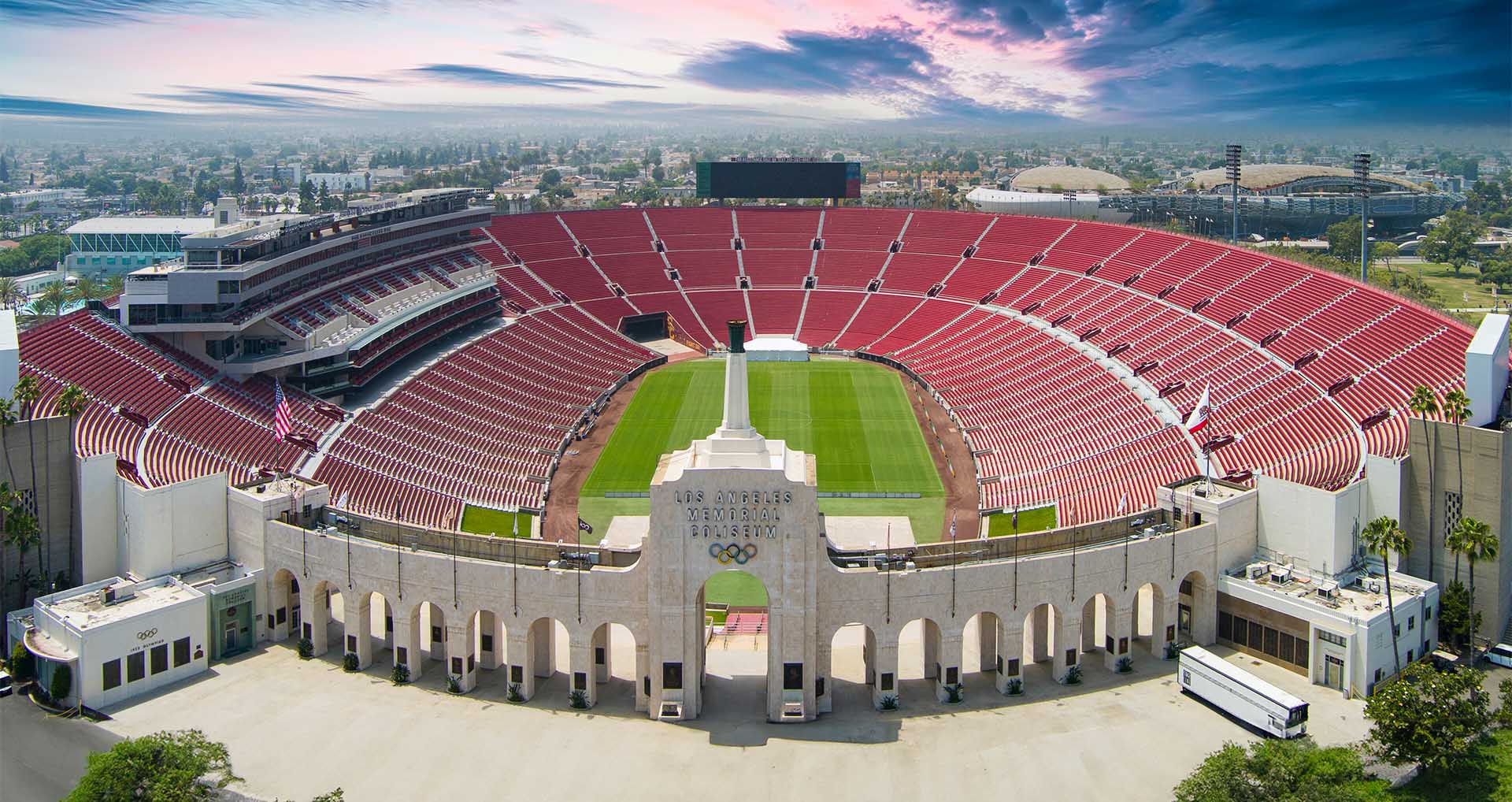
May 1, 1923: The Los Angeles Memorial Coliseum opens, adjacent to the campus of the University of Southern California. It completed a stretch of two weeks in which three of the greatest stadiums ever built on planet Earth opened: The original Yankee Stadium in New York on April 18, and the original Wembley Stadium in London on April 28. Of the three, the Coliseum is the only one that still stands, 99 years later.

Unless you count the nearby HOLLYWOOD sign and the Golden Gate Bridge in San Francisco as "buildings," the Coliseum is the most famous building in the State of California.

At its opening, seating capacity was 75,144. It was expanded to 101,574 for the 1932 Olympic Games. A renovation, necessary after the 1994 Northridge Earthquake, dropped capacity to 93,103. Another recent renovation, including wider seats, and bigger media facilities (including a new press box, named for the late Los Angeles Times executive Otis Booth), requiring the removal of some seats, has made the current capacity 77,500, making it the 2nd-biggest stadium in California, behind the Rose Bowl in nearby Pasadena.

It hosted a football game for the 1st time on October 6, 1923. The University of Southern California hosted Pomona College, and won, 23-7. The USC Trojans have used the Coliseum as their home field ever since.

Their nearby rivals, the University of California at Los Angeles, played home games there from 1933 to 1981. The UCLA Bruins now play home games at the Rose Bowl, which, due to the Trojans' success, has often seemed like a secondary home field to them, not just every other year when they play UCLA in their home-and-home series, but also on January 1, when the Rose Bowl game is usually played.

The Coliseum has also been the leading professional football venue in Southern California. In the NFL, the Los Angeles Rams played there from 1946 to 1979, and again from 2016 to 2019; the Los Angeles Raiders from 1982 to 1994; Super Bowl I in 1967 and Super Bowl VII in 1973; and the postseason Pro Bowl from 1951 to 1972, and again in 1979.

Other pro football teams using the Coliseum: The Los Angeles Dons of the All-America Football Conference from 1946 to 1949, the Los Angeles Chargers of the American Football League in 1960, the Los Angeles Express of the United States Football League from 1983 to 1985, and the Los Angeles Xtreme of the XFL in 2001.

It has hosted the U.S. national soccer team 20 times, starting in 1965; and Mexico's team 61 times. In 1967, the only season of play for the United Soccer Association, it hosted the Los Angeles Wolves, who won that league's title. It also hosted the city's entry in another league starting that season, the Los Angeles Toros of the National Professional Soccer League. After that year, the two leagues merged to form the North American Soccer League, whose Los Angeles Aztecs used the Coliseum as their home field in the 1977 and 1981 seasons.

The Los Angeles Dodgers used the Coliseum as their 1st home field after leaving Brooklyn, while waiting for Dodger Stadium to be built, from 1958 to 1961. Their home games in the 1959 World Series against the Chicago White Sox attracted over 92,000 fans, the highest-attended competitive games in Major League Baseball history. An all-time record crowd for baseball, 115,300, attended a preseason game between the Dodgers and the Boston Red Sox on March 29, 1958, honoring the Dodgers' 50h Anniversary in Los Angeles.
Baseball setup

And, of course, the Coliseum was the main venue for the 1932 and 1984 Summer Olympic Games. While SoFi Stadium will host the Opening Ceremony of the 2028 Summer Olympics, the Coliseum will host the track & field events for the 3rd time.
Post-renovation, with all red seats
and the Otis Booth Press Box

In 2018, naming rights to the playing surface were sold. It is now United Airlines Field. The Coliseum name remains for the stadium as a whole. 

*

May 1, 1923 was a Tuesday. Joseph Heller, known for his World War II novel Catch-22, was born on this day. So was television director Ralph Senensky, who directed 6 episodes of the original Star Trek series.

It was the off-season for the NFL and the NHL, and there was no NBA yet. But a full slate of Major League Baseball games was played:

* The New York Yankees, flush off the successful opening of their new Stadium, beat the Washington Senators, 8-7 at Griffith Stadium in Washington.

* The New York Giants, no longer having to share the Polo Grounds with the Yankees, and expanding it to compete with Yankee Stadium (unsuccessfully, as it turned out), hosted their arch-rivals, the Brooklyn Robins, and beat them, 4-3. The Robins were named for their manager, Wilbert Robinson. After he was fired following the 1931 season, they reverted to their previous name, the Brooklyn Dodgers.

* The Boston Red Sox beat the Philadelphia Athletics, 5-4 at Fenway Park in Boston.

* The Boston Braves beat the Philadelphia Phillies, 12-10 at Baker Bowl in Philadelphia.

* The Chicago Cubs beat the Cincinnati Reds, 3-1 at Redland Field in Cincinnati. It was renamed Crosley Field in 1934.

* The Detroit Tigers beat the Cleveland Indians, 6-5 at Navin Field in Detroit. It was renamed Briggs Stadium in 1938, and Tiger Stadium in 1961.

* The Chicago White Sox beat the St. Louis Browns, 5-3 at Comiskey Park in Chicago.

* And the Pittsburgh Pirates beat the St. Louis Cardinals, 6-2 at Sportsman's Park in St. Louis. 

May 1, 1920: Major League Baseball's Longest Game

Leon Cadore (left) and Joe Oeschger

May 1, 1920: The longest game in the history of what we now call Major League Baseball takes place. Though the 2 teams involved have since moved, it only seems like they did so in the middle of the game.

Only an estimated 4,500 fans filed into Braves Field in Boston to see the Boston Braves take on the Brooklyn Robins, as the Dodgers were known while Hall-of-Famer Wilbert Robinson was their manager from 1914 to 1931.

The Boston starter was Joe Oeschger, a righthander from Chicago, about to turn 28. He had been a member of the Philadelphia Phillies team that won the National League Pennant in 1915. The Brooklyn starter was Leon Cadore, also righthanded, also from Chicago, and already 28. He had helped the Dodgers/Robins win the NL Pennant in 1916. Both men were considered decent pitchers, though neither was especially noteworthy.

Until this day. Oeschger helped his own cause by hitting a leadoff double in the bottom of the 3rd, and got to 3rd base on a sacrifice bunt, but was stranded. The Robins got men on 1st and 2nd in the 4th, but no runs. The Robins scored in the top of the 5th, when Ernie Krueger drew a leadoff walk, got sacrificed to 2nd by Cadore, and singled home by Ivy Olson.

But with 1 out in the bottom of the 6th, the Braves got a triple from Walton Cruise. Walter Holke flew to left, but it wasn't deep enough to score Cruise. Tony Boeckel singled Cruise home with the tying run. But when Walter "Rabbit" Maranville doubled to center, Boeckel tried to score the go-ahead run, and was through out at the plate by relay from center fielder Hi Myers to Cadore, to catcher Ernie Krueger.

The Braves came close to going ahead in the bottom of the 8th: Les Mann led off with a single, Cruise sacrificed him to 2nd, and a Holke groundout got him to 3rd. But Boeckel popped up to end the threat.

They had another chance in the bottom of the 9th: Maranville led off with a single, and Lloyd Christenbury singled him to 2nd. Today, the Braves' manager would probably have pinch-hit for the pitcher. Instead, with nobody out, George Stallings led Oeschger bat for himself, and bunt the runners over. And when Ray Powell walked to load the bases, it looked like the strategy would work. But Charlie Pick grounded into a double play, and it was on to extra innings.

No one had any idea just how many extra innings there would be.

Oeschger and Cadore kept putting up goose eggs. Neither team would seriously threaten again until the bottom of the 15th inning. Cruise led off with a walk. Holke bunted him over to 2nd. But Boeckel and Maranville grounded into force plays, and Hank Gowdy flew out.

The Robins had a good chance in the top of the 17th. Zack Wheat led off with a single. Wally Hood bunted him over to 2nd. Ed Konetchy singled, but Wheat had to stop at 3rd. Chuck Ward grounded to short. Again, Wheat couldn't score, and Ward was thrown out. And Rowdy Elliott grounded into a double play.

If anything, Oeschger and Cadore seemed to be growing stronger. After Konetchy's single, there wasn't another baserunner, on either side, until the bottom of the 20th, when Mann led off with a single -- and was picked off 1st. With 2 out in the top of the 22nd, Wally Hood drew a walk, and stole 2nd. But Konetchy grounded out.

And there was only 1 more baserunner for the rest of the game. In the top of the 26th inning, Ward popped to 1st, Elliott flied to right, and Cadore, batting for himself, flied to center. In the bottom half, Mann popped to 2nd, Cruise hit a weak grounder in front of the plate, Holke singled up the middle, and Boeckel grounded to 1st, ending the 26th inning.

It was then that home plate umpire Barry McCormick called the game due to darkness, 15 years before the 1st MLB game with lights. For the Braves: 1 run, 15 hits, 2 errors, 17 men left on base. For the Robins: 1 run, 9 hits, 2 errors, 11 men left on base.

It was nearly 3 full games' worth of innings, and yet the time of the game was "only" 3 hours and 50 minutes. Today, if the Los Angeles Dodgers and the Atlanta Braves played a 9-inning game that lasted 3:50, nobody would think it was anything unusual.

For the Braves, Boeckel went 3-for-11, Maranville went 3-for-10, Oeschger went 1-for-9, and poor Charlie Pick went 0-for-11, an entire slump's worth of at-bats in a single game. For the Robins, Cadore and Chuck Ward went 0-for-10.   

Cadore appears never to have given an interview about the game. Oeschger did, saying, "If a pitcher couldn't go the distance, he soon found himself some other form of occupation."

I can find no record of how many pitches each man threw. Perhaps none was kept, given that, as Oeschger suggested, in those days, nobody cared. It's just as well: Reading those figures would probably give Brian Cashman a stroke.

UPDATE: In 2025, reading that the official record for most pitches thrown in an MLB game is 235, by Nolan Ryan over 13 innings of a 15-inning California Angels win over the Boston Red Sox on June 14, 1974, a Google search suggests that Cadore threw 360 pitches, and that this is the unofficial record.

You may be wondering what happened to the pitchers after this. Cadore was bypassed for his next start, and only went 4 1/3rd innings in his next one, but settled back into a regular rhythm, and finished the season 15-14 with a 2.59 ERA. Oeschger ended up missing 2 starts. And he did lose his next 2. After that, though, he was fine, finishing the season with a record of 15-13 and a 3.46 ERA.

Cadore continued pitching in the major leagues until 1924, with a career record of 68-72. He married Maie Ebbets, daughter of team owner Charles Ebbets. He died in 1958. Oeschger continued pitching in the major leagues until 1925, with a career record of 82-116. In 1983, as the last living member of the Pennant-winning 1915 Phillies, he was invited to throw out the ceremonial first ball before Game 1 of the World Series. He lived until 1986.

McCormick, like most umpires in those days, was a former player, having been a major league infielder from 1895 to 1904, mostly with the team now known as the Chicago Cubs. He umpired in the Federal League in both of its seasons, 1914 and 1915; in the American League in 1917; and in the National League from 1919 to 1929. He died in 1956.

The longest MLB game played to a conclusion? Two of them have gone 25 innings. On September 11, 1974, the St. Louis Cardinals beat the New York Mets, 4-3 at Shea Stadium. And on May 8, 1984, then suspended and resumed on May 9, the Chicago White Sox beat the Milwaukee Brewers, 7-6 at Comiskey Park in Chicago. At 8 hours and 6 minutes, that White Sox-Brewers game is the longest MLB game ever by time.

The Mets also lost a 24-inning game in Houston in 1968, and a 23-inning game at home to San Francisco in 1964. The Dodgers and Braves (this time, it was the Braves trying a new name that didn't stick, the Boston Bees) played to 23 innings, called because of darkness, in a 1939 game.

The longest in Yankee history? June 24, 1962, at Tiger Stadium in Detroit. The Yankees blew a 6-0 lead against the Detroit Tigers, but won anyway, 9-7, when Jack Reed hit a home run off Phil Regan in the top of the 22nd inning. Rocky Colavito went 7-for-10 for the Tigers, one of only 6 7-hit single-game performances in baseball history.

*

May 1, 1920 was a Saturday. A full slate of MLB games was played:

* The New York Yankees beat the Boston Red Sox, 6-0 at the Polo Grounds. Bob Shawkey pitched a 4-hit shutout, defeating Herb Pennock, who the Yankees traded for in 1923. Babe Ruth went 2-for-4 with his 1st home run as a Yankee, off Pennock, over the right field roof.

To this point, only Ruth himself, once before, with the Red Sox, and Shoeless Joe Jackson had hit a ball over the right field roof at the Polo Grounds. Mel Ott also did it later on. The only ball known to be hit over the left field roof came in 1951, the 1st major league home run of Willie Mays.

* The New York Giants lost to the Philadelphia Phillies, 5-2 at Baker Bowl in Philadelphia.

* The Philadelphia Athletics beat the Washington Senators, 9-4 at National Park in Washington. (It was renamed Griffith Stadium in 1922.)

* The Cincinnati Reds beat the Pittsburgh Pirates, 7-1 at Forbes Field in Pittsburgh.

* The Cleveland Indians beat the Detroit Tigers, 9-3 at Navin Field in Detroit. (It was renamed Briggs Stadium in 1938, and Tiger Stadium in 1961.) Tris Speaker not only managed the Indians to victory, but went 4-for-5 with a home run and 7 RBIs. Ty Cobb went 1-for-4 for the Tigers.

* The St. Louis Cardinals beat the Chicago Cubs, 12-4 at Cubs Park in Chicago. (It was renamed Wrigley Field in 1926.) Rogers Hornsby went 3-for-4. So did Jack Fournier, but, while Hornsby had no RBIs, Fournier had 5.

* And the Chicago White Sox beat the St. Louis Browns, 8-5 at Sportsman's Park in St. Louis. Shoeless Joe Jackson went 3-for-5 with 3 RBIs for Chicago, while George Sisler went 0-for-4 with 3 RBIs for St. Louis. How did that happen? A sacrifice fly and 2 RBI groundouts. Perhaps not as unusual as a game going 26 innings, but pretty unusual.

And in the last game of their Football League Division One season, Arsenal defeated Bradford Park Avenue (a Yorkshire team, now defunct), 3-0 at Highbury, North London. 

May 1, 1898: The Battle of Manila Bay

The USS Olympia

May 1, 1898: The Battle of Manila Bay is fought. It is the decisive naval battle of the Spanish-American War. Commodore George Dewey led the U.S. Asiatic Squadron, 9 ships, to victory over a 13-ship Spanish flotilla commanded by Contraalmirante Patricio Montojo. (His rank was equivalent in the U.S. to a Real Admiral, 2 stars.)

Dewey, a 60-year-old native of Vermont, was a graduate of the U.S. Naval Academy, and participated in the Union's capture of New Orleans during the American Civil War. He commanded the fleet from the cruiser USS Olympia. At 5:41 AM, local time, he told the Olympia's commanding officer, Captain Charles V. Gridley, "You may fire when ready, Gridley."

It was a wipeout. Six of the Spanish ships were sunk, and all the American ships survived. Only one American sailor died, and that was from dysentery, not from a battle wound or injury. The battle led to Spain ceding the Philippines to the U.S. in the peace treaty. With the additional losses of Puerto Rico, Cuba, and other possessions in the Caribbean, Spain's time as a colonial power was over.

Charles Gridley did not survive the Spanish-American War. He already had liver cancer, and died on June 5, aboard the Olympia, docked at Kobe, Japan. He was 53 years old. Dewey was promoted to Admiral of the Navy, 5 stars, equivalent to a General of the Army. He died in 1917, at 79. Dewey Square, outside South Station in Boston, is named for him. Montojo, who was court-martialed for his defeat, outlived Dewey by 8 months.

The Olympia was decommissioned after the Spanish-American War, but returned to service in World War I. It is now part of the Independence Seaport Museum in Philadelphia, and is the oldest steel American warship still afloat. It sits across the Delaware River from the World War II-era battleship USS New Jersey, in Camden.

*

May 1, 1898 was a Sunday. At the time, there was only one professional sports league in America, baseball's National League. And playing on Sunday was still illegal in many places. And so, only 2 games were played:

* The Pittsburgh Pirates beat the Cincinnati Reds, 11-5 at League Park in Cincinnati. Crosley Field would be built on the site in 1912. The Reds played home games at that location from 1884 to 1970.

* And the Louisville Colonels beat the Chicago Orphans, 4-3 at West Side Park in Chicago. This was the 1st season for the Chicago team of the NL, formerly known as the White Stockings and the Colts, without Adrian Constantine Anson on their roster since 1875, when they were still in the National Association. He became the team's 1st baseman, their captain, and eventually their manager, nicknamed "Captain," shortened to "Cap." As he got older, they called him "Pop." After he retired, someone started calling the team the Orphans, "because they missed their Pop." In 1903, they were renamed the Cubs.

May 1, 1894: Coxey's Army, the 1st March On Washington

May 1, 1894: The worst economic depression America had yet seen leads to the first march on Washington, the nation's capital.

The Panic of 1893, a stock market crash, sent the economy, already shaky since the passage of the Sherman Silver Purchase Act of 1890, down the drain. The economy had allowed Grover Cleveland to become the 1st (and still the only) former President ever to regain the office in 1892. But the Panic came just 3 months into his term, and he never had a chance.

By the Spring of 1894, people were desperate. Unemployment was way up. Bank runs paralyzed local financial systems. Credit dried up. Deflation sent wages tumbling.

Enter Jacob S. Coxey. A Pennsylvania native who ran an iron mill in Massillon, Ohio, Coxey had run for the State Senate in 1885, and lost. He had been a member of the Greenback Party and the People's Party, both of which had challenged America's two-party system from the left.

How did those challenges go? Greenback candidate Benjamin Franklin Butler, a Civil War General and former Governor of Massachusetts, won 1.3 percent of the popular vote for President in 1884. In 1892, Populist candidate James B. Weaver, a former Congressman from Iowa, won 8.5 percent, and carried the States of Colorado, Idaho, Kansas, Nevada and North Dakota for 22 Electoral Votes.

Coxey believed that a program of public works, especially road improvement, would save the economy. It would not only provide something the country really needed, but it would put people back to work, put money back in people's pockets, and remove the need for so much credit.

On March 30, 1894, Coxey left Massillon with 100 men, and set out on a 350-mile march to Washington. "Coxey's Army," as it became known in the newspapers, grew to 6,000 people by the time it camped out on the Shreve farm at Colmar Manor, Maryland on April 30. The month in between included Coxey's 40th birthday.

The next day, May 1, May Day, already known as International Workers' Day, Coxey and the leaders of his Army walked onto the grounds of the U.S. Capitol Building. Unfortunately for them, specifically, they walked onto its grass. They were arrested for this. Fortunately, the arrests were handled peacefully, and nobody got hurt.

With this, one of the great anti-climaxes of American history, the movement quickly fell apart. Coxey went down in the American imagination, at least in the short term, as a crank.

Jacob Coxey wasn't wrong. He was just significantly premature. In 1901, following the assassination of President William McKinley, Theodore Roosevelt became President, and began to put together what he called "the Square Deal," launching America's "Progressive Era." In 1912, Woodrow Wilson was elected President, and his "New Freedom" expanded on TR's work. (This in spite of the two men personally despising each other.)

In 1926, President Calvin Coolidge (in college at the time of Coxey's Army) signed the federal highway program into law. This included U.S. Route 30, over the path of Coxey's march from Massillon to Pittsburgh.

In 1932, Franklin D. Roosevelt (only 12 years old in 1894) was elected President, saying, evoking memories of his cousin's Square Deal, "I pledge myself to a New Deal for the American people. This is more than a political campaign, it is a call to arms." In 1935, he created the Works Project Administration, which built so many things that created jobs, from post offices to dams to stadiums (including the original Rutgers Stadium in 1938).

In 1956, President Dwight D. Eisenhower (3 years old in 1894) signed the Interstate Highway Act into law. Coxey's route from Pittsburgh to Breezewood, Pennsylvania is now part of Interstate 76 and the Pennsylvania Turnpike. His route from Breezewood to Frederick, Maryland is now part of Interstate 70. And his route from Frederick to Washington is now part of Interstate 270.

Coxey lived to see much of this, despite being a perennial candidate. The People's Party nominated him for the U.S. House of Representatives in 1894, and for Governor in 1895 and 1897. The Socialist Party nominated him for the U.S. Senate in 1916 and 1928; and for the House in 1922, 1924, 1926, 1928, 1930, 1932 and 1934. The Union Party nominated him for the Senate in 1936, and for the House in 1938 and 1942. He lost all of these races. He won one election in his life, for Mayor of Massillon in 1931, but lost in his 1st bid for re-election.
Jacob Coxey, May 1, 1944.
The "crank" was a prophet, all along.

On May 1, 1944, 50 years to the day after he made the 1st march on Washington, Coxey was invited to read his original petition from the Capitol Steps. He did. It was terribly delayed, but it was vindication, something rarely obtained in Washington, especially in one's own lifetime, and rarer still to one's own face. He died in 1951, at the age of 97.

*

May 1, 1894 was a Tuesday. Baseball was the only sport in America that dared to be openly professional. These games were played in the National League that day:

* The New York Giants beat the Baltimore Orioles, 7-4 at the Polo Grounds. This version of the Polo Grounds would burn down in 1911, and be replaced by the most familiar version. This version of the Orioles would go out of business after the 1899 season.

* The Boston Beaneaters beat the Philadelphia Phillies, 7-3 at the Huntingdon Avenue Grounds. Later in the year, this ballpark would burn down, and be replaced on the site by Baker Bowl. The Beaneaters eventually became the Braves.

* The Washington Senators beat the Brooklyn Bridegrooms, 2-1 at Boundary Field in Washington. Coxey's Army had no effect on this game. These Senators also went out of business after 1899. They should not be confused with the American League's version of the Senators, who became the Minnesota Twins. So named because of multiple marriages for players on their roster in 1887, the Bridegrooms eventually became the Dodgers.

* The Pittsburgh Pirates beat the Cincinnati Reds, 7-6 at League Park in Cincinnati. Crosley Field would be built on the site in 1912.

* The Cleveland Spiders beat the St. Louis Browns, 7-0 at Sportsman's Park in St. Louis. The Spiders also went out of business after 1899, while the Browns became the Cardinals. They should not be confused with the American League's version of the Browns, who became the Baltimore Orioles. And this version of Sportsman's Park would be replaced on the same site in 1909.

* And the Chicago Colts, forerunners of the Cubs, and the Louisville Colonels, another team that went out of business after the 1899 season, appear not to have been scheduled to play on May 1, 1894. 

December 31, 1999 & January 1, 2000: The Millennium

December 31, 1999:  The Millennium arrives. The people of planet Earth survived. At a terrible cost. But we hadn't destroyed ourselves. ...