Saturday, July 2, 2022

July 2, 1933: Carl Hubbell vs. Tex Carleton

Carl Hubbell

July 2, 1933: The New York Giants beat the St. Louis Cardinals, 1-0 at the Polo Grounds. Hughie Critz singled home Jo-Jo Moore with the winning run. This hit came in the bottom of the 18th inning.

Carl Hubbell of the Giants went the distance. The number of pitches the lefthanded screwballer threw in what were, essentially, 2 complete games is not known. What is known is that the native of Meeker, Oklahoma, known as "King Carl" and "The Meal Ticket," pitched shutout ball for 18 innings, allowing just 6 hits and no walks, striking out 12. I think part of that should be repeated, and spelled out: Eighteen innings, and no walks.

James "Tex" Carleton went 16 innings for the Cardinals, before giving way to Jesse Haines. Like Hubbell, Haines would be elected to the Baseball Hall of Fame. This game was not part of the reason Haines got in. Also in this game and going to Cooperstown: For the Giants, manager and 1st baseman Bill Terry, right fielder Mel Ott, and shortstop Travis Jackson; for the Cardinals, manager and 2nd baseman Frankie Frisch (a former Giant), left fielder Joe Medwick, and shortstop Leo Durocher (elected on the basis of his later managing).

And this 18-inning epic was the 1st game of a doubleheader. Despite the Polo Grounds not getting lights until 1940, the 2nd game was played in full. And the Giants won it, 1-0. Roy Parmalee pitched a 4-hit shutout, beating Dizzy Dean, another future Hall-of-Famer. Parmalee pitched 9 innings, striking out 13, and walking none.

So, the Giants scored 2 runs in 27 innings in 1 day, and walked away with 2 wins. In 27 innings, 25 strikeouts, and no walks.

NO WALKS IN TWENTY-SEVEN INNINGS IN ONE DAY!

The expression "Beat that with a stick" comes to mind, but the Cardinals tried that very thing, with their bats, and couldn't do it.

The Giants went on to win the World Series that season. The Cardinals did it the next year. From 1933 to 1937, Hubbell and Dean, and Negro Leaguer Satchel Paige, were the 3 best pitchers on the planet.

*

July 2, 1933 was a Sunday. Future hockey star Ken Wharram was born. These other baseball games were played that day:

* The New York Yankees beat the Cleveland Indians, 7-3 at Cleveland Municipal Stadium. Walter "Jumbo" Brown outpitched Mel Harder. Babe Ruth went 1-for-5. Lou Gehrig went 0-for-4 with a walk, and had an RBI on a sacrifice fly.

* The Brooklyn Dodgers swept the Chicago Cubs, 7-3 and 4-3 at Ebbets Field.

* A doubleheader was split at Braves Field in Boston. The Boston Braves won the opener, 1-0. Ed Brandt pitched a 4-hit shutout. The Cincinnati Reds won the nightcap, 3-0. Larry Benton pitched a 3-hit shutout.

* A doubleheader was split at Sportsman's Park in St. Louis. The Philadelphia Athletics won the 1st game, 6-5. Dib Williams singled Mickey Cochrane home with the winning run in the top of the 10th inning. Lefty Grove won the game in relief. The St. Louis Browns won the 2nd game, 11-6. Williams hit a home run, and Jimmie Foxx hit 2.

* The Detroit Tigers and the Washington Senators were rained out at Navin Field (later Briggs Stadium and Tiger Stadium) in Detroit. The game was made up as part of a doubleheader on August 23. The Tigers won the 1st game, 2-1. The Senators won the 2nd game, 9-5.

* The Boston Red Sox and the Chicago White Sox were rained out at Comiskey Park in Chicago. The game was made up as part of a doubleheader on August 24. The Red Sox won the 1st game, 6-1. The White Sox won the 2nd game, 7-6. In the bottom of the 10th inning, Al Simmons drew a walk, and Luke Appling tripled him home.

* And the Philadelphia Phillies and the Pittsburgh Pirates were not scheduled. A few weeks later, the Pennsylvania legislature would pass a law allowing professional sports to be played on Sunday in the State, making home games on Sunday for the Pirates, the Phillies, and the Philadelphia Athletics possible.

July 2, 1932: The Democrats Almost Blow It

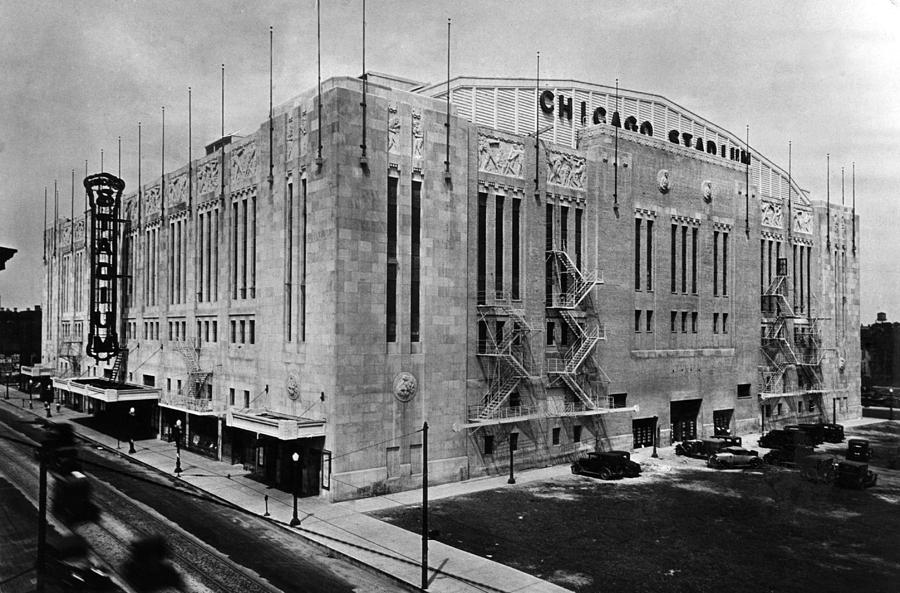
July 2, 1932: The Democratic National Convention, meeting at Chicago Stadium, home of the NHL's Blackhawks (and later the NBA's Bulls), almost blows a golden opportunity. With incumbent Republican President Herbert Hoover saddled with the Great Depression, the Democratic nominee could win -- if he could draw a contrast with the failed conservatism of the Republicans.
But so many people are opposed to the front-runner, Governor Franklin D. Roosevelt of New York, because they think either that he's too liberal, or that his health will be an issue. They knew he'd had polio, and it was not widely known how much it had affected him.

Four years earlier, at the Convention, in Houston, FDR had given the nomination speech for his predecessor as Governor, Alfred E. Smith. Smith was nominated, but lost badly. Someone asked Smith if he was worried that he was raising a rival in FDR. He said, "No, he will be dead within a year."

Instead, within 6 months, FDR was Governor of what was then the nation's largest and strongest State, and Smith was out of a job. He was asked to run the company that was building the Empire State Building. That done, he thought the Democratic Party owed him the nomination again, but even New York's Democrats were behind FDR. Smith thought he could count on the national Catholic vote, but that wouldn't be enough to help him at the Convention.

Also running were the Speaker of the House of Representatives, John Nance Garner of Texas, a.k.a. Cactus Jack; former Governor Harry Byrd of Virginia, who went on to be elected to the U.S. Senate, eventually succeeded by his son, Harry Jr.; Governors Albert Ritchie of Maryland, George White of Ohio, and William H. "Alfalfa Bill" Murry of Oklahoma; James A. Reed, Senator from Missouri and former Mayor of Kansas City; and Newton D. Baker, who had served as Secretary of War and Mayor of Cleveland.

The rule requiring that a nominee receive two-thirds of the delegates to be nominated -- a rule designed to give the racist South a veto over any candidate that is too liberal on civil rights -- nearly derails FDR, as other, more conservative candidates try to wait him out, ballot after ballot, to become the nominee.

It took 769 1/2 Delegates to be nominated. On the 1st ballot, FDR had 666 1/4, Smith had 201 3/4, and Garner had 90 1/2. On the 2nd, FDR gained to 677 3/4, Smith dropped to 194 1/4, and Garner remained at 90 1/4. On the 3rd, FDR gained to 682 3/4, Smith dropped to 190 1/4, and Garner gained to 101 1/4, with 180.25 votes scattered among others. FDR was still 87 1/4 short of the nomination, so he needed about half the Delegates not already with himself, Smith or Garner -- and it looked like none of them would budge, each of them hoping to be the one to benefit from FDR's dropoff, whenever it would happen.

If Roosevelt had dropped off, and the Democrats had nominated anybody else, he would have beaten Hoover, simply because the people were pissed at the Republicans. But it's hard to imagine any of them, except maybe Al Smith, who had already instituted a precursor to the New Deal in New York State, doing it nationally. Whether he would have gone as far as FDR ended up going, no one can be sure. But it is impossible to imagine Garner, Byrd or Ritchie going even as far as Smith. Baker had been in the Cabinet of President Woodrow Wilson, who was progressive on many issues -- but terribly regressive on race.

A Democrat other than Roosevelt as President in 1933, '34, '35 and '36 would have faced an electorate who would have considered him a failure for not doing enough. In Canada, in the early stages of the Depression, the Liberal Party were defeated by the Conservative Party in the 1930 election, with a net loss of 36 seats. William Lyon Mackenzie King was out as Prime Minister, and Richard B. Bennett was in. But, like Hoover, Bennett did very little to ease the Depression, and held off calling a new election as long as the law allowed. In 1935, the Liberals gained a net 91 seats, Mackenzie King was back in, and Bennett actually left the country. He's the only Prime Minister of Canada not buried in the country.

But if the Republicans had regained control in the 1936 election, they could have gone into the 1940 vote saying, "We're the only party that can be trusted, because the Democrats' answer is Communism." They likely would have supported the Nazis against the Soviets in 1941. There certainly wouldn't have been Lend-Lease for Britain. A Republican Secretary of State might have negotiated a separate peace between Chancellor Adolf Hitler and a Prime Minister other than Winston Churchill, and the Nazis would have won the war.

There would have been no argument for African-Americans to say, "If we can stop bullets, why not baseballs?" Professional sports would not have been integrated. The Supreme Court would not have had Hugo Black, Felix Frankfurter or William O. Douglas appointed in the 1930s, or Robert H. Jackson in the 1940s, or Earl Warren or William J. Brennan in the 1950s. Some of the civil rights gains of the 1940s, '50s and '60s would have been delayed; and some would not have happened at all.

The Democratic Party would have remained divided between big-city liberals and Southern conservatives. Harry Truman, Adlai Stevenson, John F. Kennedy and Hubert Humphrey might have been elected Senators or Governors; none of them would have been nominated for President. Lyndon B. Johnson might have been, but he would not have won on his own.

The Republicans would have remained divided between Eastern liberals and Western conservatives. But without FDR winning 4 straight elections, and Truman, JFK and LBJ running as his political heirs, the split would not have been as nasty. The turn toward evangelicalism in the wake of civil rights would not have happened, but the Grand Old Party would still have been guided by greed.

Without America getting into World War II, Dwight D. Eisenhower would never have become President; but Richard Nixon, Ronald Reagan and the George Bushes could have been. Then again, it's unlikely that Donald Trump would have. And the gains made under Democratic Presidents from Roosevelt to Biden are almost impossible to imagine.

And the Democrats almost threw this chance away, because some of them were scared of FDR's health, and some of them were scared of his liberalism. We may never know how many ballots they came to blowing it, and making the next 90 years incredibly different.

After the 3rd ballot, FDR offered the Vice Presidential nomination to Garner. He accepted, and brought the South with him. On the 4th ballot, FDR had 945, Smith 190.5, and everybody else combined had 17.5. They had a nominee.

Once nominated, Roosevelt was taken to an airport, and flew a rather rickety plane in bad weather from New York to Chicago, a perilous journey even 5 years after Charles Lindbergh flew across an ocean.

And, up until then, a potential Presidential nominee -- unless he was already a Delegate, and thus a surprise choice -- never even attended the Convention. Being publicly seen as actually seeking the nomination was considered to be wrong, and so they would go through the motions of sending a messenger to his home, and formerly informing him of his nomination there.

Instead, FDR gives his acceptance speech in person. He tells a nationwide radio audience, "I pledge you, I pledge myself, to a new deal for the American people. Let us all here assembled constitute ourselves prophets of a new order of competence and of courage. This is more than a political campaign; it is a call to arms. Give me your help, not to win votes alone, but to win in this crusade to restore America to its own people."

The phrase "New Deal" evoked the "Square Deal" of his distant cousin, Theodore Roosevelt, who had been President from 1901 to 1909. No one, not even FDR, yet knew what specific measures would be involved. But the phrase "New Deal" sticks.

So does a song played during the Convention, written right before the stock market crash of 1929, and it becomes the Democratic Party’s theme song for decades to come: "Happy Days Are Here Again."

After this Convention, at FDR's direction, the Democratic Party junked its 2/3rds rule. From 1936 onward, as the Republicans were already doing, the Democrats would have a nominee as soon as a candidate had a simple majority of the Delegates.

*

July 2, 1932 was a Saturday. These baseball games were played:

* The New York Yankees split a doubleheader with the Boston Red Sox at Fenway Park in Boston. The Yanks won the opener, 8-5. Herb Pennock went the distance for the win, and went 2-for-5 with 2 RBIs in his own cause. The Red Sox won the nightcap, 6-5. John Michaels outpitches Red Ruffing. Over the 2 games, Babe Ruth went 1-for-8 with a walk and an RBI, and Lou Gehrig went 1-for-7 with 2 RBIs.

* The New York Giants lost to the Boston Braves, 7-4 at the Polo Grounds. Billy Urbanski and Wally Berger hit home runs for the Braves. "Fat Freddie" Fitzsimmons was the losing pitcher for the Giants, but he and James "Shanty" Hogan both him home runs. 1st baseman and manager Bill Terry went 0-for-4. Mel Ott went 1-for-4 with an RBI.

* The Brooklyn Dodgers lost to the Philadelphia Phillies, 6-3 at Ebbets Field.

* The Philadelphia Athletics swept the Washington Senators, 2-1 and 5-4 at Shibe Park in Philadelphia. In the 1st game, George "Mule" Haas led off the bottom of the 11th with a triple, and Eric McNair hit a sacrifice fly to bring him home with the winning run. George Earnshaw went the distance for the win. 

Mickey Cochrane went 0-for-5 in the 1st game, and did not play in the 2nd. Over the 2 games, Haas went 3-for-8; McNair went 3-for-8 with a home run, a walk, and 3 RBIs; Doc Cramer went 4-for-9; Al Simmons went 3-for-9; and Jimmie Foxx went 2-for-7 with 2 walks and an RBI.

* The St. Louis Cardinals beat the Pittsburgh Pirates, 5-4 at Forbes Field in Pittsburgh. For the Cards, George Watkins went 1-for-4 with 3 RBIs. For the Bucs, Paul Waner went 1-for-4, and Lloyd Waner went 1-for-5.

* The Detroit Tigers beat the Cleveland Indians, 5-4 at Navin Field (later Briggs Stadium and Tiger Stadium) in Detroit.

* The Cincinnati Reds beat the Chicago Cubs, 6-3 at Wrigley Field in Chicago.

* And the Chicago White Sox beat the St. Louis Browns, 15-5 at Sportsman's Park in St. Louis.

July 2, 1921: Boxing's 1st Million-Dollar Gate

Boyle's Thirty Acres, July 2, 1921.
The little square in the middle is the boxing ring.
Fire laws? We don't need no stinkin' fire laws.

July 2, 1921: For the 1st time, a professional prizefight takes in more than $1 million in gate receipts. The era of the "Million-Dollar Gate" is on.

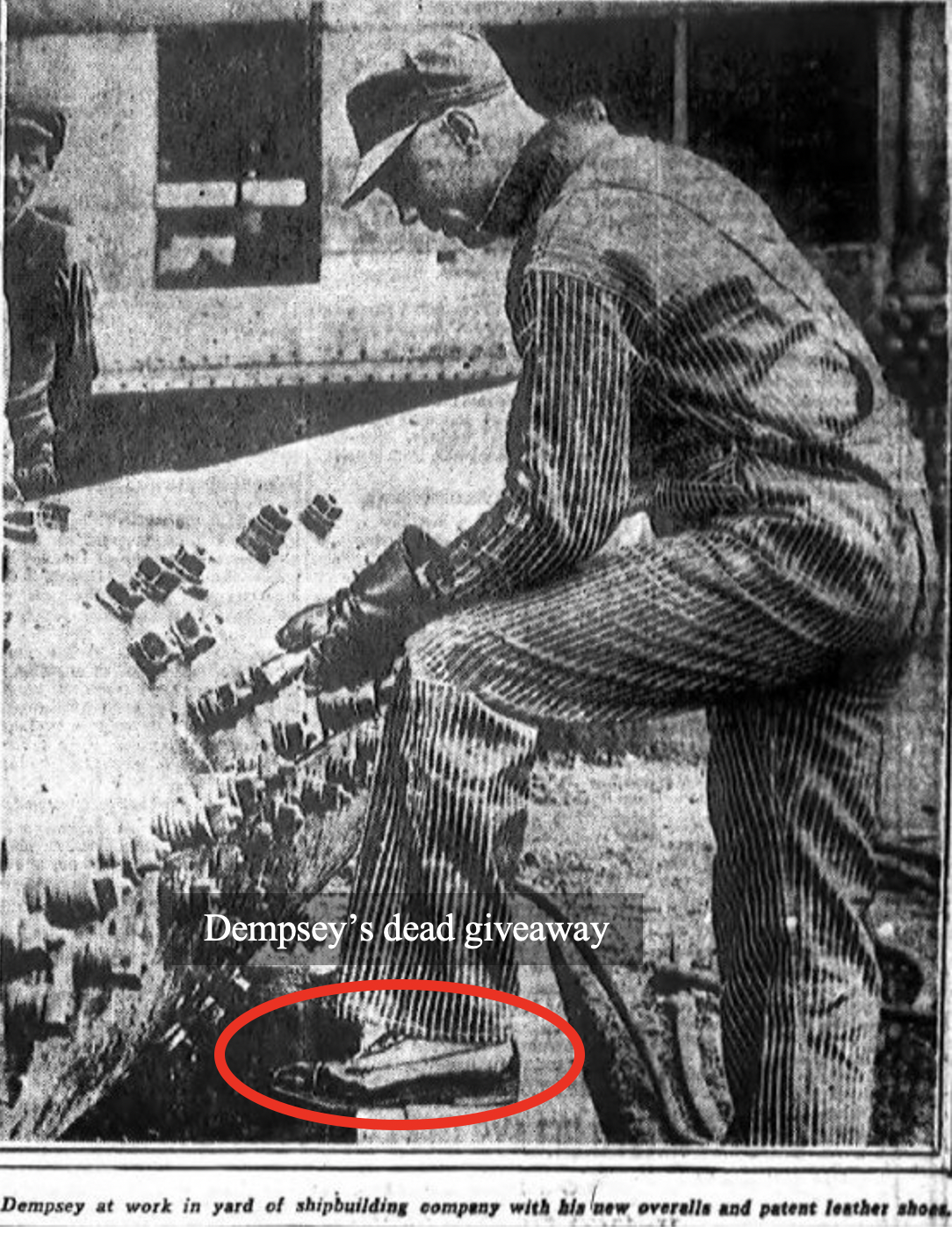
Jack Dempsey won the Heavyweight Championship in 1919, but he hadn't served in World War I. In 1920, a photo was produced showing Dempsey working in a shipyard, which should have ended the controversy right there. But someone noticed that he was wearing patent leather shoes in the photo, making some people think the photo was staged to take the curse off him.
Soon, evidence came to light that he had tried to enlist, but, despite being a very strong man for his size (he'd be classified as a cruiserweight today), the Army had classified him "4-F": "Registrant not acceptable for military service." This classification is nearly always applied to a person who fails either the physical or the psychological examination upon enlistment or reporting for the draft.
But some people still weren't satisfied. This became especially controversial in 1921, when he defended his title against the Light Heavyweight Champion, Georges Carpentier, a French pilot who had been awarded the Croix de Guerre and the Médaille Militaire. The contrast between the much-decorated Carpentier and the "slacker" Dempsey was staggering.
Professional boxing would still be illegal in the State of New York, not just the City of New York, for 2 more years. So George "Tex" Rickard, boxing's leading promoter, decided to put the fight as close to Midtown Manhattan as possible. He found a plot of land owned by John F. Boyle, a mile south of Journal Square in Jersey City, New Jersey, only 6 miles from Midtown Manhattan. There, Rickard built what was intended as a temporary structure, wooden bleachers to seat 90,000 people, calling it "Boyle's Thirty Acres."

The fight was a sellout, and generated $1,789,238, about $29 million in 2022 money. It was no contest: Dempsey knocked Carpentier out in the 4th round. Much of the crowd booed, but Carpentier showed no hard feelings. He kept the Light Heavyweight Championship for another year, and lived until 1975.

It wasn't until Dempsey was "robbed" in the "Long Count" fight against Gene Tunney in 1927 that he became a near-universal hero. He lived until 1983.

The year 1927 would also see the end of Boyle's Thirty Acres, having hosted boxing champions such as Dempsey, Benny Leonard and Jim Braddock, a Hudson County resident who would win the Heavyweight Championship in 1935. The site is now mixed residential and industrial.

*

July 2, 1921 was a Saturday. Football, basketball and hockey were out of season. These baseball games were played, all doubleheaders:

* The New York Yankees swept the Philadelphia Athletics at the Polo Grounds, 6-4 and 14-4. Bob Shawkey won the opener, with 2 home runs by Frank "Home Run" Baker. Both were former A's. Carl Mays won the nightcap. Babe Ruth went 3-for-7 with 2 walks and 3 RBIs, but no home runs.

* The New York Giants swept the Brooklyn Robins (as the Dodgers were known from 1914 to 1931) at Ebbets Field, 8-1 and 7-4.

* The Washington Senators swept the Boston Red Sox at Fenway Park in Boston, 4-1 and 7-3.

* The Boston Braves swept the Philadelphia Phillies at Baker Bowl in Philadelphia, 6-4 and 3-2, the latter in 10 innings.

* There was a split at Forbes Field in Pittsburgh. The Pittsburgh Pirates won the 1st game, 5-2. The St. Louis Cardinals won the 2nd game, 6-3.

* The Cleveland Indians swept the Chicago White Sox at League Park in Cleveland, 6-4 and 11-10. Tris Speaker went 4-for-7 with 2 walks and 2 RBIs.

* There was a split at Cubs Park in Chicago (renamed Wrigley Field in 1926). The Cincinnati Reds won the 1st game, 4-2. The Chicago Cubs won the 2nd game, 6-2.

* And the Detroit Tigers swept the St. Louis Browns at Sportsman's Park in St. Louis, 4-1 and 7-6. Neither team's superstar, the Tigers' Ty Cobb or the Browns' George Sisler, played in either game.

July 2, 1903: The Strange Death of Ed Delahanty

July 2, 1903: One of baseball's greatest and strangest players comes to one of baseball's saddest and strangest ends.

Edward James Delahanty was born on October 30, 1867, in Cleveland. He was 1 of a record 5 brothers to play Major League Baseball. Tom got 16 career hits. Joe had 222. Frank had 223. Jim had 1,159. Between them, they had 1,620. But Big Ed had 2,596 all by himself.

A left fielder for most of his career, which started in 1888, Ed batted .346 lifetime, peaking at .410 in 1899, and put together an astonishing 152 OPS+. He had 7 100+ RBI seasons, which was stunning for the time. On July 3, 1896, he hit 4 home runs in a game, making him only the 2nd player to do it, after Bobby Lowe of the Boston Beaneaters (forerunners of the Atlanta Braves) in 1894.

Ed played most of his career with the Philadelphia Phillies. In 1902, he jumped to the American League, playing for the Washington Senators. That season, by hitting .376, he won the batting title, to go with the one he won in the National League in 1899. He remains the only player to win them in both Leagues.

He died while still an active player, on July 2, 1903, only 35 years old. The incident is shrouded in mystery: He jumped the Senators while they were in Detroit to play the Tigers, and boarded a train for New York, a train that cut across Canada, through its Province of Ontario, before crossing back into the U.S. at Buffalo. He got drunk on the train, was accused of threatening passengers with a straight razor, and the conductor kicked him off.

He tried to walk across the International Railway Bridge between Fort Erie, Ontario and Buffalo, got into a fight with the bridge's night watchman, and went over the bridge into the Niagara River. His body was found at the bottom of Niagara Falls a month later.
The International Railway Bridge

Did he jump? Did he fall? Was he pushed? We will never know. The watchman was not charged.

Delahanty was elected to the Baseball Hall of Fame in 1945, his career legendary, but incomplete due to his own misbehavior -- and, perhaps, someone else's. He was also elected to the Philadelphia Baseball Wall of Fame.

As for his brothers, Joe died in 1936, Tom in 1951, Jim in 1953, and Frank was the last survivor, living until 1966.

The Bridge is still in use, but for freight traffic only.

*

July 2, 1903 was a Thursday. King Olav V of Norway was born on this day, and reigned from 1957 until his death in 1991.

These baseball games were played that day:

* The New York Highlanders beat the St. Louis Browns, 3-2 at Sportsman's Park in St. Louis. This stadium would be replaced by another on the same site with the same name in 1909, be renamed Busch Stadium in 1953, and last until 1966. Willie Keeler went 2-for-4 with an RBI for the Highlanders, who in 1913 officially took up the name that people had been calling them by for a while: The Yankees.

* The Brooklyn Superbas lost to the Pittsburgh Pirates, 8-4 at Washington Park in Brooklyn. Honus Wagner went 2-for-4 with 2 RBIs. The Superbas became the Dodgers in 1911.

* The Cincinnati Reds beat the Boston Beaneaters, 2-0 at the South End Grounds in Boston. Frank "Noodles" Hahn pitched a 7-hit shutout. The Boston team of the National League went through several name changes before settling on "Braves" in 1912.

* The Philadelphia Phillies beat the Chicago Cubs, 7-2 at Baker Bowl in Philadelphia.

* The Cleveland Naps beat the Philadelphia Athletics, 11-6 at League Park in Cleveland. This stadium would be replaced with one on the same site with the same name in 1910, and last until 1946. The Cleveland team was named for its manager and 2nd baseman, Napoleon "Nap" Lajoie. They became the Cleveland Indians in 1915, and the Cleveland Guardians in 2022.

* The Detroit Tigers beat the Washington Senators, 1-0 at Bennett Park in Detroit. This stadium would be replaced with one on the same site in 1912, named Navin Field, renamed Briggs Stadium in 1938, and renamed Tiger Stadium in 1961. George Mullin pitched a 3-hit shutout. This game was played hours before Delahanty's death. No games were canceled: The Senators were not scheduled to play the next day, anyway, as they were traveling from Detroit to Cleveland.

* The Chicago White Sox beat the Boston Americans, 6-2 at South Side Park in Chicago. The Americans became the Red Sox in 1908.

* And the New York Giants were supposed to play the St. Louis Cardinals, at the 1890-1911 version of the Polo Grounds, but got rained out. It was rescheduled as part of a doubleheader on August 13, and the Giants swept, 6-2 and 9-7. Christy Mathewson was the winning pitcher in the 1st game. The losing pitcher was a rookie named Mordecai Brown, a.k.a. "Three-Finger" Brown, due to a childhood disfigurement that gave him a great curveball. He later became the ace of the Cubs, often starting against Mathewson, ace vs. ace, future Hall-of-Famer vs. future Hall-of-Famer.

Friday, July 1, 2022

July 2, 1890: The Sherman Antitrust Act

Senator John Sherman.
His brother William was the General who burned Atlanta,
but John looks scarier to me.

July 2, 1890: The Sherman Antitrust Act is signed into law by President Benjamin Harrison. It was one of the most significant pieces of legislation between the end of the American Civil War in 1865 and the start of the New Deal in 1933.

It was proposed by Senator John Sherman, Republican of Ohio, who had been Secretary of the Treasury under President Rutherford B. Hayes, and would later be Secretary of State under President William McKinley. He was also the author of the Sherman Silver Purchase Act, signed by Harrison on the same day. That Act was supposed to help the U.S. economy grow, but backfired, leading to a recession in 1890 and, ultimately, a depression in 1893. 

For all that he did, successful and not, he was still only the 2nd-most consequential person in his family: His older brother was General William Tecumseh Sherman. The brothers were close, and William supported John's unsuccessful runs for President in 1880, 1884 and 1888. Their closeness may have been the reason Williams, when asked to run himself in 1884, said, "I will not accept if nominated and will not serve if elected."

Business monopolies had grown significantly after the Civil War, and what would now be called small businesses were being squeezed, or bought, out of existence. The Antitrust Act was designed to encourage business competition. As a Supreme Court ruling, Spectrum Sports, Inc. v. McQuillan, said in 1993:

The purpose of the Act is not to protect businesses from the working of the market; it is to protect the public from the failure of the market. The law directs itself not against conduct which is competitive, even severely so, but against conduct which unfairly tends to destroy competition itself.

The Sherman Act broadly prohibits anticompetitive agreements, and unilateral conduct that monopolizes or attempts to monopolize the relevant market. The Act authorizes the U.S. Department of Justice to bring lawsuits to enjoin, meaning to prohibit, conduct violating the Act, and additionally authorizes private parties injured by conduct violating the Act to bring suits for treble damages: Three times as much money in damages as the violation cost them.

Sherman's bill proved so popular that it passed the Senate on April 8, 1890, by a vote of 52 to 1; and the House on June 20, by a vote of 331-0. 

Over time, the federal courts have developed a body of law under the Sherman Act making certain types of anticompetitive conduct per se illegal, and subjecting other types of conduct to case-by-case analysis regarding whether the conduct unreasonably restrains trade.

Among the corporations sued under the Act, and how the Supreme Court decided:

* 1904, Northern Securities: The trust was dissolved.
* 1911, Standard Oil Company of New Jersey: Broke up the company based on geography.
* 1911, American Tobacco Company: Broke one company into four.
* 1922, baseball's National League: This one went the other way, as the Court ruled that baseball was not interstate commerce, and thus not subject to the law. This has become known as "baseball's special exemption."
* 1982, American Telephone & Telegraph (AT&T): Settled before the Court could hear that case, and "The Bell System" was broken up into "Baby Bells." This was one of the few monopolies that the general public liked, although it's hard to imagine the modern mobile phone industry with AT&T running everything.
* 2001, Microsoft: Settled before it could get to the Court, with Microsoft making concessions sufficient for the government to decide to drop the case.

*

July 2, 1890 was a Wednesday. Baseball was the only professional sport in season at the time. But this was the year of the Players' League revolt, so there were 3 leagues playing at the time.

In the National League:

* The New York Giants lost to the Pittsburgh Alleghenys, 13-9 at Recreation Park in Pittsburgh. The next season, the Alleghenys became the Pittsburgh Pirates, after one of their actions as part of the settlement of the 3-league dispute was called "nothing but piratical."

* The Cincinnati Reds beat the Brooklyn Bridegrooms, 6-1 at League Park in Cincinnati. The Brooklyn team was called the Bridegrooms because several players had gotten married in the 1886-87 off-season. They became the Dodgers in 1911.

* The Boston Beaneaters swept a doubleheader from the Cleveland Spiders, winning each game by a 5-4 score, at National League Park in Cleveland. The Spiders folded after the 1899 season. The Beaneaters became the Braves in 1912.

* The Philadelphia Phillies beat the Chicago Colts, 7-4 at West Side Park in Chicago. The Colts became the Cubs.

In the American Association:

* The Brooklyn Gladiators lost to the Louisville Colonels, 5-3 at Eclipse Park in Louisville, Kentucky. With the folding of the AA after the 1891 season, the Gladiators folded, and the Colonels joined the NL, but folded themselves after the 1899 season.

* The Syracuse Stars beat the Columbus Solons, 7-2 at Recreation Park in Columbus, Ohio. Both teams folded with the AA.

* The Philadelphia Athletics and the Toledo Maumees played to a 5-5 tie at Speranza Park in Toledo, Ohio. There is no notation on Baseball-Reference.com as to why this game did not find a winner. There is no mention of bad weather, or of extra innings, which would suggest being called due to darkness.

* The St. Louis Browns beat the Rochester Broncos, 6-2 at an early version of Sportsman's Park in St. Louis. With the folding of the AA, the Broncos folded, and the Browns joined the NL, becoming the Cardinals in 1900.

And in the Players' League, which didn't care that it was using team names already used elsewhere, as they saw themselves as the "real" versions of those teams, as they had the "real" players:

* The New York Giants beat the Cleveland Infants, 7-6 at Brotherhood Park in Cleveland.

* The Brooklyn Ward's Wonders lost to the Buffalo Bisons, 17-11 at Olympic Park in Buffalo.

* The Boston Reds beat the Pittsburgh Burghers, 4-2 at Exposition Park in Pittsburgh. Exposition Park would later be adopted by the Pirates. It was also the site of the 1st professional football game, in 1892.

* And the Chicago White Stockings beat the Philadelphia Athletics, 10-3 at South Side Park in Chicago. Both names had been used by teams in previous leagues, including the team now known as the Cubs. And both names would be used by American League teams starting in 1901.

July 2, 1881: President James Garfield Is Assassinated

July 2, 1881: President James Garfield is shot at the Baltimore & Potomac Railroad Station in Washington, while waiting for the train that would take him to a vacation on the Jersey Shore.

James Abram Garfield was elected President in 1880, after being nominated by the Republican Party. A Representative from Ohio since the 1862 election, he was a compromise candidate, after the the Convention couldn't come to agreement. The "Stalwarts" wanted former President Ulysses S. Grant -- more than Grant wanted it himself. The "Half-Breeds" wanted James G. Blaine, Senator from Maine and former Speaker of the House.

Each group rejected the other's choice, due to corruption. In Blaine's case, it was personal: He had been involved in Crédit Mobilier, a scandal over a railroad contract. In Grant's case, it wasn't personal: He was considered completely honest, but a lot of his friends were not, involved in one scandal or another, including the far-ranging Crédit Mobilier.

Garfield, as far as anyone knew at the time, was clean. Indeed, when the Crédit Mobilier scandal unfolded in 1872, Garfield testified before his Congressional colleagues that he had been offered a bribe in connection with it, but he refused it. As far as journalists then and historians since have been able to determine, he was not otherwise involved.

The Stalwarts managed to get one of their own into the Vice Presidential nomination: Chester Alan Arthur, Collector of the Port of New York. This was a position where it was easy to make a lot of dirty money, so some people presumed Arthur had. But he hadn't, and it was widely known that he hadn't, and that was part of his appeal.

Garfield won a very close election, over the Democratic nominee, Winfield Scott Hancock, a hero General of the Union Army in the Civil War. He was named for Winfield Scott, another great General who had been nominated for President, but lost, to Franklin Pierce in 1852. If Garfield hadn't been from Ohio, he might have lost that State, and lost the national popular vote, although he still would have won the Electoral Vote. But he won it, getting 51.7 percent of the vote there.

On the other hand, New York was also very close, and Arthur being on the ticket may well have made the difference in the election, even though he was one of the least qualified candidates any major-party national ticket has ever had. Garfield won the State with 50.3 percent.

Overall, with 185 Electoral Votes being necessary, Garfield won 214, to Hancock's 155; and got 48.32 percent of the popular vote, to Hancock's 48.21 percent. Not that the popular vote mattered, but Garfield won it by 10,364 votes, and by 0.11 percent, in each case the closest ever.

He was inaugurated as the 20th President of the United States on March 4, 1881, and one of his pet projects was civil service reform. That upset the Stalwarts, who, thinking they were responsible for Garfield's election, wanted the "spoils system" maintained.

And one of the Stalwarts who expected to be rewarded for his role in getting Garfield elected was Charles Julius Guiteau. He actually had nothing to do with it, but he thought he was instrumental in it. This was because he was insane. His family had committed him to a psychiatric asylum in 1875, but he escaped.
Does this look like a sane man to you?
It sure doesn't look like a sane man to me.

He kept visiting the White House, hoping to see Garfield, or at least Blaine, who, as a bone thrown to the Half-Breeds, had been appointed Secretary of State. Guiteau wanted to be named Consul to Vienna (the Austro-Hungarian Empire), but was willing to "settle" for Paris (the French Third Republic).

On May 13, having bothered the people at the White House too many times, he was banned from the building. The next day, he waited for Blaine to leave his office, and confronted him. Blaine told him, "Never again speak to me on the Paris consulship, as long as you live."

So Guiteau bought a .442 Webley British Bulldog revolver, with an ivory handle. He chose it because he thought that, after the assassination, he would be hailed as a hero for getting rid of the corrupt Garfield, and that that particular gun would look great in a museum. Did I mention that he was nuts?

Guiteau gave Garfield one last chance: He wrote a letter saying Garfield should fire Blaine, or "you and the Republican Party will come to grief." Like everything else he sent to the White House, this letter was thrown away without being opened.

And, unintentionally, Guiteau gave Garfield one more "last chance": Knowing that Garfield liked to vacation in Long Branch, Monmouth County, New Jersey, one of America's earliest shore resorts, he followed Garfield to the Baltimore and Potomac Railroad Station, on the southwest corner of 6th Street and B Street Northwest, intending to shoot him there.
But the First Lady, Lucretia Garfield, was with him, and Guiteau didn't want her to see her husband shot dead in broad daylight. Perhaps he remembered how Abraham Lincoln had been shot in the presence of his wife (albeit indoors and at night). John Wilkes Booth didn't care. Nor did Lee Harvey Oswald, decades later, care that Jacqueline Kennedy was with her husband. (That is, if you believe that Oswald did it. Ida McKinley was a few miles away from her husband William when he was shot.)

Washington can get very hot in the Summer. On July 2, the newspapers reported that Garfield was heading off to Long Branch again -- and, this time, Lucretia would not be with him as he left: She had contracted malaria, and had been sent to Long Branch without him to recover.

Who was with him at the Station? His sons, James Rudolph Garfield and Harry Augustus Garfield. And Blaine. Also there, but not going with him like the others, his Secretary of War -- Robert Todd Lincoln, son of the only President who had been assassinated to that point. There was no bodyguard or security detail, and, up to that point in Presidential history, that was not unusual.

At 9:20 AM, Guiteau saw Garfield and Blaine walk in. He waited until they were about 6 feet in front of him, and fired. The shot only grazed Garfield's shoulder. A General in the Union Army, he knew gunfire when he heard it, and called out, "My God, what is that?" No one saw the shot, giving Guiteau the chance to fire again. This bullet lodged in Garfield's back, and he went down.
Artist's depiction of the shooting.
Blaine is the bearded man in the top hat.

Guiteau, unusually for him, was calm throughout the event. He turned to walk out and head for the hansom cab that was waiting for him. But he bumped into a policeman, Patrick Kearney, who had gone into the station after hearing the first shot. As he was carried off to jail, Guiteau yelled out, "I am a Stalwart, and now, Arthur is President!"

Garfield did not die quickly. He would have been better off if he had. The doctors who treated him couldn't find the bullet -- no X-ray machines available at the time -- and subjected him to treatments that led to an infection. In other words, for all of Guiteau's planning, it could be argued that he didn't kill Garfield: Garfield's doctors did.

Mrs. Garfield received a telegram about the shooting in Long Branch, and, with some irony, she got on a train to see him, weak but determined. The President lingered on for weeks -- and, until the 25th Amendment to the Constitution was ratified in 1967, there was no mechanism for replacing a President who was alive but incapacitated -- and the First Lady decided to get him out of the hot capital, and put him on a train for Long Branch, with a specially cushioned bed to protect him from the bumpy ride.
Lucretia Garfield

On September 6, he arrived at Francklyn Cottage, in the Elberon section of Long Branch, at the city's southern end. It didn't work: On September 19, 1881, at 10:35 PM, he reached up for a pain in his chest, and called out for his Chief of Staff, David Swaim: "Oh, Swaim, this terrible pain. Press your hand on it." When he did, Garfield's hands went up, and he yelled, "Oh, Swaim? Can't you stop this? Oh, oh, Swaim!" And he died.

He was only 49 years old, 2 months short of turning 50. To this day, only 1 President has had a shorter lifespan: John F. Kennedy was 46 when he was assassinated. (The shortest-lived President who died of natural causes? James Polk was 53.)

It was after midnight by the time Vice President Arthur received the telegram about Garfield's death at his townhouse, at 123 Lexington Avenue, in the Gramercy Park neighborhood of Manhattan. John R. Brady, a Judge of the Supreme Court of the State of New York, came, and administered the Oath of Office to Arthur as the 21st President of the United States, by candlelight, at 2:15 AM on September 20, 1881.
Arthur took a train to Long Branch to pay his respects to the Garfields, and accompanied them on the funeral train to Washington. On September 22, just to make everything official, he was sworn in again at the Capitol Building, by the Chief Justice of the Supreme Court of the United States, Morrison Waite.

In spite of his lack of experience, Arthur is generally regarded to have run a good Administration. He, too, pursued civil service reform, getting the Pendleton Act passed in 1883. In other words, he governed very little like a Stalwart.

Had Garfield lived, and done as well, he would have had less affection than he got from being martyred, but he might have had more respect from history. But Garfield was beloved for his courage in the face of impending death. And Arthur was admired for not running a Stalwart-style corrupt Administration. And, of course, had Garfield had smarter doctors, he might have recovered. In other words, by shooting Garfield, Guiteau accomplished nothing.

Guiteau was formally indicted for murder on October 14, 1881. A psychiatrist testified that Guiteau was a "morbid egotist" with "a tendency to misinterpret the real affairs of life." The District Attorney for the District of Columbia argued, "There's nothing of the mad about Guiteau: He's a cool, calculating blackguard, a polished ruffian."

He was convicted and sentenced to death on January 25, 1882; and hanged on June 30. He was 40 years old. All through the trial, and up until the moment the black hood was placed over his head for his execution, he lashed out and remained proud of what he had done, believing it to be the will of God, his last words a poem he had written for the occasion: "I am Going to the Lordy."

The gun that Guiteau thought would look so good in a museum? It's not on display in one. In fact, no one knows where it is, or what happened to it. The Smithsonian Institution did have it on display for a while, but it has since been lost.

The pistol that John Wilkes Booth used to assassinate Lincoln -- an event for which it is a little too far back in history to do a "Scores On This Historic Day" entry -- is on display in the basement of Ford's Theatre in Washington, where the assassination happened.

The pistol that Leon Czolgosz used to kill McKinley is in the Buffalo History Museum. And the rifle that Oswald -- as the official story goes -- used to kill Kennedy is in a National Archives Building in College Park, Maryland, just outside D.C., and is not available for public viewing. The one on display in the Sixth Floor Museum in Dallas is a replica.

Arthur did not run for a term of his own in 1884: He had Bright's disease, a kidney disorder that is still not curable, but is treatable now, but not then. (That same year, it killed Alice Roosevelt, first wife of future President Theodore Roosevelt. In 1914, it killed Ellen Wilson, the first wife of President Woodrow Wilson. She remains the last First Lady to die "in office.") Arthur died in 1886.

Robert Todd Lincoln had been tired from his Civil War service, and declined to accompany his parents to Ford's Theatre on April 14, 1865, but he was in Washington and the time of his father's assassination. He had been with Garfield when he was shot. And he was a guest at the Pan-American Exposition in Buffalo on September 6, 1901, standing just outside the Temple of Music when William McKinley was shot. He didn't see the shooting, but he heard it.

When the Lincoln Memorial was to be dedicated in 1922, the current President, Warren G. Harding, was one of the listed speakers. Also in attendance was the Chief Justice of the United States, former President William Howard Taft. As the only surviving child of Honest Abe, Robert was invited. He refused to come. He was afraid Harding would be assassinated, too. (If he was concerned for Taft's safety, he didn't say so.)

Finally, he was talked into attending the ceremony. Harding was not assassinated, but he was already in poor health (not that the public knew this at the time), and he died in office the next year. Robert was more sure than ever that he was a jinx. He died in 1926, without ever meeting another President.

The Baltimore and Potomac Station was demolished after the opening of Union Station in 1907. In 1931, B Street was renamed Constitution Avenue, and was made part of U.S. Route 50, which it remains today. In 1941, the National Gallery of Art opened on the site of the station. It took until 2019 for the National Park Service to erect interpretive plaques about the assassination on the site.
Francklyn Cottage has long since been demolished. However, in the middle of Long Branch's boardwalk, Seven Presidents Park pays tribute to the 7 Presidents who vacationed there, and there is a statue of Garfield.
Like fellow Presidents George Washington, Thomas Jefferson, Andrew Jackson, Abraham Lincoln, Theodore Roosevelt, Woodrow Wilson, Franklin Roosevelt and Dwight D. Eisenhower, James Abram Garfield has an official memorial in Washington, D.C. -- but not at the site of the assassination. The James A. Garfield Monument, dedicated on May 12, 1887, is in front of the U.S. Capitol Building, in a traffic circle at First Street and Maryland Avenue Southwest.
*

July 2, 1881 was a Saturday. Baseball was the only sport then that was openly professional, and the National League was the only league. These 4 games were played in it that day:

* The Buffalo Bisons beat the Boston Red Stockings, 7-4 at Riverside Park in Buffalo. The Bisons went out of business after the 1885 season. The Red Stockings were the forerunners of the Atlanta Braves, and bear no relation besides name to the American League's Boston Red Sox.

* The Cleveland Blues beat the Worcester Ruby Legs, 4-0 at Kennard Street Park in Cleveland. The Blues went out of business after the 1884 season. The Ruby Legs went out of business after the 1882 season. In 1883, their place in the NL was taken by the Philadelphia Phillies. (They are not, as I believed before doing research for this post, a continuous franchise.)

* The Providence Grays beat the Detroit Wolverines, 7-5 at Recreation Park in Detroit. In spite of the Grays winning a Pennant in 1884, and the Wolverines doing so in 1887, each would end up lasting just 1 more season.

* And the Chicago White Stockings beat the Troy Trojans, 10-5 at Lakefront Park in Chicago. The White Stockings were the forerunners of the Chicago Cubs, and bear no relation besides name to the American League's Chicago White Sox.

The Trojans, who played across the Hudson River from Albany, New York, folded after the 1882 season. In 1883, their place in the NL was taken by the New York Gothams, who became the Giants in 1886, and the San Francisco Giants in 1958. (As with Worcester and the Phillies, the Trojans and the Giants are not, as I previously believed, a continuous franchise. Unlike Worcester and the Phillies, however, there were players who went from the Trojans to the Giants, 4 of them.)

July 1, 1990: The Andy Hawkins Game

Andy Hawkins, July 1, 1990

July 1, 1990: Imagine pitching a no-hitter, and losing 4-0. Andy Hawkins doesn't have to imagine it: He did it.

This was the New York Yankees' last game at Comiskey Park, which was closing after 80 years as home of the Chicago White Sox. The Yankees were in the middle of a season in which they would finish last for the 1st time since 1966 -- the only other times in their history being 1908 and 1912. So it remains the only time in this writer's lifetime that the Yankees have finished last. George Steinbrenner had just been suspended from operating the team. This allowed Gene Michael to begin the process of rebuilding.

One of the guys who is part of that was Jim Leyritz, a catcher who had made his major league debut the day before, in a Yankee win. He played out of position, at 3rd base, and hit 2 home runs. But today, manager Carl "Stump" Merrill starts Leyritz in left field, a position he has literally never played before, at any level.

Both Hawkins and White Sox starter Greg Hibbard get through the 1st 4 innings without allowing a baserunner. But in a foreshadowing of what was to come, Hawkins walks 2 batters in the 5th. He gets out of it, though, and pitches a perfect 6th. He walks a batter in the 7th, but still doesn't allow a hit. And now, we could talk about it.

Of course, you can't say the word "no-hitter" while one is in progress, because that jinxes it. It is "the other N-word." Of course, lots of people say it, and the achievement ends up being completed anyway. And, according to baseball historian John Thorn, for some reason, the words "perfect game" can be spoken aloud without jinxing the achievement.

The Yankees got 2 singles in the top of the 6th, 2 more in the top of the 7th, and a player reached on an error in the top of the 8th. But the game is still scoreless when the bottom of the 8th began. And now, it is getting later in the day, and the Sun is right over Comiskey's roof, making it tough for the outfielders to see.

Hawkins gets first Ron Karkovice, then Scott Fletcher, to pop up to 2nd base, and it looks like the inning will end benignly, and give the Yankees the chance to win the game in the top of the 9th. What follows is one of the most shocking baseball sequences I've ever seen on WPIX-Channel 11, and I still have the videotape in my basement.

The batter is Sammy Sosa, not yet the steroid-riddled slugger who would thrill people under false pretenses across town at Wrigley Field. He hits a sharp grounder to 3rd, and Mike Blowers can't handle it. He picks it up and throws to 1st. Sosa dives headfirst, and beats the throw. There is no immediate decision from the official scorer, but it is ruled an error.

Sosa steals 2nd. Ozzie Guillen, later to manage the Pale Hose to their 2005 World Championship, draws a walk. Lance Johnson also works Hawkins for a walk, and now the bases are loaded with nobody out in a tie game -- despite Hawkins still having a no-hitter.

The batter is Robin Ventura, who would eventually make his mark in postseason play for both New York teams. This time, he hits a lazy fly ball to left field. But the Sun is making the ball hard to see. And Leyritz has never played the position before. He can't see the ball, even with sunglasses. He gets right under it, but closes his glove too early, and the ball bounces off his fingers and rolls away. All 3 runners score, and Ventura ends up on 2nd base.

And Hawkins still has the no-hitter. But he's losing 3-0. In the visiting team TV broadcast booth, Phil Rizzuto is "Holy cow"ing away, and George Grande, better known as an announcer for the Cincinnati Reds, tells the Scooter, "There isn't a hole deep enough that you want to crawl into." "You," of course, meaning Leyritz.

The batter is Iván Calderón. He hits the ball to right field, where Jesse Barfield is one of the best fielders at the position. But the Sun bothers him, too, and the far more experienced outfielder makes the exact same mistake as the rookie Leyritz: He closes his mitt too early, and the ball hits it and rolls away. Ventura scores. It's 4-0 Chicago.

Rizzuto yells, "Oh, he dropped the ball, too! Holy cow, what's comin' off here?" Grande asks him if, in 50 seasons' involvement with the Yankees, he's ever seen anything like this before. He admits he hasn't. Finally, the inning ends when former Yankee Dan Pasqua bats for the White Sox, and pops up to short.

I switch over to WOR-Channel 9, where the Mets are about to finish off the Cincinnati Reds, 3-2 at Shea Stadium. Their announcers bring up what's happening at Comiskey. Ralph Kiner mentions that only 1 other pitcher has ever pitched a complete game no-hitter and lost, and says, "I think it was Ken Johnson." Tim McCarver, playing for the St. Louis Cardinals and helping them win the World Series that year of 1964, confirms that it was the pitcher for the team then known as the Houston Colt .45's, becoming the Astros the next year: "It is Ken."

I switch back to Channel 11, and I see that the fight has gone out of the Yankees. Mattingly flies deep to center. Steve Balboni, a one-dimensional player (a slugger who struck out too much to justify it) who had no speed, reaches on an error, with some irony. Merrill sends Wayne Tolleson in to pinch-run for him. But Barfield, who certainly had power, doesn't help, grounding into a game-ending double play.

After the game, for WPIX, Hawkins is interviewed by, of all people, Tom Seaver. Now broadcasting for the Yankees, Seaver was "The Franchise" for the Mets, but pitched the only no-hitter of his career for the Reds. But even he, who has seen some remarkable things in his baseball life -- some good, some not -- finds this one, to borrow a Met adjective, amazing.

Hawkins is circumspect, accepting responsibility for walking batters and putting himself in position to lose, but knowing that now, he is a part of baseball history.

A year later, Major League Baseball convenes a committee to re-examine rules, and one of their decisions is that a game can only be defined as a "no-hitter" if the game is a complete game with no hits allowed.

Not only does this mean that a player who pitches 9 no-hit innings, then loses the no-hitter in extra innings (as Harvey Haddix of the Pittsburgh Pirates famously did with a 12-inning perfect game in 1959), no longer gets the credit for it, but Hawkins lost credit for the no-hitter because he pitched "only" 8 innings. In other words, he got robbed. He got credit for a complete game, because he was the only pitcher that his team used in the game, and allowed no hits in a complete game; but, because it wasn't 9 innings, he didn't get credit for a no-hitter.

The craziest game in the worst Yankee season of my lifetime -- and maybe the craziest game in any Yankee Fan's lifetime.

*

July 1, 1990 was a Sunday. In addition to the games mentioned above -- White Sox 4, Yankees 0 and Mets 3, Reds 2 -- these games were played in Major League Baseball that day:

* The Montreal Expos beat the Atlanta Braves, 5-1 at the Olympic Stadium in Montreal.

* The Boston Red Sox beat the Texas Rangers, 15-4 at Fenway Park in Boston.

* The Philadelphia Phillies beat the Houston Astros, 8-4 at Veterans Stadium in Philadelphia.

* The Toronto Blue Jays beat the Oakland Athletics, 4-3 at the SkyDome (now the Rogers Centre) in Toronto.

* The Cleveland Indians beat the California Angeles, 5-3 at Cleveland Municipal Stadium.

* The Minnesota Twins beat the Baltimore Orioles, 4-3 at the Metrodome in Minneapolis.

* The Detroit Tigers beat the Kansas City royals, 9-4 at Royals Stadium (now Kauffman Stadium) in Kansas City.

* The Chicago Cubs beat the San Diego Padres, 11-10 at Jack Murphy Stadium in San Diego.

* The St. Louis Cardinals beat the Los Angeles Dodgers, 6-5 at Dodger Stadium in Los Angeles.

* The Pittsburgh Pirates beat the San Francisco Giants, 8-5 at Candlestick Park in San Francisco.

* And the Seattle Mariners beat the Milwaukee Brewers, 6-5 at the Kingdome in Seattle. Matt Sinatra wins it by drawing a bases-loaded walk in the bottom of the 12th inning.

Also, the World Cup was being played in Italy, and it had reached the Quarterfinal round. England beat Cameroon, 3-2 after extra time, at the Stadio San Paolo in Naples. And West Germany beat Czechoslovakia, 1-0 at the San Siro in Milan. Both winning goals were scored on penalties: Lothar Matthäus for West Germany in the 25th minute, and Gary Lineker for England in the 105th.

A weird fact: The referee for West Germany (which was about to reconsolidate with East Germany following the previous November's fall of the Berlin Wall) vs. Czechoslovakia (a country that would split into the Czech Republic and Slovakia 2 1/2 years later) was named Helmut Kohl -- the same name as the man then Chancellor of Germany. This Helmut Kohl, however, was from Austria, and thus neutral.

West Germany would beat England in the Semifinal in Turin, and then reverse their defeat in the 1986 Final by beating defending Champions Argentina in Rome.

December 31, 1999 & January 1, 2000: The Millennium

December 31, 1999:  The Millennium arrives. The people of planet Earth survived. At a terrible cost. But we hadn't destroyed ourselves. ...