Saturday, December 31, 2022

December 31, 1972: Color TV Sets Overtake Black-and-White

A 1972 Zenith print ad,
complete with period-typical shag carpeting

December 31, 1972: The end of the year leads the Federal Communications Commission to announce that this is the 1st year that Americans bought more color television sets than black-and-white sets, and the 1st year that a majority of American homes had color TV sets.

Although all-electronic color television sets were introduced in the U.S. in 1953, high prices and the scarcity of color programming greatly slowed its acceptance in the marketplace. It would take until the 1965-66 TV season for most American shows that had not already switched to color to do so.

But it still took until 1972 for color sets to overtake black-and-white sets. Indicative of this was TV Guide magazine making a switch: Until then, when they listed a show in color, it would have an icon next to it, a white "C" on a black background. Afterward, if a program was a black-and-white broadcast, such an old movie or a TV rerun, the icon next to the listing would be a black "BW" on a white background.

Oddly, while Britain developed what Americans would come to call "network television" in 1936, and we didn't really do so until 1947, their BBC and ITV didn't switch to color broadcasting until 1969.

*

December 31, 1972 was a Sunday. This was also the day that baseball star Roberto Clemente was killed in a plane crash. I have a separate entry for that event.

It was the off-season for baseball. The NFL played its Conference Championship Games:

* Although the Miami Dolphins had an undefeated regular season, the Pittsburgh Steelers hosted the AFC Championship Game at Three Rivers Stadium, because the NFL was still using a rotating system for hosting the title game, not home field advantage.

Eight days after the franchise's 1st-ever Playoff win, on the Franco Harris "Immaculate Reception," the Steelers led 10-7 in the 3rd quarter. But the Dolphins came from behind to win, 21-17.

* The Washington Redskins dominated the defending NFL Champions, the Dallas Cowboys, 26-3 at Robert F. Kennedy Stadium. Head coach George Allen led his veteran "Over-the-Hill Gang" to the team's 1st Playoff win in 30 years. 

But the Dolphins would complete the perfect season by beating the Redskins in Super Bowl VII, 2 weeks later at the Los Angeles Memorial Coliseum.

There were no games played in the NBA or the ABA on New Year's Eve 1972. There were 3 NHL games played that day:

* The New York Rangers beat the St. Louis Blues, 6-1 at Madison Square Garden. 

* The Detroit Red Wings and the Minnesota North Stars played to a tie, 4-4 at the Olympia Stadium in Detroit. 

* And the Chicago Black Hawks beat the Buffalo Sabres, 4-2 at Chicago Stadium. 

And there were 3 games played in the World Hockey Association, which was in its 1st season:

* The New England Whalers beat the New York Raiders, 3-0 in the other game played on Madison Square Garden ice that day.

* The Quebec Nordiques beat the Ottawa Nationals, 8-4 at Le Colisée de Québec. Rene Levesque must have loved that.

* And the Philadelphia Blazers beat the Los Angeles Sharks, 3-1 at the Los Angeles Memorial Sports Arena.

December 31, 1972: Roberto Clemente Is Killed

December 31, 1972: Roberto Clemente is killed in a plane crash, trying to get relief supplies from his native Puerto Rico to earthquake-ravaged Nicaragua.

Eight days earlier -- the same day as the football play known as the "Immaculate Reception" -- an earthquake measuring 6.3 on the Richter scale struck the Nicaraguan capital of Managua.

As with the San Francisco earthquake of 1906, there were fires started, and the city's firefighting equipment was damaged by the earthquake. Between the initial quake and the fires, the Managua disaster killed about 11,000 people, and left about 300,000 of the city's 1 million or so people homeless. The city's top 4 hospitals were destroyed, and there were food shortages.

The world responded with relief, but the country's right-wing dictator, Anastasio Somoza Debayle -- my autocorrect poignantly tried to turn that into "Debacle" -- had it distributed according to his own purposes, much like an old-style American city "machine politician."

Enter Roberto Clemente. The right fielder for the Pittsburgh Pirates had just completed his 18th major league season. At age 38, he showed no signs of slowing down. That season, he batted .312, helped the Pirates win their 3rd straight National League Eastern Division title, was named to his 15th All-Star game, was awarded his 12th Gold Glove, and collected his 3,000th career hit. He collected 1,877 hits in the 1960s, more than any other player.

He had won 4 NL batting titles, was named the NL's Most Valuable Player in 1966, and had helped the Pirates win the World Series in 1960 and 1971, being named the Series MVP in the ladder. 

He was not the first black Hispanic player in the major leagues, but, at this point, he was easily the greatest. Indeed, like actor-comedian Jackie Gleason was, and hockey star Wayne Gretzky later would be, he was nicknamed "The Great One." He was a point of pride for baseball fans all over Latin America, not just in his native Puerto Rico.

Already heavily involved in charities all over Latin America, Clemente had visited Managua only a few weeks before the earthquake. He organized three planeloads of relief supplies, but heard they had all been diverted by the Somoza government. He decided to accompany the fourth flight himself, to make sure that it didn't happen again.

The plane was a propeller-driven cargo plane, a DC-7. This particular plane, one of 338 that McDonnell-Douglas built between 1953 and 1958, was a bad choice, as it had a history of mechanical problems. On December 31, 1972, New Year's Eve, it was loaded up at Isla Verde International Airport outside the Puerto Rican capital of San Juan.
A DC-7, similar to the Clemente relief plane

Between cargo, and regular supplies like fuel, the plane ended up 4,200 pounds over its recommended limit. The plane took off at 9:20 PM (8:20 PM, U.S. East Coast time), for a 4-hour flight from San Juan to Managua -- meaning the New Year of 1973 would have begun for them in midflight.

But within 3 minutes, the pilot, Jerry Hill, realized he couldn't get the plane high enough due to the weight, and told the San Juan control tower that he had begun to turn around. Just afterward, one of the plane's four engines exploded, and it crashed into the Atlantic Ocean. 

Although most pieces of the plane were found, Hill was the only one of the five people on board whose body was found. There is no grand memorial for Roberto Clemente at any cemetery: He still lies somewhere off the coast of his homeland. He left behind a wife and three sons.
For baseball fans, January 1, 1973 did not present a "Happy New Year." The Pirates retired Clemente's Number 21, and wore that number in a patch on their sleeves all season long. It would be the only season from 1970 to 1975 that they didn't win the NL East title. On March 20, a special election was held for the Baseball Hall of Fame, and the five-year waiting period after a player's last game was waived, making Clemente eligible. He was elected with nearly 93 percent of the vote.
Manager Bill Virdon with the patch

The Pirates dedicated a statue of him outside Three Rivers Stadium. When they moved to the adjacent PNC Park in 2001, the statue went with them, and the neighboring 6th Street Bridge connecting the North Side with downtown Pittsburgh was renamed the Roberto Clemente Bridge.

An arena that was nearly ready to open in San Juan at the time of his death was named the Roberto Clemente Coliseum. New York City named a park across from the Bronx apartment building where Hank Greenberg grew up after a member of the Hall of Fame -- not Greenberg, but, reflecting that this neighborhood is now mostly Puerto Rican, Clemente.

On December 31, 1985, 13 years later, another New Year's Eve would be struck by air travel tragedy, as the crash outside Dallas of another McDonnell-Douglas plane with a troubled history, this one an old DC-3, killed seven people including early rock and roll star Ricky Nelson.

Earlier in 1985, Isla Verde International Airport in San Juan was renamed Luis Muñoz Marín International Airport, after the 1st elected Governor of the island, who had presided over the airport's opening in 1955.

*

December 31, 1972 was a Sunday. The end of the year marked the 1st year that Americans bought more color television sets than black-and-white sets, and the 1st year that a majority of American homes had color TV sets. I have a separate entry for that event.

It was the off-season for baseball. The NFL played its Conference Championship Games:

* Although the Miami Dolphins had an undefeated regular season, the Pittsburgh Steelers hosted the AFC Championship Game at Three Rivers Stadium, because the NFL was still using a rotating system for hosting the title game, not home field advantage.

Eight days after the franchise's 1st-ever Playoff win, on the Franco Harris "Immaculate Reception," the Steelers led 10-7 in the 3rd quarter. But the Dolphins came from behind to win, 21-17.

* The Washington Redskins dominated the defending NFL Champions, the Dallas Cowboys, 26-3 at Robert F. Kennedy Stadium. Head coach George Allen led his veteran "Over-the-Hill Gang" to the team's 1st Playoff win in 30 years. 

But the Dolphins would complete the perfect season by beating the Redskins in Super Bowl VII, 2 weeks later at the Los Angeles Memorial Coliseum.

There were no games played in the NBA or the ABA on New Year's Eve 1972. There were 3 NHL games played that day:

* The New York Rangers beat the St. Louis Blues, 6-1 at Madison Square Garden. 

* The Detroit Red Wings and the Minnesota North Stars played to a tie, 4-4 at the Olympia Stadium in Detroit. 

* And the Chicago Black Hawks beat the Buffalo Sabres, 4-2 at Chicago Stadium. 

And there were 3 games played in the World Hockey Association, which was in its 1st season:

* The New England Whalers beat the New York Raiders, 3-0 in the other game played on Madison Square Garden ice that day.

* The Quebec Nordiques beat the Ottawa Nationals, 8-4 at Le Colisée de Québec. Rene Levesque must have loved that.

* And the Philadelphia Blazers beat the Los Angeles Sharks, 3-1 at the Los Angeles Memorial Sports Arena. 

December 31, 1967: The 1st Oakland Championship

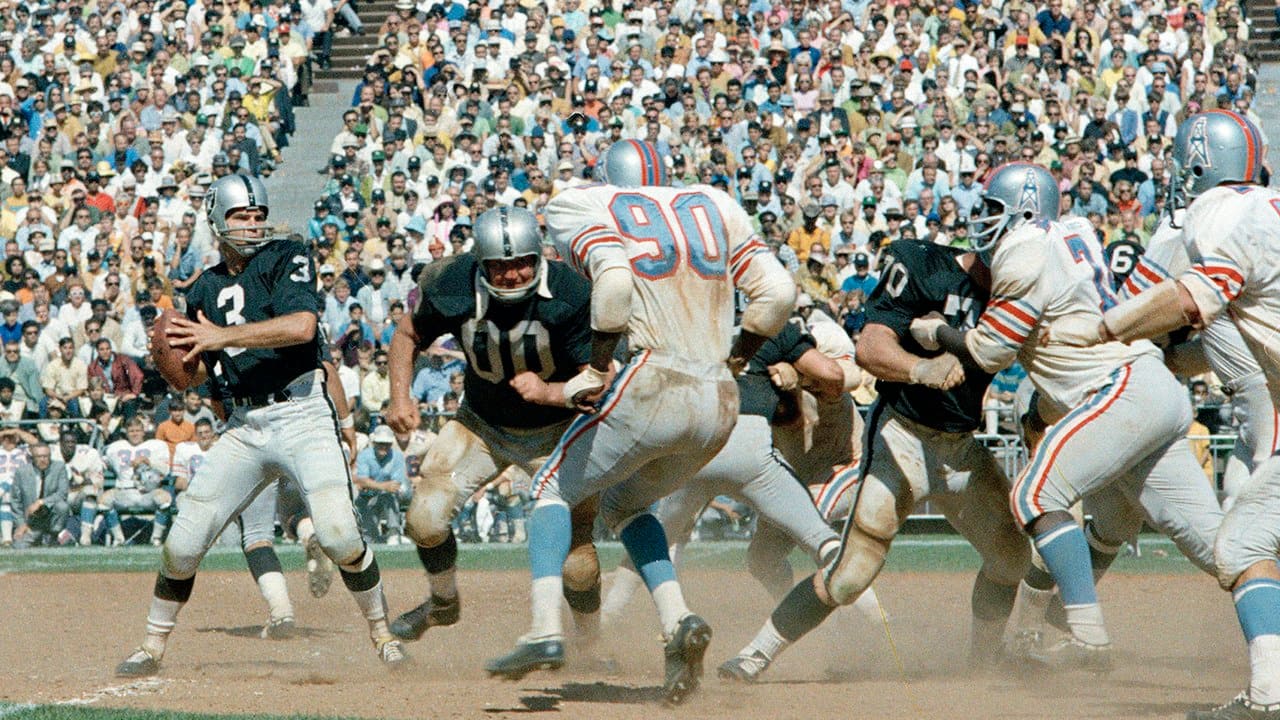
Daryle Lamonica (3) back to pass. Blocking for him
are Jim Otto (00), Dan Archer (78) and Jim Harvey (70).
Note the infield dirt, left over for baseball.

December 31, 1967: The American Football League Championship Game is played at the Oakland-Alameda County Coliseum on this New Year's Eve. The Oakland Raiders hosted the Houston Oilers.

The Oilers had played in the 1st 3 AFL Championship Games, winning in 1960 and 1961, but losing in 1962. Their starting quarterback was George Blanda. Pete Beathard was now the Oilers' quarterback. This would be the Raiders' 1st title game. Blanda was now playing for them.

But while he was their main placekicker, he was not their starting quarterback. That would be Daryle Lamonica, who threw the ball so often, and so far, he became known as "The Mad Bomber." Raider coach John Rauch, having been a quarterback himself, knew he had two good ones. Lamonica would not be elected to the Pro Football Hall of Fame, but Blanda would, along with receiver Fred Biletnikoff, center Jim Otto, guard Gene Upshaw, and cornerback Willie Brown.

The game kicked off at 2:00 Pacific Standard Time (5:00 Eastern), and the temperature was 47 degrees. Just a few minutes earlier, the NFL Championship Game had ended in Green Bay, Wisconsin, and, to those inside Lambeau Field, 47 degrees would have seemed like beach weather in comparison.

The only scoring in the 1st quarter was a 37-yard field goal by Blanda. But the Raiders pulled away in the 2nd quarter, with Hewritt Dixon scoring on a 69-yard run, and Lamonica throwing a 17-yard touchdown pass to Dave Kocourek. It was 17-0 Raiders at the half.

In the 3rd quarter, Lamonica scored on a quarterback sneak, and Blanda kicked a 40-yard field goal. Blanda kicked one from 42 yards, giving the Raiders a 30-0 lead early in the 4th quarter. The Oilers finally scored on a 5-yard touchdown pass from Beathard to Charley Frazier. But the Raiders put it away with another field goal from Blanda, this one 36 yards, and a 12-yard touchdown pass from Lamonica to Bill Miller. The final was Oakland 40, Houston 7.

This was the 1st league championship for Raiders owner Al Davis. There would be more. Moreover, while Oakland had been the much-maligned "little brother" to cosmopolitan San Francisco across the Bay, this game was the beginning of a shift.

The San Francisco Giants had won the National League Pennant in 1962, and just missed Pennants in 1964, '65 and '66. But the Raiders were now AFL Champions, and Oakland had just become home to the NHL's Seals and the ABA's Oaks, and were about to become home to baseball's Athletics. Oakland would soon have 4 teams, to San Francisco's 3 -- and when the San Francisco Warriors moved in 1971, taking the name "Golden State Warriors," taking the place of the Oaks who had moved, Oakland would, briefly, have 4 teams to San Francisco's 2.

From this game until the 49ers' NFC Championship of January 10, 1982, the City of San Francisco had no league champions in any sport, while the City of Oakland had 8: The 1967 AFL Champion Raiders; the 1969 ABA Champion Oaks; the 1972, 1973 and 1974 World Series Champion Athletics; the 1975 NBA Champion Warriors; and the 1976 and 1980 NFL Champion Raiders. And that doesn't even count the Oakland Clippers, earlier in 1967, winning the title in the National Professional Soccer League, which could hardly have been called "major league." But it did happen.

For a few years, sports-wise, Oakland was the place to be. It was a golden age -- or, as A's and Seals owner Charlie Finley might have put it, a Green and Golden Age.

In 1999, The Sporting News released their list of the 100 Greatest Football Players. Jim Otto was ranked 78th, and George Blanda 98th. In 2010, the NFL Network ranked Otto 63rd on its list of the 100 Greatest Players, but Blanda didn't make it.

*

December 31, 1967 was a Sunday. The 1967 NFL Championship Game was played the same day. While the Oakland Coliseum has been known for chilly conditions, there was no issue with the weather there on that day. That would not be the case for the NFL title game: It was well below zero at Lambeau Field in Green Bay, Wisconsin. The Green Bay Packers beat the Dallas Cowboys, 21-17, in a game that became known as the Ice Bowl. I have a separate entry for that event. The Packers went on to beat the Raiders, 33-14 in Super Bowl II, in a much-warmer Orange Bowl in Miami.

There were 2 games played in the NBA. The Los Angeles Lakers beat the expansion San Diego Rockets, 147-118. It was the 1st game the Lakers played at their new arena, The Forum, outside Los Angeles in Inglewood, California.

And the San Francisco Warriors beat the other expansion team, the Seattle SuperSonics, 126-124 at the Seattle Center Coliseum. For the Warriors, Nate Thurmond had 34 points and 25 rebounds.

There was 1 game played in the American Basketball Association, which was in its 1st season: The Pittsburgh Pipers beat the Indiana Pacers, 121-106 at the Civic Arena in Pittsburgh. The Pipers would go on to win the 1st ABA Championship. But before the 1972-73 season, they were out of business. The Pacers would win the ABA title in 1970, '72 and '73, and were 1 of the 4 teams absorbed from the ABA into the NBA in 1976.

There were 4 games played in the NHL that day:

* The New York Rangers beat the Toronto Maple Leafs, 4-0, in one of the last events at the old Madison Square Garden.

* The Philadelphia Flyers beat the Los Angeles Kings, 9-1 at The Spectrum in Philadelphia.

* The Detroit Red Wings beat the Boston Bruins, 6-4 at the Olympia Stadium in Detroit.

* The Chicago Blackhawks beat the Oakland Seals, 3-0 at the Chicago Stadium.

* The Montreal Canadiens, the Pittsburgh Penguins, the St. Louis Blues and the Minnesota North Stars were not scheduled. 

December 31, 1967: The Ice Bowl

Lambeau Field as it appeared in 1967.
Note the shadow cast by the scoreboard
at the south end. This will matter later on.

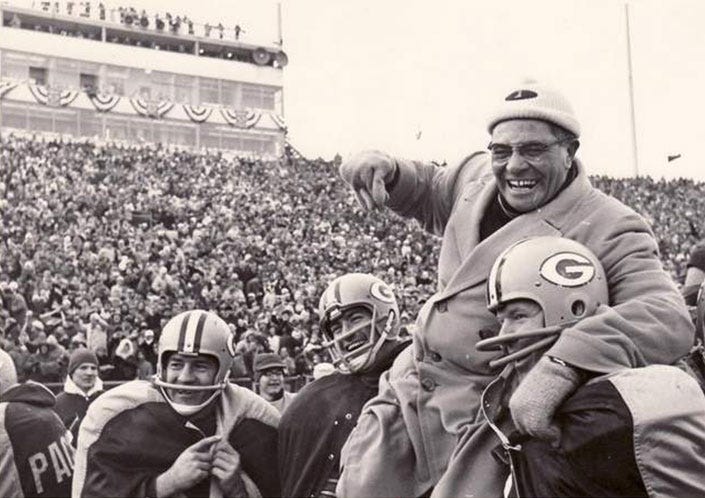
December 31, 1967: As the narrator for a 1987 NFL Films production put it, "On a day savage enough to make a Saint Bernard whimper, they played the 1967 NFL Championship Game." Or, as it has become known in football lore, The Ice Bowl.

I don't know who the narrator was -- the Internet has failed me in this regard -- but the film was made in 1987, so it wasn't John Facenda, the voice of NFL Films from 1966 until his death in 1984. Let the record show that Facenda never actually spoke the words "the frozen tundra of Lambeau Field." ESPN's Chris Berman, imitating Facenda, made that up.

The Ice Bowl isn't even the coldest game in NFL history anymore. The 1981 AFC Championship Game, played at Riverfront Stadium in Cincinnati on January 10, 1982, was 9 degrees below zero without the wind chill factor, and 37 below with it. The San Diego Chargers, used to warm weather, had played one of the hottest games in NFL history just 8 days earlier, against the Miami Dolphins at the Orange Bowl, and were totally unused to this kind of cold. The Bengals won, 27-7. This one is known as the Freezer Bowl.

Many NFL Championship Games, nearly all played in December to that point, had been plagued by cold weather. Vince Lombardi had been born and raised in Brooklyn, and had coached the Green Bay Packers since 1959, so he could handle cold weather.

But from having coached in the title games of 1956, 1958 (these 2 as an assistant coach with the New York Giants), 1961, 1962 and 1965, he knew that cold weather could be a problem for football. Fortunately, since the Packers' unusual ownership structure, and his role as both head coach and general manager, left him a virtual dictator, he had the field torn up, and heating coils placed under the field. When resodded, the idea was that the coils would keep the field from freezing. It became known as "Lombardi's Electric Blanket."

Lombardi had been offensive coordinator to Giants head coach Jim Lee Howell. The defensive coordinator was Tom Landry, who became the 1st head coach of the Dallas Cowboys, the team the Packers had defeated to win the 1966 NFL Championship, and whom they would have to beat again to win for 1967. Lombardi and Landry were opposites: Landry was a great stone face, never showing emotion during the game; while Lombardi was, in the words of his Hall of Fame guard Jerry Kramer, "a raving Italian lunatic!"

But the teams were the other way around: The Cowboys -- not yet the dominant team that they would become -- were braggarts, having earned very little right to do so thus far; while the Packers let their performance do the talking for them. The exception was Hall of Fame running back Paul Hornung, but he was retired by this point. The Packers were going for their 5th NFL Championship in 7 years, which included ending the previous season by winning "The AFL-NFL World Championship Game," retroactively named "Super Bowl I."

The day before the game, NFL Commissioner Pete Rozelle made some phone calls, and was told that the game-time temperature would be about 5 degrees above zero. (All temperatures mentioned in this post will be in degrees Fahrenheit.)

Rozelle didn't like that, and began to consider postponing the game to the next day, Monday, New Year's Day 1968, despite the fact that it would compete for TV ratings with the college bowl games. But he was told that the oncoming cold front would make it even colder on Monday. So, already in Green Bay, he called Lombardi at his house, and Landry at his hotel, and told them the game would go on as scheduled.

But the cold front arrived sooner, and was worse than expected. As Cowboy receiver Rentzel reported, he was told that it was 15 degrees below zero. The official NFL Films record of the game shows a rotating bank clock backing that up, reading "-15°."
I couldn't find a photo online.
I had to photograph it off my computer screen.
Yes, that's me and my phone in the reflection.

When Lombardi got to Lambeau Field, he discovered that it was so cold (This was before comedians began doing things like, "How cold was it?"), the mechanism for the heating coils broke. With the machine inoperable, the field was frozen. To make matters worse, when the tarp was taken off the field, it had left moisture on it, which froze. The field was an ice rink.

At the time, Lambeau Field held 50,861 people. That was the official attendance: In spite of the cold, there was not an empty seat in the house -- until an elderly spectator died from exposure. Yes, only one fan died from the cold. Among those in attendance was a 12-year-old boy from Appleton, Wisconsin, who went on to become a renowned actor: Willem Dafoe. In 2017, NFL Films released a 50th Anniversary documentary on the Ice Bowl, with Dafoe narrating. 

The marching band of the University of Wisconsin-La Crosse was scheduled to perform the pregame and halftime shows. But during -- pardon the choice of words -- the warmups, the spit inside their woodwind instruments froze, rendering them impossible to play. The mouthpieces of brass instruments stuck to their players' lips. Seven members of the band were taken to the hospital for hypothermia.

The officials' whistles also had the spit freeze inside, and, during the pregame midfield meeting with the team captains, they said that play would be stopped by the officials putting their hands on the backs of players who, due to concentrating on the ballcarrier, couldn't otherwise see that play had stopped.

Frank Gifford, the Hall of Fame running back for the Giants who was serving as one of the CBS announcers for the game, said, on the air, "I'm going to take a bite of my coffee."
The game was played anyway. When it kicked off at 1:00 PM Central Standard Time -- 2:00 Eastern -- it was 13 below, with a wind-chill factor, on the since-changed current scale, of -36.
Note the ticket price: $10. That's about $83 in 2022 money.
For the Championship Game. Today, a regular-season game
would almost certainly cost you much more.

The game did affect the Cowboys more than the Packers. The film shows Hall of Fame linebacker Ray Nitschke running onto the field in short sleeves, with no gloves. He was from Chicago. He could handle it. But Meredith's face froze, to the point where he couldn't make his words understood in the huddle unless he pressed on his cheeks. Bob Hayes, the Olympic sprinting champion who'd hauled in so many of Meredith's passes, had to run with his hands tucked in a hole cut in his jersey.

The Packers opened the game with a 9-minute drive that ended with a touchdown pass from Bart Starr to Boyd Dowler. Starr connected with Dowler again in the 2nd quarter, giving the Packers a 14-0 lead. It would then have been very easy to guess that the Texas-based team were done in by the cold, and were finished.

They weren't. They showed a tremendous amount of courage, and came back. They didn't get a single 1st down in the 2nd quarter, but fumbles by Starr and of a punt return by Wood led to Cowboy scores, making it 14-10 Green Bay at the half.

In the 3rd quarter, the Packers stopped a Cowboy drive with a fumble, and ended another that resulted in a missed field goal by Danny Villanueva. At the start of the 4th quarter, Landry gambled, and called an option pass for Dan Reeves -- later to coach the Denver Broncos, the Giants and the Atlanta Falcons -- to Rentzel. It went for 50 yards and a touchdown.

Despite seemingly everything going against them, the Cowboys led 17-14. The Packers' Don Chandler missed a field goal, and it looked like the Packers would be dethroned.

With 4 minutes and 50 seconds left, the Packers took over on their own 32-yard line. Since the goalposts would be on the goal line until the 1974 season, but Chandler had already missed a 40-yard attempt, this meant that they probably needed to get the ball to the Dallas 30-yard line for a field goal -- but that would only have tied it, and sent this already-miserable experience to overtime.

Starr advanced the Packers with short passes to Dowler and Donny Anderson. But a hit knocked Dowler down, and his head hit the frozen turf. Even with the protection of a football helmet, he was knocked unconscious. As with the Super Bowl nearly a year earlier, Max McGee came in to replace him. Unlike that Super Bowl, McGee would not turn out to be the hero this time.

Lombardi's most famous play was the "power sweep": Both guards, Kramer and Fred "Fuzzy" Thurston, would pull out of the line at the snap, and run in the same direction (either left or right), and Starr would pitch to a running back, who would then run behind the guards. This had worked so many times with Hornung and Jim Taylor, and now with Anderson and Elijah Pitts.

This time, Lombardi had a trick up his sleeve, a play known in the Packer playbook as "54-Give." He called it the "sucker play": It was a fake power sweep, with Gale Gillingham, having replaced Thurston, pulling to the right. This caught the attention of the Cowboys' Hall of Fame defensive tackle, Bob Lilly, and he followed. This left a hole up the middle, and running back Chuck Mercein got to the 3-yard line.

The Packers then needed to get to the 1-yard line for a 1st down, and did. Some of the Cowboys thought Anderson had scored. Had there been a rule at the time, allowing a coach to challenge a call via instant replay, what happened next might not have happened, and Anderson would have been the big hero of the game. But the officials didn't see the ball cross the plane of the goal line, and so it was 1st and goal on the 1.

It was getting late. Lambeau Field did have lights, so darkness was not going to be an issue. But a lack of sunlight was. To make matters worse, the action was now at the south end of the field, where the shadow of the scoreboard loomed, making it even colder. I've seen sources say that, with the wind chill factor (on the old scale), it was as low as 48, or even 55, degrees below zero.

There was less than a minute left. On 1st down, Starr handed off to Anderson, but he slipped on the icy field. On 2nd down, Anderson slipped even before Starr could get the ball to him. Now, it was 3rd and goal on the 1. The Packers called their last timeout. There were 16 seconds left.

On the film, Lilly can be shown kicking the field, and he kicks up specks of frost. The Cowboys actually considered getting a drill, and drilling holes in the field, to get a better footing. I don't know if that was legal at the time, or if they would have had time for it, even if they took all their remaining timeouts.

The Packers' dilemma was equally tricky. Run the ball and fail, and they wouldn't be able to stop the clock in time to kick the tying field goal. Pass the ball, and it could fall incomplete, leaving 4th down with the clock stopped with a few seconds left, and you could still kick the field goal -- but it could also be intercepted, as Tom Brown did with Meredith's desperation pass with just under a minute to play, which clinched the Packer victory in the Championship Game the year before, in Dallas. Kick the field goal now, on 3rd down, and Chandler could miss again; and, even if he makes it, the game is still only tied.

Starr wasn't as good a passer as his contemporaries Johnny Unitas, Sonny Jurgensen and Joe Namath, but he was smarter than any of them. He recommended a play called "31-Wedge," telling Lombardi, "Coach, the linemen can get their footing on the wedge, but the backs are slipping. I'm right there. I can just shuffle my feet and lunge in."

At this point, Lombardi, who had famously said, "Fatigue makes cowards of us all," was as cold and as tired as anyone, and was not looking forward to overtime, so he told Starr, "Run it, and let's get the hell out of here!"

Starr called the play. It required guard Kramer and center Ken Bowman to double-team the Cowboys' other tackle, Jethro Pugh. Bowman snapped the ball, Starr took it, lowered his head, and followed the block.

Touchdown. On the film, Mercein can be shown raising his hands. He's not signaling, "Touchdown!" He's showing the referee that he's not illegally helping Starr. To this day, Cowboy fans insist that Kramer was offside. As if the Cowboys wouldn't win a whole slew of games due to cheating and favorable officials' calls in the years to come. Besides, Anderson might have broken the plane of the goal line 3 plays earlier, and the refs missed that.
Starr (15) over the goal line. Mercein (30) with his hands up.
Kramer (64) having blocked Pugh (75).
This is Walter Iooss Jr.'s photo for Sports Illustrated.
The most familiar shot of the touchdown is in black & white,
and I wanted a color photo.

In his 1981 book Pro Football's 10 Greatest Games, in which he included both this game and the previous season's NFL Championship Game between the Packers and the Cowboys, sports historian (usually specializing in baseball) John Thorn wrote, "It is the most famous touchdown in football history."

He published that book before the 1982 Dwight Clark "The Catch," but put Starr's Sneak ahead of the 1958 Alan Ameche overtime score (he included that title game in the book), and the 1974 Clarence Davis "Sea of Hands" catch (he included that game, too), and apparently ahead of the 1972 Franco Harris "Immaculate Reception" (he did not include that game).

Chandler kicked the extra point to make it 21-17. There were still 13 seconds left. The Packers kicked off, and the Cowboys let it go into the end zone. Meredith threw 2 incompletions, and, at 3:44 PM Central Time (4:44 Eastern), the game was over.
How anybody still had any desire to remain outside
long enough to tear down the goalposts, I'll never know.

The Packers went Super Bowl II, in considerably friendlier weather at the Orange Bowl in Miami, and beat the AFL Champion Oakland Raiders, 33-14. Lombardi retired as head coach after that game, but stayed on as general manager. As with the 1964-65 Yankees, the team seemed to get old all at once, and the dynasty collapsed. The team wouldn't reach the title game again for 29 years, winning Super Bowl XXXI in the 1996-97 season.

After the 1968 season, Lombardi accepted Edward Bennett Williams' offer to be head coach and general manager of the Washington Redskins, and began to rebuild them in 1969. But he developed colon cancer -- much more easily treatable now, but fatal then. He died on September 3, 1970, only 57 years old. The Redskins hired George Allen away from the Los Angeles Rams, and reached Super Bowl VII 3 seasons later.

The Cowboys got tagged as a team that "can't win the big one." They reached Super Bowl V, but lost to the Baltimore Colts. Finally, they came to dominate the NFC in the 1970s, reaching 5 Super Bowls, winning Super Bowls VI and XII. They began calling themselves "America's Team." They were featured on TV so much that people joked that CBS stood for "Cowboys Broadcasting System." Landry remained head coach until 1989, and died in 2000.

The Ice Bowl lives on in sports memory. It still gives chills, even to people like me who weren't even born yet. In 2019, a poll ranked this game 3rd on a list of the 100 Greatest Games of the NFL's 1st 100 years.

*

December 31, 1967 was a Sunday. The 1967 AFL Championship Game was played the same day. The Oakland Raiders beat the Houston Oilers, 40-7 at the Oakland Coliseum. While that stadium has been known for chilly conditions, there was no issue with the weather there on that day.

There were 2 games played in the NBA. The Los Angeles Lakers beat the expansion San Diego Rockets, 147-118. It was the 1st game the Lakers played at their new arena, The Forum, outside Los Angeles in Inglewood, California.

And the San Francisco Warriors beat the other expansion team, the Seattle SuperSonics, 126-124 at the Seattle Center Coliseum. For the Warriors, Nate Thurmond had 34 points and 25 rebounds.

There was 1 game played in the American Basketball Association, which was in its 1st season: The Pittsburgh Pipers beat the Indiana Pacers, 121-106 at the Civic Arena in Pittsburgh. The Pipers would go on to win the 1st ABA Championship. But before the 1972-73 season, they were out of business. The Pacers would win the ABA title in 1970, '72 and '73, and were 1 of the 4 teams absorbed from the ABA into the NBA in 1976.

There were 4 games played in the NHL that day:

* The New York Rangers beat the Toronto Maple Leafs, 4-0, in one of the last events at the old Madison Square Garden.

* The Philadelphia Flyers beat the Los Angeles Kings, 9-1 at The Spectrum in Philadelphia.

* The Detroit Red Wings beat the Boston Bruins, 6-4 at the Olympia Stadium in Detroit.

* The Chicago Blackhawks beat the Oakland Seals, 3-0 at the Chicago Stadium.

* The Montreal Canadiens, the Pittsburgh Penguins, the St. Louis Blues and the Minnesota North Stars were not scheduled.

December 31, 1962: The Failure of the American Basketball League

December 31, 1962: The American Basketball League folds, early in its 2nd season.

Since the Basketball Association of America took on some teams of the National Basketball League in 1949, and took on the name of the National Basketball Association, the NBA had been the only major league in the sport. But when Abe Saperstein, founder and owner of the all-black Harlem Globetrotters, was denied a Los Angeles-based expansion team, and Minneapolis Lakers owner Bob Short was allowed to move his team to Los Angeles for the 1960-61 season, Saperstein acted.

Saperstein contacted George Steinbrenner, the Cleveland shipbuilding executive who owned the Cleveland Pipers, champions of the Amateur Athletic Union, and Paul Cohen, who owned the Tuck Tapers of the National Alliance of Basketball Leagues, and they formed the ABL.

Saperstein hired Bill Sharman, a former star for USC and the Boston Celtics, to coach the Los Angeles Jets. Their star player would be Los Angeles native George Yardley, who had starred with the Fort Wayne and Detroit Pistons.

Steinbrenner, only 31 years old when the league began play for the 1961-62 season, was already a man of big ideas and big ambition. He hired John McLendon, formerly the coach at historically-black Tennessee State University, as his head coach. If the ABL was to be considered a "major league," then this made him the 1st black head coach or manager in major league sports. (Unless one wanted to count the NFL in its very 1st season, which was a little premature, and Fritz Pollard coached the 1920 Akron Pros.)

Just as he would later be the 1st team owner in Major League Baseball to embrace free agency, Steinbrenner made a big splash with his 1st big signing for the Pipers: Jerry Lucas, who had led Ohio State to 3 straight NCAA Finals, including the 1960 National Championship. Because he was still in college, Lucas couldn't play for the Pipers in 1961-62. For legal reasons, he wouldn't be able to play in 1962-63, either. But Steinbrenner figured, with Lucas on his team from 1963-64 onward, he could rule the ABL.

The original 8 teams were the Jets, the Pipers, the Washington Tapers, the Pittsburgh Rens (short for "Renaissance"), the Chicago Majors, the Kansas City Steers, the San Francisco Saints, and the Hawaii Chiefs.

Among the players who had already been NBA stars were Yardley in Los Angeles, Connie Dierking in Cleveland, Gene Conley in Washington, and Ken Sears in San Francisco. Bill Spivey had starred at the University of Kentucky, but was caught up in the 1951 college basketball point-shaving scandal. Although acquitted, he was still banned from the NBA, and had played on semipro teams ever since, finishing his career with the Jets.

Among the players who would eventually become NBA stars were Lucas, Dick Barnett and Larry Siegfried in Cleveland; and Connie Hawkins in Pittsburgh. Hawkins had been a star on the playgrounds of New York City and at the University of Iowa, but had been banned from the NBA for his connection to a gambler. He would star in the American Basketball Association, before his NBA ban was finally lifted.

The Pipers won the 1962 ABL title, beating the Steers, 3 games to 2. George Steinbrenner had his 1st sports championship. Cleveland would not win another title in pro basketball for 54 years.

Various moves, in both leagues, doomed the ABL. Saperstein's founding franchise, the Los Angeles Jets, folded before the 1st season even ended. The Philadelphia Warriors moved to San Francisco, so the Saints moved across the Bay, taking on the name of a defunct minor-league baseball team, the Oakland Oaks. The Tapers moved to Philadelphia, to fill this void. Traveling to Hawaii was cost-prohibitive for most teams, so the Chiefs took the Jets' place in the L.A. market, becoming the Long Beach Chiefs.

But even as a 6-team league, the ABL couldn't compete. The Chiefs still had to compete for attention with the Los Angeles Lakers, and the Lakers won. The Oaks still had to compete for attention with the San Francisco Warriors, and the Warriors won.

And the Majors had to compete for attention with the NBA's Chicago Zephyrs, and both ended losing: The Majors folded, and the Zephyrs moved for the 1963-64 season, becoming the Baltimore Bullets. They became the Washington Bullets in 1973, and the Washington Wizards in 1997.

Finally, a rumor spread that the NBA's Syracuse Nationals were going to move to Philadelphia for the 1963-64 season. The rumor was true: They became the Philadelphia 76ers. So the Tapers were doomed.

And so, with no team in the New York market, and their teams in the other big markets failing, the ABL folded on New Year's Eve 1962. The Kansas City Steers were in 1st place at the time, and were declared league Champions. Kansas City has never won another pro basketball title.

After the folding, it came out that Steinbrenner had a secret deal with NBA Commissioner Maurice Podoloff: The Cleveland Pipers would merge with the Kansas City Steers and join the NBA, with Lucas staying in Ohio, in Cleveland, and boosting the NBA's attendance. A schedule was printed for the 1963–64 NBA season with the Pipers playing the New York Knicks in the 1rst game.

The gambit worked, but the ABL sued to block the move, and as a result, Steinbrenner had a team, but no league to put it in. Instead of returning to the ABL, Steinbrenner folded the team. This was the 1st move of his as a sports team owner that backfired. It wouldn't be the last.

The ABL did have a legacy, though. It was the 1st basketball league to have a three-point field goal. The ABA would use it for its entire existence, 1967 to 1976, and the NBA adopted it in 1979. It also had a 30-second shot clock, compared to the NBA's 24-second clock; and a free throw lane of 18 feet, compared to the 12 feet then used in the NBA.

Jerry Lucas would stay in Ohio, but with the Cincinnati Royals, where he would play alongside fellow future Hall-of-Famers Oscar Robertson and Jack Twyman. Dick Barnett would help the New York Knicks win the 1970 and 1973 NBA Championships. In 1973, those Knicks would also have Lucas, and beat a Lakers team coached by Bill Sharman, which won the title the year before. Connie Hawkins would lead the Pittsburgh Pipers to the 1st ABA title in 1968, then star in the NBA with the Phoenix Suns and the Lakers.

Saperstein, Sharman, Lucas and Hawkins would all be elected to the Basketball Hall of Fame -- albeit, in each case, for reasons other than what they did in the ABL.

*

December 31, 1962 was a Monday. Baseball was out of season. No NBA games were scheduled. The NFL Championship Game was played the day before, and the Green Bay Packers beat the New York Giants, 16-7 at Yankee Stadium. There was 1 NHL game played: The New York Rangers and the Detroit Red Wings played to a tie, 1-1 at the Olympia Stadium in Detroit.

There was also a college football bowl game played: West Texas State beat Ohio University, 15-14 in the Sun Bowl, in the stadium of the same name in El Paso, Texas.

December 31, 1961: Those Who Stayed Were Champions

December 31, 1961: The NFL Championship Game is played at the 2nd City Stadium in Green Bay, Wisconsin. In 1965, it will be renamed Lambeau Field.

In spite of the previous success of the Green Bay Packers, this is the 1st time the game is played in Green Bay. The previous City Stadium had never hosted it. The Packers had finished 1st in the NFL in 1929, 1930 and 1931; and 2nd behind a team that would have been in the Eastern Division in 1927. But there was no NFL Championship Game for them to host, or for which to be the visiting team, until 1933.

Once that was established, the way the old system worked out, the Championship Game was hosted by the Eastern Division winners in even-numbered years, and the Western Division winners in odd-numbered years. The Packers won the West in 1936, 1938, 1944 and 1960, and played the Championship Game on the road. Their only previous time hosting was in 1939, and with a seating capacity of just 25,000, City Stadium was considered too small, so they moved it to Wisconsin State Fair Park in the Milwaukee suburb of West Allis. They won, beating the New York Giants, 27-0.

In 1956, the NFL gave the Packers an ultimatum: Build a bigger stadium, or move. They built what became Lambeau Field in 1957, and seating capacity was 32,500. By 1961, it was 38,669. (By the time of the 1967 title game, the Ice Bowl, it was 50,861. It reached 56,263 in 1970, 60,890 in 1990, 72,515 in 2003, and 81,441 by 2013.) Now, all they had to do was qualify for the title game, by winning the Western Division.

The 1961 season was also the one in which the teams involved adopted their familiar helmet logos: The Packers, football-shaped "G" monogram, for Green Bay (they've never used a "GB," although Lombardi had practice caps made with such a logo); the Giants, the lower-case "ny," for "New York."

The Giants won the NFL Championship in 1956, with head coach Jim Lee Howell. What we would now call his offensive coordinator was Vince Lombardi, and his defensive coordinator was Tom Landry. Lombardi left to become the head coach of the Packers in 1959. Landry left to become the head coach of the expansion Dallas Cowboys in 1960. It would take them a few years to get their act together.

Meanwhile, the Giants again reached the Championship Game in 1958 and 1959, losing to the Baltimore Colts both times. In 1961, Allie Sherman replaced Howell as Giants head coach, and Y.A. Tittle replaced Charley Conerly as quarterback. But running back Frank Gifford came out of retirement, and Sam Huff still led the best defense in the NFL.

The Giants lost their opener, home to the St. Louis Cardinals, then won 5 straight -- the 1st 4 on the road, as the New York Yankees kept using Yankee Stadium all the way to the World Series -- then lost at home to the Dallas Cowboys, won 4 straight, lost to the Packers in Green Bay, beat the defending Champion Philadelphia Eagles away, and finished with a home tie with the Cleveland Browns. At 10-3-1, they won the Eastern Division.

Back to Lombardi: When he arrived, the Packers were coming off a 1-10-1 season. He told his players, "We may not win, but we won't be losing with the same people." With that in mind, he cut the man then regarded as the team's best player, end Billy Howton, because he didn't think Howton was serious enough.

But he kept the actual best player, Paul Hornung: While Hornung was the life of the party off the field, he was completely dedicated on it. And that summed up what Lombardi meant when he gave the Packers their slogan: "Those who stay will be champions."

Sure enough, in just 1 season, having gotten rid of the unserious, and having promoted the dedicated, he took the Packers to to 7-5. In 1960, they went 8-4, and won the Western Division, but lost the NFL Championship Game to the Philadelphia Eagles. It would be the only postseason game Lombardi ever lost.

In 1961, they lost their opener to the Detroit Lions in Milwaukee, then won 6 straight, lost to away to the Baltimore Colts, won their next 4, lost away to the San Francisco 49ers, and closed with a win away to the Los Angeles Rams, finishing 11-3.

With Bart Starr quarterbacking an offense with Hornung and Jim Taylor running, Boyd Dowler receiving, and one of the great offensive lines of all time, including Hall-of-Famers Jim Ringo at center, Jerry Kramer at guard and Forrest Gregg at tackle -- Lombardi called Gregg "the finest player I ever coached," and he later coached the Cincinnati Bengals into their 1st Super Bowl -- the Pack dropped 49 points on the Browns, 45 on the Colts, and 35 on the Rams.

The defense was fearsome, with end Willie Davis, tackle Henry Jordan, linebacker Ray Nitschke, cornerback Herb Adderley, and safeties Willie Wood, and former Giant Emlen Tunnell all going to the Hall of Fame. They shut out the Chicago Bears, held the Colts and the Minnesota Vikings to just 7 points each, held the Lions to 9 in their rematch, and held the 49ers in their earlier win and the Vikings in their other game to 10.

This was the 1st title game played in Green Bay, which would become famous for its cold weather, especially after the 1967 NFL Championship Game, which became known as the Ice Bowl. Green Bay wasn't the furthest-north city in the NFL anymore -- the expansion Vikings now were -- but they were further north than 2 of the Canadian Football League's 9 teams, the Toronto Argonauts and the Hamilton Tiger-Cats.

For the 3rd time, the Giants faced a frozen field for an NFL Championship Game. For the 3rd time, they decided to try sneakers rather than cleats, to get better traction. (This would eventually be outlawed.) In 1934 and 1956, both times against the Bears, it worked. This time, it didn't.

The game kicked off at 1:00 PM Central Time (2:00 Eastern). The 1st quarter ended with the game scoreless, and that would be the highlight of the day for the Giants. It was all Packers: Hornung scored on a 6-yard run, Starr threw a 13-yard pass to Dowler, Starr threw a 14-yard pass to Ron Kramer, and Hornung kicked a 17-yard field goal -- all in the 2nd quarter. Green Bay led, 24-0.

In the 3rd quarter, Hornung kicked a 22-yard field goal, and Starr threw a 13-yard touchdown pass to Kramer. Hornung added a 19-yard field goal. Meanwhile, the Packer defense completely shut Big Blue down. Packers 37, Giants 0. It was only the 5th shutout in an NFL Championship Game -- and, after 4 more NFL Championship Games and 56 Super Bowls, it remains the last. (The 1939 game was also a Packer shutout of the Giants, 27-0.

The Packers beat the Giants again in the 1962 NFL Championship Game, 16-7 at Yankee Stadium. The Giants made one more Championship Game in 1963, losing to the Chicago Bears, then collapsed, not reaching the Playoffs again until 1981.

The Packers fell short in 1963 and 1964, then became the only team ever to win 3 straight NFL Championship Games: 1965, 1966 and 1967. This included the 1st 2 Super Bowls, before Lombardi retired. After coaching the Washington Redskins to a big improvement in 1969, Lombardi developed colon cancer, and died the next year.

Nevertheless, he was right about his Packers: In 7 seasons, 5 times, those who stayed were champions.

UPDATE: The Packers have the largest team Hall of Fame in North American sports. Through the 2025 NFL season, the inductees from the Lombardi Era, 1959 to 1968, are:

* Offense: Quarterbacks Bart Starr and Zeke Bratkowski; running backs Paul Hornung, Jim Taylor, Elijah Pitts, Donny Anderson and Travis Williams; wide receivers Gary Knafelc, Ron Kramer, Max McGee and Boyd Dowler; tight ends Marv Fleming and Carroll Dale; centeres Jim Ringo and Ken Bowman; guards Jerry Kramer, Fred "Fuzzy" Thurston and Gale Gillingham; tackles Forrest Gregg, and Bob Skoronski; and kicker-punter Don Chandler.

* Defense: Ends Willie Davis, Dave Hanner and Lionel Aldridge; tackles Henry Jordan and Ron Kostelnik; linebackers Ray Nitschke, Bill Forester, Dan Currie, Dave Robinson and Lee Roy Caffey; cornerbacks Herb Adderley and Jesse Whittenton; and safeties Willie Wood and Bob Jeter.

* Management: Head coach and general manager Vince Lombardi, assistant coaches Red Cochran and Phil Bengtson; scout Jack Vainisi; longtime executives Fred Leicht, Frederick Trowbridge, Jerry Atkinson, Dominic Olejniczak and Tom Miller; trainer Bud Jorgensen and team physician E.S. Brusky; team historian Lee Remmel; team photographer Vernon Biever; band director Wilner Burke; video director Al Treml; broadcaster Ray Scott; journalist Art Daley; the Hall of Fame's founder, William Brault; and longtime Packer fan Al Schneider.

Lombardi, Starr, Hornung, Taylor, Kramer, Thurston, Davis and Nitschke have also been inducted into the Wisconsin Athletic Hall of Fame.

After Lombardi left, it would be a long time before there was another title. Elected to the Packers Hall of Fame from the 1970s: Linebacker Fred Carr, cornerbacks Ken Ellis and Willie Buchanon, running back John Brockington, and placekicker Chester Marcol.

Elected from the 1980s: Quarterbacks Lynn Dickey and Don Majkowski; running back Gerry Ellis; receivers James Lofton and Sterling Sharpe; tight end Paul Coffman; center Larry McCarren; tackle Greg Koch; defensive end Ezra Johnson; linebackers Mike Douglass, John Anderson, Tim Harris and Johnny Holland; cornerback Mark Lee; safeties Johnny Gray and Mark Murphy (not to be confused with the Mark Murphy who was Packer team president from 2007 to 2025); placekicker Jan Stenerud; and executive Robert Parins.

*

December 31, 1961 was a Sunday. The AFL Championship had been played a week earlier, with the Houston Oilers beating the San Diego Chargers, 10-3 at Balboa Stadium in San Diego. There had been 2 college bowl games the day before the NFL Championship Game, and the 4 major bowls were played the next day, New Year's Day. This included the Sugar Bowl, at Tulane Stadium in New Orleans, in which Number 1-ranked Alabama clinched the National Championship, beating Arkansas, 10-3.

Baseball was out of season. The NBA scheduled no games for the day. The NHL scheduled 2. The New York Rangers lost to the Boston Bruins, 7-4 at the old Madison Square Garden. And the Detroit Red Wings beat the Toronto Maple Leafs, 4-2 at the Olympia Stadium in Detroit. The Montreal Canadiens and the Chicago Black Hawks were not scheduled.

December 31, 1940: The Nazi Plot to Hijack the Election

William Rhodes Davis

December 31, 1940: A Nazi plot to hijack the recent Presidential election is revealed. It had failed, of course.

As the calendar year began, it was believed by most people that President Franklin D. Roosevelt would respect the 2-term limit on the Presidency -- which, until the ratification of the 22nd Amendment to the Constitution, in 1951, was unofficial. The Nazis concluded that if Roosevelt could be replaced by someone not willing to intervene in the Nazis' takeover of Europe, the prospects of U.S. involvement in the European phase of World War II would be greatly reduced, and possibly eliminated.

So they found a sympathetic, well-connected American. William Rhodes Davis was an oilman with a sketchy business past who, in the late 1930s, made a fortune by selling cut-rate Mexican oil to the German government. Davis had cultivated connections inside the Democratic Party, making a big donation to its 1936 election efforts.

But when The War began, the British imposed a blockade on German ports, interfering with Davis' ability to make money from dealing with Germany. He believed that the only way to save his business was by personally making peace in Europe, by negotiating a deal between the warring parties himself. Davis approached the White House with his plan for peace. FDR turned him down.

Davis then traveled to Germany, met with leaders of the Third Reich, including Hermann Göring, President of the Reichstag -- in effect, Germany's equivalent of the Speaker of the U.S. House of Representatives -- and returned with the vague outlines of a deal that would have given Germany territorial gains in exchange for Roosevelt mediating a peace treaty. Roosevelt refused to even meet with Davis upon his return, worried that he might be compromised and acting as a Nazi agent.

As it turned out, FDR was absolutely right about that. Davis had talked to Göring about the possibility of a non-interventionist winning the 1940 election. He even had, he thought, the perfect candidate in mind: John L. Lewis, the head of the Congress of Industrial Organizations (CIO), and the President of the United Mine Workers. Widely popular among America's working people, he was nonetheless opposed to many of FDR's New Deal reforms, and was a non-interventionist. Of course, being the leader of a labor union, and aside from his New Deal opposition a leftist, he would have been considered unacceptable to German Chancellor Adolf Hitler himself, as anything other than a temporary tool to achieve Hitler's aims.

Göring gathered $5 million -- about $104 million in 2022 money, which would have bought quite a bit of newspaper and magazine advertising space, and radio airtime -- to support the plan, and had it stashed at the German embassy in Washington D.C. for Davis' use.

But both major parties put a stop to the plan. FDR ran for a 3rd term anyway, and was easily renominated. And the Republicans nominated an interventionist, Wendell Willkie. The Nazi money did Lewis no good: He paid for a national radio address by Lewis on Labor Day, September 2, denouncing Roosevelt. The President was re-elected on November 5, anyway, with an electoral landslide, although the popular vote was the closest of what turned out to be his 4 runs.

In December 1940, Verne Marshall, head of the No Foreign War Committee, claimed that Davis, upon returning from a trip to Germany in 1939, presented the State Department with a peace plan representing Göring's views, and called for President Roosevelt to serve as mediator between the warring nations. Marshall criticized FDR for failing to take advantage of the opportunity, but most viewed the plan as an attempt to impose a "German peace." The German government, of course, denied any knowledge of such a plan.

On December 31, 1940, in reaction to Davis's role in forming and financing the No Foreign Wars Committee, U.S. Senator Joshua B. Lee, Democrat of Oklahoma, said, "The record of this man Davis shows conclusively the great financial stake he has in a complete Nazi victory in the European war. Much of the gasoline sending showers of fiery death into the defenseless heart of London was sold to the German government by this man Davis."

On January 7, 1941, Davis was subpoenaed to testify before a grand jury in Washington, D.C., investigating campaign expenditures for violations of the Hatch Act and the Corrupt Practices Act during the 1940 Presidential campaign. The same day, Senator Burton K. Wheeler, Democrat of Montana, a non-interventionist, scheduled Davis to testify before the Senate Interstate Commerce Subcommittee about the "peace place" described by Marshall.

Davis died of a heart attack in Houston on August 1, 1941. The traitor was 52 years old. In 1946, O. John Rogge, an official in the U.S. Department of Justice, issued a report on Davis' activities, proving his guilt beyond a reasonable doubt. The report ended up being buried until 1961.

Davis' grandson, Joseph Graham Davis Jr., a.k.a. Gray Davis, served as Governor of California from 1999 to 2003 -- as a Democrat. His loyalty to America has never been seriously questioned.

*

December 31, 1940 was a Tuesday. Baseball was out of season. The NBA hadn't been founded yet. There were 2 games played in the NHL. The New York Rangers and the Boston Bruins played to a 2-2 tie at the Boston Garden. And the New York Americans beat the Montreal Canadiens, 4-2 at the old Madison Square Garden.

The next day, New Year's Day 1941, Stanford beat Nebraska in the Rose Bowl, Boston College beat Tennessee in the Sugar Bowl, Texas A&M beat Fordham in the Cotton Bowl, Mississippi State beat Georgetown in the Orange Bowl, and Western Reserve beat Arizona State in the Sun Bowl. 

December 31, 1999 & January 1, 2000: The Millennium

December 31, 1999:  The Millennium arrives. The people of planet Earth survived. At a terrible cost. But we hadn't destroyed ourselves. ...