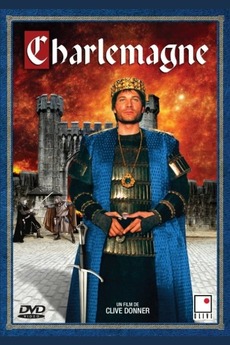
February 28, 1993: The miniseries Charlemagne, le Prince à Cheval (meaning, "Charles the Great, the Prince on Horseback") premieres on French TV network France 2. French actor Christian Brendel plays the man who, for all intents and purposes, created France.
Based primarily on an intimate contemporary biography written by the courtier Einhard, it consists of 3 episodes, and covers the period from the death of Charlemagne's father, Pepin the Short, on September 24, AD 768 to his coronation as the first Holy Roman Emperor on Christmas Day, December 25, 800.
The film includes Charlemagne's victories over the Saxons in Germany, but there is a minor anachronism, regarding Saxon leader Widukind's surrender and conversion to Christianity, which in reality did not occur until AD 807 or 808.
In real life: He was born on April 2, 748. Where is unknown, but it is believed to have been somewhere in present-day France. His father was Pepin the Short, himself the son of Charles Martel, "The Hammer," who had defeated Muslim forces at the Battle of Poitiers in 732, ensuring that Muslim control of Western Europe would be limited, for a few more centuries, to the Iberian Peninsula, in other words Spain and Portugal.
Martel's titles were Duke and Prince of the Franks, and Mayor of the Palace. The Franks were Germanic peoples that invaded the Western Roman Empire in the 5th century, conquering France when most of it was known as Roman Gaul, and the Visigothic Kingdom in what is now southern France by 507.
In 768, Pepin died, leaving his kingdom to 2 of his sons, Charles and Carloman. Despite feuding over Carloman's refusal to support his older brother in putting down a rebellion in Aquitaine, in southwestern France, Carloman's death in 771, only 20 years old, is believed to have been due to natural causes.
This made Charles ruler of present-day France, Belgium, the Netherlands, Luxembourg, most of Germany, Austria, and the northern half of Italy, as he also held the title of King of the Lombards (Lombardy is a northern province, including Milan.) Eventually, he conquered what would become Czechoslovakia, and parts of Hungary and Romania.

As a result, he became known as Charles the Great -- in Latin, Carolus Magnus; in German, Karl der Große; and, in French, Charles le Magne, or "Charlemagne." On Christmas Day, December 25, 800, indebted to him for his troops saving his life, Pope Leo III created the Holy Roman Empire, and crowned Charlemagne as its Emperor at St. Peter's Basilica in Rome. (As a modern joke goes, it wasn't an empire, it wasn't Roman, and it certainly wasn't holy.)
This empire, retroactively known to Germans as the First Reich, never had a single, permanent capital city. Instead, rulers held shifting imperial seats and traveled with their courts. Charlemagne favored Aachen, now in western Germany near the borders of France and Belgium, building his palace complex and Palatine chapel, now known as Aachen Cathedral. By 1745, the House of Habsburg held control, and placed their capital in Vienna, Austria.
Contrary to the Middle Ages' reputation as "the Dark Ages," contacts with the wider Mediterranean world through Spain and Italy, the influx of foreign scholars at court, and the relative stability and length of Charlemagne's reign led to a cultural revival known as the Carolingian Renaissance.
He took an active and direct role in shaping intellectual life which led to the revival's zenith. He promoted learning as a matter of policy and direct patronage, with the aim of creating a more effective clergy. Latin was standardized as the empire's language, and its use was brought into territories well beyond the former Roman Empire, forming a second language community of speakers and writers and sustaining Latin creativity in the Middle Ages. Carolingian authors produced extensive works, including legal treatises, histories, poetry, and religious texts.

Charlemagne died on January 28, 814, about 66 years old. Although he had established the Carolingian dynasty, it began to break up after his death, much like the empire of Alexander the Great, 1,100 years earlier. Unlike Alexander's, Charlemagne's empire broke up among his sons. On August 10, 843, the Treaty of Verdun divided it among his sons Lothar I of West Francia, Louis II of Middle Francia, and Charles II of East Francia. By 987, Hugh Capet had founded the Capetian dynasty, and this is considered to be when France was united -- although infighting and the interference of England meant that it wasn't truly united until the 15th Century.
According to historian Jennifer Davis, Charlemagne "invented medieval rulership," and his influence can be seen at least into the 19th Century. He is often known as "the father of Europe" because of the influence of his reign and the legacy he left across the large area of the continent.
Just as it has been suggested that every person of Asian descent alive today is a descendant of Genghis Khan, it has also been suggested that every person of European descent alive today is a descendant of Charlemagne -- which means that there are people who are descendants of both conquerors.
Indeed, later monarchs of France and German considered him to be an ancestor, and he is included as "Charles I" (Charles the First) on the list of each monarchy. Frederick Barbarossa (meaning "Redbearded") in late 12th Century Germany and Napoleon Bonaparte in early 19th Century France both looked to him as a role model.
And yet, in a 2025 episode of Epic Rap Battles of History, "Epic" Lloyd Ahlquist played Charlemagne, against a later French warlord-turned-emperor, Napoleon Bonaparte, played by "Nice" Peter Shukoff. Lloyd had previously played Napoleon, against Peter as film character Napoleon Dynamite.
*
February 28, 1993 was a Sunday. Baseball and football were out of season. There were 8 games in the NBA:
* The New Jersey Nets beat their arch-rivals, the New York Knicks, 102-76 at the Brendan Byrne Arena at the Meadowlands. This was the nationally-televised (NBC) game in which the Knicks John Starks "clotheslined" the Nets' Kenny Anderson, sending him crashing to the court, breaking his wrist and knocking him out for the season. After the season, the Nets' Dražen Petrović was killed in a car crash. That didn't quite end the Nets' renaissance, as they made the Playoffs the next season, but it did cut it short.
* The Boston Celtics beat the Portland Trail Blazers, 122-110 at the Boston Garden.
* The San Antonio Spurs beat the Orlando Magic, 94-90 at the Orlando Arena.
* The Miami Heat beat the Minnesota Timberwolves, 105-93 at the Miami Arena.
* The Indiana Pacers beat the Dallas Mavericks, 110-96 at the Market Square Arena in Indianapolis. Reggie Miller scored 31 points.
* The Denver Nuggets beat the Charlotte Hornets, 110-103 at the McNichols Arena in Denver.
* The Cleveland Cavaliers beat the Phoenix Suns, 101-94 at the America West Arena (now the Mortgage Matchup Arena) in Phoenix.
* And the Los Angeles Lakers beat the Los Angeles Clippers, 124-112 at The Forum outside Los Angeles in Inglewood, California.
And there were 7 games in the NHL:
* The New York Islanders beat the Hartford Whalers, 7-6 at the Hartford Civic Center (now the PeoplesBank Arena). Pierre Turgeon scored the winning goal, with 2:21 left in overtime. Turgeon had 2 goals and 2 assists. Pat Verbeek scored 3 goals.
* The New Jersey Devils beat the Detroit Red Wings, 6-3 at the Brendan Byrne Arena at the Meadowlands. Yes, the arena held an NBA game and an NHL game on the same day.
* The Pittsburgh Penguins beat the Washington Capitals, 4-2 at the Capital Centre in the Washington suburb of Landover, Maryland.
* The Ottawa Senators beat the Quebec Nordiques, 6-4 at the Ottawa Civic Centre (now the TD Place Arena).
* The St. Louis Blues beat their arch-rivals, the Chicago Blackhawks, 7-1 at the Chicago Stadium.
* The Winnipeg Jets beat the Minnesota North Stars, 7-6 at the Winnipeg Arena. Teemu Selänne scored 4 goals.
* And the Edmonton Oilers beat the San Jose Sharks, 4-1 at the Northlands Coliseum in Edmonton.


