Monday, January 31, 2022

January 31, 1941: "Buck Privates" Introduces "The Boogie Woogie Bugle Boy"

Left to right: Maxene, Patty, LaVerne

January 31, 1941: Buck Privates premieres. It's a comedy, with America's entry into World War II still a matter of "if" instead of "when." The comedy duo Bud Abbott and Lou Costello play small-time big-city hucksters who accidentally enlist in the U.S. Army. The plot is not as important as the humor.

In hindsight, this film could have been titled Abbott & Costello Meet the Andrews Sisters. No, they weren't playing monsters, like Dracula, the Frankenstein monster, or the Wolf Man. But, in this film, playing themselves, they sang a song that became a monster hit: "The Boogie Woogie Bugle Boy."

The Sisters were from Minneapolis. LaVerne, a contralto, was born on July 6, 1911. Maxene, a soprano, was born on January 3, 1916. And Patty, a mezzo-soprano, was born on February 16, 1918. (Another sister, Anglyn, was born in 1914, but died at 8 months old.) They had their 1st hit in 1937, and became superstars in 1938 with their version of "The Beer Barrel Polka."

"Boogie Woogie Bugle Boy" was the song that would make them legends. Written by Don Raye and Hughie Price, it's about a trumpet player who's popular in the jazz clubs of Chicago, but gets drafted. At least, unlike in many an Army joke, they assign him a job for which he's qualified: Playing the wake-up call, a.k.a. "reveille," for his unit on a bugle.

The Sisters' appearance in Buck Privates was art imitating life: They were already touring with the USO, the United Service Organization, which entertained American troops wherever they might be -- which was about to be all over the world. The Sisters were involved in the founding of the Stage Door Canteen in New York and the Hollywood Canteen in Los Angeles, and occasionally sang at both.

In 1942, they had their biggest song of the war years, "Don't Sit Under the Apple Tree (with Anyone Else But Me)." In 1945, their hit "Rum and Coca-Cola" was a precursor to the calypso craze.

In 1947, Patty married Marty Melcher, a talent agent, but she left him when she found out he was cheating on her with Doris Day. (They later married.) In 1952, Patty married their piano player, Walter Weschler, who became their manager, and demanded more money for Patty, since, despite being the youngest, she was the lead singer. This caused some dissension, and they broke up the next year. They reunited in 1956, but rock and roll had arrived, and, forever identified with the World War II era, The Andrews Sisters had become an anachronism.

LaVerne married Lou Rogers, a trumpet player in the Vic Schoen band. They had no children. Maxene married Lou Levy, a music publisher, and he became their manager until Patty insisted that Walter replace him. Maxene and Lou adopted a daughter, Aleda Ann, and a son, Peter. The couple separated, and Maxene later began a lesbian relationship that lasted for the rest of her life.

LaVerne died of liver cancer on May 8, 1967, at the age of 55. She had usually been the peacemaker between the other 2, and, while they continued to perform together with various (unrelated) stand-ins for LaVerne, by 1971, they had had it with each other, and never performed together again. Maxene lived until October 21, 1995, at 79. Patty never had children, and was the last survivor, living until January 30, 2013, at 94. As Maxene's children were adopted, their genetic line ended with Patty.

Bette Midler had her 1st hit with a cover of "Boogie Woogie Bugle Boy" in 1973. In 2007, Christina Aguilera had a hit with "Candyman," with almost the same music, and lyrics by herself and Linda Perry, complete with a 1940s-style music video.

*

January 31, 1941 was a Friday. Actress Jessica Walter and Democratic Congressional leader Dick Gephardt were born on this day.

Baseball and football were out of season. The NBA hadn't been founded yet. And the NHL had no games scheduled. So there were no scores on this historic day. 

January 31, 1936: "The Green Hornet" Debuts

Gordon Jones in the 1940 serial

January 31, 1936: The Green Hornet debuts on Detroit radio station WXYZ, 1270 on the AM dial, created by station owner George W. Trendle and writer Fran Striker.

The Green Hornet was Britt Reid, the wealthy publisher of a newspaper, The Daily Sentinel, who saw a crime wave in his city, and decided that what was needed was "a modern-day Robin Hood," so he took on the masked persona and pretended to be a competing gangster, muscling in on bad guys' territory, and setting them up to be captured by the cops.

He was assisted by Kato, an Asian mechanical genius, who designed and built the character's knockout-gas gun, and turned Britt's car into the souped-up "Black Beauty." Originally, Kato was said to be Japanese. But by the time of the 1st film serial in 1940, the Japanese were committing war crimes against China, so the character was rewritten as Korean. Although a capable fighter, his only use of martial arts, in either of the film serials, was the occasional judo chop.

On radio, the Hornet was played by Al Hodge from 1936 to 1945. He would later star as the early science fiction TV hero Captain Video. Bob Hall took over the role in 1945, and Jack McCarthy was the last in the role, from 1947 to 1952. Kato was played by Raymond Toyo, and later by Rollon Parker. For the entire run, it was directed by James Jewell, and his sister, Leonore Jewell Allman, played Lenore Case, Britt's secretary, who occasionally had to be rescued by the Green Hornet, and finally discovered his secret identity in 1948.

In 1947, Britt revealed his identity to the Daily Sentinel's actual owner, his father, Dan Reid Jr. The father had his own revelation, that Britt was not the first fighter for justice in the family: Dan is the son of Dan Reid, a Texas Ranger who was martyred, and whose brother fought criminals in the Wild West as the Lone Ranger. The Reid family fortune came from the silver mine that also supplied the Ranger's bullets.

The radio show could legally do this, because Trendle and Striker had created the Lone Ranger 3 years earlier, and his show was still running, with WXYZ as its flagship station. Every subsequent version of the Hornet has added a generation, but he's still descended from the Lone Ranger's martyred brother.

Two film serials were produced: The Green Hornet in 1940, with Gordon Jones in the title role; and The Green Hornet Strikes Again! in 1941, with Warren Hull starring. Both were directed by Ford Beebe. In both versions, Kato was played by Keye Luke, who had already become famous playing Lee Chan, the "number one son" in the Charlie Chan films.

Anne Nagel played Lenore Case, who supported the Hornet; and Wade Boteler played Mike Axford, the paper's leading reporter, who opposed the Hornet, seeing only the criminal side of him, not the "Robin Hood" side. Neither discovered his true identity over the length of the serials.

In 1966, William Dozier, creator and producer of the Batman TV series, wanted to try another superhero show. For his version of The Green Hornet, he cast former Surfside Six star Van Williams as Reid, who was made a rich man of his time: A swinging playboy who, in addition to his newspaper, also ran a TV station, known as Daily Sentinel TV. It used the initials DSTV, so that it couldn't be pinned down to a single city, and thus not have to start with a W (indicating that it was in the Eastern U.S.) or a K (the West). Nor was a channel number ever mentioned.

Hong Kong-based actor and martial arts expert Bruce Lee was cast as Kato -- allegedly, because he was the only Asian-American actor that Dozier could find who could properly pronounce the name "Britt Reid." The character was every bit the genius as before, adding to the hero's arsenal a "Hornet Sting": A device that looked like a walking stick, and used sound waves as a weapon.
Van Williams (left) and Bruce Lee.
Kato never got a "superhero name."

To match Lee, his ethnicity was changed to Chinese, and one episode, "The Praying Mantis," included the Hornet and Kato taking on the unnamed city's Chinese gangs, or "tongs," as a friend of Kato's was the son of a tong leader who was trying to take his group legitimate, and their rivals didn't want them to "go straight."

Aside from Kato, 2 characters knew Britt's secret identity from the beginning. Wende Wagner played Lenore Case, or "Casey." And while Batman had the city's police commissioner as his establishment ally (but not knowing his secret identity), Dozier didn't want the Hornet's ally to have the exact same job, so Walter Brooke was cast as the District Attorney, Frank Scanlon, who did know.

Lloyd Gough played Mike Axford, the Daily Sentinel’s crime reporter, said to be an old friend of Britt's father, the Sentinel's previous publisher. Gough played down Axford's previously-established stereotypical Irish accent and well-meaning bumbling, but kept the character's clueless hatred of the Hornet, and the pride of an aging crimebuster who occasionally got in over his head while pursuing a story, and had to be reluctantly (on his part) rescued by the Hornet.

A key difference this time is that Britt's father, seen only in a portrait in his office, is dead. The episode "The Frog Is a Deadly Weapon" mentions that he had been framed for murder, though it is left ambiguous as to whether he was convicted and died in prison, or acquitted and then the stress of the experience killed him. What is clear is that he was set up by a gangster that the elder Reid was pursuing, Glenn Connors, played by Victor Jory. Finally given the chance to do so, the Hornet defeated him in the episode.

Unlike with Batman, Dozier did not narrate the show, but he did narrate its opening, which sounds like a holdover from the days of radio:

Another challenge for the Green Hornet, his aide Kato, and their rolling arsenal, the Black Beauty. On police records a wanted criminal, the Green Hornet is really Britt Reid, owner-publisher of the Daily Sentinel. His dual identity is known only to his secretary, and to the District Attorney. And now, to protect the rights and lives of decent citizens, rides The Green Hornet!

Just as The Lone Ranger kept Giacomo Rossini's William Tell Overture as its theme song when making the transition from radio to TV, The Green Hornet had a familiar classical piece as a theme: Flight of the Bumblebee, composed in 1900 by Nikolai Rimsky-Korsakov, played by the great jazz trumpeter Al Hirt, while Lionel Newman conducted the orchestra in an arrangement by Billy May, who was responsible for the arrangements in some of Frank Sinatra's best work.

Van Williams said he wouldn't have done the series if it was going to be as campy as Batman. At first, it wasn't. But the ratings were never good. A crossover with Batman, "A Piece of the Action" and "Batman's Satisfaction," aired, establishing that Bruce Wayne and Britt Reid were rivals.

A fight between Batman and the Green Hornet, and between Robin and Kato, ended in a draw as the police came in. Lee insisted: He was willing to lose a fight to Batman, since it was his show; but his pride was such that he refused to lose a fight to Robin, a character then seen widely as a joke. (This was long before, in the comics, Dick Grayson, the original Robin, became Nightwing and the leader of the Teen Titans, and became regarded as a character who, while keeping his sense of humor and sunny attitude, could be taken much more seriously.)

The crossover didn't help the ratings, and the show was canceled after 1 season. Lee wrote Dozier a letter thanking him for "my start in show business."

The Green Hornet appeared in a few comic books, including one showing the nephew of the '66 Britt Reid and the niece of the '66 Kato fighting crime together, with Diana Reid, daughter of Britt and Casey (and thus the 1st cousin of this younger Britt), filling in for the deceased Scanlon as D.A.

In 2010, Seth Rogen made a Green Hornet film, playing the starring role as a ridiculous playboy who, unlike previous editions of the character, was a wasted disappointment to his father, but nevertheless enlists the help of Kato, played by Jay Chou, to avenge him after his murder by a Russian gangster, played by Christoph Waltz with his usual bad-guy scenery-chewing. Cameron Diaz played Lenore Case. Michel Gondry directed. The film flopped: It infuriated the character's existing fans (myself included), and didn't add many new ones. 

Also in 2010, filmmaker Kevin Smith, long with an interest in superheroes and comic books, began writing a series for the Green Hornet, which still runs, set in the present day, with a female Kato. In July 2020, he announced plans to develop a Green Hornet animated TV series, based on his series. As of January 31, 2022, a new film project, separate from Smith's idea, is also planned.

In 1978, WXYZ, the station where the Green Hornet and the Lone Ranger debuted, switched from music to talk. In 1984, the call letters were changed from the alphabetical closure WXYZ to WXYT, the "T" standing for "Talk." In 2000, it switched to sports/talk, and was rebranded as "The Bet Detroit" in 2021.

Wade Boteler died in 1943, Fran Striker in 1962, Gordon Jones in 1963, Anne Nagel in 1966, Rollon Parker in 1968, George Trendle in 1972, Bruce Lee in 1973, Warren Hull in 1974, James Jewell in 1975, Ford Beebe in 1978, Al Hodge in 1979, Lloyd Gough in 1984, Walter Brooke in 1986, Bob Hall and Leonore Allman in 1989, Keye Luke and William Dozier in 1991, Jack McCarthy in 1996, Wende Wagner in 1997, Al Hirt in 1999, Raymond Toyo in 2000, and Van Williams in 2016.

(UPDATE: On June 23, 2022, it was announced that Leigh Whannell, the Australian filmmaker who co-created the Saw franchise, would direct the reboot. On April 7, 2023, it was reported that Chris Pine would play the Hornet, but this was not confirmed. As of January 31, 2026, the 90th anniversary of the premiere of the radio series, both the film reboot and the animated TV series remain in limbo.)

*

January 31, 1936 was a Friday. Baseball and football were out of season. The NBA hadn't been founded yet. And there were no games scheduled in the NHL. So there were no scores on this historic day.

January 31, 1933: "The Lone Ranger" Debuts

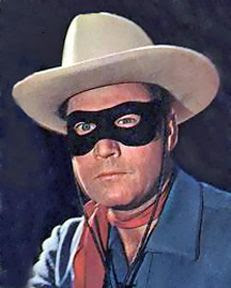
Clayton Moore, in the 1949-57 TV series

January 31, 1933: Detroit radio station WXYZ, 1270 on the AM dial, debuts a new program, The Lone Ranger, created by station owner George W. Trendle and writer Fran Striker. A legend is born.

While details differ across the various versions, the basic story of the Lone Ranger's origin is consistent in most versions of the franchise. He is the sole survivor of a group of 6 ambushed Texas Rangers, sometime after the American Civil War. The Rangers, led by Captain Dan Reid, pursue a band of outlaws led by Bartholomew "Butch" Cavendish, but are betrayed by a civilian guide who was secretly working with Cavendish, and who led the unsuspecting Rangers into an ambush at a canyon known as Bryant's Gap.

Later, a Native American named Tonto discovers one of the Rangers, Captain Reid's younger brother, John Reid, barely alive, and he nurses the man to health. In some versions, Tonto recognizes the lone survivor as the man who had saved his life when they both were children. According to the television series, Tonto gave Reid a ring and the name "Kemo Sabe," which he said means "trusty scout." (In some versions, it means "trusted friend.")

John tells Tonto that he intends to hunt down Cavendish and his men, and to bring them to justice. To conceal his identity, and honor his fallen brother, Reid fashions a black domino mask using cloth from his late brother's vest. To aid in the deception, Tonto digs a sixth grave and places at its head a cross bearing John Reid's name, so that Cavendish and his gang will believe that all the Rangers had been killed. In many versions, Reid continues fighting for justice as the Lone Ranger even after the Cavendish gang is captured.

Trendle and Striker drew up guidelines for the Lone Ranger, including a strict moral code:

  • He was never seen without his mask or some sort of disguise.
  • He was never captured or held for any length of time by lawmen, avoiding his being unmasked.
  • He always used perfect grammar and precise speech, devoid of slang and colloquialisms -- not only making him different from many other Western characters, before and after, but also making him understandable in all regions of the country, once the show got nationally syndicated.
  • Whenever he was forced to use guns, he never shot to kill, but instead tried to disarm his opponent as painlessly as possible.
  • He was never put in a hopeless situation; for example, he was never seen escaping from a barrage of gunfire merely by fleeing toward the horizon.
  • He rarely referred to himself as "the Lone Ranger." If someone's suspicions were aroused, either he would present one of his silver bullets to confirm his identity, or someone else would attest on his behalf; the latter happened at the end of most episodes when someone would ask, "Who was that masked man?" as the Lone Ranger departed. His decision to adopt the moniker of Lone Ranger was inspired by Tonto: Following the ambush at Bryant's Gap, Tonto observed him to be the only Ranger left. In other words, he was the "lone" Ranger.
  • Though the Lone Ranger offered his aid to individuals or small groups facing powerful adversaries, the ultimate objective of his story always implied that their benefit was only a byproduct of the development of the West or the country.
  • Adversaries were rarely other than American, to avoid criticism from minority groups, with some exceptions. He sometimes battled foreign agents, though their nation of origin was generally not named. An exception was his having helped the Mexican statesman Benito Juárez against French troops of Emperor Maximilian, as occurred in the radio episodes "Supplies for Juarez" (September 18, 1939), "Hunted by Legionnaires" (September 20, 1939), and "Lafitte's Reinforcements" (September 22, 1939).
  • The names of unsympathetic characters were carefully chosen, so that they never consisted of two names if it could be avoided. More often than not, a single nickname or surname was selected.
  • The Lone Ranger never drank or smoked, and saloon scenes were usually shown as cafes, with waiters and food instead of bartenders and liquor.
  • Criminals were never shown in enviable positions of wealth or power, and they were never successful or glamorous.

The original radio series was directed by John Jewell, who came up with the names "Tonto" and "Kemosabe." Although clearly highly intelligent, Tonto spoke in broken English, to emphasize that he had learned it as a second language. Unfortunately, this perpetuated the stereotype of "Indians" speaking in such form: If he had the infamous Star Wars line, it would have been "Me have bad feeling about this, Kemosabe." In the local Native American language, "Tonto" meant "wild one." But because it means "stupid" in Spanish, the character was renamed "Toro," for "Bull," in the media of Spanish-speaking countries.

The Lone Ranger's horse was white, and named Silver, and when he rode away at the end of each episode, he would yell, "Hi-yo, Silver, away!" Tonto rode a paint horse named Scout, and would yell, "Get 'em up, Scout!"

George Seaton was the first voice of the Lone Ranger, until Earle Graser took over on May 16, 1933. On April 8, 1941, he was killed in a car accident. Brace Beemer took over until the end of the radio show in 1954. Tonto was played by John Todd.

From the beginning of the radio series, the Lone Ranger's theme has been "March of the Swiss Soldiers," the 4th and final part of the Overture to Giacomo Rossini's 1829 opera William Tell.

Republic Pictures released 2 film serials: The Lone Ranger in 1938, starring Lee Powell; and The Lone Ranger Rides Again, starring Robert Livingston. Both times, Tonto was played by Victor Daniels, under the name Chief Thunder-Cloud.

The best-known version of the character was on a TV series that ran from 1949 to 1957, and was the 1st hit show for the new ABC television network. The opening sequence featured the William Tell Overture, and announcer Fred Foy saying:

The Lone Ranger! A fiery horse with the speed of light, a cloud of dust, a hearty "Hi-yo, Silver!" The Lone Ranger! With his faithful Indian companion, Tonto, the daring and resourceful masked rider of the Plains led the fight for law and order in the early West. Return with us, now, to those thrilling days of yesteryear! The Lone Ranger rides again!

Clayton Moore starred in the 1949-50 and 1950-51 seasons, before being fired in a salary dispute with George Trendle, who still had the rights to the character. John Hart replaced Moore in the 1952-53 season. Trendle sold the rights in 1954, and Moore was immediately rehired for the 1954-55 season. The series did not run in 1955-56, but was brought back for one more season in 1956-57. Throughout the series, Tonto was played by Jay Silverheels, a Mohawk actor from Canada.

For the rest of their lives, both Moore and Hart made public appearances as the Lone Ranger. On a 1982 episode of Happy Days, Hart played himself, in costume, because the Lone Ranger was the hero of the character of Arthur "The Fonz" Fonzarelli. The Ranger gave the Fonz a silver bullet.

The TV show had such an effect that reviving the character has proven problematic. In 1961, CBS produced a pilot, Return of the Lone Ranger, starring Tex Hill, but it wasn't picked up. In 1981, The Legend of the Lone Ranger starred Klinton Spilsbury. Tonto was played by Native actor Michael Horse, and Butch Cavendish by Christopher Lloyd. "Wild West" figures Wild Bill Hickok, Buffalo Bill Cody and George Armstrong Custer were depicted, and Jason Robards played President Ulysses S. Grant. The film was a massive flop, Spilsbury was particularly roasted by the critics, and he never appeared in another film.

In 2013, The Walt Disney Company tried again, with Armie Hammer as the Lone Ranger (wearing a white hat as always, but otherwise wearing black instead of his traditional powder blue), Johnny Depp as a supposedly more accurate-looking (but ultimately ridiculous-looking) Tonto, and William Fichtner as Cavendish. It was another flop. In a sick irony, Fichtner's version of Cavendish is said to be a cannibal; while, in 2021, Hammer was accused of abusing women, including the claim that he wanted to eat them.

George Seaton, as said, died in 1941, Victor Daniels in 1955, John Todd in 1957, Fran Striker in 1962, Brace Beemer in 1965, George Trendle in 1972, George Seaton in 1979, Jay Silverheels in 1980, Clayton Moore in 1999, John Hart in 2009, Fred Foy in 2010, and Tex Hill in 2014. As of January 31, 2022, Klinton Spilsbury, Michael Horse, Armie Hammer and Johnny Depp are still alive.

As a fan of hockey's New Jersey Devils, I have noted that their arch-rivals, the New York Rangers, whom Devils (and New York Islanders) fans like to say "suck," wear blue shirts, although a deeper blue than that worn by the Lone Ranger. Noting also that baseball's Texas Rangers and Scottish soccer's Rangers Football Club also wear blue shirts -- and that they also have an unfortunate string of bigotry in their fan bases -- I like to say, "The only Ranger in a blue shirt who doesn't suck is the Lone Ranger."

In 1936, WXYZ introduced another hero, set in the present day: The Green Hornet. The identity was adopted by newspaper publisher Britt Reid, son of Dan Reid Jr., grandson of Dan Reid, and thus the grandnephew of the Lone Ranger. This fact was not revealed until a 1947 episode of the radio series, when Britt reveals his dual identity to his father, who explains that he's not the first costumed crimefighter in the family. Every subsequent version of the Hornet has added a generation, but he's still descended from the Lone Ranger's martyred brother.

In 1935, WXYZ moved from Mutual Broadcasting to the NBC Blue Network. In 1946, NBC Blue separated from NBC, and became the American Broadcasting Company, or ABC. In the 1950s, "Wixy" became Detroit's Top 40 radio station. In 1967, losing its audience to WKNR, and to CKLW across the river in Windsor, Ontario, Canada, it switched to an adult contemporary format. WXYZ switched to talk radio in 1978. Since 1984, the station has used the call letters WXYT. In 2000, it switched to sports talk.

Writing in the Denver Post in 1962, Jack Guin wrote, "An intellectual is a man who can listen to the William Tell Overture without thinking of the Lone Ranger." Less intellectual even than that is a joke:

Q: Where does the Lone Ranger take his garbage?
A: To the dump, to the dump, to the dump, dump, dump!

*

January 31, 1933 was a Tuesday. Hockey Hall-of-Famer Camille Henry of the New York Rangers was born on this day.

Baseball and football were out of season. The NBA hadn't been founded yet. But there were 4 games played in the NHL:

* The New York Rangers lost to the Detroit Red Wings, 2-1 at the old Madison Square Garden.

* The New York Americans lost to the Toronto Maple Leafs, 7-1 at Maple Leaf Gardens in Toronto.

* The Montreal Canadiens beat the Ottawa Senators, 3-1 at the Montreal Forum.

* The Chicago Black Hawks beat the Boston Bruins, 5-1 at the Boston Garden.

* The Montreal Maroons were the only team not scheduled.

January 31, 1920: Joe Malone Scores 7 Goals In a Game

January 31, 1920: A player scores 7 goals in a single National Hockey League game.

Yes, it really happened. No, there were no overtimes.

Maurice Joseph Malone was born on February 28, 1890 in Sillery, Quebec, which has since been absorbed into Quebec City. A center, he played for his hometown team, the Quebec Bulldogs, and was with them when they joined the 1st professional hockey league, the National Hockey Association, for the 1910-11 season.

In 1912 and 1913, he led them to the NHA Championship. The 1912 Stanley Cup Finals were the 1st to feature 6 players on a side. Previously, there had been 7, but the position of "rover" -- essentially, splitting time between offense and defense -- was eliminated. The Bulldogs played the Moncton Victorias of Moncton, New Brunswick, Champions of the Maritime Professional Hockey League, in a best-2-out-of-3 series. The Bulldogs won the 1st 2 games, rendering the 3rd unnecessary.

In 1913, they did the same to that season's MPHL Champions, the Sydney Millionaires of Sydney, Nova Scotia. No Quebec City-based team has won the Cup since.

"Phantom Joe" remained with the Bulldogs through the 1916-17 season, the NHA's last. The National Hockey League was founded, but the manpower drain of World War I meant that the Bulldogs could not field a team. Their remaining players were put in a dispersal draft, and he was claimed by the Montreal Canadiens.

In that 1917-18 season, he played all 20 games, and scored 44 goals. That's 2.20 goals per game. When Maurice Richard broke that record with 50 goals in 1944-45, it was in a 50-game season, so it was 1.00 goal per game. When Phil Esposito scored 76 in 1970-71, it was in 78 games, so it was 0.97 goals per game. When Wayne Gretzky scored 92 in 1981-82, it was in 80 games, so it was 1.15 goals per game. So Malone's record has never been approach.

Quebec City was ready to join the NHL for the 1919-20 season, with a team sponsored by the Quebec Athletic Club. So they put the Bulldogs name to rest, and registered as the Quebec Athletics. Malone was allowed to join them. In the December 30, 1919 issue of the Ottawa Journal, a man identified only as a "veteran ice hockey fan" compared Malone to one of the best baseball players of the era -- but not to Ty Cobb or Babe Ruth:

This fellow Malone, he is not the fastest but he is the smoothest forward in the league. He is absolutely reliable around a net. He is a great stickhandler, and a player who never gets flurried no matter how hard the going is. What Eddie Collins is to baseball, Malone is to hockey.

On January 31, 1920, the Bulldogs played the Toronto St. Patricks, the team that became the Toronto Maple Leafs in 1927, at the Quebec Arena. Malone scored just 6:50 into the game. Reg Noble tied it for Toronto 3 minutes later. Quebec got goals from Dave Ritchie and Ed Carpenter scored later in the 1st period, but Ken Randall closed the St. Patricks to within 3-2 by the end.

Malone scored his 2nd goal just 55 minutes into the 2nd period. Charles Corbett "Corb" Denneny, brother of Ottawa Senators superstar Cyril "Cy" Denneny, got Toronto to within 4-3. Then Malone scored again, getting his hat trick. Reg Noble made it 5-4 Quebec, but Malone scored again, getting a single-period hat trick.

Early in the 3rd period, the St. Patricks got a goal from Mickey Roach, and now the Bulldogs' lead was just 6-5. Within 30 seconds, George Carey scored for Quebec and Cully Wilson scored for Toronto, to make it 7-6 Quebec. But, having already scored 4 goals in a span of 33 minutes, Malone decided it was time to put the game away. He scored with 10 minutes even left in regulation, with 8 minutes even, and again with 45 seconds to go.

Final score: Quebec 10, Toronto 6. Or, if you prefer, Joe Malone 7, Toronto 6. He ended up leading the League with 39 goals.

But even Phantom Joe couldn't offset Frank Brophy, who had the worst season any NHL goaltender has ever had, allowing 7.11 goals per game. The game in which Malone scored 7 goals was 1 of only 4 games the Bulldogs allowed all season.

The team moved to Hamilton, Ontario for the 1920-21 season, becoming the Hamilton Tigers. Malone played 2 more seasons with them, and then closed his career with 2 more seasons with the Canadiens, retiring by winning the 1924 Stanley Cup. He scored 179 goals in NHA play, and 143 in the NHL, for a total of 322 goals. He was only 34 when he hung up his skates.

He was elected to the Hockey Hall of Fame in 1950, and died on May 15, 1969. In 1998, 74 years after his last game, The Hockey News ranked him 39th on their list of the 100 Greatest Hockey Players, the earliest player to make the list.

Seven goals in an NHL game has never been done again. Six goals in an NHL game has been done seven times:

* Edouard "Newsy" Lalonde had done it just 3 weeks before Lalonde's achievement, on January 10, 1920, for the Montreal Canadiens.

* Malone struck again 2 months after his 7, netting 6 on March 10, 1920.

* The aforementioned Corb Denneny did it for the St. Patricks on January 26, 1921.

* His brother Cy Denneny did it for the Ottawa Senators less than 6 weeks later, on March 7, 1921.

* Syd Howe (no relation to Gordie) did it for the Detroit Red Wings on February 3, 1944.

* Gordon "Red" Berenson did it for the St. Louis Blues on November 7, 1968.

* And Darryl Sittler did it for the Toronto Maple Leafs on February 7, 1976.

In 1998, The Hockey News released their list of the 100 Greatest Hockey Players. Joe Malone was ranked 39th.


*


January 31, 1920 was a Saturday. There was 1 other game played in the NHL that day: The Ottawa Senators beat the Montreal Canadiens, 11-3. Harry "Punch" Broadbent scored 3 goals. The Senators got 2 more each from Jack Darragh, Frank Nighbor, and the aforementioned Cy Denneny; and 1 each from Georges "Buck" Boucher (brother of later New York Rangers legend Frank Boucher) and Eddie Gerard. All 6 of those players ended up in the Hockey Hall of Fame, and, this season, started the Senators on a run of 4 Stanley Cups over the next 8 seasons: 1920, 1921, 1923 and 1927.

Baseball and football were out of season, and professional basketball barely existed. But the 2nd Round Proper of England's FA (Football Association) Cup was played:

* Arsenal visited Bristol City and lost, 1-0.
* Birmingham City hosted Darlington and won, 4-0.
* Bradford City hosted Sheffield United and won, 2-1.
* Bradford Park Avenue hosted Castleford Town and won, 3-2.
* Chelsea hosted Swindon Town and won, 4-0.
* Leicester City hosted Manchester City and won, 3-0.
* Notts County hosted Middlesbrough and won, 1-0.
* Plymouth Argyle hosted Barnsley and won, 4-1.
* Preston North End hosted Blackpool and won, 2-1.
* Tottenham Hotspur hosted West Stanley and won, 4-0.
* West Ham United hosted Bury and won, 6-0.
* Aston Villa visited Manchester United and won, 2-1.
* Cardiff City visited Wolverhampton Wanderers, 2-1.
* Huddersfield Town visited Newcastle United and won, 1-0.
* Liverpool visited Luton Town and won, 2-0.
* Burnley hosted Sunderland, and finished in a 1-1 draw. Four days later, there was a replay at Sunderland, who won, 2-0.

In the Final, on April 24, Aston Villa beat Huddersfield Town, 1-0 at Stamford Bridge, Chelsea's ground in West London.

Sunday, January 30, 2022

January 31, 1915: The Beginning of Chemical Warfare

January 31, 1915: The Imperial German Army launches 18,000 shells filled with tear gas and chlorine at the Russian 2nd Army at the Battle of Humin-Bolimów in World War I, in what is now Poland. It is the 1st use of chemical warfare, and it is devastating.

In the Spring, the Germans began using poison gas on British and French troops at the Second Battle of Ypres. By the thousands, men found their lungs burned, giving them breathing problems for the rest of their lives even if they did survive; and their eyes burned, often going permanently blind.

The British Army had required its soldiers to grow mustaches, which tended to trap the gas. So, for the first time, they were ordered to shave the 'taches off. (Americans usually abbreviate it as 'stache, the British as 'tache.) Gas masks were developed, with varying levels of success.

Military historian Andrew Robertshaw, a technical advisor for the film version of the World War I story War Horse, wrote about the 1914 "Christmas True," saying that such a truce would have been unthinkable a year later: "This was before the poisoned gas, before aerial bombardment. By the end of 1915, both sides were far too bitter for this to happen again."

When the U.S. Army entered the war, it started the Chemical Warfare Division. Among those serving in it were a pair of baseball legends, Captain Christy Mathewson and Captain Ty Cobb. During a training exercise, Mathewson got a lungful of "mustard gas," weakening his lungs, and leading to his death in 1925, only 45 years old. It made him, at least in America, the most famous victim of poison gas.

Poison gas was banned as an instrument of warfare. Nevertheless, it has been used by tyrants since, including on their own people when rebelling, including Saddam Hussein in Iraq in the 1990s, and Bashar Assad in Syria in the 2010s.

Saddam's general in charge of gassing Kurdish rebels was Ali Hassan Majid al-Tikriti, who became known as "Chemical Ali." During the Iraq War of the 2000s, I joked that President George W. Bush was so dumb, when told about Chemical Ali, he said, "I'll always remember him as Gaseous Clay."

*

January 31, 1915 was a Sunday. Sociologist Alan Lomax, game-show host Garry Moore, and monk-author Thomas Merton were born that day.

Baseball and football were out of season. Professional basketball barely existed. Professional hockey had its 1st league, the National Hockey Association. However, no games were scheduled for that day. There may have been laws against playing on Sunday. Therefore, there were no scores on this historic day.

January 31, 1879: Washington's Birthday Is Declared a Federal Holiday

January 31, 1879: Congress establishes the anniversary of the birth of the 1st President of the United States, George Washington, as a federal holiday: "Washington's Birthday."

Washington was born on February 22, 1732, at Popes Creek, in Westmoreland County, Virginia, 70 miles south of the national capital that would be built at a site he chose and would be named after him. His great-grandfather, John Washington, had settled a plantation there in 1657, during the Protectorate of Oliver Cromwell, between the reigns of the House of Stuart. His father, Augustine Washington, built what became the birth house there in 1718, during the reign of King George I of Britain. The future "Father of Our Country" was born there during the reign of King George II.

The house burned down on Christmas Day, December 25, 1779, during the War of the American Revolution, and thus during the reign of King George III. However, it appears to have been an accident, not the work of the British Army. The Memorial House was built on the site in 1932, to commemorate the 200th Anniversary of Washington's birth.
Washington's Birthday was celebrated on February 22 from 1879 until 1970. To give federal employees a three-day weekend, in 1968, the Uniform Monday Holiday Act moved it to the 3rd Monday in February, which can occur between February 15 and 21, starting in 1971.

The day soon became known as Presidents(') Day -- the presence and placement of the apostrophe varies -- and provides an occasion to remember all the U.S. Presidents, to honor Abraham Lincoln's and Washington's birthdays together, or any single President of choice.
Lincoln was born on February 12, 1809, in Hodgenville, Kentucky, 59 miles south of Louisville, in, yes, a log cabin. But the cabin in question had been dismantled at some point prior to his death from assassination on April 15, 1865. A replica was built in 1911.
Contrary to popular belief, Lincoln's Birthday has never been a federal holiday, although some States, including my own New Jersey, observed it as a State holiday. When I started in public school in 1975, we got both Lincoln's Birthday on February 12 and Washington's Birthday on the 3rd Monday in February off from school. By the time I reached junior high school in 1981, we were observing just one February holiday, Presidents Day.

*

January 31, 1879 was a Friday. There were no scores on this day: Baseball and football were both out of season, basketball didn't exist yet, and hockey barely did.

January 30, 2000: The Greatest Show On Turf

January 30, 2000: The franchises I grew up knowing as the Los Angeles Rams and the Houston Oilers play each other in Super Bowl XXXIV, at the Georgia Dome in Atlanta.

But the Rams moved to become the St. Louis Rams in 1995, and the Oilers to Memphis in 1997, then to Nashville in 1998, and finally changed their name to the Tennessee Titans in 1999.

In midseason, the Rams, coached by former Philadelphia Eagles coach Dick Vermeil, replaced starting quarterback Trent Green with Kurt Warner, and the result became known as "The Greatest Show On Turf." Warner could throw passes to receivers Isaac Bruce, Torry Holt, Az-Zahir Hakim and Ricky Proehl, and to running back Marshall Faulk, who, in this 1999-2000 season, maybe have become the best all-around player in the game. Tackle Orlando Pace was then the best offensive lineman in the league.

It wouldn't have mattered much if they didn't also have a good defense, with tackles Ray Agnew and D'Marco Farr, ends Kevin Carter and Grant Wistrom, linebackers Lendon Fletcher and Mike Jones, and cornerbacks Dré Bly and Todd Lyght. So while the Rams had 9 games of at least 34 points, they also had 11 games of allowing 14 or fewer points.

They won 13 of their 1st 15, clinching the top seed on the NFC side of the Playoffs, before a meaningless loss away to the Philadelphia Eagles in their season finale. In the Playoffs, they won a 49-37 shootout over the Minnesota Vikings, and went the other way in the NFC Championship Game, winning a defensive struggle over the Tampa Bay Buccaneers, 11-6.

The Titans struggled in their 1st 2 seasons, as the Tennessee Oilers. But in their 1st season under the Titans name, their 1st season at the Adelphia Coliseum (now Nissan Stadium), coach Jeff Fisher's men were embraced by Nashville fans. The embracees included quarterback Steve McNair, running back Eddie George, receiver Kevin Dyson, tight end Frank Wycheck, center Bruce Matthews, defensive end Jevon Kearse (known as The Freak), safeties Blaine Bishop and Anthony Dorsett (son of Hall-of-Famer Tony), and ageless placekicker Al Del Greco.

The Titans weren't flashy, but they won 7 of their last 8 games, saving their biggest offensive outputs for their last 2, a 41-14 win over the Jacksonville Jaguars at home, and a 47-36 battle away to the Pittsburgh Steelers. A last-minute kickoff return, featuring a lateral from Wycheck to Dyson, beat the Buffalo Bills in the Wild Card Round, becoming known as the Music City Miracle. They beat Peyton Manning and the Indianapolis Colts away, 19-16, and then went to Jacksonville and beat the Jags again, 33-14, for the AFC Championship.

For the Rams, it was their 1st trip to the Super Bowl in 20 years, and they were looking for their 1st World Championship in 49 years, since Los Angeles beat Cleveland in the 1951 NFL Championship Game. For the Oilers/Titans franchise, it was their 1st trip to the Super Bowl ever. They had won the 1st 2 AFL Championships, in 1960 and '61, and also made it to the AFL Championship Game in '62 and '67. But except for back-to-back trips to the AFC Championship Game in '78 and '79, their NFL experience had been a bust. Until now.

For St. Louis as a city/metro area, there had not been a World Championship in over 17 years, since the Cardinals won the 1982 World Series. They had lost 2 World Series and a National League Championship Series in the interim. The NFL version of the Cardinals had moved to Arizona after the 1987 season. The NHL's Blues hadn't reached the Stanley Cup Finals since 1970. And there was no NBA team.

For Tennessee, this was all new. They'd had teams in "rebel leagues" like the ABA, the WFL and the USFL, but until now, with the NHL also adding the Nashville Predators for the 1997-98 season, they'd had nothing in the major leagues.

Vermeil had gotten the Eagles into Super Bowl XV, but they lost it. Before Super Bowl XXXIV, he got phone calls from many of his Eagle players, telling him they were pulling for him.

The Rams were favored by 7, possibly because the game would be played on artificial turf, which they usually played on at the Trans World Dome (now The Dome at America's Center), while the Titans played their home games on natural grass.

The 1st half was a defensive struggle. The Rams went 3-for-4 on field goal attempts, the Titans 0-for-1, and neither team could get into the end zone. The half ended with the Rams up, 9-0. On their opening drive of the 2nd half, the Rams blocked a Titan field goal attempt.

Finally, "The Greatest Show On Turf" took over, and Warner got the Rams going, leading to a 9-yard touchdown pass to Holt. It was 16-0 St. Louis. The Titans answered with a touchdown drive of their own, ending with a 1-yard run by George. They went for the 2-point conversion, but missed, and it was 16-6 Rams as the 3rd quarter ended.

The Titans forced the Rams to punt on their next drive. McNair took advantage of this by taking his team 79 yards in 13 plays, concluding with George running it in from 2 yards out. The Titans were now within 16-13, with 7:21 to go. The Titans forced the Rams to put again, and they got close enough for another field goal attempt by Del Greco. With 2:12 left, the game was tied, 16-16.

This was the 1st time a team had a lead of 16 or more points in a Super Bowl, and blown it. Could the Rams recover? Yes: On their next play from scrimmage, Warner threw a bomb to Bruce, who took it 73 yards for a touchdown. With 1:54 left, the Rams led, 23-16.

The Titans' last chance began at their own 12-yard line with 1:48 left. They were aided by a pair of dumb defensive penalties by the Rams, putting the ball on the Ram 40 with 59 seconds to go.

On a 3rd & 5, McNair escaped what looked like a sure sack, and passed to Dyson for a 1st down and the Ram 10. With 6 seconds left, the Titans called their last time-out. At this point, there had never been a Super Bowl go to overtime. Of course, if the Titans scored, and went for 2 instead of 1, there would be no overtime.

Fisher's plan for the last play (at least, of regulation time) was to have Wycheck run straight up the right side, as a decoy, to lure Jones away from Dyson. Dyson would then slant left through the middle and be open at around the 5-yard line. McNair would then pass to him for the touchdown that would make it no worse than 23-22.

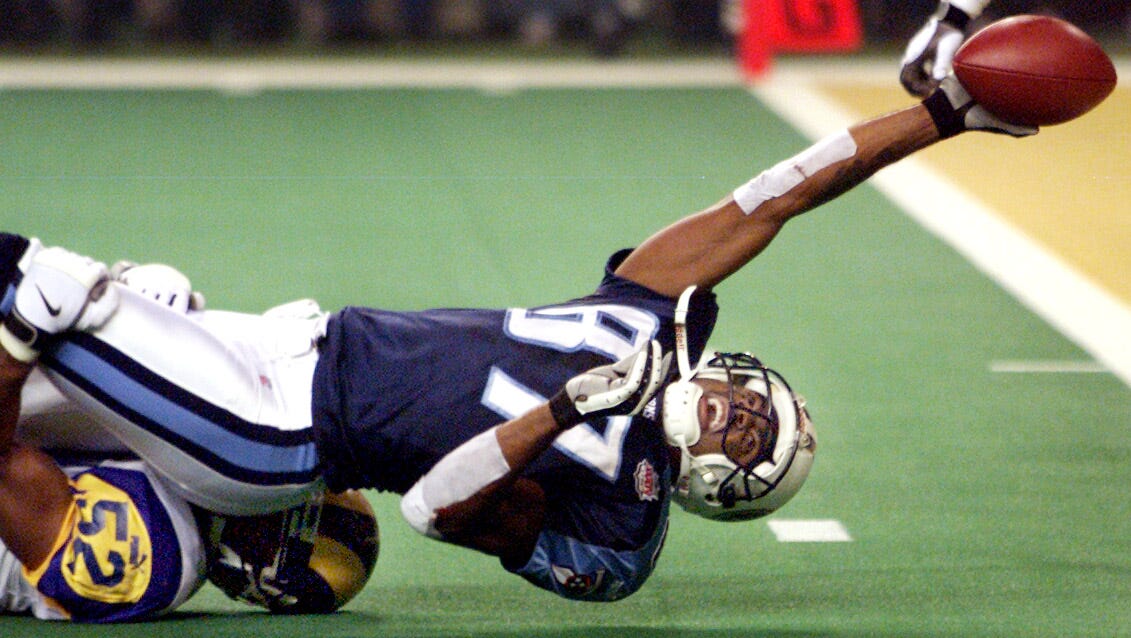
It didn't work. Jones saw Dyson getting ready to catch the ball. Jones ran toward Dyson, and wrapped is arms around Dyson's legs to tackle him, less than 3 yards short of the goal line. But Dyson knew he was not yet down, and he reached out with his arm, holding the ball, hoping to have it break the plane of the goal line for the touchdown. But the way that Jones tackled him, his shoulder hit the ground, ending the play, and the ball was still about one full foot away from the goal line.
It's become known as "The Tackle" and "The Longest Yard." The Titans had fought bravely, but were one yard short of, at the very least, being tied at the end of regulation of the Super Bowl. The Rams had blown a 16-point 2nd half lead in the Super Bowl, but were still World Champions. They also became the 1st team to win NFL Championships in 3 different cities: Cleveland in 1945, Los Angeles in 1951, and St. Louis in 1999-2000.

Warner's story of being a supermarket bagger and an Arena Football League quarterback in Iowa to winning the Most Valuable Player award in a Super Bowl was made into the recent movie American Underdog, starring Zachary Levi. And Dick Vermeil, once again crying tears of joy after a big win, finally got his ring.

After failing to repeat, the Rams got back to the Super Bowl in the 2001-02 season, but lost to the New England Patriots on a last-play field goal. Soon, "The Greatest Show On Turf" broke up, and the Rams became a mediocre team again. Warner went, ironically, to the former St. Louis football team, now the Arizona Cardinals, and got them into Super Bowl XLIII, but lost.

St. Louis lost interest in the Rams, and when they moved back to Los Angeles in 2016, there wasn't much of a fuss over it. The Rams got back to the Super Bowl in the 2019 season, but lost. They're back in it this season, and will play the Cincinnati Bengals in Super Bowl LVI in their new home, SoFi Stadium in Inglewood, California. (They had previously played Super Bowl XIV in the Rose Bowl, 14 miles from their home at the time, the Los Angeles Coliseum, but lost it to the Pittsburgh Steelers.)

The Titans reached the AFC Championship Game again in the 2002 season, but lost it to the then-Oakland Raiders, They were still a Playoff team as late as 2008, but fell apart. They have rebuilt, making the Playoffs in 4 of the last 5 seasons, including another AFC Championship Game in the 2019 season, which could have set up a Super Bowl rematch with the Rams, but they lost to the Kansas City Chiefs.

In 2019, a poll ranked this game 16th on a list of the 100 Greatest Games of the NFL's 1st 100 years.

UPDATE: On February 13, 2022, the Rams beat the Cincinnati Bengals, 23-20, and won Super Bowl LVI.

Rams Aeneas Williams, Kurt Warner, Marshall Faulk, Orlando Pace, Isaac Bruce, D'Marco Farr, Kevin Carter, Mike Jones, Torry Holt, head coach Dick Vermeil and assistant coach Mike Martz have been elected to the St. Louis Sports Hall of Fame. Vermeil, Bruce, Trent Green and Grant Wistrom have been elected to the Missouri Sports Hall of Fame.

The Titans have a Ring of Honor: Its inductees include:

* From their previous tenure as the Houston Oilers: Founding owner Bud Adams, 1960s quarterback George Blanda, 1960s safety Ken Houston, 1960s punter Jim Norton, 1970s head coach O.A. "Bum" Phillips, 1970s receiver Billy "White Shoes" Johnson, 1970s defensive end Elvin Bethea, 1970s linebacker Robert Brazile, 1980s running back Earl Campbell, 1980s guard Mike Munchak, 1990s general manager Mike Holovak, 1990s quarterback Warren Moon, 1990s guard Bruce Matthews.

* From their Titans era: Adams, Matthews, head coach Jeff Fisher, quarterback Steve McNair, running back Eddie George and tight end Frank Wycheck.

Adams, Fisher, McNair, George and safety Blaine Bishop have been elected to the Tennessee Sports Hall of Fame.

*

January 30, 2000 was a Sunday. There were, of course, no other football games on this day. And baseball was out of season.

Traditionally, in order to avoid competing for TV viewers even with the interminable pregame programming on Super Sunday, the NBA avoids scheduling many games for the day. This time, they scheduled 2: The New York Knicks beat the Sacramento Kings, 120-111 at Madison Square Garden. And the Houston Rockets beat the Los Angeles Lakers, 89-83 at The Summit in Houston. (The arena has since been converted into the Central Campus of the Lakewood Church, Dr. Joel Osteen's "megachurch.")

The NHL scheduled 3 games. The Montreal Canadiens beat the Carolina Hurricanes, 3-0 at the Molson Centre (now the Bell Center) in Montreal. The Washington Capitals beat the Philadelphia Flyers, 2-0 at the MCI Center (now the Capital One Arena) in Washington. And the Chicago Blackhawks beat the Vancouver Canucks, 3-1 at GM Place (now the Rogers Arena) in Vancouver.

December 31, 1999 & January 1, 2000: The Millennium

December 31, 1999:  The Millennium arrives. The people of planet Earth survived. At a terrible cost. But we hadn't destroyed ourselves. ...