Saturday, October 1, 2022

October 1, 1958: The American Express Card Is Launched

October 1, 1958: The American Express Card is launched. This is why, in every print ad campaign, the "Member Since" date on the cards shown is "58."

The name on the cards in print ads is "C F FROST," in honor of Charles Frost, advertising executive at Ogilvy & Mather, the company that began the "Do you know me?"/"Don't leave home without it" ad campaign in 1975.

American Express had introduced the concept of the traveler's cheque (not "check") in 1891. From 1975 to 1995, actor Karl Malden did commercials for American Express Traveler's Cheques: He asked, in the event that your cash or credit cards were stolen, "What will you do? What will you do?" And he closed the ads by saying, "American Express Traveler's Cheques: Don't leave home without them!"

At around the same time, AmEx hired celebrities who might not be recognized out of costume or out of makeup, asking, "Do you know me?" The ads would close with a joke based on their identity, their name being printed on the card, an announcer saying, "To apply for the card, look for this display wherever the card is welcomed," and the celebrity delivering the tagline: "The American Express Card: Don't leave home without it!"

Diners Club had introduced the concept of the credit card in 1950, but American Express made the concept take off.

A few days earlier, on September 18, 1958, Bank of America launched BankAmericard. But their rollout flopped, though it turned a profit in 1961. By the 1970s, it surpassed American Express as the most-used credit card.

In 1969, Interbank introduced the MasterCharge card. This allowed lots of people to pay their BankAmericard bill with their MasterCharge, and their MasterCharge with their BankAmericard, a process that got them even deeper into debut, and was later outlawed with the Credit Card Accountability, Responsibility, and Disclosure (CARD) Act of 2009.

On March 1, 1977, BoA, consolidating its operations, changed the name of the card to Visa, to make it easier to use worldwide. On August 28, 1979, MasterCharge was renamed MasterCard.

*

October 1, 1958 was a Wednesday. There was only 1 score on this historic day, and it was in Game 1 of the World Series. The Milwaukee Braves beat the New York Yankees, 4-3 at Milwaukee County Stadium. Bill Bruton singled Joe Adcock home with the winning run in the bottom of the 10th inning, off Ryne Duren in relief of Whitey Ford -- who didn't allow another run in Series play until 1962. Warren Spahn went the distance for the win. Hank Aaron went 1-for-4 with a walk. Bill "Moose" Skowron and Hank Bauer hit home runs for the Yankees. Mickey Mantle went 0-for-3 with 2 walks.

October 1, 1956: The Silver Age of Comics Begins

October 1, 1956: Showcase Comics #4 is published, featuring the debut of a new version of an established superhero, the Flash. This is considered to be the beginning of the Silver Age of Comic Books.

The Golden Age of Comics had ended 2 years earlier, with the publication of Seduction of the Innocent by Dr. Fredric Wertham, which resulted in the creation of the Comics Code Authority, designed to reduce the amount of violence and sexual innuendo (intended or perceived) in comic books. Sales tanked, so new heroes, and new versions of old heroes, were created.

The original version of the Flash was Jay Garrick, a college student in Keystone City, who inhaled "heavy water vapors," and gained super-speed as a result. The new version, introduced in Showcase #4, was Barry Allen, a "police scientist" in Central City, the kind of character who would later be represented by the likes of Gary Dourdan's Warrick Brown on CSI: Crime Scene Investigation and Pauley Perrette's Abby Sciuto on NCIS.

In other words, he  was old enough to have gotten his doctorate, and had been helping to solve crimes even before he got his powers. That happened when a lightning bolt crashed through the window of his lab, electrifying some chemicals, knocking them over, and dousing him in them.

The success of the new Flash led to a new version of Green Lantern in 1959, and a new version of the Atom in 1961. Also in 1961, DC would bring their old and new versions of heroes together with the story "The Flash of Two Worlds," introducing the concept of the multiverse, with the new versions on Earth-One and the old ones on Earth-Two; and Marvel Comics began their "Marvel Universe" with Fantastic Four #1.

In 1971, the Silver Age of Comics gave way to the Bronze Age, marked by the challenging of the Comics Code Authority with drug stories, first Spider-Man's "Green Goblin Reborn!" and then, a few weeks later, by the Green Lantern and Green Arrow story "Snowbirds Don't Fly." Comics became darker, even world-weary.

*

October 1, 1956 was a Monday. Theresa May, Prime Minister of Great Britain from 2016 to 2019, was born.

There were no scores on this historic day: Baseball was between the regular season and the World Series (which the New York Yankees would win over the Brooklyn Dodgers), football was in midweek (there would be no Monday Night Football for another 14 years), and the NBA and NHL seasons hadn't started yet. 

October 1, 1955: "The Honeymooners" Premieres

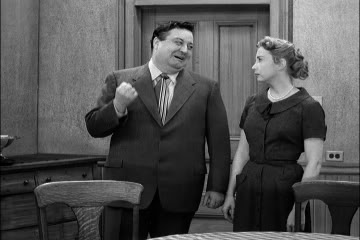
Left to right: Jackie Gleason, Audrey Meadows, Art Carney and Joyce Randolph.

October 1, 1955: A new show premieres on CBS. Well, sort of: The Honeymooners had been a sketch on The Jackie Gleason Show, but now it becomes a standalone half-hour situation comedy, perhaps the greatest "sitcom" in history.

Like the variety show that spawned it, the sitcom was filmed before a live audience, in the ballroom of the Park Sheraton Hotel. In 1928, Mob financier Arnold Rothstein had been killed in his room at that hotel. In 1957, Albert Anastasia, "the Boss of All Bosses," was killed in the hotel's barber shop. In 1984, it returned to its original name, the Park Central Hotel.

The 1st episode, appropriately enough, discusses television itself: It is titled "TV Or Not TV," and shows what happens when Brooklyn bus driver Ralph Kramden (Gleason) and sewer worker, upstairs neighbor and best friend Ed Norton (Art Carney) go halfsies on a television set, because neither one can afford their own. (Ralph has never had one, because he's cheap. Ed's 1st one just broke down.)

Ralph's wife, Alice Kramden (Audrey Meadows), wants a TV set, but she doesn't think this arrangement will work. Interestingly, unless you count Alice's groan over a tricky sink, Ed's wife, Thelma "Trixie" Norton (Joyce Randolph), has the 1st line in the show's history: "Hiya, Alice!"

Ralph was always yelling at Alice. Today, we would call that "verbal abuse." And one of the things he yelled at her was threats. "You are gonna get yours." "You're going to the Moon!" "Hoo-hoo, would I like to... " "Oh-ho... Oh-ho... Bang! Zoom!"

And, just once in the "Classic 39" episodes -- he used this one a lot more when it was just a sketch on his earlier Jackie Gleason Show -- "One of these days, one of these days, pow! Right in the kisser!" As comedian Bill Maher put it, Ralph was always threatening to graduate from verbal to physical abuse, and mainstream America was fine with this, and thought it was funny.

You know how many times Ralph actually hit Alice onscreen in those 39 episodes? Zero. Because Alice wouldn't have put up with it. No, she couldn't have beaten Ralph in a genuine fight -- Gleason was 5-foot-10, and was usually around 240 pounds but peaked at 285 -- but if she so much as slapped him just once, he would have been so shocked that the woman he loved had done that to him, that he would have backed down. For all his "king of the castle" bluster, Ralphie Boy was whipped.

Sure, Ralph would get in Alice's face and berate her, but she was just as likely to get into his. Check out this exchange, from the aforementioned 1st episode, after she accused him of being cheap, leading to the lack of amenities in their apartment (and 328 Chauncey Street, which is a real address, was actually in the Bushwick section of Brooklyn, not in Bensonhurst like was so often said onscreen):

Ralph: When we got married, you said, "Ralph, I'd be happy to live in a tent with you!"
Alice: I'm still willing. I think it'd be an improvement.
Ralph, shaking his fist in her face: You wanna go to the Moon? Do ya wanna go to the Moon?
Alice: That would be an improvement, too!

Look at this picture. Ralph has his fist balled up. Is Alice intimidated? Hell, no: She's standing her ground, ramrod straight, and giving Ralph a death stare.
She was from Brooklyn, too, you know: Alice Gibson Kramden was one tough redhead. She gave as good as she got, and, while Ralph would frequently continue the verbal thrust-and-parry, just as often, he would back down, and make that big sad moon face, and be contrite, and apologize.

And she would forgive him. Because, deep down, she loved him as much as he loved her. And he would acknowledge just how good a fit she was for him, say, "Baby, you're the greatest!" and grab her and bend her over and kiss her like in romantic movies -- a much better "Pow, right in the kisser." For all his big talk, he was a romantic and a sentimentalist.
Lucille Ball may have been the first woman with any power in television production, but Audrey Meadows was TV's first feminist.

The show had the occasional sports reference. In "The Golfer," Ralph tries to learn how to play golf to impress a bus company official. In "Here Comes the Bride," Ralph notes that Alice's sister, finally getting married, has been a bridesmaid so often, she caught her own bouquet. Alice said her foot slipped, and Ralph compares her to Willie Mays, saying, "If my foot could slip like that, I'd be playing center field for the New York Giants!"

In "Young At Heart," Ralph wears a varsity football letter sweater. The letter is V, although the name of his school is never revealed. (There is a Martin Van Buren High School in New York, but it's in Queens, and is unlikely to have been Ralphie Boy's alma mater.) And in the last episode, "A Man's Pride," Ralph runs into a high school nemesis at a boxing card at the old Madison Square Garden.

Gleason died in 1987, Meadows in 1996, Carney in 2003. As of October 1, 2022, Randolph is not only the last survivor of the main cast, she may be the last surviving castmember, period. Even the actors who played the kids on the show have died. (UPDATE: Randolph died in 2024, 9 months before she would have turned 100.)

In 2005, a film re-imagining The Honeymooners was released, directed by John Schultz, and set in the present day. Reflecting the current demographics of Brooklyn, it was a mostly-black cast. Ralph was played by Cedric the Entertainer, Alice by Gabrielle Union, Ed by Mike Epps, and Trixie by Regina Hall. Eric Stoltz and John Leguizamo also appear, in a plot based around, as original Alice would have put it, one of Ralph's "crazy harebrained schemes" to get rich quick.

The film flopped: Original Honeymooners fans didn't warm up to the reboot, though that may have been due less to race than to the casting of anyone other than the classic actors; and fans of the particular actors didn't take to it, either. The film cost $25 million to make, cheap by recent standards, but only grossed half that, making it as big a flop as one of Ralph's crazy harebrained schemes. Whoever suggested it was a good idea had a BIIIIIIIIG MOUUUUUUUUTH!

*

October 1, 1955 was a Saturday. In real life in Brooklyn, Game 4 of the World Series was played at Ebbets Field. The New York Yankees took a 2-0 lead on the Brooklyn Dodgers, including a home run by Gil McDougald. But the Dodgers came roaring back, with home runs from Roy Campanella, Gil Hodges and Duke Snider, and beat the Yankees 8-5.

Clem Labine was the winning pitcher. Don Larsen was the losing pitcher: Larsen would have his day in the October Sun, and it would be against the Dodgers, but this would not be it. The Dodgers tied the Series, and won it at Yankee Stadium in Game 7 on October 4.

The starts of the NBA and NHL seasons were a few weeks away. However, in spite of it being a Saturday, there was 2 NFL games played on the day:

* The Washington Redskins beat the Philadelphia Eagles, 31-30 at Connie Mack Stadium in Philadelphia.

* And the Baltimore Colts beat the Detroit Lions, 28-13 at Memorial Stadium in Baltimore.

Also, Arsenal beat Aston Villa, 1-0 at Highbury in North London.

October 1, 1950: The Dick Sisler Game & Connie Mack's Farewell

October 1, 1950: Dick Sisler hits a home run off Don Newcombe in the top of the 10th inning at Ebbets Field, and the Phillies beat the Brooklyn Dodgers 4-1, to clinch the National League Pennant. It is the only Pennant the Phils would win in a 65-year stretch from 1915 to 1980.

This was the 2nd of 3 straight seasons in which the National League race came down to the last day of the regular season with the Dodgers involved. The year before, they had to win to clinch and eliminate the St. Louis Cardinals, and they did. The year after, they had to win to force a Playoff with their arch-rivals, the New York Giants, and they did -- for all the good that ended up doing them.

The Phillies were the youngest team, by average player, ever to win the National League Pennant. Before the season started, Harry Grayson, the sports editor of the Newspaper Enterprise Association, gave them the nickname "The Whiz Kids," a takeoff on a radio show titled Quiz Kids.

Managed by Eddie Sawyer, only 40 years old but experienced with them, as he had managed some of them in the minor leagues, the Phillies had been strong all season long, led by center fielder sparkplug Richie Ashburn, slugging left fielder Del Ennis, ace starting pitcher Robin Roberts, and Jim Konstanty, who became the 1st relief pitcher ever to be named either League's Most Valuable Player.

But they had lost 3 starting pitchers down the stretch: Curt Simmons went into the Army when his National Guard unit was called up on September 10, rookie Bubba Church sustained an awful eye injury on September 15, and rookie Bob Miller suffered a shoulder injury the next day. Simmons had won 17 games, Church 8, and Miller 11; but none would win another game that season. If not for Roberts winning 20, and Konstanty winning 16 and saving 22 more, the Phils would have been hopeless.

Richard Alan Sisler was born on November 2, 1920 in St. Louis. His father was George Sisler of the St. Louis Browns, one of the best all-around players of his generation: A .340 lifetime hitter whose 1920 total of 257 hits stood as a major league record for 84 years, a 4-time American League leader in stolen bases, and, according to contemporary observers, the best-fieldling 1st baseman of his time.

His brother Dave Sisler would be a major league pitcher, and his brother George Sisler Jr. became a longtie baseball executive. Oddly, George Sr. was a scout for the Dodgers at the time, and was in the ballpark when Dick hit the home run. A reporter asked George how he felt, and he said, "I felt awful and terrific at the same time."

A 1st baseman and left fielder, Dick debuted with the Cardinals in 1946, contributing to a World Series-winning team a a rookie. He was traded to the Phillies in 1948. That 1950 season was his only selection to the All-Star Game. He was traded to the Cincinnati Reds in 1952, and back to the Cardinals later that year, last playing in the majors with them in 1953. He finished his career with a .276 batting average, and just 55 home runs, but 1 of them won a Pennant.

Dick went into coaching, and won another Pennant in 1961, on the staff of Fred Hutchinson of the Cincinnati Reds. When Hutchison left the team late in the 1964 season due to cancer, Dick stepped in as interim manager. Ironically, his Reds were a big reason why his former team, the Phillies, did not win the Pennant that season. But it was his other former team, the Cardinals, who did.

When Hutch died, Dick was named the official manager, and won 89 games in 1965, but was fired after the season, anyway. The Cardinals brought him onto the coaching staff of his former teammate Red Schoendienst, and, together, they won the 1967 World Series, and lost the 1968 World Series. He later coached for the San Diego Padres and, in 1979 and '80, under Joe Torre on the Mets.
He spent most of the 1980s working in the Cardinal farm system, helping to build a team that won 3 Pennants and the 1982 World Series. He died on November 20, 1998, at the age of 78.

The Dick Sisler Game was is also the last major league game as a manager for Burt Shotton, who'd managed the Dodgers to Pennants in 1947 and 1949, and eased the path of Jackie Robinson as he and general manager ranch Rickey reintegrated baseball.
An outfielder, Shotton had played in the major leagues from 1909 to 1923, including 1915 to 1917 with the St. Louis Browns, where he was a teammate of George Sisler -- hence, George's scouting for the Dodgers. Shotton had previously managed the Phillies from 1928 to 1933, and the Reds in 1934, and had also coached for the Cardinals and the Cleveland Indians.

He left the Indians after the 1945 season. When Rickey needed a manager for 1947 after Leo Durocher's yearlong suspension, he asked for Shatoon, who told Rickey, "I romised my wife I would never put on another uniform." So Rickey talked him into managing in a suit, like Connie Mack.

Speaking of whom...

Also on this day, the Philadelphia Athletics complete a massively disappointing 102-loss season by beating the Washington Senators, 5-3 at Shibe Park. It is the last game for A's manager Connie Mack: Approaching his 88th birthday, his sons Earle, Roy and Connie Jr., agreeing on little else, agree to gang up on him and force him to finally retire as manager -- something he, as also the owner, did not want to do.

Before the A's move to Kansas City, the Phillies, new owners of the ballpark, will rename it Connie Mack Stadium, and will erect a statue of him outside.

Having first played in what we would now call Major League Baseball in 1886, the 1st term of Grover Cleveland, and made it to 1950, the 2nd term of Harry Truman, Connie Mack was involved in 4,490 regular-season games, far and away a major league record. (Vin Scully was on hand for 10,766 games over 67 seasons, but that was as a broadcaster.)
Shotton and Mack were the last managers to wear street clothes during a game. Although no rule specifically mandates that a manager must wear a uniform, there is now a rule that states that, aside from medical and security personnel, no one is allowed on the field of play during a game unless they are wearing some form of baseball uniform.

At 87, Mack remains the oldest manager in MLB history. The oldest who was not also the team's owner is Jack McKeon, who was just short of 81 when he served as interim manager of the Florida Marlins in 2011, having previously led them to win the 2003 World Series. Otherwise, the oldest regular manager was Casey Stengel, who had to retire as manager of the New York Mets after an injury at his 75th birthday party.

Pitcher Bobby Shantz is the last living man to have been managed by Connie Mack, 72 years after Mack's last game. Dodger pinch-hitter Tommy "Buckshot" Brown was the last living player from the Dick Sisler Game. For the Phillies, the last survivor, backup infielder Ralph "Putsy" Caballero, died in 2017. Curt Simmons, who did not appear in the game, was the last living 1950 Phillies Whiz Kid.

In 1978, the Phillies established the Philadelphia Baseball Wall of Fame. They elected one Phillie and one Athletic every year until 2003, and have elected a single Phillie every year after that. From the 1950 Whiz Kids, they have elected Robin Roberts, Richie Ashburn, Del Ennis, Granny Hamner, Curt Simmons, Willie "Puddin' Head" Jones.

Mack was the 1st A's figure elected. Also elected from the 1950 A's were Wally Moses, Elmer Valo, Bobby Shantz, Eddie Joost, Ferris Fain, Sam Chapman and Gus Zernial. But it says something about the fall of the A's that, for most of the 1930s and '40s, the only player elected to the Wall was "Indian" Bob Johnson.

Mack, Shantz and Johnson have also been elected to the Philadelphia Sports Hall of Fame. Of the 1950 Whiz Kids, so have Roberts, Ashburn, Ennis, Hamner, Simmons, Jones, and broadcaster Byrum Saam -- but, oddly, not manager Eddie Sawyer.

UPDATE: Simmons died on December 13, 2022, Brown on January 15, 2025. Shantz turned 100 on September 26, 2025.

*

October 1, 1950 was a Sunday. Actor Randy Quaid was born.

These other MLB games were played:

* The Yankees lost to the Boston Red Sox, 7-3 at Fenway Park in Boston. The game is meaningless, as the Yankees had long since clinched the Pennant. Ted Williams went 4-for-5 with 3 RBIs. Joe DiMaggio was held out, to save his injured heel for the World Series.

* The New York Giants beat the Boston Braves, 5-1 at the Polo Grounds.

* A doubleheader was split at Comiskey Park in Chicago. The Chicago White Sox won the opener, 4-3. The St. Louis Browns won the nightcap, 10-6 at Comiskey Park in Chicago. The nightcap was the last game for Luke Appling, the Hall of Fame shortstop for the Chiago White Sox. Appling goes 1-for-4, but, batting .234 at age 43, it was time. "Old Aches and Pains" retires with a lifetime batting average of .310, and 2,749 hits.
* A doubleheader was split at Crosley Field in Cincinnati. The Cincinnati Reds won the 1st game, 3-2. The Pittsburgh Pirates won the 2nd game, 3-1.

* The Cleveland Indians beat the Detroit Tigers, 7-5 at Briggs Stadium in Detroit. The ballpark was renamed Tiger Stadium in 1961.

* And the Chicago Cubs beat the St. Louis Cardinals, 3-2 in 11 innings, at Sportsman's Park in St. Louis. Stan Musial hit a home run.

Since this was a Sunday, there were also NFL games:

* The New York Giants beat the Cleveland Browns, 6-0 at Cleveland Municipal Stadium.

* The Pittsburgh Steelers beat the Washington Redskins, 26-7 at Griffith Stadium in Washington.

* The Green Bay Packers beat the Chicago Bears, 31-21 at Green Bay City Stadium.

* The next day, the Chicago Cardinals beat the Baltimore Colts, 55-13 at Comiskey Park.

* The Los Angeles Rams beat the San Francisco 49ers, 35-14 at Kezar Stadium in San Francisco. Since the 49ers had come in from the All-America Football Conference, this was the 1st game ever between them and the Rams, which became one of the NFL's best rivalries.

* Two days earlier, on the Friday, the football team named the New York Yanks (not "Yankees") lost to the Detroit Lions, 44-21 at Yankee Stadium.

* And, with some irony, given what else was going on in sports in their city, the Philadelphia Eagles had the week off.

October 1, 1949: The Death of Buddy Clark

October 1, 1949: A small plane crashes on Beverly Boulevard in West Los Angeles. The pilot, Jim Hayter, and 4 of his passengers survived. One did not: Singer Buddy Clark.

He was born Samuel Goldberg on July 26, 1912, in the Dorchester section of Boston. He first joined a "big band" in 1932, and in 1934 began singing with Benny Goodman on the NBC radio show Let's Dance. From 1936 to 1938, he sang on NBC's Your Hit Parade.

But he didn't have hit records, and serving in World War II delayed his appearance on the music charts. His 1st hit came in 1946, with "Linda," written by Jack Lawrence, in honor of the daughter of his lawyer, Lee Eastman. That girl, Linda Eastman, became better known by her married name: Linda McCartney.

Clark had several hits in 1947, including the Number 1 hit "Peg O' My Heart," and topped the chart again the next year with "Love Somebody," a duet with Doris Day.

On October 1, 1949, he got together with some friends: Sam Hayes, a noted radio announcer; Sally Hayes, Sam's wife; and a pair of NBC executives, Jennings Pierce and Frank Behrend. Together, they boarded a small plane, and flew from Los Angeles to Palo Alto, California, to watch a football game.

The University of Michigan, then ranked Number 1 in the country, and coming off back-to-back National Championships, played Stanford at Stanford Stadium. Although Stanford ended up going 7-3-1, the game was no contest: Michigan won, 27-7. Clark and his friends were part of a crowd of 87,123 to watch Michigan extend its winning streak to 25 games. (They lost the next week, home to Army.)

On the way back, the plane ran out of fuel, lost altitude, and crashed on Beverly Boulevard at its intersection with Rampart Boulevard, not far from its intended landing. A coroner's jury ruled that pilot James Hayter acted "with a lack of care and caution."

Hayter later enlisted in the U.S. Air Force, but was involved in another accident, in 1956. He survived that, retired with the rank of Lieutenant Colonel, and lived until 2012. By that point, Buddy Clark had been long forgotten, a star of the Hit Parade era, buried by the legacy of rock and roll.

*

October 1, 1949 was a Saturday. This was the day of the Communist takeover of China. I have a separate entry for that event.

There would be National Football League and All-America Football Conference games the next day. The National Basketball Association and the National Hockey League were preparing to start new seasons in the coming weeks.

And the Major League Baseball season was reaching its climax: The next day would be the last day of the regular season, and it would turn out to be the only time in the single-division era, 1901 to 1968, that both League's Pennants remained unclinched at the final day began.

* The New York Yankees beat the Boston Red Sox, 5-4 at the original Yankee Stadium. It was Joe DiMaggio Day, since the Red Sox included Joe's brother Dom, and the rest of their family could participate as well.

Joe told the crowd of 69,551, "I'd like to thank the Good Lord for making me a Yankee." The Good Lord only knows what George Weiss, then the Yankees' general manager and the farm director who had approved Joe's signing in 1934, thought about that.

The Yankees trailed the Red Sox by 1 game going into these last 2 games, and had to win both of them in order to win the American League Pennant. Allie Reynolds did not have his best stuff, and the Sox took a 4-0 lead in the 3rd inning. Joe Page, one of the earliest great relief pitchers, had to pitch more than 6 innings. The Yankees came back, knocking Mel Parnell out in the 5th inning, and tied it up. In the bottom of the 8th, left fielder Johnny Lindell hit a home run off Joe Dobson, and the Yankees won. 

The next day, Vic Raschi held the Sox off long enough to gain a 5-3 win and the Pennant, the 1st under manager Casey Stengel.

* The Brooklyn Dodgers lost to the Philadelphia Phillies, 6-4 at Shibe Park in Philadelphia. Del Ennis, Andy Seminick and Willie "Puddin' Head" Jones hit home runs for the Fightin' Phils, 

* The Chicago Cubs beat the St. Louis Cardinals, 3-1 at Wrigley Field in Chicago. What that meant was, on the last day, a Dodger win or a Cardinal loss would give the Dodgers the National League Pennant. The next day, the Dodgers won, 9-7, on 10th inning RBI singles by Duke Snider and Luis Olmo -- bookending an intentional walk to Jackie Robinson -- so it didn't matter that the Cardinals also won their finale, 13-5.

* The New York Giants lost to the Boston Braves, 3-0 at Braves Field in Boston. Vern Bickford -- one of the pitchers the Braves relied on when they couldn't start Warren Spahn or Johnny Sain and knew it would do no good to pray for rain -- allowed 8 hits 6 walks, but still pitched a shutout.

* The Philadelphia Athletics beat the Washington Senators, 7-4 at Griffith Stadium in Washington.

* The Cleveland Indians beat the Detroit Tigers, 4-0 at Briggs (later Tiger) Stadium in Detroit. Mike Garcia allowed 7 hits and 4 walks, but still pitched a shutout.

* And the St. Louis Browns beat the Chicago White Sox, 8-6 at Sportsman's Park in St. Louis.

As I said, it was a Saturday. In addition to the game that Buddy Clark and his friends watched, notable college football games played that day included Notre Dame defeating Washington, 27-7; and Oklahoma beating Texas A&M 33-13.

As for New Jersey's teams, Rutgers lost to Temple, 14-7 at Temple Stadium in Philadelphia; and Princeton lost to Navy, 28-7 at Municipal Stadium in Baltimore, which was later converted into Memorial Stadium, home of the Orioles and Colts.

New York City still had something of a college football following. NYU went to Lewisburg, Pennsylvania and lost 14-0 to Bucknell. City College played at home at Lewisohn Stadium, and lost 20-14 to Colby College of Maine. (CCNY only played 1 more season before dropping its football program.) And Fordham didn't open its season for another week.

This was also the day that the George R. White Memorial Stadium opened in Boston. White Stadium would be the longtime home of high school football in the city. It opened with these games:

* Boston Technical High School beat Boston College High School, 12-6.
* Dorchester High School beat Boston Trade High School for Boys, 18-0.
* The English High School beat Roxbury Memorial High School, 12-6.
* And the Boston Latin School beat Boston High School of Commerce, 33-6.

The Boston Latin School is America's oldest high school, having opened in 1635, and while the term "magnet school" wasn't coined until 1968, it has always been one. Commerce closed in 1960. Roxbury Memorial closed the same year. Boston Tech moved into its building, and in 1994 was renamed The John D. O'Bryant School of Mathematics and Science, for a longtime black educator in the city who had recently died. Boston Trade, also in Roxbury, closed in 1970. BC High is actually across the city from the BC campus, on the Boston campus of the University of Massachusetts, across from the John F. Kennedy Presidential Library and Museum. Dorchester High closed in 2003.

And, in English soccer, Arsenal beat East Midlands team Derby County, 2-1, at the Arsenal Stadium, a.k.a. Highbury, in North London.

October 1, 1949: Red China

October 1, 1949: The People's Republic of China, a Communist state, is declared by Mao Zedong. This brings the 37-year-old Republic of China, and the 22-year-old Chinese Civil War between each side's respective forces, to an end.

As American conservatives said, 600 million people were suddenly hurled into slavery. But then, as with Cuba 9 years later, "Nationalist China," led by Chiang Kai-shek and now limited to the island of Formosa (which was renamed Taiwan), was not a particularly free country. Certainly, it was not a wealthy one.

Those conservatives supported Chiang because of his stand against Communism. In particular, Henry Luce, co-founder and now sole operator of Time magazine, who had been born to American missionaries in China and retained affection for the country, admired Chiang, and his wife, Soong Mei-ling, known throughout the world as "Madame Chiang."

She rallied support for his regime, even as he got more and more corrupt: The leading American General assisting Nationalist China, "Vinegar Joe" Stilwell, called him "Peanut" and "Generalissimo Cash My Check." Luce called the Chiangs Time's "Man and Wife of the Year for 1937." It was the 1st time he'd given the distinction to more than one person.
Still, when American conservatives asked, "Who lost China?" they expected the American people to answer, "The Democrats." Or, perhaps specifically, President Harry S Truman. Or his Secretary of State, Dean Acheson. Or his former Secretary of State, now Secretary of Defense, George C. Marshall. Or General Stilwell. Or Harry Dexter White, a State Department official involved with China, suspected of being a Communist spy, hounded into suicide in 1948.

The truth was this: China was lost by Chiang Kai-shek, even more than it was won by Mao Zedong. Chiang ruled Taiwan until his death in 1975; Mao, the People's Republic, until his death the following year. With his son from his 1st marriage, Chiang Ching-kuo, taking over as dictator of Taiwan, Madame Chiang lost her influence on the island, and moved to New York, living their until her death in 2003, at the age of 105. The younger Chiang ended martial law on Taiwan in 1987, and died the next year.

Today, "Red China" is home to 1.4 billion people, more than any country on Earth, although India may surpass it in the next 20 years. After its "reopening" in the 1970s, it became a sports power, and moved toward becoming an economic power as well. It remains totalitarian in practice, but mostly in official name is it still Communist.

American conservatives still consider China to be a threat. They are not: They know that any overt attack on America would be national suicide, economically as well as militarily. They're not stupid.

*

October 1, 1949 was a Saturday. This was the day of the plane crash that killed singer Buddy Clark. I have a separate entry for that event.

There would be National Football League and All-America Football Conference games the next day. The National Basketball Association and the National Hockey League were preparing to start new seasons in the coming weeks.

And the Major League Baseball season was reaching its climax: The next day would be the last day of the regular season, and it would turn out to be the only time in the single-division era, 1901 to 1968, that both League's Pennants remained unclinched at the final day began.

* The New York Yankees beat the Boston Red Sox, 5-4 at the original Yankee Stadium. It was Joe DiMaggio Day, since the Red Sox included Joe's brother Dom, and the rest of their family could participate as well.

Joe told the crowd of 69,551, "I'd like to thank the Good Lord for making me a Yankee." The Good Lord only knows what George Weiss, then the Yankees' general manager and the farm director who had approved Joe's signing in 1934, thought about that.

The Yankees trailed the Red Sox by 1 game going into these last 2 games, and had to win both of them in order to win the American League Pennant. Allie Reynolds did not have his best stuff, and the Sox took a 4-0 lead in the 3rd inning. Joe Page, one of the earliest great relief pitchers, had to pitch more than 6 innings. The Yankees came back, knocking Mel Parnell out in the 5th inning, and tied it up. In the bottom of the 8th, left fielder Johnny Lindell hit a home run off Joe Dobson, and the Yankees won. 

The next day, Vic Raschi held the Sox off long enough to gain a 5-3 win and the Pennant, the 1st under manager Casey Stengel.

* The Brooklyn Dodgers lost to the Philadelphia Phillies, 6-4 at Shibe Park in Philadelphia. Del Ennis, Andy Seminick and Willie "Puddin' Head" Jones hit home runs for the Fightin' Phils, 

* The Chicago Cubs beat the St. Louis Cardinals, 3-1 at Wrigley Field in Chicago. What that meant was, on the last day, a Dodger win or a Cardinal loss would give the Dodgers the National League Pennant. The next day, the Dodgers won, 9-7, on 10th inning RBI singles by Duke Snider and Luis Olmo -- bookending an intentional walk to Jackie Robinson -- so it didn't matter that the Cardinals also won their finale, 13-5.

* The New York Giants lost to the Boston Braves, 3-0 at Braves Field in Boston. Vern Bickford -- one of the pitchers the Braves relied on when they couldn't start Warren Spahn or Johnny Sain and knew it would do no good to pray for rain -- allowed 8 hits 6 walks, but still pitched a shutout.

* The Philadelphia Athletics beat the Washington Senators, 7-4 at Griffith Stadium in Washington.

* The Cleveland Indians beat the Detroit Tigers, 4-0 at Briggs (later Tiger) Stadium in Detroit. Mike Garcia allowed 7 hits and 4 walks, but still pitched a shutout.

* And the St. Louis Browns beat the Chicago White Sox, 8-6 at Sportsman's Park in St. Louis.

As I said, it was a Saturday. Notable college football games played that day included Number 1 Michigan winning at Stanford 27-7, Notre Dame winning by the same score against Washington, and Oklahoma beating Texas A&M 33-13.

As for New Jersey's teams, Rutgers lost to Temple, 14-7 at Temple Stadium in Philadelphia; and Princeton lost to Navy, 28-7 at Municipal Stadium in Baltimore, which was later converted into Memorial Stadium, home of the Orioles and Colts.

New York City still had something of a college football following. NYU went to Lewisburg, Pennsylvania and lost 14-0 to Bucknell. City College played at home at Lewisohn Stadium, and lost 20-14 to Colby College of Maine. (CCNY only played 1 more season before dropping its football program.) And Fordham didn't open its season for another week.

This was also the day that the George R. White Memorial Stadium opened in Boston. White Stadium would be the longtime home of high school football in the city. It opened with these games:

* Boston Technical High School beat Boston College High School, 12-6.
* Dorchester High School beat Boston Trade High School for Boys, 18-0.
* The English High School beat Roxbury Memorial High School, 12-6.
* And the Boston Latin School beat Boston High School of Commerce, 33-6.

The Boston Latin School is America's oldest high school, having opened in 1635, and while the term "magnet school" wasn't coined until 1968, it has always been one. Commerce closed in 1960. Roxbury Memorial closed the same year. Boston Tech moved into its building, and in 1994 was renamed The John D. O'Bryant School of Mathematics and Science, for a longtime black educator in the city who had recently died. Boston Trade, also in Roxbury, closed in 1970. BC High is actually across the city from the BC campus, on the Boston campus of the University of Massachusetts, across from the John F. Kennedy Presidential Library and Museum. Dorchester High closed in 2003.

And, in English soccer, Arsenal beat East Midlands team Derby County, 2-1, at the Arsenal Stadium, a.k.a. Highbury, in North London. 

October 1, 1944: The St. Louis Browns Win Their Only Pennant

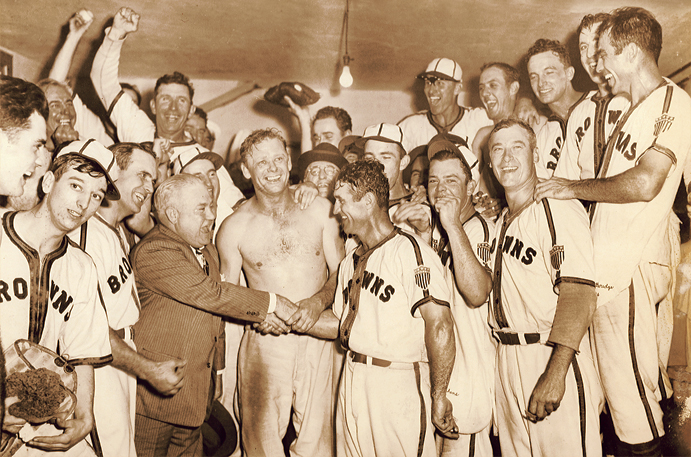
October 1, 1944: The St. Louis Browns beat the New York Yankees, 5-2 at Sportsman's Park in St. Louis. This, combined with the Detroit Tigers' 4-1 loss to the Washington Senators at Briggs Stadium in Detroit, enables the Browns to clinch the American League Pennant. It is their first. They are the last of Major League Baseball's "Original 16" teams (a term not used back then) to do so.

Had the Tigers won, or had both they and the Browns lost, a 1-game Playoff for the Pennant would have been held between them. Sportsman's Park was renamed Busch Stadium in 1953, and Briggs Stadium was renamed Tiger Stadium in 1961.

This was only the 2nd time a team had beaten the Yankees to clinch a Pennant. It had previously happened in 1904, when the team that would become known as the Boston Red Sox did it. It would not happen again until the Kansas City Royals did it in the 1980 AL Championship Series. (It has since been done by the Red Sox in 2004, the Texas Rangers in 2010, the Detroit Tigers in 2012, and the Houston Astros in 2017 and 2019.)

Sigmund "Sig" Jakucki outpitches Mel Queen, despite falling behind 2-0 in the 3rd inning. Mike Kreevich led off the bottom of the 4th with a single, followed by a game-tying home run from Chet Laabs. In the 5th, same combination: Single by Kreevich, homer by Laabs. Vern Stephens added a homer in the 8th.

Managed by Luke Sewell, brother of Cleveland Indians Hall-of-Famer Joe Sewell, the Browns finished the season 89-65, finishing 1 game ahead of the Detroit Tigers and 6 ahead of the defending World Champion Yankees. They had previously come the closest to a Pennant in 1922, when, with what was almost certainly a better team, they went 93-61 but finished a game behind the Yankees.

For most of their history, they were terrible, losing 107 games in back-to-back seasons, 1910 and 1911; 108 in 1937; and 111 in 1939. Noting that St. Louis was the center of America's leather industry and the home of several breweries, someone countered the insult of the Washington Senators -- "Washington: First in war, first in peace, and last in the American League" -- with "St. Louis: First in shoes, first in booze, and last in the American League."

In contrast, the St. Louis Cardinals had won National League Pennants in 1926, '28, '30, '31, '34, '42 and '43, and did so again in '44. The Browns were the landlords at Sportsman's Park, the Cards the tenants, but the tenants were more successful.

And it just so happened that the Cards stood in the Browns' way in their 1st World Series. The Browns won Games 1 and 3, bringing them 2 wins from a World Championship. But this would be the high-water mark of the team, as the Cards took the next 3 games for the title.

When World War II ended, and everybody's players came back from the service, the Browns fell back into a condition where mediocrity would have been an improvement. After the 1953 season, they were moved to become the Baltimore Orioles. They did not win another until Pennant, and did not win the franchise's 1st World Championship, until 1966.

The Browns/Orioles franchise and the Cardinals have never played each other in another World Series. Both teams made the Playoffs in the seasons of 1996, 2012 and 2014, but neither team won its respective Pennant in the years in question.

After 1944, there would not be another team winning their 1st Pennant until September 23, 1957, when the Milwaukee Braves do it -- or, if you don't count moved teams, until October 6, 1969, when the Mets pull off their "Miracle."

The last survivor of the 1944 Browns was 2nd baseman Don Gutteridge -- who, ironically, started his career with the St. Louis Cardinals. He lived until 2008, age 96.

*

October 1, 1944 was a Sunday. These other baseball games were played that day:

* A doubleheader was split at the Polo Grounds. The New York Giants beat the St. Louis Cardinals in the opener, 6-5. George Haussmann drew a bases-loaded walk in the bottom of the 13th inning to win it. Giants manager Mel Ott, not yet retired as a player, put himself in the game as a pinch-hitter, but did not reach base.

The Cardinals won the nightcap, 10-6. Ott did not put himself into this game. Stan Musial and Whitey Kurowski hit home runs. The reason the Cardinals dominated the war years is that they lost fewer players to the military draft than most teams. Especially telling is the fact that they won the Pennant every year from 1942 to 1946, except for 1945, the 1 year that Musial missed while serving in the U.S. Navy.

* The Philadelphia Athletics swept a doubleheader from the Cleveland Indians at Cleveland Municipal Stadium, 5-2 and 5-0. Mel Harder had pitched 9 shutout innings in the 2nd game, but ran out of gas, and the A's torched him for 5 runs in the top of the 10th.

* A doubleheader was split at Comiskey Park in Chicago. The Boston Red Sox won the 1st game, 3-1. The Chicago White Sox won the 2nd game, 4-1.

* The Brooklyn Dodgers beat the Cincinnati Reds, 6-5 at Ebbets Field.

* A doubleheader was split at Braves Field in Boston. The Chicago Cubs won the 1st game, 4-3. The Boston Braves won the 2nd game, 7-6.

* And a doubleheader was split at Shibe Park in Philadelphia. The Pittsburgh Pirates won the 1st game, 9-1. The Philadelphia Phillies won the 2nd game, 7-1.

There was only 1 game played in the NFL: The Green Bay Packers beat the Detroit Lions, 27-6 at the Dairy Bowl in the Milwaukee suburb of West Allis, Wisconsin. The Dairy Bowl was a football stadium built in the infield of a speedway, now known as the Milwaukee Mile, at the Wisconsin State Fair Park.

December 31, 1999 & January 1, 2000: The Millennium

December 31, 1999:  The Millennium arrives. The people of planet Earth survived. At a terrible cost. But we hadn't destroyed ourselves. ...