Sunday, July 3, 2022

July 3, 1912: The $11,000 Beauty

July 3, 1912: The New York Giants sweep a doubleheader from the Brooklyn Dodgers, 2-1 and 10-9 at the Polo Grounds.

Note that I didn't say that they swept "their arch-rivals." The Dodgers then thought of the Giants as such, but this was not reciprocated. This was just 4 years after the Giants and the Chicago Cubs had a very nasty Pennant race that included Fred Merkle's "Boner" and the ensuing "playoff" game, so the Giants and their fans still thought of the Cubs as their rivals.

The 2nd game of the doubleheader was a back-and-forth affair, and the great Christy Mathewson had to come in and nail down the save. That had not been the case in the 1st game: Richard William "Rube" Marquard outpitched George Napoleon "Nap" Rucker.

Like Cleveland baseball star Napoleon Lajoie, Rucker was nicknamed "Nap" because of part of his name. Marquard was nicknamed "Rube" because of the great George "Rube" Waddell, another lefthanded pitcher with a great fastball. Marquard had another nickname: The $11,000 Beauty.

A baseball player, an athlete, a tough guy, nicknamed "Beauty"? Beats being called the $11,000 Lemon.

Richard William Marquard was born on October 9, 1886 in Cleveland. After going 23-13 for the Canton Chinamen -- yes, such a team name actually existed; the "Progressive Era" was only comparatively progressive -- of the Central League in 1907, and 28-19 to help the Indianapolis Indians win the 1908 American Association Pennant, the New York Giants signed him for $11,000, a record signing for the time -- about $350,000 in 2022 money.

When he got off to a rough start in the majors, going 5-13 in 1909 (but with a 2.60 ERA), the press called him "the $11,000 Lemon." But he led the National League in strikeouts in 1911, helping the Giants win the Pennant, and he became "the $11,000 Beauty."

The win on July 3 made him 19-0 on the season. In fact, he had won his last 26 decisions, dating back to September 4, 1911. He allegedly celebrated by buying an opal stickpin to reward himself. Upon being told by a friend that opals were a jinx, he threw the pin into a river. Too late: If such a curse existed, it had already done its work, and he lost his next decision, to the Cubs of all teams, 7-2 on July 8.

He went 24-7 in 1911, 26-11 in 1912, and and 23-10 in 1913. The Giants won the Pennant in all 3 seasons. After a down year in 1914, the Giants traded him to the Dodgers -- or the Robins, as they were known from 1914 to 1931, while Wilbert Robinson was their manager. In 1916, he went 13-6, and Jeff Pfeffer went 25-11, and the Robins won the Pennant. (Rucker was still on the team, but was hurt most of the season.)

In 1920, Marquard helped the Robins win yet another Pennant. They were set to play the Cleveland Indians -- his hometown team. On October 9, his 34th birthday, a few hours before Game 4, the 1st World Series game ever played in Cleveland, Marquard was arrested. He tried to sell a ticket for $350 ($5,121 in 2022 money -- and you thought Yankee Stadium tickets were expensive now!), but his would-be customer is an undercover cop. When the case went to court, he was found guilty, and fined one dollar, plus court costs, for a total of $3.80 -- about $55.60 now.

His teams went 0-5 in World Series play. He was 2-5 with a 3.07 ERA in World Series games. He retired after the 1925 season, at which point he was 201-177, with a 3.08 ERA, a 1.237 WHIP, and 1,593 strikeouts -- at the time, 3rd all-time by a lefthander, trailing only Waddell and Eddie Plank. He was elected to the Baseball Hall of Fame in 1971, and lived until 1980.

Dave Bancroft, a Hall of Fame shortstop acquired by the Giants after Marquard left them, was also nicknamed "Beauty."

*

July 3, 1912 was a Wednesday. These other baseball games were played that day:

* The New York Highlanders (renamed the Yankees the next season) were swept in a doubleheader by the Washington Senators, 3-2 and 10-2 at American League Park (later renamed Griffith Stadium) in Washington. In the 1st game, Jack Martin got 3 hits, but the rest of the Highlanders only managed 6 hits off Jim "Hippo" Vaughn. Walter Johnson outpitched Ray Fisher in the 2nd game.

* The Philadelphia Phillies beat the Boston Braves, 8-5 at Braves Field in Boston.

* The Boston Red Sox beat the Philadelphia Athletics, 7-2 at Shibe Park (later to be renamed Connie Mack Stadium) in Philadelphia. Tris Speaker went 1-for-5 for Boston. Eddie Collins went 2-for-4 for Philadelphia.

* The Cleveland Naps (named for Lajoie) beat the Detroit Tigers, 8-6 at the brand-new Navin Field (later to be renamed Briggs Stadium and Tiger Stadium) in Detroit. Lajoie went 2-for-4 with a walk and an RBI. Shoeless Joe Jackson went 1-for-4 with a walk and an RBI. Ty Cobb went 2-for-5 with an RBI.

* The Chicago White Sox and the St. Louis Browns were rained out at Sportsman's Park (later to be renamed Busch Stadium) in St. Louis. The game was made up as part of a doubleheader on September 24. The White Sox won the 1st game, 6-2. The 2nd game was tied 2-2 after 10 innings, and was then called due to darkness.

* And the Chicago Cubs, the Cincinnati Reds, the Pittsburgh Pirates and the St. Louis Cardinals were not scheduled.

July 3, 1905: France Finally Separates Church and State

Émile Loubet

July 3, 1905: The Chamber of Deputies, the lower house of France's national legislature, passes a bill for the separation of church and state, 341 to 233. It becomes law in the nation's Third Republic, and remains so into its Fifth Republic.

This is bigger than it might appear to a 21st Century audience. It is often presumed that the French Revolution of 1789 to 1795 fully overturned the established order, known as the Ancien Régime. Certainly, there was a desire to overturn the Roman Catholic Church, as much as there was to overturn the royal House of Bourbon. Writer and philosopher Denis Diderot, who died a few years before the Revolution, is credited with saying, "Man will never be free until the last king is strangled with the entrails of the last priest."

But the Revolution fell into the Reign of Terror, and ultimately failed. The stated ideals of Liberté, égalité, fraternité -- liberty, equality and brotherhood --  were tossed aside for the dictatorship, and then the empire, of Napoleon Bonaparte.

This was followed by a conservative retrenchment, a new monarchy that teamed up with the Church to reassert the old values and turn back a few attempted revolutions, including the June Rebellion of 1832, the centerpiece of Victor Hugo's 1862 novel Les Misérables. This was followed by the Second Empire, run by Napoleon's grandnephew, Emperor Napoleon III, before it fell in the Franco-Prussian War in 1870. The Third Republic was subsequently founded.

The Dreyfus Affair that began in 1894 uncovered a considerable amount of anti-Semitism in France, particularly among the nation's Catholics. Finally, in 1905, President Émile Loubet wanted full separation. His popularity, having grown through his settling of the Dreyfus Affair and his diplomacy in building the Triple Entente with Britain and Russia, helped to pass it.

And so, 116 years after 1789, when France had its Revolution, and America's Bill of Rights enshrined freedom of religion into the First Amendment to its federal Constitution, France also had an official separation of church and state -- something that Canada took until 1982, with its Charter of Rights and Freedoms, to have; and that Britain still does not have, as it is officially tied to the Church of England. France has been a largely secular nation ever since, though Catholicism remains the leading religion.

Speaking of Canada: It has been noted that, due to its separation from France proper, the Canadian Province of Quebec, formerly known as New France, faced a tighter grip from the Church than did the "mother country." It would take until the "Quiet Revolution" of the 1960s for that grip to be broken.

This is not to say that the Catholic Church said, "Oh well, we lost this one. Let's move on." Hardly. On February 11, 1906, Pope Pius X wrote a papal open letter titled Vehementer Nos, which is Latin for "We strongly." Given that the Pope is, technically, the Church's monarch, he was speaking for the Church and using "the Royal We."
Pope Pius X

He wrote, "Our soul is full of sorrowful solicitude and Our heart overflows with grief... How, indeed, could it be otherwise, immediately after the promulgation of that law which, by sundering violently the old ties that linked your nation with the Apostolic See, creates for the Catholic Church in France a situation unworthy of her and ever to be lamented?"

He said the new law "must be deplored by all the right-minded." Why? Because it was "disastrous to society as it is to religion." He called it a "great calamity." He wrote, "That the State must be separated from the Church is a thesis absolutely false, a most pernicious error." And why is that? Because it was "a great injustice to God."

God's thoughts on the matter were not recorded by the media that existed at the time.

*

July 3, 1905 was a Monday. Johnny Gibson was born. From my original hometown of Bloomfield, New Jersey, he was a runner who competed in the 1928 Olympics in Amsterdam, although he did not win a medal. He later served as the longtime track & field coach at Seton Hall University, and lived to be 101 years old.

These baseball games were played that day:

* The New York Highlanders beat the Philadelphia Athletics, 5-0 at Hilltop Park in Upper Manhattan. Al Orth, a pitcher known as "The Curveless Wonder," pitched a 4-hit shutout. Willie Keeler went 3-for-4 with an RBI for the Highlanders, who became the New York Yankees in 1913.

* The New York Giants beat the Philadelphia Phillies, 9-1 at National League Park (later renamed Baker Bowl) in Philadelphia.

* The Brooklyn Superbas beat the Boston Beaneaters, 2-1 at Washington Park in Brooklyn. The Superbas became the Brooklyn Dodgers in 1911, and the Boston team became the Braves in 1912.

* The Boston Americans, forerunners of the Red Sox, beat the Washington Senators, 6-2 at the Huntington Avenue Grounds in Boston.

* The Pittsburgh Pirates beat the Cincinnati Reds, 4-3 at Exposition Park in Pittsburgh. Honus Wagner went 2-for-3 with a walk and an RBI.

* And the Chicago White Sox, the Cleveland Naps (forerunners of the Indians and the Guardians), the Detroit Tigers, the St. Louis Browns, the Chicago Cubs and the St. Louis Cardinals were not scheduled.

Saturday, July 2, 2022

July 3, 1890: Idaho Is Admitted As the 43rd State

July 3, 1890: Idaho is admitted to the Union as the 43rd State.

Idaho is in the Rocky Mountains, although some people consider it part of the Northwest. It had been acquired as part of the Oregon Treaty of 1846, with the Idaho Territory being separated in 1863. It has become known for its production of potatoes.

Politically, Idaho has been Western conservative, with a libertarian bent: Pro-gun, pro-landowner. In the 1964 Presidential election, along with Nebraska (47.4 percent) and his home State of Arizona (50.4 percent), Idaho (49.1 percent) was 1 of only 3 States outside the South that gave Barry Goldwater more than 45.1 percent of the vote; and it hasn't voted for the Democratic nominee for President since that time with Lyndon Johnson.

Their highest-ranking politician has been Dirk Kempthorne: Mayor of the capital city of Boise from 1986 to 1993, then U.S. Senator until 1999, then Governor until May 26, 2006, when he resigned to accept George W. Bush's appointment as Secretary of the Interior, holding that post to the end of the Administration in 2009.

With 235,000 people, the capital city of Boise is easily the most populous city in the State. So there are no major league teams there. Due to distance, the most popular teams are the Seattle Seahawks (about 500 miles northwest of Boise) and the Denver Broncos (over 800 miles southeast).

The highest-ranking professional sports teams are the Boise Hawks and the Idaho Falls Chukars of the Pioneer League, an independent baseball league roughly equivalent to Class A (three steps below the major leagues); and a pair of minor-league hockey teams, the Boise-based Idaho Steelheads of the ECHL and the Idaho Falls Spud Kings of the USPHL.

The only college playing in the NCAA's Football Bowl Subdivision (FBS, formerly named Division I-A) is Boise State University, where their Albertsons Stadium has the famous blue artificial field known as "the Smurf Turf." In the Football Championship Subdivision (FCS, formerly named Division I-AA), the University of Idaho play in Moscow, close to a State Line, so that the nearest school is actually Washington State University; and Idaho State University, in Pocatello. The State has several ski resorts.

*

July 3, 1890 was a Thursday. It was the year of the Players' League revolt in baseball, 1 of only 4 seasons -- 1884, 1914 and 1915 being the others -- that what we now call Major League Baseball had 3 leagues.

In the National League:

* The New York Giants lost to the Pittsburgh Pirates, 4-0 at Recreation Park in Pittsburgh.

* The Brooklyn Bridegrooms lost to the Cincinnati Reds, 9-6 at League Park in Cincinnati. In 1899, the Bridegrooms -- so named because several players got married in the 1887-88 off-season -- became the Superbas. In 1911, they became the Dodgers.

* The Boston Beaneaters beat the Cleveland Spiders, 8-0 at National League Park in Cleveland. This ballpark was replaced by a new League Park in 1891, which was replaced by another League Park in 1910, which became home of the team that became the Cleveland Indians until 1946. The Spiders folded after the 1899 season. The Beaneaters became the Braves in 1912.

* The Chicago Colts beat the Philadelphia Phillies, 8-5 at West Side Park in Chicago. The Colts became the Cubs in 1903.

There were no games that day in the American Association. In the Players' League, none of whose teams survived its folding after the season, there were 3 games:

* The PL's version of the New York Giants beat the Cleveland Infants, 5-0 at Brotherhood Park in Cleveland. I can find no record of why the Cleveland team was called the Infants. Maybe they wanted to emphasize that their league was new and unconnected to what they saw as the corruption in established baseball. Or maybe they once reacted poorly to a loss, and were called "crybabies," and "Infants" came from that. There was not much imagination in the PL teams' names, the "Infants" aside.

* The Brooklyn Ward's Wonders beat the Buffalo Bisons, 9-3 at Olympic Park in Buffalo. The Brooklyn team was named after their star shortstop, the PL's founder, John Montgomery Ward. Although the Buffalo Bisons name would be applied to later teams in multiple sports, this team died with the PL.

* And the Chicago Pirates, beat the PL's version of the Philadelphia Athletics, 8-6 at South Side Park in Chicago. This is not the same South Side Park that would later be the 1st home of the American League's Chicago White Sox and the Negro Leagues' Chicago American Giants.

July 3, 1886: The 1st Automobile

July 3, 1886: Karl Benz publicly unveils for his Benz Patent-Motorwagen in Mannheim, Baden-Württemberg, Germany. It is a motor tricycle with a rear-mounted 58.2 cubic-inch internal-combustion engine. He drives it on the Ringstrasse, at 10 miles per hour.

It is the first automobile. It was financed by the dowry of his wife, the former Bertha Ringer.

Karl Friedrich Michael Vaillant was born on November 25, 1844 in Mühlburg, Baden-Württemberg. His parents, Josephine Vaillant and Johann Georg Benz, were not yet married at the time of his birth. After their marriage, he was renamed Karl Friedrich Benz.

Although he was only 2 years old when his father died, Karl followed him into the profession of locomotive engineering. He combined this with his love of bicycles, and looked for a way to combine them into a single vehicle. The Benz Patent-Motorwagen was the result.
In 1888, Bertha Benz drove Benz Patent-Motorwagen Number 3 from Mannheim to Pforzheim, Baden-Württemberg -- 121 miles. She did this without telling her husband. This drive, and the Number 3's display at the 1889 World's Fair in Paris, helped to popularize the automobile.

Gottlieb Daimler was working on an automobile as early as 1885, and made his first successful one in 1892. His engineering partner was Emil Jellinek, who had a daughter named Mercedes. Daimler died in 1900, and he and Benz never met. Nevertheless, in 1926, 3 years before Karl Benz died, the companies merged as Daimler Benz. "Mercedes-Benz," or just "Mercedes," would become renowned as the greatest automobiles in the world -- even if German competitors BMW (Bavarian Motor Werks) would call their car, in commercials airing in America, "the ultimate driving machine."

*

July 3, 1886 was a Saturday. These games were played in baseball's National League:

* The New York Giants beat the Chicago White Stockings, 7-3 at West Side Park in Chicago. The White Stockings became the Cubs in 1903, although their former name would be taken up by an AL team in 1901, later shortened to "White Sox."

* The Detroit Wolverines beat the Boston Beaneaters, 7-5 at Recreation Park in Detroit. The Wolverines would win the Pennant in 1887, but rising costs forced them out of business after the next season. The Beaneaters would go through a few name changes, before becoming the Braves in 1912.

* The St. Louis Maroons beat the Washington Nationals, 3-2 at an early version of Sportsman's Park in St. Louis. This would be the last season for the Maroons. The Nationals were consolidated out of existence after the 1899 season, although their name would be taken up by the moved Montreal Expos in 2005.

* The Philadelphia Quakers beat the Kansas City Cowboys, 8-2 at Association Park in Kansas City. This would be the only season for the Cowboys. The Quakers became the Phillies in 1891.

And in the American Association:

* The New York Metropolitans beat the Louisville Colonels, 15-7 at Eclipse Park in Louisville, Kentucky. The Metropolitans, like the NL team founded in 1962, were called the Mets for short, but only lasted 1 more season. The Colonels joined the NL in 1892, but were consolidated out of existence after the 1899 season.

* The Brooklyn Grays lost to the St. Louis Browns, 4-0 at Sportsman's Park. The Grays joined the NL in 1890, the Browns in 1892. The Browns would become the Cardinals in 1900, although their former name would be taken up by an AL team in 1902. The Grays would go through a few name changes, and became the Dodgers in 1911.

* The Baltimore Orioles beat the Pittsburgh Alleghenys, 12-3 at Recreation Park in Pittsburgh. The Alleghenys joined the NL in 1887, the Orioles in 1892. The Alleghenys became the Pirates in 1891. The Orioles were consolidated out of existence after the 1899 season, although their name would be taken up by the St. Louis Browns when they moved to Baltimore in 1954.

* The Cincinnati Red Stockings beat the Philadelphia Athletics, 8-2 at American Park in Cincinnati. The Red Stockings joined the NL and changed their name to the Reds, both in 1890. That same year, this version of the Athletics folded, though their name would be taken up by an AL team in 1901.

July 2, 1994: Andrés Escobar Is Killed

July 2, 1994: The World Cup continues in America, with the Round of 16. Spain beat Switzerland, 3-0 at RFK Stadium in Washington. And Germany beat Belgium, 3-2 at the old Soldier Field in Chicago.

Unfortunately, the worst thing that could have happened as a result of this World Cup happened: Somebody was killed. Not in the stands, or outside the stadium, in a hooligan fight. Not even on U.S. soil. But because of something that happened inside the stadium. Andrés Escobar was 27 years old.

On ESPN, Steve Levy made the point that we may mock notable sports goats like Ralph Branca and Bill Buckner, but we don't kill them. That was not true with Andrés Escobar.

Born in 1967 in Medellín, he had been a centerback for his hometown team, Atlético Nacional, helping them win the Copa Libertadores, South America's version of Europe's Champions League, in 1989; and Colombia's national league, Primera A, in 1991. He was considered one of the best players in the country.

But Medellín was also the capital of the country's drug trade, home of the Medellín Cartel, run by the unrelated Pablo Escobar, killed in a shootout with the National Police the preceding year. Colombia's drug issues were so bad that, in 1983, having been awarded the 1986 World Cup, the federal government handed it back to FIFA, claiming they could not guarantee the safety of the players and the spectators. It was held in Mexico City instead.

It was suspected that some of the drug lords, in a flash of patriotism, had bet heavily on their national team during the World Cup, and lost big in part due to the own goal committed by Andrés Escobar in the 35th minute of Colombia's 2-1 loss to the U.S. on June 22 at the Rose Bowl in Pasadena.

Colombia finished last in their Group. Afterward, Escobar decided to return to Colombia instead of visiting relatives in Las Vegas. On July 1, he called his friends, and they went to the El Indio nightclub. His friends split up.

At approximately 3:00 the next morning, Escobar was alone in the parking lot of El Indio, in his car, when 3 men appeared. They began arguing with him. Two of the men took out handguns. Escobar was shot six times with a .38 caliber pistol. It was reported that the killer shouted "¡Gol!" ("Goal!") after every shot. The group then drove away in a Toyota pick-up truck, leaving Escobar to bleed to death. Escobar was taken to the hospital where he died 45 minutes later.

In 2013, Francisco Maturana, Escobar's manager at Atlético Nacional, denied that Escobar's murder had any connection to football or the World Cup, but rather was due to his being "in the wrong place at the wrong time" at a violent time in Colombia's history. Few people believed him.

In 2001, as Colombia was preparing to host the Copa América, South America's national-team tournament, the city of Medellín inveiled a statue of Andrés Escobar.

*

July 2, 1994 was a Saturday. These Major League Baseball games were played:

* The New York Yankees lost to the Seattle Mariners, 12-6 at Yankee Stadium. Dave Fleming outpitched Jimmy Key. Ken Griffey Jr. went 5-for-6 with an RBI. Bernie Williams hit a home run.

* The New York Mets lost to the San Diego Padres, 4-1 at Jack Murphy Stadium in San Diego. Tony Gwynn went 3-for-4 with a walk and 3 RBIs. Rico Brogna hit a home run for the Mets, but they only had 3 other hits and a walk.

* The Boston Red Sox beat the Oakland Athletics, 10-2 at Fenway Park in Boston. Mo Vaughn, Tom Brunansky and Wes Chamberlain hit home runs for the BoSox. Rickey Henderson went 0-for-2 before being removed for a pinch-hitter.

* The California Angels beat the Baltimore Orioles, 1-0 at Camden Yards in Baltimore. Cal Ripken went 2-for-3.

* The Atlanta Braves beat the Florida Marlins, 5-0 at Joe Robbie Stadium (now Hard Rock Stadium) in Miami Gardens, Florida. Greg Maddux pitched 7 innings of 4-hit shutout ball, and 2 relievers finished the 4-hit shutout.

* The Houston Astros beat the Chicago Cubs, 5-4 at the Astrodome in Houston.

* The Cincinnati Reds beat the Pittsburgh Pirates, 8-2 at Three Rivers Stadium in Pittsburgh.

* The Cleveland Indians beat the Minnesota Twins, 9-1 at Jacobs Field (now Progressive Field) in Cleveland.

* The Chicago White Sox beat the Milwaukee Brewers, 5-0 at the new Comiskey Park (now Rate Field) in Chicago. Alex Fernandez pitched a 4-hit shutout, no walks, 10 strikeouts.

* The Colorado Rockies beat the St. Louis Cardinals, 7-5 at Busch Memorial Stadium in St. Louis.

* The Toronto Blue Jays beat the Kansas City Royals, 7-6 at Kauffman Stadium in Kansas City.

* The Detroit Tigers beat the Texas Rangers, 6-1 at The Ballpark (now Choctaw Stadium) in the Dallas suburb of Arlington, Texas.

* The Los Angeles Dodgers beat the Philadelphia Phillies, 9-3 at Dodger Stadium in Los Angeles.

* And the Montreal Expos beat the San Francisco Giants, 10-9 at Candlestick Park in San Francisco. Barry Bonds went 0-for-2 with 2 walks.

July 2, 1981: The Meadowlands Arena Opens

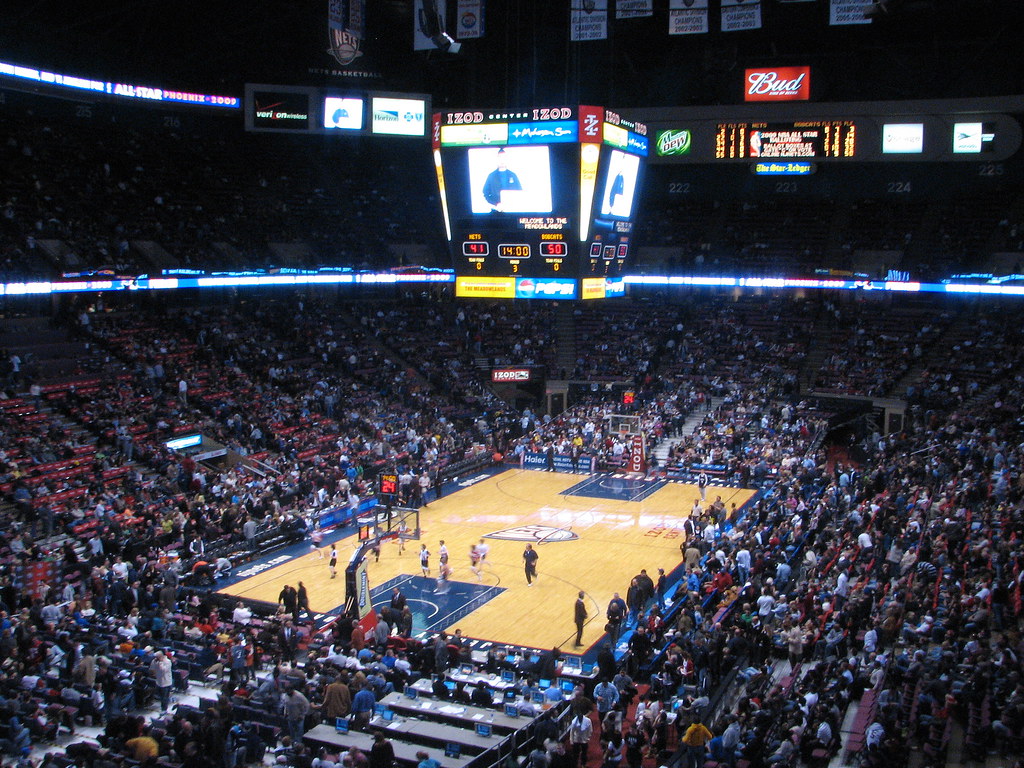
July 2, 1981: The arena planned for the Meadowlands Sports Complex in East Rutherford, Bergen County, New Jersey opens. It is named the Brendan Byrne Arena, for the outgoing Governor who got it built.

It is 7.7 miles west of Times Square in Midtown Manhattan, New York City -- like its football neighbor, Giants Stadium, roughly the same distance as Yankee Stadium in The Bronx, north, and Shea Stadium in Queens, east; but across a State Line, so there is, however subtle, a culture shift.

The Complex is off Exit 16W of the Western Spur of the New Jersey Turnpike, at the intersection of New Jersey Route 3. New Jersey Route 120 -- at the time, Route 20 -- bisects the complex: The Stadium and the Racetrack are to the west, the Arena to the east. For most of the arena's existence, its address has been 50 Route 120.

The 1st event was a concert by Bruce Springsteen & The E Street Band. Bruce, a native of Freehold, Monmouth County, New Jersey, began a 6-night stand there. Other notable acts to perform there during their heyday include the Rolling Stones in 1981, Queen in 1982, Rush and New Jersey natives Bon Jovi in 1986, Michael Jackson in 1988, and The Dave Matthews Band in 1999.
On December 7 and 8, 2003, Paul Simon and Art Garfunkel played the Arena during their Old Friends Reunion Tour. The opening act was one of their inspirations, without whom they never would have made it: The Everly Brothers.

The intended main tenant for the building was the NBA's New Jersey Nets, who had spent the previous 4 seasons at the 9,000-seat Rutgers Athletic Center after moving from Long Island as the New York Nets. Their 1st game was on October 30, 1981, and they lost to their neighbors (they were rarely "rivals"), the New York Knicks, 103-99.
The Nets made the Playoffs in their 1st 5 seasons in the building, and in 15 of their 29 overall seasons there. They won the NBA Eastern Conference title in 2002 and 2003. They won the Atlantic Division in 2002, '03, '04 and '06. Sounds decent.

But they had as many horrible seasons as good ones. They went 19-63 in 1987-88, 17-65 in 1989-90, 16-34 in 1999, and 26-56 4 times. They were 12-70 in their last season in the building, 2009-10. And when they finally got into the NBA Finals, they were swept by the Los Angeles Lakers in 2002, and lost in 6 games to the San Antonio Spurs in 2003.

Finally, on March 24, 2004, Bruce Ratner bought the team, and announced the intention to move them to a new arena he was planning for Brooklyn. It didn't open until the start of the 2012-13 season, leaving the Nets as a lame duck franchise for a whopping 8 years, the last 2 (2010-11 and 2011-12) at the Prudential Center in Newark.

From 1985 to 2007, Seton Hall University, in nearby South Orange, Essex County, used the Arena for games too big for their 1,655-seat on-campus Walsh Gymnasium. They reached the NCAA Final in 1989, losing to the University of Michigan in overtime. In the 2010-11 season, after every other tenant had left, Fordham University in The Bronx used it as home court for 4 games.

In 1996, the NCAA Division I Men's Basketball Tournament held its Final Four at the Arena, and this remains the only time it's been held in the New York Tri-State Area since 1951. On March 30, the Semifinals were held: The University of Kentucky beat the University of Massachusetts, 81-74; and Syracuse University beat Mississippi State University, 77-69. In the Final on April 1, Kentucky beat Syracuse, 76-67.

The New Jersey Sports and Exposition Authority, which oversees the Meadowlands Complex, also wanted to bring an NHL team to the Arena. On May 27, 1982, they got one: The New Jersey Devils. The franchise had begun play in 1974, as the Kansas City Scouts. After 2 terrible seasons, they were sold to a group that moved them to Denver, Colorado, and renamed them the Colorado Rockies, a name that would later be given to Denver's Major League Baseball team.

The Devils played their 1st regular-season game on October 5, 1982, a 3-3 tie against the Pittsburgh Penguins. For 5 years, they were terrible, enduring such slights as a 13-4 loss away to the Edmonton Oilers in 1983, after which Wayne Gretzky called the Devils "a Mickey Mouse operation"; a snow-ridden game in 1987 that attracted only 334 fans; and games against nearby teams like the New York Rangers, the New York Islanders, the Philadelphia Flyers and the Boston Bruins that seemed like home games for the visitors.

Finally, in the 1987-88 season, the Devils made the Playoffs, and got to within 1 game of the Stanley Cup Finals. They did so again in 1993-94, but lost a Game 7 to the Rangers in double overtime at Madison Square Garden, after blowing Game 6 at home.
They became more successful than the Nets ever have, winning the Stanley Cup at home on June 24, 1995, beating the Detroit Red Wings, 5-2, to complete a 4-game sweep. They won the Cup on the road in Dallas in 2000, and at home again in 2003 against Anaheim. The Devils appeared in 1 other Finals, in 2001, losing at home in Game 6 and in Denver in Game 7.
Scott Stevens lifts the Stanley Cup at the Brendan Byrne Arena,
June 24, 1995. One of the greatest nights of my life.

In the Spring of 2003, the Arena hosted both the NBA and the NHL Finals, something done by only 4 other arenas: The Boston Garden in 1957, '58 and '74; Madison Square Garden in 1972 and '94; The Spectrum in Philadelphia in 1980; and the Chicago Stadium in 1992. (None has ever won both, with some John Starks bricks preventing the closest call in 1994.) The Arena hosted the NBA All-Star Game in 1982, and the NHL All-Star Game in 1984.

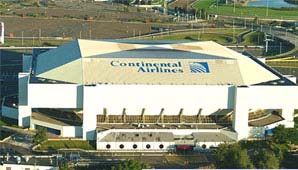
In 1996, a Republican-controlled State legislature, angry at Byrne for signing the State's income tax into law, vengefully took his name off the building, and put, of course, a corporation's name on it, that of Continental Airlines, based at Newark International Airport. Byrne said, "I was immortal for 15 years." Byrne lived until 2018, outliving the usefulness of the arena named for him, if not the building itself. Byrne also outlived Continental Airlines: They were bought out by United Airlines in 2012.
Building a sports complex in East Rutherford, just off the New Jersey Turnpike, close to the Lincoln Tunnel and to New York City, seemed like a great idea in the 1970s. But after Giants Stadium and the Meadowlands Racetrack opened in 1976, the drawbacks kicked in.

There was plenty of parking, but it was poorly managed. Getting in and out took forever. Taking public transportation was no good: You couldn't do it from most of New Jersey, as the Meadowlands Rail Line didn't open until 2009 (in time for the football teams to move next-door to what's now MetLife Stadium), and the buses from New York's Port Authority Bus Terminal got stuck in traffic on Routes 495 and 3.

And the smell wasn't too good, even before all that exhaust settled over the area, and combined with the natural swamp air to form what Jerry Seinfeld might have called "some sort of mutant funk."

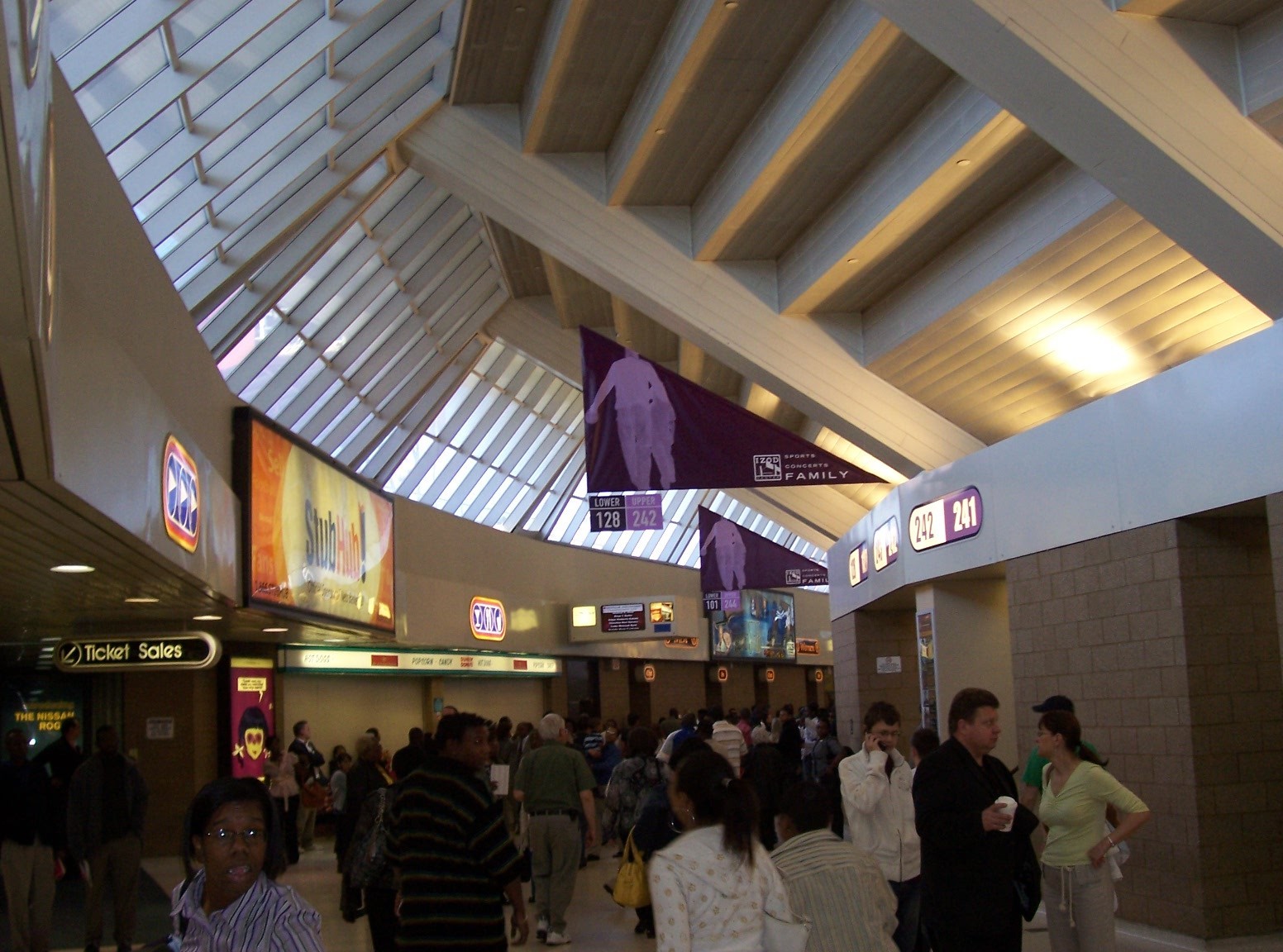
The arena that opened in 1981, known as the Izod Center from 2007 until the building's official closing in 2015 -- didn't improve things. One level of concourse for two levels of seats simply doesn't work if there's more than 12,000 people in the building. Then again, until the Nets got good in the 2001-02 season, that was rarely a problem for them. It wasn't a problem all that often after that, either. And it wasn't often a problem for the Devils, either.
The arena was drafty, especially in the upper deck. The sight lines weren't great: The older Madison Square Garden and Nassau Coliseum both had better ones. The sound didn't carry well, even though the sound system was always too loud -- perhaps to cover up for the fact that crowds generally weren't big, unless championship teams with marquee players were in.

The Nets and the Devils both had to get out of that arena. Both did. After considering building next-door, and next-door to the Hoboken Terminal, the Devils opened the Prudential Center in downtown Newark in 2007. The Nets moved there in 2010, and finally the Barclays Center in Brooklyn opened in 2012, and the Nets moved there.
Surrounded by the American Dream Meadowlands retail complex

The Meadowlands Arena, all naming rights having lapsed, was closed in 2015, and was targeted for demolition. But not so fast: It has found a second life, converted into a TV and film studio, for productions such as the new version of The Equalizer, starring Queen Latifah, who, under her original name of Dana Owens, was an All-State basketball player at nearby Irvington High School in Essex County.

Not what we expected the Arena to be on its 40th Anniversary -- but at least it got to have one. Some stadiums and arenas with better histories don't last that long.

*

July 2, 1981 was a Thursday. The NFL, the NBA and the NHL were all out of season. And the Major League Baseball Players' Association was on strike.

But there was one score on this historic day. It was in the Canadian Football League. The Saskatchewan Roughriders beat the Toronto Argonauts, 19-18 at Exhibition Stadium in Toronto.

July 2, 1980: "Airplane!" Premieres

Left to right: Julie Hagerty, Leslie Nielsen,
Lorna Patterson and Robert Hays

July 2, 1980: Airplane! premieres. It may be the funniest movie ever made.

Jerry Zucker, Jim Abrahams, and David Zucker (collectively known as Zucker, Abrahams and Zucker, or ZAZ) wrote Airplane! while they were performing with the Kentucky Fried Theatre, a theatre group they founded in 1971. To obtain material for comedy routines, they routinely recorded late-night television, and reviewed the tapes later primarily to pull the commercials, a process Abrahams compared to "seining for fish."

During one such taping process, they unintentionally recorded the 1957 film Zero Hour!, and, while scanning the commercials, found it to be a "perfectly classically structured film" according to Jerry Zucker. Abrahams later described Zero Hour! as "the serious version of Airplane!"

It was the first film script they wrote, completed around 1975, and was originally called The Late Show. The script originally stayed close to the dialog and plot of Zero Hour!, as ZAZ thought they did not have a sufficient understanding of film at the time to structure a proper script. ZAZ's script borrowed so much from Zero Hour! that they believed they needed to negotiate the rights to create the remake of the film and ensure they remain within the allowance for parody within copyright law.

They were able to obtain the rights from Warner Bros. and Paramount for about $2,500 at the time. The original script contained spoofs of television commercials, but people who proofread it advised them to shorten the commercials, and they eventually removed them. When their script was finished, they were unable to sell it.

While failing to sell their script, the trio met director John Landis, who encouraged them to write a film based on their theatre sketches. They managed to put The Kentucky Fried Movie into production in the late 1970s, and released it in 1977. David Zucker said, "It was the first time we had ever been on a movie set. We learned a lot. We learned that if you really wanted a movie to come out the way you wanted it to, you had to direct. So, on the next movie, Airplane!, we insisted on directing."

Eventually the Airplane! script found its way to Paramount through Michael Eisner. Eisner learned of the script via Susan Baerwald, another scriptwriter with United Artists, and had Jeffrey Katzenberg track down and meet with ZAZ to discuss details. Avco Embassy Pictures also expressed interest in producing the film, but ZAZ decided to go with Paramount. Paramount insisted the film be shot in color rather than black-and-white as ZAZ wanted, and to be set aboard a jet airliner rather than a propeller plane, to better identify with modern filmgoers.

In exchange, Paramount acquiesced to ZAZ's desire to cast serious actors for the film rather than comedy performers. Jerry Zucker stood beside the camera during shooting, while David Zucker and Abrahams watched the video feed to see how the film would look; they conferred after each take.

David Zucker explained that "the trick was to cast actors like Robert Stack, Leslie Nielsen, Peter Graves, and Lloyd Bridges. These were people who, up to that time, had never done comedy. We thought they were much funnier than the comedians of that time were." He felt Stack was the most important actor to be cast, since he was the "linchpin" of the film's plot.

Stack initially played his role in a way that was different from what the directors had in mind. They showed him a tape of impressionist John Byner impersonating Robert Stack. According to the producers, Stack was "doing an impression of John Byner doing an impression of Stack." Stack was not initially interested in the part, but ZAZ persuaded him. Bridges' children, including his sons Jeff and Beau, by then actors themselves, advised him to take the part.

For the role of Dr. Rumack, ZAZ initially suggested Dom DeLuise, Christopher Lee, and Jack Webb, all of whom turned it down, before they considered Nielsen, who was "just a fish in water" in his role, according to Jerry Zucker. Nielsen's career to this point had consisted mostly of serious leading roles, but he wanted to work in comedy, and was looking for a film to help in the transition. He was considered a "closet comedian" on set, pranking his fellow actors between shots, but immediately adopted his somber, serious persona when performing as Rumack. Lee would later acknowledge that turning down the role, to star in the 1979 film 1941 with John Belushi, was a huge mistake.

It's one of the most quotable movies of all time:

* Roger Murdock (co-pilot, played by Kareem Abdul-Jabbar): We have clearance, Clarence.
Captain Clarence Oveur (Graves): Roger, Roger. What's our vector, Victor?
Tower voice: Tower's radio clearance, over!
Oveur: That's Clarence Oveur. Over.

* Rumack (Nielsen): You'd better tell the Captain we've got to land as soon as we can. This woman has to be gotten to a hospital.
Elaine Dickinson (a stewardess, played by Lorna Patterson): A hospital? What is it?
Rumack: It's a big building with patients, but that's not important right now.

* Rumack: Captain, how soon can you land?
Captain Oveur (Graves): I can't tell.
Rumack: You can tell me. I'm a doctor.

* Rumack: Can you fly this plane, and land it?
Ted Striker (Robert Hays): Surely, you can't be serious.
Rumack: I am serious, and don't call me Shirley.
Ted: I flew single-engine fighters in the Air Force, but this plane has four engines. It's an entirely different kind of flying, altogether.
Rumack and Randy, at the same time: It's an entirely different kind of flying.

* Steve McCroskey (Bridges, handing Johnny a sheet of paper with information on it): Johnny, what can you make out of this?
Johnny (Steven Stucker): This? Why, I can make a hat, or a brooch, or a pterodactyl.

* In the original movie, the flight director said, "Looks like I picked the wrong week to quit smoking." As McCroskey, Bridges repeated this. Later in the movie, it was "Looks like I picked the wrong week to quit drinking," and he drank out of a flask. Later still, he popped a pill, and said, "Looks like I picked the wrong week to quit amphetamines." Finally, as the plane was coming in, he said, "Looks like I picked the wrong week to quit sniffing glue!" And it's this that finally gets to him, and sends him crashing through the window, literally over the edge.

Not all of the movie holds up. Some of the jokes are period-specific. The war flashbacks are to World War II, when they should be to Vietnam. And there's racial references and a scene of a woman getting slapped that would not be allowed today.

A sequel was released in 1982, titles Airplane II: The Sequel. This involved a bomb on a flight to the Moon, and had William Shatner replacing Robert Stack as the flight controller.

UPDATE: Jim Abrahams died in 2024. Both Zucker brothers were still alive at the time.

*

July 2, 1980 was a Wednesday. These Major League Baseball games were played that day:

* The New York Yankees beat the Boston Red Sox, 8-0 at Fenway Park. Rudy May pitched a 6-hit shutout. Graig Nettles hit a home run. Reggie Jackson went 1-for-3 with a walk and an RBI. Apparently, the Red Sox were for loading and unloading only. Carl Yastrzemski did not play.

* The New York Mets beat the Chicago Cubs, 3-1 at Shea Stadium, close enough to La Guardia Airport for the sound of planes taking off and landing to be an issue.

* The Montreal Expos beat the Philadelphia Phillies, 6-1 at the Olympic Stadium in Montreal. Steve Rogers outpitched Steve Carlton. Mike Schmidt went 0-for-3 with a walk. Pete Rose went 2-for-4.

* The Atlanta Braves beat the Houston Astros, 14-0 at Atlanta-Fulton County Stadium. Phil Niekro knuckleballed his way to a 5-hit shutout. The Braves scored 7 runs in the 3rd inning. The Astros must have had fish for dinner.

* The Baltimore Orioles beat the Toronto Blue Jays, 6-2 at Exhibition Stadium in Toronto. Eddie Murray went 0-for-4, but drew a walk.

* The St. Louis Cardinals beat the Pittsburgh Pirates, 7-5 at Three Rivers Stadium in Pittsburgh. A single by Ken Oberkfell and a double by Tony Scott gave the Cards the winning runs in the top of the 11th. Willie Stargell only appeared as a pinch-hitter, and drew a walk.

* The Detroit Tigers beat the Cleveland Indians, 7-6 at Tiger Stadium in Detroit.

* The Chicago White Sox beat the California Angels, 1-0 at Comiskey Park in Chicago. Ross Baumgarten pitched a 1-hit shutout, allowing only a walk to Tom Donohue in the 6th inning and a single to Rod Carew in the 7th. Looks like the Angels picked the wrong week to quit hitting.

* The Oakland Athletics beat Milwaukee Brewers, 5-3 at Milwaukee County Stadium. The A's got RBI singles from Jeff Newman and Wayne Gross in the top of the 10th inning. Rickey Henderson did not play. Nor did Paul Molitor. Robin Yount went 1-for-5. 

* The Kansas City Royals beat the Minnesota Twins, 4-3 at Royals Stadium (now Kauffman Stadium) in Kansas City. John Wathan singled Rusty Torres home with the winning run in the bottom of the 10th inning. George Brett did not play.

* The Los Angeles Dodgers beat the San Diego Padres, 10-7 at Dodger Stadium in Los Angeles.

* The Cincinnati Reds beat the San Francisco Giants, 6-2 at Candlestick Park in San Francisco. Johnny Bench did not play.

* And the Texas Rangers beat the Seattle Mariners, 6-3 at the Kingdome in Seattle.

December 31, 1999 & January 1, 2000: The Millennium

December 31, 1999:  The Millennium arrives. The people of planet Earth survived. At a terrible cost. But we hadn't destroyed ourselves. ...