Showing posts with label william shatner. Show all posts

Tuesday, October 11, 2022

October 11, 1963: "The Twilight Zone" Airs "Nightmare at 20,000 Feet"

October 11, 1963: The Twilight Zone, the CBS science-fiction fantasy series created and mostly written by Rod Serling, airs what has become its most popular episode: "Nightmare at 20,000 Feet." It was written by Richard Matheson, who wrote more episodes of the show than anyone but Serling, and also wrote the original version of I Am Legend. It was directed by Richard Donner, who later directed the 1978 film Superman.

It may be the most popular episode because it features William Shatner, later to play Captain Kirk on Star Trek. But it's a riveting story anyway.

It's one of the few pop-culture depictions of mental illness in that era to make the patient appear sympathetic. Shatner plays Robert Wilson, who is flying home with his wife, Julia (Christine White) after 6 months in a psychiatric facility, following a mental breakdown -- on a plane.

His seat is at a window, overlooking the plane's left wing. It is rainy and stormy during the flight, and he sees some sort of creature (referred to in the script as a "gremlin," played by an uncredited Nick Cravat, a stuntman) tearing up an electrical panel on the wing. He knows that if he mentions it, people will think he's crazy, and the authorities on the ground will presume he's had a relapse. He alerts first his wife, then the flight attendant (Asa Maynor), then the flight engineer (Edward Kemmer). None of them sees the gremlin.

Afraid that the plane will crash due to the damaged win, Robert sees a sleeping police officer, takes his gun, straps himself into his seat so he won't be sucked out of the plane due to the difference in air pressure, and opens an emergency exit window. Despite the weather and the speed of the plane, he manages to shoot the gremlin, which falls off.

Safely on the ground, Robert is shown in a straitjacket, strapped to a gurney. He is going back into treatment, yet he is the calmest person on the tarmac. The camera then shows the damage to the plane's engine, meaning that something did damage it. But was it the gremlin? Lightning? The bullets that Robert fired? Or something else? Regardless, he now knows that he no longer has to fear losing his sanity -- even if, for now, he is the only one who knows.

Kemmer was a pilot in real life: He had been a fighter pilot in World War II, shot down and captured alive by the Nazis. He also preceded Shatner as star of a science-fiction TV show, starring on the ABC series Space Patrol from 1950 to 1955. Maynor was then married to Edd Byrnes, who played Kookie on 77 Sunset Strip.

Shatner had previously appeared on The Twilight Zone in another Matheson-panned episode, "Nick of Time," airing on November 18, 1960. He and Patricia Breslin (who, in real life, later married Cleveland Browns/Baltimore Ravens owner Art Modell) played a honeymooning couple seemingly trapped in an Ohio diner by a fortune-telling machine.

Other Trek actors on TZ: Leonard Nimoy had one line in "A Quality of Mercy," December 29, 1961, starring Dean Stockwell as a bigoted soldier in World War II who gets turned into a Japanese soldier, fighting against the Americans; James Doohan played a Mr. Johnson in "Valley of the Shadow," January 17, 1963, about a small town with advanced technology, something Scotty would have appreciated; and George Takei played a Japanese-American gardener who verbally sparred with a WWII vet played by Neville Brand in "The Encounter," May 1, 1964.

When Twilight Zone: The Movie was filmed in 1982, there were 4 episodes re-imagined for it, including "Nightmare at 20,000 Feet" and "A Quality of Mercy." In the latter, Vic Morrow played a bigoted businessman who, the last time we see him, gets put on a cattle car to a Nazi concentration camp, since his anger is at Jews, and blacks, and Asians. Unfortunately, the Asian sequence included a Vietnam War helicopter, and Morrow was among those killed when it crashed. John Lithgow starred in the redo of "Nightmare at 20,000 Feet," with a less fake-looking, and thus a much scarier-looking, "gremlin."
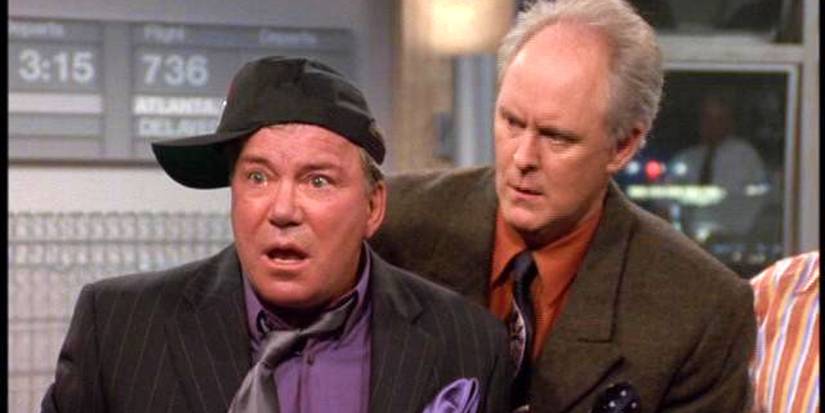
In 1999, Shatner made a guest appearance on the NBC sitcom 3rd Rock from the Sun, playing "The Big Giant Head," the commanding officer of the alien-appearing-as-human Solomon family, led by Lithgow as Dick. The BGH arrives at their local airport, and when asked about his flight he responds, "Horrifying, at first. I looked out the window and... I saw something on the wing of the plane!" Dick says, "The same thing happened to me!"
Rod Serling died in 1975, Nick Cravat in 1994, Ed Kemmer in 2004, Christine White and Richard Matheson in 2013, Richard Donner in 2021. As of October 11, 2022, William Shatner and Asa Maynor are still alive.

*

October 11, 1963 was a Friday. Baseball season was over, having ended 5 days earlier, with the Los Angeles Dodgers completing a 4-game sweep of the New York Yankees in the World Series.

The NBA season hadn't started yet. The NHL season had, but no games were scheduled. There were no games in the NFL. There was 1 in the American Football League: The Boston Patriots beat the Oakland Raiders, 20-14 at Fenway Park in Boston.

There were 4 games in college football:

* Number 4 Navy lost to Southern Methodist University, 32-28 at the Cotton Bowl in Dallas. Navy recovered, and rose back to Number 2, before returning to the Cotton Bowl, and losing to Number 1 Texas.

* Virginia Tech beat George Washington University, 22-8 at District of Columbia Stadium (later Robert F. Kennedy Stadium) in Washington. GWU dropped its football program in 1966.

* Louisiana State University (LSU) beat the University of Miami, 3-0 at the Orange Bowl in Miami.

* And Syracuse beat UCLA, 29-7 at the Los Angeles Memorial Coliseum.

Thursday, September 8, 2022

September 8, 1966: "Star Trek" Premieres

Back row, left to right: James Doohan as Scotty, Walter Koenig as Chekov,
Majel Barrett as Nurse Chapel, Nichelle Nichols as Uhura,
and George Takei as Sulu. Front row: DeForest Kelley as McCoy,
William Shatner as Kirk, and Leonard Nimoy as Spock.

September 8, 1966: The TV series Star Trek first airs on NBC, with the episode "The Man Trap" -- a.k.a. "The Space Vampire."

The show was created by Gene Roddenberry (1921-1991), who had previously been a combat pilot in World War II and a Los Angeles police officer. He pitched it to the network as "Wagon Train to the stars," in essence a Western in space. But with his ship's Captain, he was inspired by C.S. Forester's novels about Captain Horatio Hornblower, and he liked to call his adventures "Hornblower in space."

The show had a pilot filmed in December 1964, titled "The Cage." NBC passed on the story, but approved the concept, and asked for a 2nd pilot. Except for Leonard Nimoy as Spock, it was a completely new cast that filmed "Where No Man Has Gone Before" in July 1965. The show was picked up, although that 2nd pilot didn't air until September 22, 1966, the 3rd episode to air.

As for the pilot, here's the affiliates you could have watched it on, if you were in what would now be considered a "major league" city (note that not all of these are still NBC affiliates, or operating under the same call letters as there were using in 1966):

* Channel 2: WGRZ, Buffalo; WSB, Atlanta; KPRC, Houston; KUTV, Salt Lake City.

* Channel 3: KYW, Philadelphia; WKYC, Cleveland; KSNV, Las Vegas; KCRA, Sacramento.

* Channel 4: WNBC, New York; WRC, Washington; WBZ, Boston; WDIV, Detroit; WTMJ, Milwaukee; WSMV, Nashville; WDAF, Kansas City, KFOR, Oklahoma City; WOAI, San Antonio; KCNC, Denver; KNBC, Los Angeles; KRON, San Francisco.

* Channel 5: WLTW, Cincinnati; WMC, Memphis; WMAQ, Chicago; KSDK, St. Louis; KXAS, Dallas; KING, Seattle.

* Channel 6: WFBM, Indianapolis; WDSU, New Orleans.

* Channel 7: WSVN, Miami.

* Channel 8: WFLA, Tampa; KGW, Portland, Oregon.

* Channel 9: WSOC, Charlotte.

* Channel 10: KGTV, San Diego.

* Channel 11: WBAL, Baltimore; WIIC, Pittsburgh, WTVD, Raleigh.

* Channel 12: WTLV, Jacksonville; KPNX, Phoenix.

The series depicted the USS Enterprise, a starship with a crew of 430, representing the Starfleet (one word) of the United Federation of Planets, a galactic version of the United Nations, headquartered on Earth, at some unspecified point in the future.
Since they didn't want to be locked into an exact time, they obscured this with the clever use of "Stardates." Despite at least 2 episodes suggesting that the series took place around 200 years later, later series would definitively place it 300 years in the future -- i.e., the 1st episode took place in the year 2266.

The ship's mission, partly invoking the late President John F. Kennedy's "New Frontier," was written by  Roddenberry, and recited near the start of each episode by William Shatner:

Space: The final frontier. These are the voyages of the starship Enterprise. Its five-year mission: To explore strange new worlds, to seek out new life and new civilizations, to boldly go where no man has gone before!

The show ran for 3 years, and led to a brief animated series and 6 movies. It has spun off several connected TV series.

Of the main cast, pictured above:

* DeForest Kelley, who played the Chief Medical Officer, Lieutenant Commander Leonard H. McCoy, a.k.a. "Bones," died on June 11, 1999, at the age of 79.

* James Doohan, who played the Chief Engineer, Lieutenant Commander Montgomery Scott, a.k.a. "Scotty," died on July 20, 2005, at 85.

* Majel Barrett, Roddenberry's wife, who played Nurse Christine Chapel (her rank was never stated on the original series), and also voiced the computers on every starship in every show for as long as she lived, died on December 18, 2008, at 76.

* Leonard Nimoy, who played the ship's half-human and half-Vulcan First Officer and Science Officer, Commander Spock, died on February 27, 2015, at 83.

* Nichelle Nichols, who played the Communications Officer, Lieutenant Nyota Uhura, died on July 30, 2022, at 90.

* George Takei, who played the Chief Helmsman, Lieutenant Hikaru Sulu, is 86.

* Walter Koenig, who played a navigator, Ensign Pavel Chekov, is also 86. His character was created when the Soviet Union objected to the fact that, despite their pioneering status in spaceflight, there were no Russians in the Enterprise crew, and Roddenberry admitted they had a point. Koenig said, "When they thought I was Russian, 22 and single, I got more mail than anybody except Leonard (Nimoy). When they found out I was American, 31 and married, the mail dried up."

* And William Shatner, who played Captain James T. Kirk, is 91.

(By the end of their movies' run in 1994, Kirk had been promoted to Admiral, and demoted back down to Captain; Spock, Scotty and Sulu had been promoted to Captain; and McCoy, Uhura, Chekov and Chapel to Commander.)

In a 2011 episode of the YouTube series Epic Rap Battles of History, "Epic" Lloyd Ahlquist played Captain Kirk, although his impersonation sounded more like one of Shatner's exaggerated acting. In non-speaking guest roles, Omar Garaibeh played Spock, and Jon Na played Sulu. Both were ERB crew members. Kirk's opponent was Christopher Columbus, played by "Nice" Peter Shukoff.

*

September 8, 1966 was a Thursday. The next day, the science fiction series The Time Tunnel and the superhero show The Green Hornet debuted.

This was the off-season for the NFL, the AFL, the NBA and the NHL. And, wouldn't you know it, Thursday often being a travel day in Major League Baseball, no games were scheduled for this day. So there were no scores on this historic day.

Don't blame me, blame the leagues.

Wednesday, January 26, 2022

January 26, 1968: ABC Airs "Alexander the Great" With William Shatner & Adam West

January 26, 1968: ABC airs Alexander the Great, which had been filmed as the pilot for an intended TV series -- in 1963. But it wasn't picked up.

So why broadcast it now? Because the actor they had cast as Alexander was well-known for Broadway, and had appeared in the 1961 film Judgement and Nuremberg, and in "Nick of Time," an episode of The Twilight Zone. He would appear in another Twilight Zone episode later in 1963, "Nightmare at 20,000 Feet." More importantly, he was now in the 2nd season of a popular NBC TV show, Star Trek, in which he played the lead role, Captain James T. Kirk. His name was William Shatner.

And, playing Cleander, one of Alexander's officers, was an actor who had appeared on several TV shows, but had also become the lead of a popular TV show in 1966, Batman. His name was William West Anderson, but was acting under the name of Adam West.

So ABC, which was broadcasting Batman, broadcast Alexander the Great, hoping people would watch it to see "Captain Kirk" commanding "Batman." Also of note: John Cassavetes, who played the villain of the piece, Karanos; veteran actor Joseph Cotten, as Antigonus; and Tanya Lemani, an Iranian-American dancer who would play a similar character, an ill-fated dancer in a society mirroring that of Earth's Middle East, on the Star Trek episode "Wolf in the Fold."

The plot is fairly simple: It's 330 BC, and Alexander is marching through the Persian Empire, in pursuit of King Darius III. But he has to face down opposition within his own ranks, led by Karanos.

The episode was not as successful as Alexander: It was shown once, didn't get good ratings, and has never been broadcast again, although it is available on YouTube. Shatner and West were not close, but they remained admirers of each other's work.

As for the real guy: He was born on July 20, 356 BC, in Pella, in what is now northern Greece. He was the son of King Philip II of Macedon. The Greek statesman Demosthenes frequently denounced Philip, resulting in the world "philippic." He died in 336 BC, making his son King Alexander III at age 20.

The following year, he conquered all of Greece, basically without breaking a sweat. The year after that, he decided to punish the Achaemenid Empire, formerly the Persian Empire, for its attempts to conquer Greece a century and a half earlier. Why did he still care? In 4 years, he conquered it, including the Siege of Halicarnassus in 334, the Sieges of Tyre and Gaza in 332, the Battle of Gaugamela (in present-day Iraq) in 331, and the Battle of the Persian Gate at Persepolis (in present-day Iran) in 330.

But he was a fair opponent. When he heard that King Darius III had been killed by his cousin, Bessus, Alexander moved his pursuit to Bessus, and when he was captured, Alexander ordered his execution. Would he have done that had Darius been captured alive? We'll never know. What we do know is that conquering this empire gave him the name that has followed him for over 2,300 years: Alexander the Great.

In 331 BC, he founded a city on the Mediterranean coast of Egypt, naming it for himself: Alexandria. He used it to spread Greek culture throughout the Mediterranean and Middle East regions, including building the foremost library in the ancient world.

In 326 BC, he got as far as the Indus River, into present-day Pakistan, and thus Greek culture reached India, and he brought South Asian culture to the lands he conquered. He had conquered more territory than any human being before him.

And, unlike the one man who has since topped him, Genghis Khan, 1,500 years later, what he left behind stayed: All the knowledge of Greece, Rome, Egypt, Israel, Asia Minor, Mesopotamia, Persia and South Asia has remained, in each of those places and their former empires. Someone (I forget who) called Alexander "a two-thousand year man." He was a man who spread learning, and he was a general who never lost a battle.

But one thing he could not conquer was dissension in his own ranks. He turned back, got to Babylon (near present-day Hillah, Iraq, about 50 miles south of present-day Baghdad), and tried to settle things there, and rule from there. He had planned to invade Arabia, but he died on June 10, 323 BC, in the palace that had been built by King Nebuchadnezzar II, at the age of 33. The cause is still debated: It could have been a fever, it could have been an overdose of alcohol, it could have been poison.

The men among whom he left divisions of his empire couldn't hold it together, and lost their holdings due to their civil wars. While Alexandria still stands, and is the 2nd-largest city in Egypt after Cairo, both the library he built there and the tomb where he was laid to rest no longer exist. The current whereabouts of his remains are unknown. But the Hellenistic culture he founded survives, and Greek became a major language of the world, including in the Byzantine Empire, based in present-day Turkey, until its collapse in 1453.

But for all he achieved, there have been few films about Alexander the Great. Besides the Shatner pilot, he has been played by Richard Burton in Alexander the Great in 1956, and Colin Farrell in Alexander in 2004.

Twice, in Star Trek, to Shatner as Captain Kirk -- once by Leonard Nimoy as Spock, in "Patterns of Force," and one by Steve Ihnat as Captain Garth, excuse me, Lord Garth, in "Whom Gods Destroy," Alexander was listed alongside Julius Caesar, Napoleon Bonaparte, Adolf Hitler and Lee Kuan as would-be conquerors of Earth. Spock added Pharoah Ramses II; Garth added Krotus. (Both Lee Kuan and Krotus were characters created for Star Trek, but neither has ever been canonically explained beyond the mentions of their names.) Neither of those examples mentioned Khan Noonien Singh (Ricardo Montalbรกn), but, in "Space Seed," Spock compared Khan to Alexander and Napoleon. And, in "Requiem for Methuselah," James Daly as the apparently immortal Flint told Kirk that he had been Alexander, among other historical figures.

In a 2016 episode of Epic Rap Battles of History, Zach Sherwin played him against "Nice" Peter Shukoff as Czar Ivan IV of Russia, a.k.a. Ivan the Terrible. It's a "battle royale" that also includes "Epic" Lloyd Ahlquist as King Frederick II of Prussia, a.k.a. Frederick the Great; Mike Betette as Roman general Gnaeus Pompeius Magnus, a.k.a. Pompey the Great; and Meghan Tonjes as Empress Catherine II of Russia, a.k.a. Catherine the Great.

*

January 26, 1968 was a Friday. Baseball and football were out of season. The NHL had no games scheduled. But there were 4 games played in the NBA:

* The New York Knicks lost to the St. Louis Hawks, 103-94 at the Kiel Auditorium in St. Louis. Cazzie Russell scored 31 points in defeat for the Knicks.

* The Los Angeles Lakers beat the Boston Celtics, 118-112 at the Boston Garden. Elgin Baylor scored 33. But the Celtics went on to beat the Lakers in the NBA Finals.

* The Philadelphia 76ers beat the Cincinnati Royals, 123-113 at The Spectrum in Philadelphia. Hal Greer scored 36, Wilt Chamberlain 22. For the Royals, Connie Dierking scored 33, and Oscar Robertson 29.

* And the Baltimore Bullets beat the San Francisco Warriors, 125-110 at the Cow Palace outside San Francisco in Daly City, California. Earl Monroe scored 35

And there were 4 games in the American Basketball Association:

* The Pittsburgh Pipers beat the Minnesota Muskies, 115-107 at the Civic Arena in Pittsburgh. Art Heyman scored 31 for the Pipers.

* The Denver Rockets beat the New Orleans Buccaneers, 104-97 at the Loyola Field House, at Loyola University in New Orleans. Larry Jones scored 34 for the Nuggets.

* The Dallas Chaparrals beat the Houston Mavericks, 122-96 at the Dallas Memorial Auditorium.

* And the Kentucky Colonels beat the Anaheim Amigos, 96-93 at the Anaheim Convention Center.

December 31, 1999 & January 1, 2000: The Millennium

December 31, 1999:  The Millennium arrives. The people of planet Earth survived. At a terrible cost. But we hadn't destroyed ourselves. ...