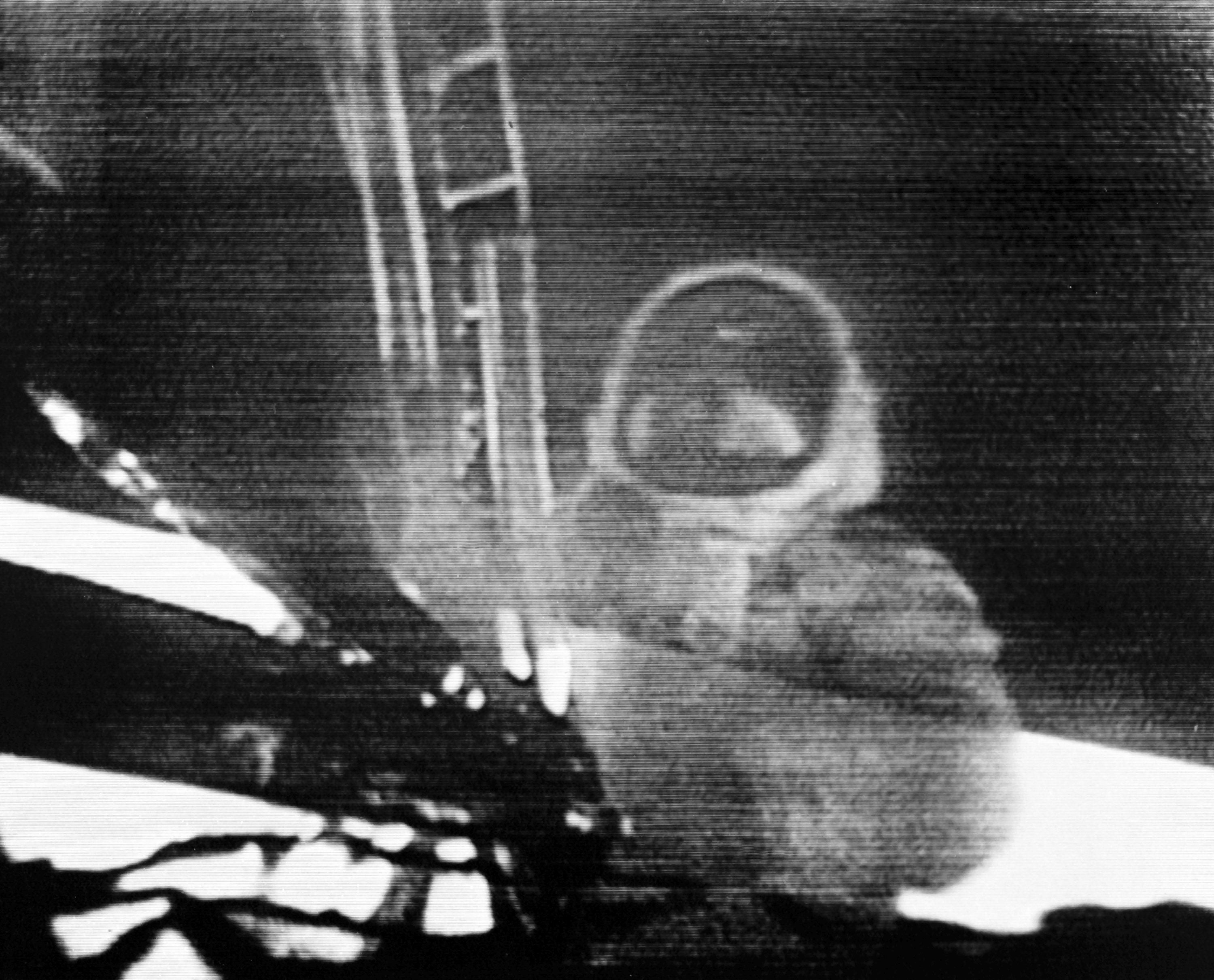
July 20, 1969: At 4:17 PM, U.S. Eastern Time, the lunar module Eagle, of the Apollo 11 mission, landed on the Sea of Tranquility, on the side of the Moon facing Earth, 4 days after being launched from the John F. Kennedy Space Center at Cape Canaveral, on the Atlantic Coast of Florida.
(From 1963, when President Kennedy was assassinated, until 1973, the launch site was known as Cape Kennedy. The Florida legislature changed the name back. Since the NASA facility was still named for JFK, the Kennedy family publicly accepted the decision.)
The mission's commander was Lieutenant Junior Grade Neil Alden Armstrong, U.S. Navy, from Wapakoneta, in western Ohio, about halfway between Toledo and Dayton. In contact with Mission Control, in Houston, Texas, he spoke the 1st words any human had spoken from the surface of another body in our solar system: "Houston, Tranquility Base here: The Eagle has landed."

With him, aboard Eagle, was the craft's pilot, Colonel Edwin Eugene Aldrin Jr., U.S. Air Force, known as Buzz, of the New York suburb of Montclair, Essex County, New Jersey. Orbiting the Moon above them, in the command module Columbia, was Colonel Michael Collins, U.S. Air Force, who grew up in many places around the world, as his father was a high-ranking U.S. Army officer.
All 3 men reached their 39th birthdays during the course of calendar year 1969, and each was taking part in his 2nd spaceflight, with their 1st having happened in 1966: Armstrong had commanded Gemini 8, Collins had flown on Gemini 10, and Aldrin had flown on Gemini 12 in 1966.
At 10:56 PM, Armstrong stepped down the ladder on the side of Eagle, and put his left foot down on the surface of the Moon. He chose his 1st words very carefully, knowing that the whole world would remember them: "That's one small step for a man, one giant leap for mankind."
Except, between his Midwestern accent and the transmission of the words from the Moon to Houston, from Houston to the TV networks in New York, and from the networks in New York through the TV set speakers of the world, it sounded like he said, "One small step for man..." Which made no sense, as "man" and "mankind" were usually interchangeable.
It didn't matter. A man was standing on the Moon, and he was an American. Buzz Aldrin followed Armstrong a few minutes later. Four days later, they returned to Earth, and got a ticker-tape parade in New York City.
 Every Summer, my grandparents rented a bungalow at South Seaside Park, on the Jersey Shore. This was that weekend for 1969. They, and my parents, watched the Moon landing at The Sand Bar. Not yet born, I tell people I had "an obstructed view." The bar is still there, and is now Chef Mike's Atlantic Bar & Grill, or "The ABG." It is 84 road miles south of Midtown Manhattan.
None of the Apollo 11 astronauts suffered any ill effects from their trip. None of them ever went into space again. None had to.

Collins would be appointed an Assistant Secretary of State, and serve as the director of the Smithsonian Institution's National Air and Space Museum in Washington, D.C., where Columbia is on display. Aldrin battled clinical depression and alcoholism, recovered, and has become an advocate for recovery and for the space program.
Left to right: Neil Armstrong, Michael Collins, Buzz Aldrin
All 3 men reached their 39th birthdays during the course of calendar year 1969, and each was taking part in his 2nd spaceflight, with their 1st having happened in 1966: Armstrong had commanded Gemini 8, Collins had flown on Gemini 10, and Aldrin had flown on Gemini 12 in 1966.
At 10:56 PM, Armstrong stepped down the ladder on the side of Eagle, and put his left foot down on the surface of the Moon. He chose his 1st words very carefully, knowing that the whole world would remember them: "That's one small step for a man, one giant leap for mankind."
Except, between his Midwestern accent and the transmission of the words from the Moon to Houston, from Houston to the TV networks in New York, and from the networks in New York through the TV set speakers of the world, it sounded like he said, "One small step for man..." Which made no sense, as "man" and "mankind" were usually interchangeable.
It didn't matter. A man was standing on the Moon, and he was an American. Buzz Aldrin followed Armstrong a few minutes later. Four days later, they returned to Earth, and got a ticker-tape parade in New York City.

None of the Apollo 11 astronauts suffered any ill effects from their trip. None of them ever went into space again. None had to.

Aldrin, Collins & Armstrong honored at the White House
on the 40th Anniversary, 2009
Armstrong was, for a time, the most famous man in the world, more so than the President, the Pope, or any athlete. He could have used his fame to make gobs of money. Basically a private person, he chose not to. He taught at the University of Cincinnati, and served on the commissions that investigated the near-disaster of Apollo 13 in 1970 and the explosion of the space shuttle Challenger in 1986.
In 1985, he was part of an expedition to the North Pole, led by a man who wanted to bring "the world's greatest explorers" together. Also on the expedition was Sir Edmund Hillary, the New Zealander who became the 1st man to reach the summit of the world's highest mountain, Mount Everest in Nepal, in 1953. By a weird twist of fate, the Moon landing was on Hillary's 50th birthday.
In 1985, he was part of an expedition to the North Pole, led by a man who wanted to bring "the world's greatest explorers" together. Also on the expedition was Sir Edmund Hillary, the New Zealander who became the 1st man to reach the summit of the world's highest mountain, Mount Everest in Nepal, in 1953. By a weird twist of fate, the Moon landing was on Hillary's 50th birthday.
Armstrong lived and worked on a farm near his Ohio hometown, and died of long-term heart trouble on August 25, 2012, at age 82. Collins died on April 28, 2021, at 90. As of July 20, 2022, Aldrin is still alive, at 92.
*
The manned Apollo missions: The dates, the commanding officer, the lunar module pilot, the command module pilot, the command module, the lunar module, and what the mission is known for:
* Apollo 7, October 11 to 22, 1968: Walter Schirra, Walter Cunningham, Donn Eisele, modules not named, the first 3-man U.S. space mission.
* Apollo 8, December 21 to 27, 1968: Frank Borman, James Lovell, William Anders, modules not named, the first Earth spacecraft to orbit the Moon, with the first view of the far side of the Moon shown to Earth, and the astronauts' Scripture reading on Christmas Eve.
* Apollo 9, March 3 to 13, 1969: James McDivitt, David Scott, Russell "Rusty" Schweickart, Gumdrop, Spider, testing of the separation and redocking of the modules while in lunar orbit.
* Apollo 10, May 18, to 26, 1969: Thomas Stafford, John Young, Gene Cernan, Charlie Brown, Snoopy, a full test of the lunar module, getting close to the Moon's surface, just to be sure it could be done, but not actually landing, and returning to dock with the command module.
* Apollo 11, July 16 to 24, 1969: Neil Armstrong, Edwin "Buzz" Aldrin, Michael Collins, Columbia, Eagle, the first landing on the Moon, and the first Moonwalk.
* Apollo 12, November 14 to 24, 1969: Charles "Pete" Conrad, Alan Bean, Richard Gordon, Yankee Clipper, Intrepid, landing near the unmanned probe Surveyor 3, seeking to study the effects of long-term "residence" of man-made objects on the Moon.
* Apollo 13, April 11 to 17, 1970: Jim Lovell, Fred Haise, Jack Swigert, Odyssey, Aquarius, the near-disaster that meant they couldn't land on the Moon, and, with Odyssey without power, needed Aquarius' power to get back to Earth safely.
* Apollo 14, January 31 to February 9, 1971: Alan Shepard, Edgar Mitchell, Stuart Roosa, the return to space after the Apollo 13 near-disaster. Shepard, who became the first American in space 10 years earlier, hit a golf ball on the Moon.
* Apollo 15, July 26 to August 7, 1971: David R. Scott, James Irwin, Alfred Worden, Endeavour, Falcon, the first use of the land vehicle known as the "lunar rover."
* Apollo 16, April 16 to 27, 1972: John Young, Charles Duke, Ken Mattingly, Casper, Orion, nothing particularly noteworthy, other than that Mattingly was supposed to be the command module pilot on Apollo 13, but got bumped for medical reasons, and got a second chance.
* Apollo 17, December 7 to 19, 1972: Gene Cernan, Harrison "Jack" Schmitt, Ronald Evans, America, Challenger, the longest-lasting Moon mission -- and, through July 20, 2022, the last.
*
Landing on the Moon. Reaching the highest mountain. Running a mile in under 4 minutes, as Roger Bannister became the 1st man to do in 1954. Flying between the mainlands of North America and Europe, as Charles Lindbergh became the 1st man to do in 1927. These were huge events. Big deals were made of them at the time.
I was born at the end of 1969, 5 months after this epochal event. My generation -- even people 4 or 5 years older than I am -- can't remember a time when there had never been a man on the Moon.
Of course, most of us can't remember there being a man on the Moon, as Apollo 17 left on December 14, 1972, and there hasn't been a manned Moon landing since, launched by any nation.
But when Armstrong stepped onto the surface of the Moon at 10:56 PM Eastern Time on that magical night, and said, "That's one small step for a man, one giant leap for mankind," it felt like the ultimate achievement. Like we could do anything. As baseball historian Robert Creamer liked to say of Joe DiMaggio's 56-game hitting streak in 1941, "We did that. One of our boys. One of the human race did this marvelous thing."
*
On July 20, 2010 -- it should have been a year earlier, on the 40th Anniversary of the event -- I listed the Major League Baseball games played on July 20, 1969, which was a Sunday. I did this because I'm a sports nut and a history buff. At the time, I did not know that I would end up making a regular "Scores On This Historic Day" feature for this blog 10 years later.
So, by allowing myself to copy-and-paste those scores today, I inadvertently gave myself a lucky break 11 years in advance.
According to an oft-told tale, in 1963, Gaylord Perry, a pretty good pitcher who made it to the Hall of Fame (some would say by cheating with illegal pitches), was taking batting practice with the San Francisco Giants, and their manager, Alvin Dark, said that man would land on the Moon before Perry hit a home run.
Well, Perry did indeed hit his 1st major league home run -- his 1st of 6, as it turned out -- on July 20, 1969, apparently just a few minutes after Apollo 11 landed on the Moon, but a few hours before Armstrong stepped onto its surface. So did Dark, or anyone else, actually make this dubious, but oh-so-slightly true, prediction? It's uncertain.
On July 20, 1969, the Yankees were playing the Washington Senators, managed by Ted Williams, at the old Yankee Stadium. In the bottom of the 11th inning, Roy White doubled, and Gene Michael (not exactly a clutch hitter, not exactly any kind of hitter for that matter) singled him home to win, 3-2.

Other games on Moonday:
* The Mets split a doubleheader with the expansion Montreal Expos at Jarry Park in Montreal. The Expos won the 1st game, 3-2, with a Mack Jones homer off Gary Gentry making a winner of Gary Waslewski.
Well, Perry did indeed hit his 1st major league home run -- his 1st of 6, as it turned out -- on July 20, 1969, apparently just a few minutes after Apollo 11 landed on the Moon, but a few hours before Armstrong stepped onto its surface. So did Dark, or anyone else, actually make this dubious, but oh-so-slightly true, prediction? It's uncertain.
On July 20, 1969, the Yankees were playing the Washington Senators, managed by Ted Williams, at the old Yankee Stadium. In the bottom of the 11th inning, Roy White doubled, and Gene Michael (not exactly a clutch hitter, not exactly any kind of hitter for that matter) singled him home to win, 3-2.

The scoreboard at Yankee Stadium,
announcing the landing (not the Moonwalk).
* The Mets split a doubleheader with the expansion Montreal Expos at Jarry Park in Montreal. The Expos won the 1st game, 3-2, with a Mack Jones homer off Gary Gentry making a winner of Gary Waslewski.
The Mets did recover pretty well from this one, starting with winning the 2nd game, 4-3, with a 10th-inning sequence very similar to the one the Yankees had in their game: A double by a starting outfielder with a lot of promise, in this case Ron Swoboda, followed by a game-winning single by a light-hitting infielder, in this case Bobby Pfeil. Don Cardwell started the nightcap for the Mets, but Ron Taylor blew a save before Jack DiLauro turned out to be the winning pitcher.
* The Phillies lost a doubleheader to the Chicago Cubs, 1-0 and 6-1 at Connie Mack Stadium in Philadelphia, with Ferguson Jenkins outdueling Grant Jackson in the 1st game and Dick Selma beating Bill Champion in the 2nd.
* The Boston Red Sox beat the Baltimore Orioles, 6-5 at Fenway Park in Boston.
* The California Angels split a doubleheader with the Oakland Athletics at Anaheim Stadium in the Los Angeles suburb of Anaheim, California. The Angels took the 1st game, 7-3. This was the major league debut of Vida Blue, and he was the losing pitcher. The A's won the 2nd game, 9-6. Over the 2 games, Reggie Jackson went 4-for-8 with a home run and 3 RBIs, and Sal Bando went 5-for-8 with 5 RBIs.
* The Phillies lost a doubleheader to the Chicago Cubs, 1-0 and 6-1 at Connie Mack Stadium in Philadelphia, with Ferguson Jenkins outdueling Grant Jackson in the 1st game and Dick Selma beating Bill Champion in the 2nd.
* The Boston Red Sox beat the Baltimore Orioles, 6-5 at Fenway Park in Boston.
* The California Angels split a doubleheader with the Oakland Athletics at Anaheim Stadium in the Los Angeles suburb of Anaheim, California. The Angels took the 1st game, 7-3. This was the major league debut of Vida Blue, and he was the losing pitcher. The A's won the 2nd game, 9-6. Over the 2 games, Reggie Jackson went 4-for-8 with a home run and 3 RBIs, and Sal Bando went 5-for-8 with 5 RBIs.
* Another doubleheader was played at Cleveland Municipal Stadium. The Detroit Tigers beat the Cleveland Indians in the opener, 3-2; the Tribe took the nightcap, 5-4 in 10 innings.
* It must have rained all over the country the day before, because a 5th doubleheader was played, at Comiskey Park in Chicago. The expansion Kansas City Royals swept the White Sox, winning the 1st game 8-6, then taking the 2nd 3-2 in 11.
* The Minnesota Twins beat the expansion Seattle Pilots (soon to become the Milwaukee Brewers), 4-0 at Sick's Stadium in Seattle.
* It must have rained all over the country the day before, because a 5th doubleheader was played, at Comiskey Park in Chicago. The expansion Kansas City Royals swept the White Sox, winning the 1st game 8-6, then taking the 2nd 3-2 in 11.
* The Minnesota Twins beat the expansion Seattle Pilots (soon to become the Milwaukee Brewers), 4-0 at Sick's Stadium in Seattle.
In his memoir of the 1969 season, Ball Four, Pilots pitcher Jim Bouton wrote:
If you want to know what aspect of the moon landing was discussed most, in the bullpen it was the sex life of the astronauts. We thought it a terrible arrangement that they should go three weeks or more without any sex life. (Pitcher John) Gelnar said that if those scientists were really on the ball they would have provided three germ-free broads for the astronauts.
* The Atlanta Braves pounded the expansion San Diego Padres, 10-0 at what was then known as Atlanta Stadium (later Atlanta-Fulton County Stadium). Hank Aaron got 2 hits, but neither was a home run. The Braves did get a homer from a future Hall-of-Famer, Orlando Cepeda.
* The Atlanta Braves pounded the expansion San Diego Padres, 10-0 at what was then known as Atlanta Stadium (later Atlanta-Fulton County Stadium). Hank Aaron got 2 hits, but neither was a home run. The Braves did get a homer from a future Hall-of-Famer, Orlando Cepeda.
* And in the game where Perry hit his 1st big-league homer, the Giants were playing their arch-rivals, the Los Angeles Dodgers, at Candlestick Park in San Francisco. The Giants won, 7-3.


No comments:
Post a Comment