
Atlanta, 1966
April 12, 1966: The Braves play their 1st game in Atlanta. Joe Torre hits the 1st major league home run in Atlanta Stadium, but the Pittsburgh Pirates spoil the festivities in 13 innings, 3-1, on a home run by Willie Stargell. (The stadium was renamed Atlanta-Fulton County Stadium in 1975.)
The Braves announced their move to Atlanta in 1965. That year was the high-water mark of the Civil Rights Movement. The Voting Rights Act was signed into law. The Selma-to-Montgomery March had just happened. The Civil Rights Act had been signed into law the year before. The lunch-counter sit-ins, the Freedom Rides, the March On Washington for Jobs and Freedom, and the integrations of the universities of Georgia, Mississippi and Alabama had all taken place, with mixed success in some cases and total success in others. All this had happened within the last 5 years. And Dr. Martin Luther King Jr. was the current holder of the Nobel Peace Prize.
Dr. King was from Atlanta. The Mayor at the time was Ivan Allen Jr. He ran his father's office-supply company, and took it to new heights, making himself one of the South's richest men. He lived long enough to get an offer he couldn't refuse: Staples bought him out in 1999.
In 1961, Allen ran for Mayor against segregationist Lester Maddox, who would later be elected Governor of Georgia. Allen won, and began to build on the work of his predecessor, William Hartsfield, for whom the city's famous airport is named.
As a businessman, Allen understood that he had the chance to change the image of his city. More than that, he had the chance to help change perceptions of the State of Georgia and of the South itself. The city underwent its greatest construction phase since after its burning in the Civil War 100 years earlier. He built the Memorial (now the Woodruff) Arts Center, in effect Atlanta's version of New York's Lincoln Center. He created MARTA, the Metropolitan Atlanta Rapid Transit Authority, which reworked the city's bus system, and, after he left office, built its subway. He also got Interstate 285, a beltway, a.k.a. "The Perimeter" and "The O Around the A," built.
He got Atlanta Stadium (later Atlanta-Fulton County Stadium) built and, although it wouldn't open until after he left office, he got the Omni Coliseum approved. This enabled the city to go from no major league teams when he took office on January 1, 1962 to 3 of them when he left on January 1, 1970.
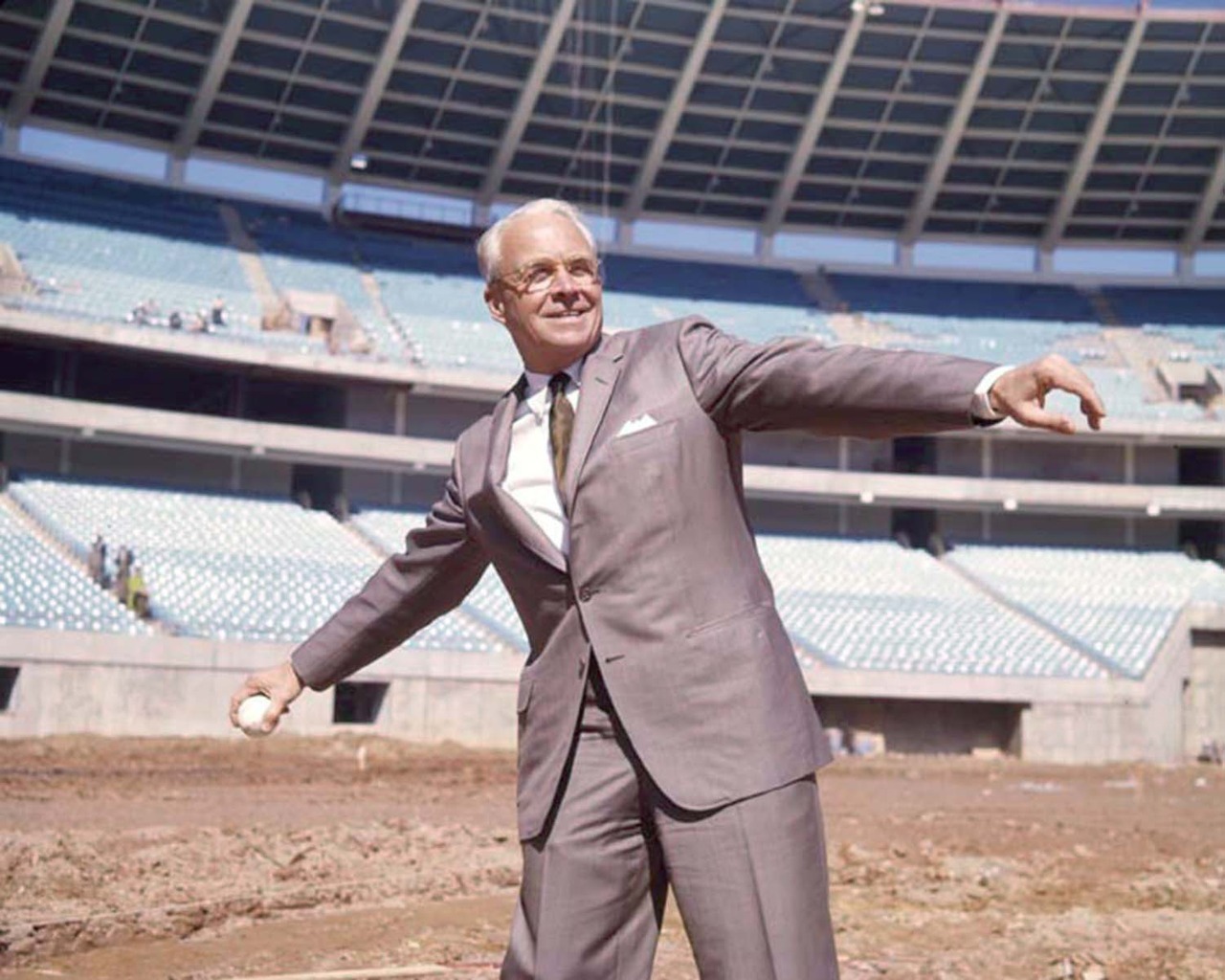
Allen posing inside the stadium his Administration was building, 1964.
It opened in 1965, and hosted the Beatles
before it hosted the Braves or the Falcons.
More low-income housing was built in his 8 years in office than in the previous 30. He needed to do this to alleviate the concerns of local black leaders, including Dr. Martin Luther King Sr., that he wasn't doing enough for the poor and was focusing too much on business, especially downtown -- a criticism since leveled at many urban mayors, black and white alike (including Newark's Sharpe James in the 1980s and '90s).
"It is wonderful to be idealistic and to speak about human values," Allen said, "but you are not going to be able to do one thing about them if you are not economically strong. If there is any one slogan I lived by as Mayor of Atlanta, that would be it."
So, with the concerns of both business and civil rights in mind, he brought the 2 concepts together. The day he was sworn in, he ordered all "WHITE" and "COLORED" signs removed from City Hall, and personally desegregated the City Hall cafeteria by dining with local black activists. He desegregated municipal hiring. He hired the city's first black firemen. He let it be known that black Atlanta policemen would be allowed to arrest white criminals. He desegregated the city's pools. By January 1964, 6 months before President Lyndon Johnson signed the Civil Rights Act into law, 14 Atlanta hotels had already desegregated themselves.
Allen billed Atlanta as "The City Too Busy to Hate." That made the sports establishments stand up and take notice. Atlanta also offered a bigger stadium, if not necessarily a better one, than Milwaukee County Stadium: 52,000 to 44,000. (Milwaukee County Stadium would later expand to 53,000.) Today, the Braves' team museum is named for Allen.
Atlanta-Fulton County Stadium was a multipurpose facility, designed to host both baseball and football, and it didn't do a good job with either one, so much so that, by 1997, both the Braves and the Falcons had gotten new stadiums and their 1st home was demolished. That process was repeated in 2017, as both teams abandoned their still relatively new stadiums for brand-new ones, the Falcons with a retractable-roof stadium next-door, the Braves for a "ballpark village" in the city's northwest suburbs.
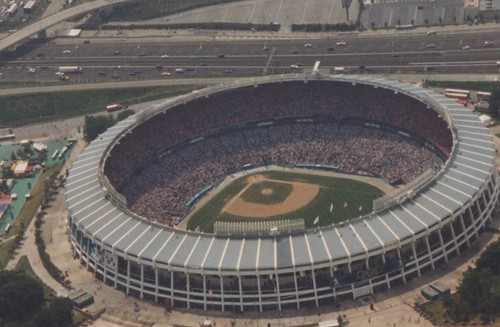
Just another oversized concrete ashtray.
At least it had real grass, not artificial turf.
But Atlanta has seen little success. From 1966 to 1990, the Braves won just 2 Division titles and no Pennants. Then, they won their Division in every completed season from 1991 to 2005, and won 5 Pennants, but just 1 World Series. They eventually won another in 2021. The Falcons have been to just 2 Super Bowls, and lost both ignominiously.
The NBA's Hawks should be so lucky: They reached the Conference Finals their 1st 2 seasons after moving from St. Louis, 1968-69 and 1969-70; then didn't make the Conference Finals again until 2015, and again in 2021. They haven't made the NBA Finals since 1961, or won them since 1958, both times in St. Louis.
And the city has failed with 2 NHL teams: The Flames arrived in 1972 and moved to Calgary in 1980, and the Thrashers arrived in 1999 and moved to Winnipeg in 2011. A Sun Belt city that lost 2 teams to Canada: This is NHL Commissioner Gary Bettman's nightmare.
The city has had decent success with soccer. The Atlanta Chiefs won the North American Soccer League title in 1968, and reached the Final again in 1969. Atlanta United debuted in 2017, won the MLS Cup the next season, and won the U.S. Open Cup the year after that.
UPDATE: The Braves have a team Hall of Fame. Their inductees from their Atlanta years are: Players Hank Aaron, Rico Carty, Phil Niekro, Ralph Garr, Dale Murphy, Tom Glavine, John Smoltz, David Justice, Terry Pendleton, Javy López, Greg Maddux, Larry "Chipper" Jones, Andruw Jones (no relation) and Tim Hudson; plus managers Joe Torre and Bobby Cox, and coach Leo Mazzone; team owners Bill Bartholomay and Ted Turner; executives Bill Lucas, Paul Snyder and John Schuerholz; trainer Dave Pursley; and broadcasters Ernie Johnson Sr., Pete Van Wieren, Skip Caray, Don Sutton and Joe Simpson.
The Falcons have a Ring of Honor. Their inductees are: Tommy Nobis, Claude Humphrey, Jeff Van Note, Steve Bartkowski, Mike Kenn, William Andrews, Gerald Riggs, Jessie Tuggle, Deion Sanders, Todd McClure, Warrick Dunn, Roddy White, Matt Ryan, and team owner Arthur Blank.
The Hawks don't have a team Hall of Fame, but they do retire numbers: 9, for Bob Pettit from their St. Louis years; 21, Dominique Wilkins; 23, Lou Hudson; 44, Pete Maravich; and 55, Dikembe Mutombo. They have also witheld 40 from circulation since Jason Collier died as an active player. They also have banners honoring former owner Ted Turner and former Mayor Kasim Reed, who was involved in keeping the team from moving.
There is also a Georgia Sports Hall of Fame, in Macon. It honors State natives who excelled in sports, stars from colleges such as the University of Georgia and Georgia Tech, and these major league stars:
* Braves: Aaron, Nierko, Murphy, Smoltz, Glavine, both Joneses, Tim Hudson, Cox, Mazzone, Bartholomay, Turner, Lucas, Schuerholz, Johnson, Van Wieren, Caray, Bob Horner, Brian Jordan, Jeff Treadway (more for being a Georgia native than for being a Brave), Marquis Grissom, and executive Stan Kasten.
* Falcons: Nobis, Humphrey, Van Note, Bartkowski, Tuggle, Blank, Alfred Jenkins, Billy "White Shoes" Johnson, founding owner Rankin Smith, coach Mario Campbell, and coach Dan Reeves, elected more for being a Georgia native and a UGa player than for coaching the Falcons into their 1st Super Bowl.
* Hawks: Wilkins, Lou Hudson, Wayne "Tree" Rollins, and Shareef Abdur-Rahim.
* Through 2025, no Flames, Thrashers, Chiefs or Atlanta United have been honored.
*
April 12, 1966 was a Tuesday. Future football star Lorenzo White was born. Two days later, on April 14, two Atlanta Braves legends were born: Greg Maddux in San Angelo, Texas; and David Justice in Cincinnati.
These other baseball games were played that Opening Day:
* The New York Yankees lost to the Detroit Tigers, 2-1 at Yankee Stadium. Mickey Lolich outpitched Whitey Ford. The Yankees' only run came on a home run by Joe Pepitone. Mickey Mantle went 2-for-3, before being replaced to ease his aching legs. Roger Maris went 1-for-3 with a walk. Al Kaline went 0-for-3 with a walk.
After winning 5 straight Pennants, and 13 of the last 16, the Yankees fell to 6th place the season before, as everybody seemed to get hurt, or old, or both, all at once. And 1966 would be their only last-place finish between 1912 and 1990.
* The Baltimore Orioles beat the Boston Red Sox, 5-4 at Fenway Park in Boston. This game went 13 innings, and in a rarity, the winning run, Luis Aparicio, scored on a bases-loaded balk by pitcher Jim Lonborg. It was a weird beginning for what turned out to be the greatest season in Orioles history.
New acquisition Frank Robinson went 2-for-4 with a walk. Brooks Robinson went 3-for-6. Each of them hit a home run. Brooks had 3 RBIs. For the Sox, Carl Yastrzemski went 1-for-6.
* The Los Angeles Dodgers beat the Houston Astros, 3-2 at Dodger Stadium in Los Angeles. With Sandy Koufax and Don Drysdale both still working into shape following their Spring Training holdouts, Claude Osteen was the winning pitcher, outpitching Robin Roberts, who was entering his final season.
* The San Francisco Giants beat the Chicago Cubs, 9-1 at Candlestick Park in San Francisco. Juan Marichal outpitched Larry Jackson. Willie Mays and Len Gabrielson hit home runs for the Jints. Ernie Banks went 0-for-3 with the Cubs.
* The Chicago White Sox beat the California Angels, 3-2 at Comiskey Park in Chicago. Tommy McCraw singled Floyd Robinson home with the winning run in the bottom of the 14th inning.
* The Minnesota Twins beat the Kansas City Athletics, 2-1 at Metropolitan Stadium in the Minneapolis suburb of Bloomington, Minnesota. Sandy Valdespino singled Zoilo Versalles home off Jim "Catfish" Hunter in the bottom of the 9th, making a winning pitcher out of Jim "Mudcat" Grant. So, 2 Jims, 2 fishing nicknames. Harmon Killebrew went 0-for-3.
* The day before, in the traditional American League opener in the nation's capital, the Cleveland Indians beat the Washington Senators, 5-2 at District of Columbia Stadium in Washington. (It was renamed Robert F. Kennedy Memorial Stadium in 1969.) President Lyndon B. Johnson was unavailable for the traditional first ball ceremony, so Vice President Hubert Humphrey stepped in for him. Sam McDowell outpitched Pete Richert.
* And these teams had yet to debut for the season: The New York Mets, the Cincinnati Reds, the Philadelphia Phillies and the St. Louis Cardinals. In the Reds' case, this was unusual: They traditionally hosted the 1st National League game of the season, because of their predecessors, the 1869-70 Cincinnati Red Stockings, baseball's 1st openly professional team.
The NBA Playoffs were underway. The Boston Celtics beat the Philadelphia 76ers, 120-112, in Game 5 of the Eastern Division Finals, at the Philadelphia Civic Center, to advance to the NBA Finals. They did this despite 46 points and 34 rebounds from Wilt Chamberlain. John Havlicek led the Celtics with 32 points, and Bill Russell had 31 rebounds.
The Los Angeles Lakers went on to beat the St. Louis Hawks in the Western Division Finals, and the Celtics beat the Lakers in the NBA Finals.
The Stanley Cup Playoffs were also underway. In Game 3 of one Semifinal, the Montreal Canadiens beat the Toronto Maple Leafs, 5-2 at Maple Leaf Gardens in Toronto. In Game 3 of the other, the Chicago Black Hawks beat the Detroit Red Wings, 2-1 at the Olympia Stadium in Detroit. The Canadiens went on to beat the Black Hawks in the Finals.


No comments:
Post a Comment