Friday, July 1, 2022

July 1, 1974: Great Adventure Opens

July 1, 1974: The Great Adventure theme park opens in Jackson, Ocean County, New Jersey, about 60 miles southwest of Midtown Manhattan, and 50 miles northeast of Center City Philadelphia.

It took the place of such already-gone amusement parks as Steeplechase Park in Brooklyn's Coney Island (which closed in 1964, leaving Astroland as Coney's only remaining amusement park), Palisades Amusement Park in the town of the same name in Bergen County (closed in 1971), and Woodside Amusement Park in Philadelphia's Fairmount Park (closed in 1955). It essentially meant the demise of Willow Grove Park in Bucks County, Pennsylvania in 1975. But it also meant a closer option for Philadelphia-area people than the Jersey Shore, 60 miles away at its closest point.

New York businessman Warner LeRoy bought the land from the parachute-making Switlik family, and built the park. The main part of the park was called the Enchanted Forest, and it included roller coasters, a log flume, a monorail, and Wild West-themed rides. Its arcades and eateries, including the ice cream-themed Yum Yum Palace, and its drive-through safari, quickly became beloved by young people in New Jersey, New York, Pennsylvania and Delaware. My family went there that first year, and then every year through 1985.

In 1977, the Six Flags amusement-park company bought Great Adventure. A deal was cut with Warner Brothers to have their cartoon characters, like Bugs Bunny, in costumes. They also cut deals with DC Comics for rides based on their characters, such as Superman and Batman.
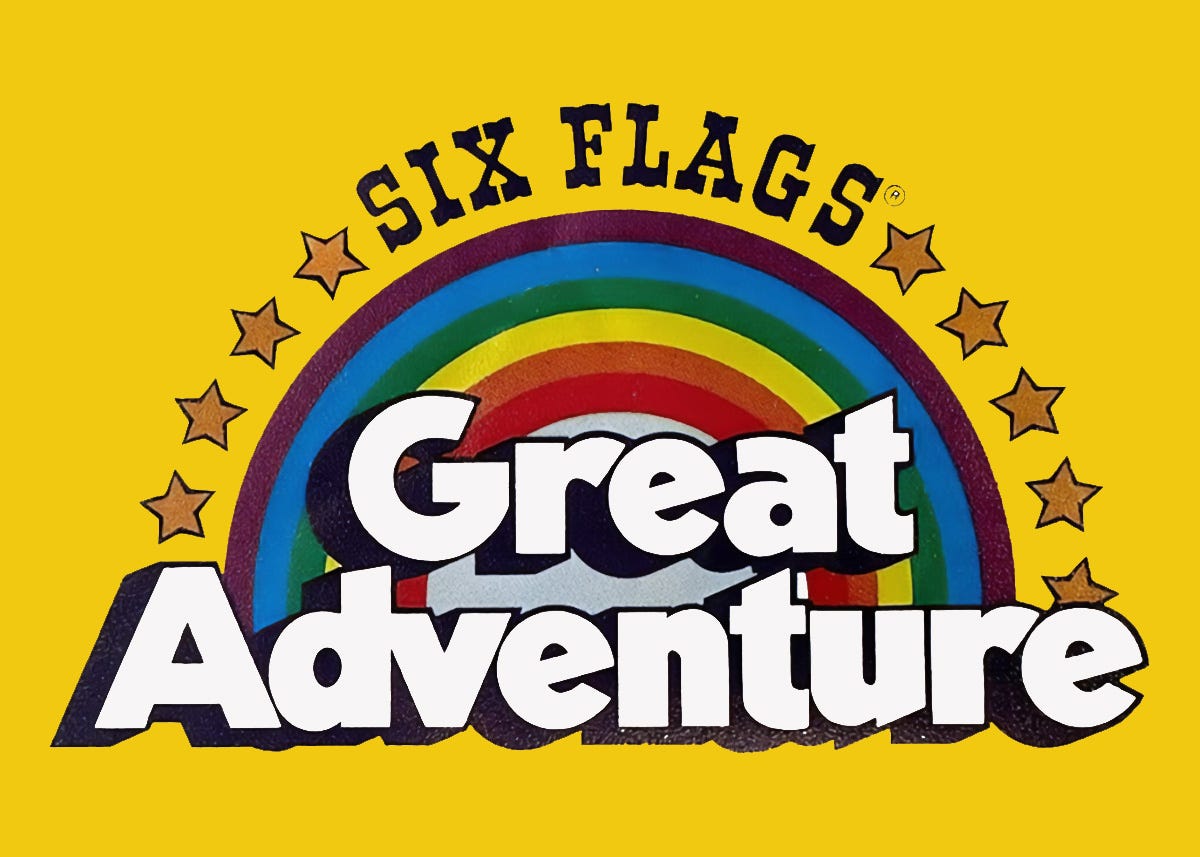
The classic rainbow & stars logo

On May 11, 1984, a fire at the Haunted Castle killed 8 teenagers from Queens, and forever cast a pall over the park. But it remains open to this day.

It's hard to believe it's been almost 50 years. It doesn't seem like something that goes back as far as Richard Nixon. To me, it will always bring up thoughts of the late 1970s, the Jimmy Carter years, or the early 1980s, the 1st Ronald Reagan term. It was an escape from the nonsense of the outside world, which was probably why that '84 fire stands out so much in New Jersey's collective memory: The outside world broke through the bubble.

It was a wonderland carved out of the Pine Barrens, for, as the Ringling Brothers/Barnum & Bailey Circus put it, "children of all ages." To this day, many of us refuse to use the corporate name of Six Flags. The original name was perfect: Great Adventure.

*

July 1, 1974 was a Monday. These games were played in Major League Baseball that day:

* The New York Yankees lost to the Detroit Tigers, 4-3 at Tiger Stadium in Detroit. Ron Blomberg hit a home run, but Jim Northrup won the game with a home run off Doc Medich in the 8th inning. Al Kaline went 1-for-4 with an RBI.

* The Boston Red Sox beat the Baltimore Orioles, 6-4 at Memorial Stadium in Baltimore. Carl Yastrzemski went 1-for-2 with a walk and an RBI. Brooks Robinson went 0-for-3, but drove in a run with a groundout.

* The Cleveland Indians swept a doubleheader with the Milwaukee Brewers at Cleveland Municipal Stadium, 3-1 and 9-3.

* The Kansas City Royals beat the Chicago White Sox, 9-0 at Comiskey Park in Chicago. Bruce Dal Canton pitched a 5-hit shutout, and rookie George Brett went 0-for-5.

* The Texas Rangers beat the Minnesota Twins, 6-2 at Metropolitan Stadium in the Minneapolis suburb of Bloomington, Minnesota. Harmon Killebrew hit a pinch-hit home run, the 553rd home run of his career, and Rod Carew went 1-for-4 with a walk.

* The Oakland Athletics beat the California Angels, 5-3 at Anaheim Stadium (now Angel Stadium of Anaheim). Nolan Ryan took a 3-2 lead into the top of the 8th inning, but gave up a single to Bert Campaneris, an RBI double to Sal Bando, an intentional walk to Reggie Jackson, an RBI sacrifice fly to Joe Rudi, a walk to Gene Tenace, and an RBI double to Ángel Mangual.

* While the entire American League played that day, only 2 games were played in the National League. The Montreal Expos beat the Chicago Cubs, 10-4 at Jarry Park in Montreal.

* And the Houston Astros beat the Atlanta Braves, 3-0 at Atlanta Stadium. (It was renamed Atlanta-Fulton County Stadium the next season.) Don Wilson pitched a 5-hit shutout, and Phil Niekro got knocked out of the box in the 4th inning, having allowed just 2 runs, but 10 hits. Hank Aaron did not play in this game.

July 1, 1972: Jane Fonda In Vietnam

July 1, 1972: Actress Jane Fonda takes action that will make her famous around the world, admired by many, and thoroughly despised by many others.

The daughter of Henry Fonda and the sister of Peter Fonda, she had already become a star, starring in Cat Ballou, Barbarella and They Shoot Horses, Don't They?, and winning an Academy Award for Best Actress the year before for her role in Klute. (She wasn't the 1st actress to play a prostitute as "Oscar bait," and she certainly wasn't the last.)

Thus far, though, entertainers had usually not used their stardom for political causes. Bob Hope had organized OSU tours for the troops during World War II, the Korean War and the Vietnam War, and would do it one more time after this, in the Persian Gulf War. Hollywood's Republicans had rented the Los Angeles Memorial Coliseum for a rally for Presidential nominee Thomas Dewey in 1944. On the other side, right after World War II, Frank Sinatra had done a short film for his song "The House I Live In," promoting inclusiveness as an American value. The March On Washington in 1963 had been bipartisan: Democrats Marlon Brando and Harry Belafonte were there, but so was Republican Charlton Heston.

By early 1972, the war in Vietnam still had no end in sight. The promise that Richard Nixon had made in the Presidential election of 1968 had proven to be worthless. Through 1963, 202 American servicemen had died in Vietnam. In 1964, 216 died; in 1965, 1,928; in 1966, 6,350; in 1967, 11,363; in 1968, 16,899; in 1969, with Nixon taking office at the beginning of the year, 11,780; in 1970, 6,173; and in 1971, 2,414. Total: 57,325.

Fonda visited Vietnam, including the North Vietnamese capital of Hanoi, to witness firsthand the bombing damage to the dikes along the Red River. She concluded that the U.S. Air Force had been intentionally targeting the dikes, which turned out to be true.

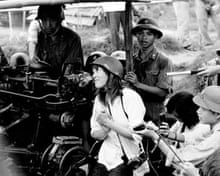
She also posed next to an anti-aircraft gun. For this, ever since, conservatives have called her a traitor and "Hanoi Jane." They have said she directly led to the deaths of American servicemen, which is not merely a lie, but a very stupid one. (The conservatives don't even get the story right: They say she posed on top of the gun, as if she was having sex with it. That never happened.)
Next to it. Not on top of it.

Fonda has apologized for her pose with the gun, calling it "a huge mistake." The Eisenhower Administration men who started the Vietnam War never apologized for it. Robert McNamara, who had been Secretary of Defense under Presidents John F. Kennedy and Lyndon B. Johnson, offered more of an apology than anyone else in a position to need to do so. No one in the Nixon Administration, including Nixon himself, ever apologized for widening the war before winding it down.

Another 759 American servicemen died in Vietnam in 1972, and another 68 in 1973 before, as George W. Bush would have said, "major combat operations had ended." Total: 58,152.

In 2022, Jane Fonda is 84 years old, and is filming 80 for Brady, about 4 senior-citizen women who followed New England Patriots quarterback Tom Brady to Super Bowl LI in 2017, along with fellow film legends Rita Moreno, Lily Tomlin and Sally Field. She has survived both breast cancer and skin cancer, and has not given up her many fights. She is a hell of a lot braver than most of her haters.

*

July 1, 1972 was a Saturday. These Major League Baseball games were played:

* The New York Yankees beat the Cleveland Indians, 5-1 at Yankee Stadium. Mike Kekich went the distance for the win. Thurman Munson went 2-for-3 with a walk and 2 RBIs. Bobby Murcer went 1-for-4. Graig Nettles hit a home run for the Indians. Before the next season, the Yankees acquired him in a trade.

* The New York Mets beat the Montreal Expos, 2-0 at Jarry Park in Montreal. Jerry Koosman pitched a 4-hit shutout, outpitching Mike Torrez. Dave Marshall hit a home run for the Mets, while Willie Mays went 0-for-4 for them.

* The Boston Red Sox beat the Milwaukee Brewers, 5-4 at Fenway Park in Boston. Marty Pattin went the distance, and hit a home run. He must have been loose, quack. (That's a Ball Four reference.) Ben Oglivie, later to star for the Brewers, hit 2 home runs for the Red Sox, and Carl Yastrzemski went 1-for-4.

* The St. Louis Cardinals swept a doubleheader from the Philadelphia Phillies, 6-4 and 1-0 at Veterans Stadium in Philadelphia. Bob Gibson won the 1st game. Lou Brock went 3-for-8 with a walk over the 2 games.

* The Pittsburgh Pirates beat the Chicago Cubs, 4-3 at Three Rivers Stadium in Pittsburgh. The Cubs led 3-2 going into the bottom of the 9th, but Milt May led off with a single off Fergie Jenkins, and Roberto Clemente hit a home run to win it. It was part of a 2-for-4 with 3 RBIs day for Clemente. Willie Stargell went 1-for-3.

* The Detroit Tigers beat the Baltimore Orioles, 2-0 at Tiger Stadium in Detroit. Mickey Lolich pitched a 7-hit shutout, outpitching Dave McNally. Al Kaline hit a home run. Brooks Robinson went 0-for-3 with a walk.

* The Chicago White Sox beat the Minnesota Twins, 5-1 at Comiskey Park in Chicago. The Twins' only run was on a home run by Harmon Killebrew. Rod Carew went 2-for-4.

* The Kansas City Royals beat the Texas Rangers, 3-2 at Kansas City Municipal Stadium. Gail Hopkins singled John Mayberry Sr. home with the winning run in the bottom of the 11th inning.

* The Houston Astros beat the Atlanta Braves, 4-2 at the Astrodome in Houston. Don Wilson outpitched Phil Niekro. Hank Aaron went 1-for-4 with an RBI.

* The Cincinnati Reds beat the San Diego Padres, 3-2 at San Diego Stadium (later renamed Jack Murphy Stadium and Qualcomm Stadium). Pete Rose went 1-for-4, and Johnny Bench went 0-for-4.

* The California Angels beat the Oakland Athletics, 5-3 at Anaheim Stadium (now Angel Stadium of Anaheim). Nolan Ryan went the distance, striking out 16 batters. Reggie Jackson went 0-for-4.

* And the San Francisco Giants beat their arch-rivals, the Los Angeles Dodgers, 8-5 at Candlestick Park in San Francisco. Willie McCovey, Dave Kingman and Dave Rader hit home runs, in support of Sam McDowell. Frank Robinson, in his only season with the Dodgers, did not play in this game.

July 1, 1971: The Hillside Coke Commercial

July 1, 1971: One of the most famous TV commercials of all time airs for the 1st time: The Hillside Coke Commercial.

Advertising agency McCann Erickson had taken the song "I'd Like to Teach the World to Sing (In Perfect Harmony)," written by British writers Roger Cook and Roger Greenaway, and hired Bill Backer and Billy Davis to re-write it with their biggest client in mind: Coca-Cola.

Cook and Greenaway had already written a Top 10 hit for The Fortunes, "You've Got Your Troubles." They would go on to write another for The Hollies, "Long Cool Woman In a Black Dress."

Davis (not to be confused with Billy Davis Jr. of The 5th Dimension) was a cousin of Lawrence Payton of The Four Tops, and worked with Berry Gordy Jr. even before Gordy founded Motown Records. Together, they and Gwen Gordy -- Berry's sister and Billy's then-girlfriend -- wrote Jackie Wilson's hits "Reet Petite" and "Lonely Teardrops," and Marv Johnson's "You Got What It Takes," all of them now retroactively considered building blocks of Gordy's "Motown Empire."

Davis moved from Detroit to Chicago, where he produced songs for Chess Records, and was then hired to write commercial jingles by McCann Erickson. He went on to produce the one Coke commercial that might match this one for enduring popularity: "Hey Kid, Catch!" with Mean Joe Greene of the Pittsburgh Steelers in 1979. That commercial introduced the slogan and song "Have a Coke and a Smile." Davis also wrote the jingle "If You've Got the Time" for Miller beer.

But he didn't write "Have a Coke and a Smile." That was written by Backer, who also coined the Coke slogans "It's the Real Thing" and "Things go better with Coke." For Miller beer, he coined the slogan "Miller Time"; and for Miller Lite, he created the "Less filling," "Tastes great" call-and-response, after New York Jets running back Matt Snell inadvertently gave him another slogan for the beer: "Everything you always wanted in a beer. And less."

Backer, Davis and Cook (but not Greenaway) were trying to fly out of Shannon Airport in Ireland, and tempers were flaring. But the next morning, they saw some other would-be flyers enjoying themselves, because they were also enjoying Coca-Cola. Backer grabbed a napkin and wrote, "I'd like to buy the world a Coke," and showed it to the others.

Cook gave Backer and Davis permission to adapt a song they'd already written, titled "True Love and Apple Pie." A British vocal group named The New Seekers recorded it in London. (Keith Potger was the only member of the original Seekers, an Australian group, to be in the new version.)

The commercial was explained at the end:

On a hilltop in Italy,
We assembled young people
From all over the world...
To bring you this message
From Coca-Cola Bottlers
All over the world.
It's the real thing. Coke.

It's been parodied many times, most famously in the final episode of the TV series Mad Men in 2015, suggesting that Don Draper (played by Jon Hamm), after spending the entirety of the 1960s (and, apparently, most of the 1950s) smoking, drinking, adultering and lying his way through the advertising industry, comes to a moment of clarity at a meditation retreat, and combines his previous thought process with what he's been taught at the retreat, and comes up with the idea for the commercial. It was an idea so cheesy, the episode should have been sponsored by Kraft.

*

July 1, 1971 was a Thursday. Rapper Missy Elliott and actress Julianne Nicholson were born.

These Major League Baseball games were played that day:

* The New York Yankees lost to the Washington Senators, 3-1 at Robert F. Kennedy Stadium in Washington. Mike Kekich was outpitched by Jim Shellenback, who allowed only 4 hits, 2 of them by Danny Cater.

* The New York Mets lost to the Pittsburgh Pirates, 3-0 at Shea Stadium. Jerry Koosman was outpitched by 4 Pirate hurlers, starting with 5 innings from Dock Ellis, as they pitched a 5-hit shutout. Roberto Clemente went 3-for-5. Willie Stargell went 2-for-4 with an RBI.

* The Atlanta Braves beat the Montreal Expos, 7-3 at Jarry Park in Montreal. Hank Aaron only appeared as a pinch-hitter, and drew a walk.

* The Cincinnati Reds beat the Philadelphia Phillies, 5-1 at Veterans Stadium in Philadelphia. Pete Rose went 2-for-5 with an RBI, and Johnny Bench went 3-for-3 with a walk. 

* The Cleveland Indians beat the Baltimore Orioles, 3-2 at Cleveland Municipal Stadium. Frank Robinson went 1-for-3 with a walk and a solo home run, and Brooks Robinson went 0-for-4.

* The Boston Red Sox beat the Detroit Tigers, 8-7 at Tiger Stadium in Detroit. Carl Yastrzemski went 0-for-4, but did draw a walk. Al Kaline went 2-for-4 with a walk and an RBI.

* The Chicago White Sox beat the Milwaukee Brewers, 6-4 at Milwaukee County Stadium.

* The Kansas City Royals beat the California Angels, 9-4 at Anaheim Stadium (now Angel Stadium of Anaheim).

* The Los Angeles Dodgers beat the San Diego Padres, 2-1 at San Diego Stadium (later to be renamed Jack Murphy Stadium and Qualcomm Stadium).

* The San Francisco Giants beat the St. Louis Cardinals, 8-7 at Candlestick Park in San Francisco. Willie Mays did not play. Lou Brock went 2-for-5 with an RBI, and Joe Torre went 1-for-5 with a solo home run.

* The Minnesota Twins and the Oakland Athletics, having just wrapped up a series against each other, were not scheduled to play.

* And the Chicago Cubs and the Houston Astros were also not scheduled to play.

July 1, 1964: The Cape May-Lewes Ferry Opens

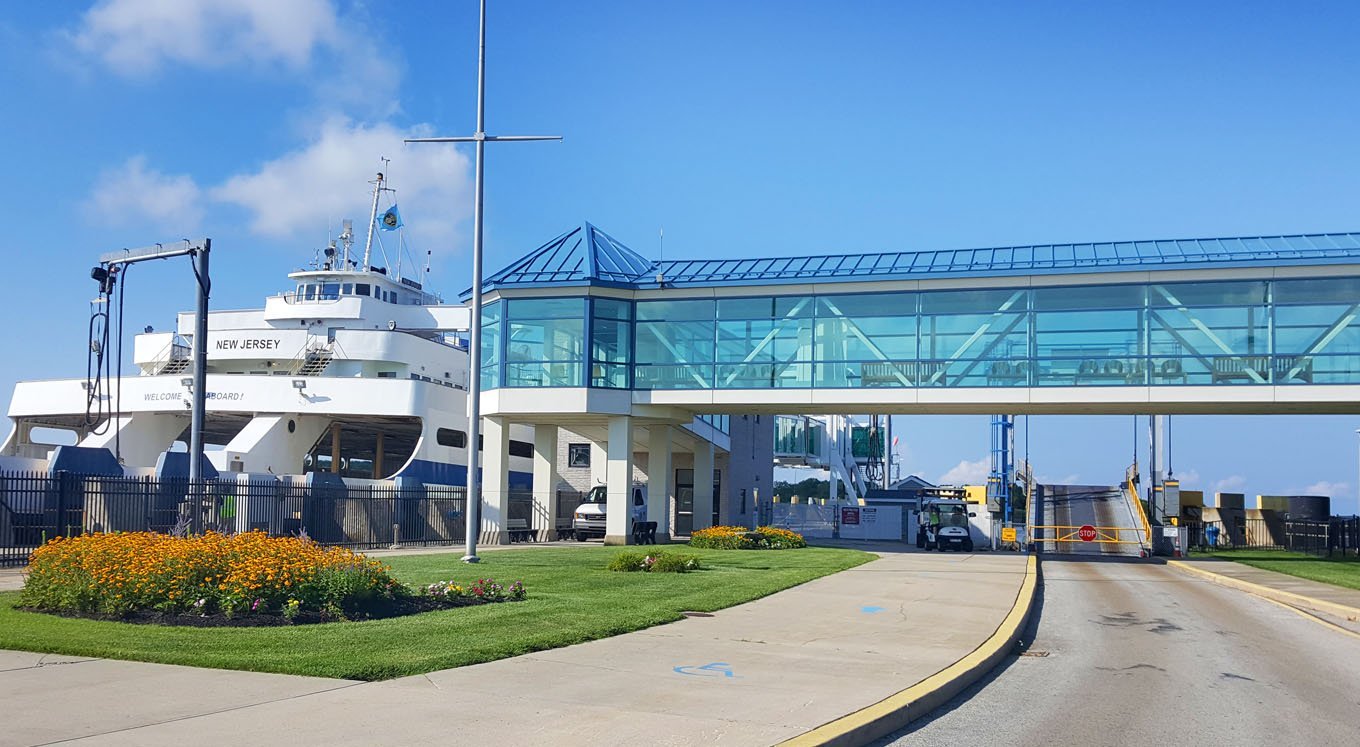
Cape May Ferry Terminal

July 1, 1964: The Cape May-Lewes Ferry begins operation, connecting North Cape May in Lower Township, Cape May County, New Jersey with Lewes, Delaware, across 17 miles of Delaware Bay. Fare: $21 per car, and $8.00 per passenger therein; so, $29.

Ferry service across the Bay had been planned since 1926, when what is now named the Benjamin Franklin Bridge opened, connecting Philadelphia with Camden, New Jersey. But people trying to get from New Jersey to Delaware, or vice versa, had to use that bridge. For people in southernmost New Jersey, or anywhere in Delaware, it was a bit out of the way.

The construction of the original span of the Delaware Memorial Bridge in 1951 helped a little; the opening of the Walt Whitman Bridge in 1957 didn't help at all, since it was further north than the Delaware Memorial. So the Delaware River and Bay Authority (DRBA) acted, and bought 5 ferries from Virginia, as their service had been replaced by the Chesapeake Bay Bridge-Tunnel 3 months earlier. They were replaced in the 1970s.

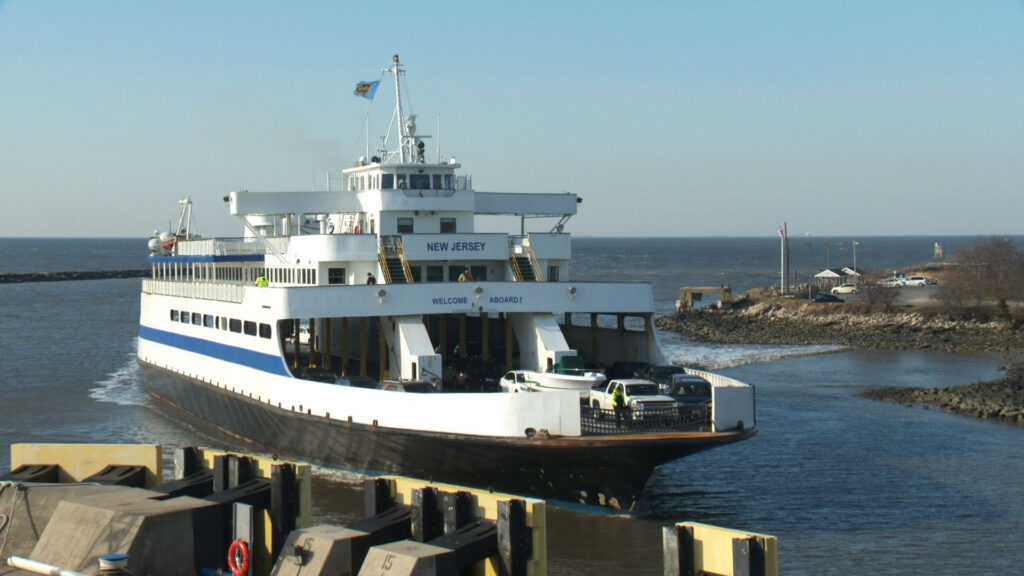
Currently, there are 3 vessels in the fleet: The MV Delaware and the MV New Jersey, both launched in 1974; and the MV Cape Henlopen (named for the Delaware terminus), launched in 1981. The trip takes 1 hour and 25 minutes, and is part of U.S. Route 9. Shuttle bus service is available from the downtowns of Cape May and Lewes to the terminals, and vice versa.
The MV New Jersey

The Ferry made it 45 years without an accident, until December 10, 2009, when the New Jersey ran aground on a sandbar near the mouth of the Cape May Canal during an unusually low tide. The ferry was freed by a rising tide, and did not suffer any structural damage. Nor were there any injuries.

On March 30, 2019, after going 3 miles from Cape May, the ferry lost power with 143 passengers on board. After 2 hours being stuck in the bay, the ferry was towed back to Cape May. And on November 17, 2020, after leaving Cape May in high winds, the Cape Henlopen ran aground off the coast of Cape May. No passengers were harmed, and the vessel was towed back to Cape May shortly after.

Although the 17-mile distance is almost exactly the same as that of the Chesapeake Bay Bridge-Tunnel, no bridge has ever been seriously suggested to replace the route. But in DC Comics, Superman's hometown of Metropolis is said to be in Delaware, a bit north of Lewes; while Batman's hometown of Gotham City is said to be in New Jersey, on the opposite side of the Bay, in real-life Cumberland County; and the Metro-Narrows Bridge stands alongside the route of the Ferry, with Cape May renamed Cape Finger, not for its shape (which would be understandable), but in memory of Batman's co-creator, Bill Finger.

*

July 1, 1964 was a Wednesday. These baseball games were played:

* The New York Yankees lost to the Kansas City Athletics, 5-4 at Yankee Stadium. Reliever Bill Stafford wasted a good start by Whitey Ford, and a home run by Mickey Mantle, and Ralph Terry gave up a home run to Billy Bryan in the top of the 11th inning.

* The New York Mets beat the Houston Astros, 8-6 at the Astrodome in Houston.

* The Minnesota Twins beat the Boston Red Sox, 14-3 at Fenway Park in Boston. Harmon Killebrew went 1-for-3 with 3 walks. Carl Yastrzemski went 2-for-3 with a walk and an RBI.

* The Baltimore Orioles beat the Los Angeles Angels, 4-2 at Memorial Stadium in Baltimore. Brooks Robinson went 1-for-4 with an RBI.

* The Cincinnati Reds beat the Chicago Cubs, 6-5 at Crosley Field in Cincinnati. Pete Rose hit a home run to win the game in the bottom of the 10th inning. Frank Robinson went 1-for-2 with 2 walks and an RBI. Ron Santo hit 2 home runs, Billy Williams hit 1, and Ernie Banks went 2-for-5.

* The Detroit Tigers beat the Cleveland Indians, 3-1 at Tiger Stadium in Detroit. Al Kaline went 1-for-4.

* The Chicago White Sox swept a doubleheader from the Washington Senators, 8-7 and 2-1 at Comiskey Park in Chicago.

* The St. Louis Cardinals beat the Milwaukee Braves, 6-1 at Milwaukee County Stadium. Hank Aaron went 1-for-4.

* The Los Angeles Dodgers beat the Philadelphia Phillies, 3-2 at Dodger Stadium in Los Angeles. Sandy Koufax went the distance for the win.

* And the San Francisco Giants beat the Pittsburgh Pirates, 2-1 at Candlestick Park in San Francisco. Willie Mays hit a home run. Roberto Clemente went 2-for-4 with an RBI.

July 1, 1963: ZIP Codes Take Effect

July 1, 1963: ZIP Codes come into use. 

Most towns weren't big enough to need more than one postal zone. For those that were, there were simple numbers, one or two digits, starting in 1943. For example: From the time he was born in 1943 until he went off to war in 1965, my father lived in the Forest Hill Section of the North Ward of Newark. People living in the North Ward would write their addresses as "Newark 4, New Jersey." With ZIP Codes, it became "Newark, NJ 07104." Note that the 4 became the last digit. An address of "New York 17, NY" became "New York, NY 10017."

The Zone Improvement Plan created regional zones, as follows:

000-005 Not In Use
006, 007 and 009 Puerto Rico
008 U.S. Virgin Islands
010-014 Western Massachusetts
015-026 Eastern Massachusetts
027-029 Rhode Island
03 New Hampshire
04 Maine
05 Vermont
06 Connecticut
07 Northern New Jersey
08 Southern New Jersey
09 U.S. Military Bases in in Europe, Central Asia and the Middle East
100, 101 and 102 New York City, Manhattan
103 New York City, Staten Island
104 New York City, The Bronx
105-108 New York State, Westchester County
109 New York State, Rockland County
110 New York State, Long Island, Floral Park
111 New York City, Queens, Long Island City
112 New York City, Brooklyn
113 New York City, Queens, Flushing
114 New York City, Queens, Jamaica
115 New York State, Long Island, Mineola
116 New York City, Queens, Far Rockaway
117-119 New York State, Long Island, Suffolk County
12 Upstate New York
13 Central New York
14 Western New York
150-165 Western Pennsylvania
166-176 Central Pennsylvania
177-189 Eastern Pennsylvania outside Philadelphia
190-192 Philadelphia
193-196 Philadelphia Western Suburbs
197-199 Delaware
200, 202-205 Washington, D.C.
201 Virginia, Dulles International Airport
206-209 Maryland, Washington side
210-219 Maryland, Baltimore side
220-238 Virginia
247-269 West Virginia
27-28 North Carolina
29 South Carolina
30-31 Georgia
32-34 Florida
35-36 Alabama
370-385 Tennessee
386-399 Mississippi
40-42 Kentucky
43-45 Ohio
46-47 Indiana
48-49 Michigan
50-52 Iowa
53-54 Wisconsin
55-56 Minnesota
58 North Dakota
59 Montana
60-62 Illinois
63-65 Missouri
66-67 Kansas
68-69 Nebraska
700-715 Louisiana
716-729 Arkansas
73-74 Oklahoma
75 Texas, Dallas-Forth Worth Metroplex
76 Texas, rest of North
77 Texas, Houston area
78 Texas, San Antonio area
79 Texas, West
80-81 Colorado
820-831 Wyoming
832-839 Idaho
84 Utah
85-86 Arizona
870-888 New Mexico
889-899 Nevada
900-918 California, Los Angeles area
92 California, San Diego area
93 California, Central
940-951 California, San Francisco Bay Area
952-961 California, Northern
962-966 U.S. Military bases in Far East and Antarctica
967-968 Hawaii
969 Guam
97 Oregon
980-994 Washington State
995-999 Alaska

Outside cities, ZIP Codes were arranged alphabetically. For example, I grew up in East Brunswick, in Central New Jersey. Our ZIP Code was, and remains, 08816. A town neighboring us both geographically and alphabetically, Edison, had 08817, 08818 and 08820, with 08819 available for overspill. (So far, despite Edison's huge growth, it hasn't been needed.) Oddly, they also use 08837. 

Other neighboring towns fulfilled this, with some a little off: The Dayton section of South Brunswick is 08810, the Franklin Park section of Franklin is 08823, the Kendall Park section of South Brunswick is 08824, Helmetta is 08828, Jamesburg and Monroe are 08831, Metuchen is 08840, Milltown is 08850, the Monmouth Junction section of South Brunswick is 08852, Piscataway is 08854 (a slight outlier), most of Old Bridge is 08857 (some of it uses the South Amboy post office, some of it the Matawan office), the Parlin section of Sayreville is 08859, Perth Amboy is 08861, the rest of Sayreville is 08872, the Somerset section of Franklin is 08873, South Amboy is 08879, South River is 08882, and Spotswood is 08884.

New Brunswick is 08901, North Brunswick is 08902, Rutgers University (in New Brunswick and Piscataway) is 08903, and Highland Park has the State's highest-numbered ZIP Code, 08904.

An ad in a comic book of 1963 explained it this way:
In 1984, "ZIP + 4" was introduced, leading to 9-digit ZIP Codes. The house I grew up in, in East Brunswick, New Jersey, had the Code of 08816. From 1984 until we moved out in 1991, it became 08816-4307. (Don't mail anything to that ZIP Code now, please. Whoever has it now would not appreciate it. It might not even be used for the same house.)

In 1990, Fox premiered the TV Show Beverly Hills 90210, guaranteeing that America's young people would know at least one ZIP Code -- hopefully, two, counting their own.

Of all the changes that happened in America in the 1960s, and particularly during the Administration of President John F. Kennedy, two that were huge parts of our culture, but are rarely talked about now, are the institutions of Area and ZIP Codes.

*

July 1, 1963 was a Monday. It was the off-season for the NFL, the AFL, the NBA and the NHL. Since Monday is usually a travel day in Major League Baseball, not everybody was scheduled to play: 

* The New York Yankees beat the Boston Red Sox, 7-5 at the old Yankee Stadium. ZIP Code 10451. Fenway Park in Boston is 02215. Jim Bouton didn't have it that day, but Stan Williams and some timely hitting bailed him out. Clete Boyer hit a home run. Mickey Mantle was injured, and didn't play.

* A doubleheader was split at Connie Mack Stadium in Philadelphia, 19132. The Pittsburgh Pirates, who played at Forbes Field in Pittsburgh, 15260, won the opener, 2-1. The Philadelphia Phillies won the nightcap, 8-1. (The South Philadelphia sports complex is 19148.)

* The Kansas City Athletics beat the Baltimore Orioles, 6-4 at Memorial Stadium in Baltimore. (21218. Camden Yards is 21201. Kansas City Municipal Stadium was 64127, and Kauffman Stadium is 64129.)

* The Houston Colt .45s beat the St. Louis Cardinals, 4-3 at Colt Stadium in Houston. (77054. The Astrodome uses the same ZIP Code. Minute Maid Park is 77002. In St. Louis, Busch Stadium, formerly Sportsman's Park, was 63107. The Busch Stadium built in 1966 and the one built in 2006 both used 63102.) Rusty Staub singled home the winning run in the 11th inning, for the team that became the Houston Astros 2 years later.

* The Los Angeles Dodgers beat the Milwaukee Braves, 2-1 at Dodger Stadium in Los Angeles. (90012. Milwaukee County Stadium, and its replacement American Family Field, have been 53214.) Wally Moon won it with a single in the bottom of the 9th. Johnny Podres went the distance for the win. Hank Aaron went 0-for-4.

* The Cincinnati Reds beat the San Francisco Giants, 4-3 at Candlestick Park in San Francisco. (94124. Oracle Park is 94107. Crosley Field was 45234, and Riverfront Stadium and Great American Ball Park both used 45202.) Willie Mays went 0-for-4, Willie McCovey went 1-for-5, rookie Pete Rose went 2-for-5, and Frank Robinson did not play.

* The New York Mets were not scheduled. They were then still playing at the Polo Grounds, 10039. The next year, they moved to Shea Stadium, 11368. Ebbets Field was 11225.

* Neither Chicago team was scheduled. The Cubs' Wrigley Field is 60613. The White Sox' Comiskey Park, and its replacement Rate Field, were both assigned 60616.

* Also not scheduled: The Cleveland Indians, whose Municipal Stadium was 44114, and whose Progressive Field is 44115; the Detroit Tigers, whose Tiger Stadium was 48216, and whose Comerica Park is 48201; the Los Angeles Angels, then groundsharing at Dodger Stadium, but in 1966 moved to Anaheim Stadium, now Angel Stadium, 92806; the Minnesota Twins, whose Metropolitan Stadium was 55425, while the Metrodome was 55415, while Target Field is 55403; and the Washington Senators, whose District of Columbia Stadium, later renamed Robert F. Kennedy Stadium, and Nationals Park are both 20003.

July 1, 1946: Superman vs. the Ku Klux Klan

July 1, 1946: The Ku Klux Klan, America's leading proponents of bigotry, face one opponent they cannot defeat: Superman.

Superman, of course, is a fictional character. He does not exist in real life. He beat the Klan, anyway. With help.

In 1946, Stetson Kennedy, a human rights activist, 29 years old and a native of Jacksonville, Florida, infiltrated the KKK and other racist/terrorist groups. Concerned that the organization had links to the government and police forces -- which, in the Southern States, it most certainly did -- Kennedy decided to use its findings to strike at the Klan in a different way. (Note: William Stetson Kennedy, his full name, was not related to the Kennedy political family of Massachusetts.)
He contacted the producers of the Superman radio show, which was recorded at station WOR in New York, and syndicated nationally over the Mutual Broadcasting System. He proposed a story where the superhero, voiced by actor and game show host Bud Collyer (born Clayton Johnson Heermance Jr.), battles the Klan. Looking for new villains, and unable to reproduce the effects of some Superman opponents from the comic books due to budgetary reasons, the producers eagerly agreed.

Kennedy provided information, including details of Klan rituals and the like to the writers. The result was a series of episodes, "Clan of the Fiery Cross," in which Superman took on the Klan. The trivialization of the Klan's rituals and natures had a negative impact on Klan recruiting and membership numbers. According to one source, it "led to a steep decline in membership from which the KKK never recovered."

Reportedly, Klan leaders denounced the show, and called for a boycott of Kellogg's products, which sponsored the radio show. However, the story arc earned spectacular ratings, making Superman the most highly rated kids' radio program, and the food company stood by its support of the show. They later sponsored the TV show The Adventures of Superman, starring George Reeves.

Bud Collyer lived until 1969; Stetson Kennedy, until 2011. In 2019, Chinese-American writer Gene Luen Yang and the Japanese-American artist team calling itself Gurihiru adapted the story into a comic book series, Superman Smashes the Klan, setting it in 1946 like the original radio series, and making Chinese-Americans the focus, with assistance from African-Americans, the Daily Planet newspaper, and Superman himself.

*

July 1, 1946 was a Monday. These baseball games were played that day:

* The Brooklyn Dodgers beat the Philadelphia Phillies, 11-6 at Ebbets Field. Cookie Lavagetto went 3-for-5 with 2 RBIs.

* The Cleveland Indians beat the St. Louis Browns, 6-4 at Cleveland Municipal Stadium.

* The Detroit Tigers beat the Chicago White Sox, 2-0 at Briggs Stadium (later Tiger Stadium) in Detroit. Virgil Trucks pitches a 7-hit shutout. Roy Cullenbine hits a home run, and Hank Greenberg goes 1-for-4 with an RBI.

* The Pittsburgh Pirates beat the Chicago Cubs, 1-0 at Wrigley Field in Chicago. Rip Sewell pitched a 4-hit shutout, outpitching Hank Wyse.

* The Cincinnati Reds beat the St. Louis Cardinals, 5-4 at Sportsman's Park in St. Louis. Ray Lamanno hit a sacrifice fly to score Benny Zientara with the winning run in the top of the 13th inning. Al Libke went 3-for-5 with a home run, a walk, and 2 RBIs. Stan Musial went 0-for-6, but Enos Slaughter went 4-for-6.

* And the New York Yankees, the Boston Red Sox, the Philadelphia Athletics, the Washington Senators, the New York Giants and the Boston Braves were not scheduled.

July 1, 1943: The Courage and Execution of Willem Arondéus

July 1, 1943: Dutch artist, author and Resistance fighter Willem Arondéus is executed by the Nazis in Haarlem, the city in the Netherlands that gave its name to the famous black neighborhood in New York City. He was 48 years old.

He was born on August 22, 1894 in Naarden, the Netherlands. He started working as an illustrator, designer of posters and tapestries and a painter. In 1923, he was commissioned to paint a large mural for Rotterdam City Hall. During that same period, he illustrated poems by writers J.H. Leopold, Pieter Cornelis Boutens and Martinus Nijhoff. He decided he could write as well as anyone he was working for. In 1938, he published Het Uilenhuis (The Owls House) and In de bloeiende Ramenas (In the Blossoming Winter Radish).

The Nazis conquered the Netherlands on May 17, 1940. In 1942, Arondéus began publishing the underground newspaper Brandarisbrief. (This translates as "Brandaris' Letter." Brandaris is the oldest lighthouse in the country, overlooking the Wadden Sea since 1594.) In 1943, the Brandarisbrief merged with another publication called De Vrije Kunstenaar (The Free Artist). Through this work, he met other members of the Dutch Resistance, and set his skills toward forging identity documents to help protect Jews against deportation and death.

But the forgeries could be checked against the Municipal Office for Population Registration to determine legitimacy. So, on the night of March 27, 1943 -- the day my father was born -- Arondéus and some friends disguised themselves as policemen, knocked the security guards out, dragged them to safety (they didn't want to kill any Dutch people), and went in.

They piled registration cards, and soaked them in benzene. They stole some blank cards to make more forgeries, and also some cash, then set their time bombs and got out. The firefighters put the fire out quickly, but the water damage ended up helping the Resistance cause: About 15 percent of the total cards were destroyed, probably saving many Dutch Jews from certain death.

The Nazis put up a reward, and someone ratted Arondéus out. He was arrested a month later. He refused to name anyone else involved in the plot, but the Gestapo found his notebook, and 13 others were arrested. All 14 were sentenced to death. Arondéus pleaded guilty and took all the blame, which resulted in two of his accomplices being granted clemency.

Arondéus was openly gay, at a time when few people were, even in the comparatively liberal Netherlands. His last words were to Laura Mazirel, his attorney and a fellow Resistance fighter: "Tell people that homosexuals are not cowards."

Many of those involved in the bombing, including Arondeus, were later honored by Yad Vashem as Righteous Among the Nations for their efforts to save Jews from the Holocaust.

*

July 1, 1943 was a Thursday. Stage composer Jeff Wayne was born that day.

These baseball games were played:

* The New York Yankees lost to the Cleveland Indians, 3-2 at League Park in Cleveland. Al Smith (not to be confused with the later White Sox outfielder or the former Governor of New York) outpitched Charles "Butch" Wensloff. Tribe shortstop and manager Lou Boudreau went 1-for-3 with 2 walks. Yankee right fielder George "Tuck" Stainback went 3-for-4. Most of the Yankees' big names, including Joe DiMaggio, were serving in The War.

* The Brooklyn Dodgers lost to the Cincinnati Reds, 10-9 at Ebbets Field. In the top of the 12th inning, Dain Clay singled Eddie Miller home, and Lonny Frey got Ray Mueller home on a sacrifice fly. In the bottom of the 12th, Bobby Bragan walked with the bases loaded to get a run home, but the Brooks could get no closer.

For the Reds, Miller went 4-for-6 with 2 RBIs, Frey went 3-for-7 with a home run and 3 RBIs, and Eric Tipton went 3-for-4 with 2 walks and an RBI. For Dem Bums, Joseph "Arky" Vaughan went 4-for-5 with 2 walks and 5 RBIs; and Mickey Owen went 3-for-5 with a walk.

* The Chicago Cubs beat the Boston Braves, 6-5 at Braves Field in Boston.

* A doubleheader was split at Shibe Park in Philadelphia. The Philadelphia Phillies won the opener, 6-1. The Pittsburgh Pirates won the nightcap, 2-1. Over the 2 games, for the Phils, Ron Northey went 5-for-9 with an RBI, and Babe Dahlgren went 4-for-9 with 2 RBIs.

* The Detroit Tigers beat the Boston Red Sox, 3-2 at Briggs Stadium (later Tiger Stadium) in Detroit. For the Red Sox, Leon Culberson went 4-for-5, and Jim Tabor went 3-for-5. Hank Greenberg of the Tigers and Ted Williams of the Red Sox were unavailable.

* The Chicago White Sox beat the Washington Senators, 2-0 at Comiskey Park in Chicago. Bill Dietrich pitched a 4-hit shutout, outpitching Early Wynn, who would later be the White Sox' ace. Luke Appling went 2-for-3 with a walk.

* And the St. Louis Browns beat the Philadelphia Athletics, 2-1 at Sportsman's Park in St. Louis. Browns catcher Joe Schultz, later to be a coach on the 1964 and 1967 World Champion St. Louis Cardinals and the manager of the infamous 1969 Seattle Pilots of Ball Four fame, singled Vern Stephens home with the winning run in the bottom of the 11th inning. Bob Muncrief of the Browns and Don Black of the A's both went the distance.

* And the New York Giants and the St. Louis Cardinals moved their game scheduled for this day to the previous day, making for a doubleheader. (They played again on July 2, so wartime travel restrictions had nothing to do with it.) The Giants won the 1st game, 4-3. Buster Maynard hit a sacrifice fly to score Sid Gordon with the winning run in the bottom of the 10th inning. former Cubs catching star Ernie Lombardi went 3-for-5 with a home run and 2 RBIs, then got the 2nd game off.

The Cards won the 2nd game, 5-0. Howie Pollet pitched a 6-hit shutout. Over the 2 games, Gordon went 3-for-9 with an RBI, Mikey Witek went 4-for-8 with a walk, Giant right fielder and manager Mel Ott went 0-for-7, but did draw 2 walks, and Stan Musial went 4-for-9 with an RBI.

December 31, 1999 & January 1, 2000: The Millennium

December 31, 1999:  The Millennium arrives. The people of planet Earth survived. At a terrible cost. But we hadn't destroyed ourselves. ...